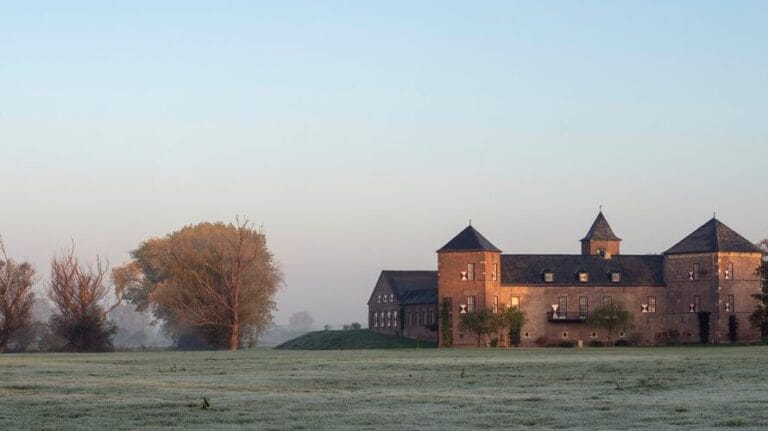
Kruisherenklooster, Sint Agatha: A Crosier Mother House in the Netherlands


Site at a Glance
- Rating
- 4.4
- Popularity
- Low
- Country
- Netherlands
- Primary era
- Modern
- External website
- Open
- Eras represented
- Medieval, Early Modern, Modern
- Civilizations
- Dutch, Holy Roman Empire
- Site type
- Religious
- Remains
- Monastery
On this page12 sections
History
Kruisherenklooster, Sint Agatha, is a monastery in the Netherlands that developed beside a chapel dedicated to Saint Agatha and became the mother house of the Canons Regular of the Holy Cross, commonly called the Crosiers. The monastery was completed in 1378, and its present complex combines surviving medieval fabric with a largely Neo-Gothic rebuilding from 1906.
Chapel and foundation
A chapel stood beside a crossing of the Maas opposite Middelaar by 1315. The area was frequently affected by flooding, and Saint Agatha was associated with protection from natural disasters. In 1342, twelve bishops granted the chapel an indulgence, a remission of temporal punishment in Catholic theology. Prayer there was traditionally said to reduce the time spent in purgatory by forty days.
Members of the Order of the Holy Cross settled near the chapel around 1371 to serve it. Jean IV of Cuijk, a medieval lord of the territorial lordship of Cuijk, is credited with bringing the canons from Leerdam. Their responsibilities included caring for the poor, clearing marshland, and establishing a Latin School, where Latin was the principal language of instruction. The monastery was completed in 1378 and was dedicated to Saint Agatha.
Sint Agatha became the principal or founding community of the Crosiers. It was the only medieval monastery to survive the Reformation in Protestant territory, preserving the order’s institutional presence through later political and religious upheavals.
War, confiscation, and rebuilding
The monastery lay in the Land of Cuijk, which was placed in pledge to William of Orange in 1559. Its properties, including agricultural land, were confiscated, although William and his successors allowed the Crosiers to lease them again. The Iconoclasm of 1566 did not affect Sint Agatha.
Spanish troops plundered and largely destroyed the monastery in 1580 during the Eighty Years’ War, the long Dutch revolt against Spanish Habsburg rule. The canons lived elsewhere for several decades before returning and rebuilding during the Twelve Years’ Truce, the temporary suspension of the conflict from 1609 to 1621. Maurice of Nassau, a Dutch stadtholder and military commander, subsequently supported the community.
Further restoration was required in 1647. The monastery was closed in 1648 under William II of Orange, who was then a prince and later king of the Netherlands, and the canons took refuge in Middelaar. They returned in 1653 under Maurice of Nassau’s protection. A fire damaged the monastery in 1732, while the grounds and buildings continued to develop in the eighteenth century.
Education and religious revival
The Latin School served boys from surrounding villages and trained future missionaries. Its educational role later became associated with missionary formation, and many Crosier missionaries left Sint Agatha during the twentieth century.
The Batavian Republic’s National Assembly established religious equality in 1796, but the monastery was affected by an 1812 decree against contemplative monasteries considered to have no general utility. The community was forbidden to accept new novices, and King William I continued that policy. William II lifted the prohibition in 1840, when only two Crosiers remained at Sint Agatha.
The community recovered during the second half of the nineteenth century. Pope Gregory XVI granted the monastery an Odilia indulgence in 1843, encouraging pilgrimage to Sint Agatha. Saint Odilia, the patron saint of the Order of the Holy Cross, was also invoked against eye diseases. Water associated with her at the monastery was used by sufferers and sent to many parts of the world until the middle of the twentieth century.
After novices could again be accepted, the diocesan priest Van den Wijmelenberg joined the order and became its master general, helping to revive the community. The Crosiers acquired relics of Saint Odilia of Cologne, and the church belonging to the religious community became a pilgrimage site.
Twentieth-century continuity
The monastery was partly demolished and rebuilt in Neo-Gothic style in 1906. It remains in religious use and is described as the oldest monastery in the Netherlands still inhabited by clergy. Sint Agatha also houses a Crosier house of studies, a residence for the education and formation of members of the order, and the European provincialate, the administrative headquarters of the European religious province. That province is under the patronage of Blessed Theodore of Celles, regarded as the founder of the Order of the Holy Cross.
On 8 May 1944, a fire broke out in the chapel without being caused by wartime military action. The tower collapsed onto the nave, contributing to the loss of numerous artworks. The chapel was repaired in 1949.
Modern institutions have added an archival and scholarly role to the monastery’s religious functions. An archive depot was built on the grounds in 2004, and the Erfgoedcentrum Nederlands Kloosterleven has occupied part of the buildings since 2006. Its founding organization was established in 2002 by 80 religious orders and congregations and manages archives and documents from more than 100 Dutch monastic communities. A related foundation established in 1998 manages the Crosiers’ monumental library, archives, and many artworks.
The complex is protected as historic heritage. In December 2023, the 22-kilogram Graduale of Johannes van Deventer was added to the Netherlands’ Memory of the World Register, a UNESCO program for documentary heritage considered to have exceptional significance and requiring recognition and preservation. The Maurits Window, donated by Maurice of Nassau and held in the Rijksmuseum since the nineteenth century, returned to the monastery in 2020 and was digitally unveiled by King Willem-Alexander on 10 February 2021.
Remains
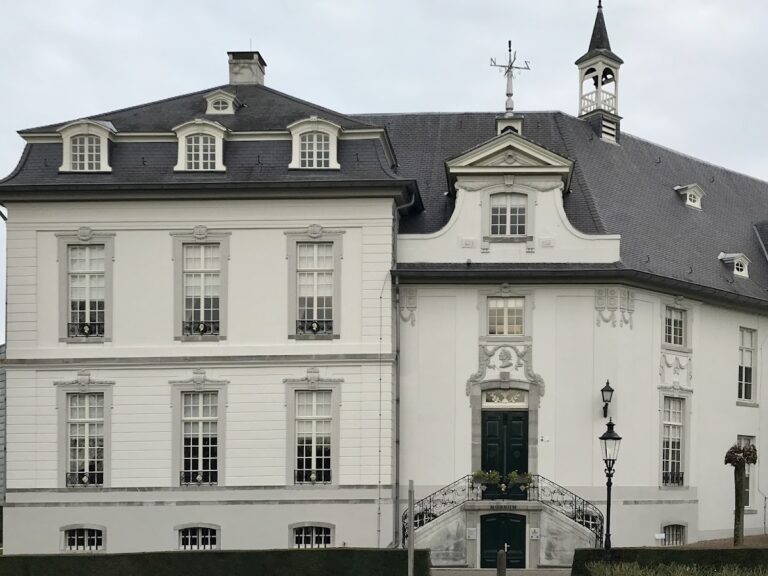
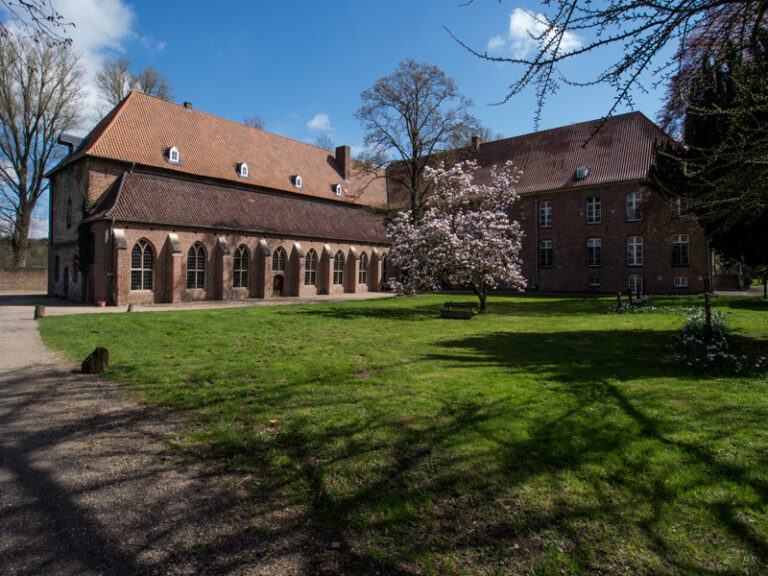
The surviving complex consists of three wings and a chapel enclosing a cloister. Its exterior is predominantly Neo-Gothic, reflecting the 1906 rebuilding, but substantial earlier fabric remains. The buildings, chapel, enclosed garden, and associated collections together preserve the physical and institutional development of the Crosier community.
Monastery and chapel
Wings and cloister
The west wing was altered in 1906, 1962, and 2004. The south wing retains a fifteenth-century cloister with pointed-arch windows. It was raised in the seventeenth century, and the cloister of the east wing joins it. The rear of the complex was enlarged in the eighteenth century, creating a building history in which medieval, early modern, and twentieth-century work remain connected within the same enclosure.
Chapel
The chapel acquired its present form in the fifteenth century and was extended around 1500. Remains of an older building can be seen in the south wall of its eastern bays. Inside is an early-eighteenth-century statue of the Immaculate Conception, together with tombstones from the last quarter of the fifteenth century and the first quarter of the sixteenth century. The tombstones bear the arms of the Schenck van Nijdeggen, Wylick, Torck, and Egmont families.
The 1944 fire destroyed the famous fourteenth-century Calvary, a representation of Christ’s crucifixion, as well as three altars and carved choir stalls made in 1856. The rest of the building was spared, and the chapel was repaired in 1949.
Gatehouse and Latin School
A simple gatehouse dated 1644 marks the monastery’s early modern building phase. The adjoining Latin School building was seventeenth-century in date and had alternating bands of brick and natural stone. It survived until the last quarter of the twentieth century and belonged to the educational history of the monastery.
Gardens and associated features
The monastery garden complex was laid out from the eighteenth century and enclosed by a wall. It contains orchards, kitchen gardens, and fishponds. Farm buildings also stood within the garden until 1985. Crosier monks cultivated parts of the grounds, where clipped box hedges formed religious and symbolic designs, including a cross on a globe, a serpent, and a ship.
Among the garden features are an underground potato cellar and an eighteenth-century prefabricated house. Notable trees include an approximately 150-year-old tulip tree, red and green beeches, and an old oak. These elements preserve the practical and cultivated character of the monastery grounds alongside their religious associations.
Library and documentary collections
The Crosier collections associated with the monastery include a monumental library, archives, and many artworks. Among them is the Graduale of Johannes van Deventer, a large choirbook written around 1500. Its addition to the Netherlands’ Memory of the World Register in 2023 reflects the continuing preservation role carried by Sint Agatha’s buildings and collections.
Nearby sites