Monastery of Minorits: A Franciscan Monastery in Brno


Site at a Glance
- Rating
- 4.7
- Popularity
- Very Low
- Country
- Czechia
- Primary era
- Early Modern
- External website
- Open
- Eras represented
- Medieval, Early Modern
- Civilizations
- Habsburg, Holy Roman Empire, Kingdom of Bohemia
- Site type
- Religious
- Remains
- Monastery
On this page11 sections
History
The Monastery of Minorits is a Franciscan monastery in Brno, Czechia, traditionally established around 1230. Its foundation is probably associated with King Wenceslas I of Bohemia and Jan Velen Černohorský of Boskovice. It is the oldest monastery still operating within Brno, and its community has remained on the same site for more than 750 years.
Foundation and medieval development
The original monastery church, dedicated to St John the Baptist, was consecrated in 1257 by Bruno, Bishop of Olomouc. A fire destroyed the monastery in 1262, prompting the rebuilding of the complex and the construction of the Church of St Johns. The monastery continued to expand during the fourteenth century, while the church and its associated institutions became closely connected with the later development of the community.
During the Hussite Wars, a conflict in fifteenth-century Bohemia over religious reform, the monastery sheltered Minorites from Bohemia and members of the monastery at Zábrdovice. After the wars, the community developed again, but religious life declined during the first half of the sixteenth century as Lutheranism spread and the number of friars fell. Financial difficulties affected the monastery during both the fifteenth and sixteenth centuries.
War, renewal, and Baroque rebuilding
The buildings were damaged in 1645 during the Swedish siege of Brno, an episode of the Thirty Years’ War, the major European conflict that lasted from 1618 to 1648. The following decades brought renewed material and spiritual development. A new Baroque rebuilding campaign began in 1660. Baroque architecture was characterized by monumental forms, dramatic spaces, and elaborate decoration, and the work at the monastery included the addition of the Loreto Chapel.
In 1635, Giovanni Battista Alouisi, an Italian composer, served as the monastery’s guardian, the superior of a Franciscan community. By 1756, sixty religious members lived there. The eighteenth-century rebuilding gave the Church of St Johns its present monumental form and was designed by the Bavarian architect Mořic Grimm, who lived from 1669 to 1757.
Later institutional history
During the nineteenth century, the monastery housed a philosophical institute of the order, and its library held more than 10,000 volumes. The folk-song collector František Sušil also spent part of his life there. The church continued to serve as a place associated with the Opavian branch of the Přemyslid dynasty, the medieval ruling family of Bohemia, and with the Moravian noble house of Boskovice.
Bombing damaged the monastery at the end of the Second World War. In 1950, Czechoslovakia’s communist regime seized the complex and forcibly expelled the religious community. After the fall of communist rule, the Minorites resumed control. Six friars lived in the community in 2020. Since 1995, the monastery has published the magazine Immaculata and has housed the national center of the Knights of the Immaculate, a Catholic Marian movement devoted to the Immaculate Virgin Mary.
The monastery is a protected cultural monument in Brno’s historic center. Its long continuity is also reflected in the streets around it. Jánská Street takes its name from the Church of St John the Baptist and the later Church of St John the Evangelist, while Minoritská Street was described in the fourteenth century as lying opposite the garden of the Friars Minor. It was later associated with St John’s Monastery and has carried its present name since the early nineteenth century.
Remains
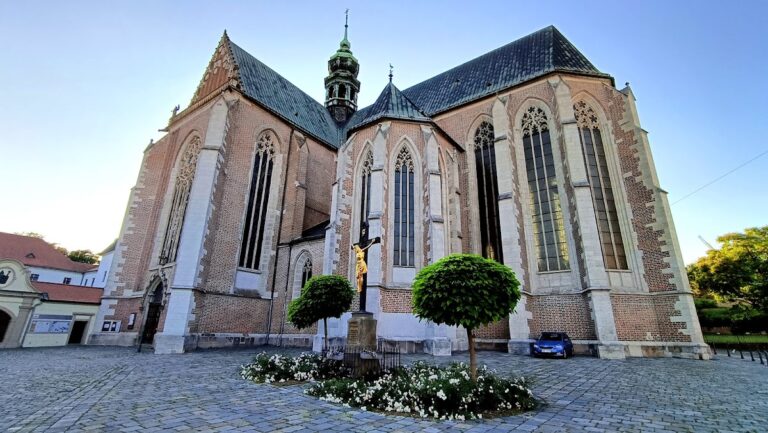
The complex occupies the corner of Orlí and Minoritská streets in Brno-střed. It comprises the Church of St Johns, a Loreto Chapel, a bell tower, and monastic buildings arranged around three courtyards. The surviving ensemble combines the medieval foundation of the monastery with the monumental Baroque rebuilding that shaped its present appearance.
Church and devotional buildings
Church of St Johns
The Church of St Johns is the principal church of the complex and the building with which the monastery’s later history is closely connected. Its present monumental form dates from the eighteenth-century Baroque rebuilding designed by Mořic Grimm. The high altar retable contains a painting by J. Stern, made in 1761, showing saints venerating the Virgin Mary. An organ built in 1732 is described as the oldest organ in Brno.
Loreto Chapel
The Loreto Chapel was added during the rebuilding campaign that began in 1660. It contains a Holy House, an imitation of the house associated in Christian tradition with the Annunciation, and Holy Stairs, a devotional stairway representing the steps traditionally linked with the Passion of Christ.
Burials and monastic buildings
Dynastic and noble burials
The monastery church contains the tomb of Mikuláš of Opava, an Opavian Přemyslid nobleman, and his wife Anežka, who supported the restoration of the building. The church was originally intended to serve as the dynastic burial place of the Opavian branch of the Přemyslid dynasty.
The complex also contains the ancestral burial ground of the Boskovice family. Those buried there include Vaněk of Černá Hora of Boskovice, a Moravian provincial governor who died in 1438; Václav the Younger of Boskovice, who died in 1482; his wife Kunka of Kravaře, who died in 1510; Václav Bučovický of Boskovice, who died in 1554; and Jan Šembera of Boskovice, the last male member of the family, who died in 1597.
Courtyards and bell tower
The monastic buildings are organized around three courtyards, forming the residential and institutional framework of the friars’ community. A bell tower belongs to the complex alongside the church, chapel, and convent buildings, preserving the spatial arrangement of the monastery as a continuing religious foundation.