Daeheungsa: A Buddhist Temple and Jogye Order Head Temple in South Korea
Site at a Glance
- Country
- South Korea
- Primary era
- Early Modern
- Eras represented
- Medieval, Early Modern
- Civilizations
- Goryeo, Joseon
- Site type
- Religious
- Remains
- Temple
On this page12 sections
History
Daeheungsa is a Korean Buddhist temple on the slopes of Mount Duryun in South Korea and serves as the head temple of the Jogye Order’s 22nd district. Its exact foundation date is uncertain: one tradition credits the monk Jeonggwan with founding it in 426, another assigns its foundation to Ado in 544 and says Jajang and Doseon later rebuilt it, while an estimate places its beginnings in the second half of the ninth century.
Origins and names
The temple is traditionally considered older than the Goryeo dynasty. A naming tradition traces an earlier name, Handeumjeol, to Mount Handeum, the mountain’s former name, and links it to the later form Daedum. The temple was also called Daedunsa; Daeheungsa replaced that name during the Japanese colonial period.
Hyujeong and the Seosan school
In 1592, as the Japanese invasions of Korea began, King Seonjo appointed the monk Hyujeong, known as Seosan Daesa, to command monk forces across the eight provinces. Hyujeong called monks to arms and organized them to resist the invasion. King Jeongjo later composed an inscription praising Seosan’s loyalty.
After the war, Seosan’s robe and bowl were brought to Daeheungsa. In the seventeenth and eighteenth centuries, the temple became the principal center of the Seosan school, a Buddhist lineage associated with Hyujeong. It also grew into a major center for Seon, the Korean meditation-focused Buddhist tradition, and Gyo, doctrinal or scriptural Buddhist teaching. Daeheungsa has a longstanding place in Korean tea culture and is regarded as a historical center of that tradition.
Rebuilding and heritage recognition
Daeheungsa was repeatedly destroyed and rebuilt. The surviving buildings are nineteenth-century reconstructions. Cheonbuljeon, the Thousand Buddha Hall, burned in 1811 and was rebuilt in 1813.
The temple became a South Korean Historic Site in 2009. The surrounding area had been designated Haenam Daedunsan Scenic Site No. 4 in 1975 and reclassified as Historic and Scenic Site No. 9 in 1998. That latter designation was revoked on 21 December 2009, after the Duryunsan-Daeheungsa area was designated Scenic Site No. 66 on 9 December. In 2018, Daeheungsa became part of UNESCO’s World Heritage property Sansa, Buddhist Mountain Monasteries in Korea, recognized under criterion iii as exceptional testimony to a cultural tradition.
Remains
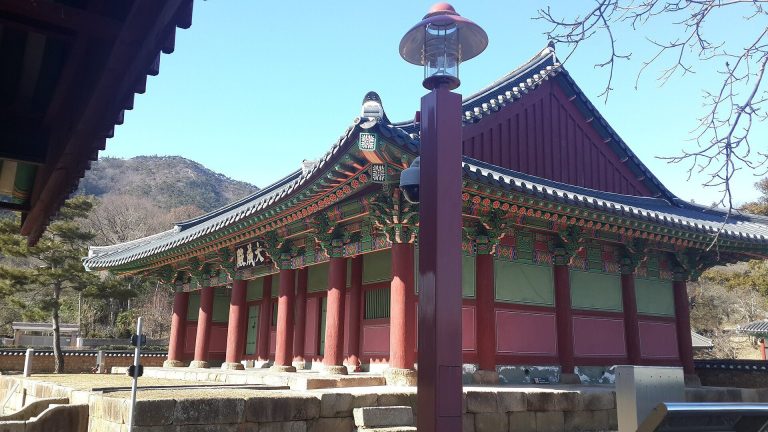
Daeheungsa’s grounds cover 60,163 square metres on Mount Duryun’s slopes. The temple is arranged in two courts: a northern court centered on the Main Buddha Hall and a southern court centered on the Thousand Buddha Hall. A long approach walkway winds through forest at the foot of the mountain before reaching the temple.
Courts, halls, and sacred images
The northern court contains the Main Buddha Hall, a Hall of the Underworld, an Arhat Hall, a Mountain Spirit Shrine, and two additional halls. An arhat is a Buddhist practitioner who has attained liberation. In the southern court, the Thousand Buddha Hall stands with Dragon-Flower Hall, a pavilion, an incense hall, a Seon center, and an administrative office.
Thousand Buddha Hall
The Thousand Buddha Hall contains 1,000 smiling Buddha images. Together, they represent the Buddha’s presence in the past, present, and future, as well as the possibility that anyone may become a buddha.
Buddha at the Maitreya hermitage
At the northern Maitreya hermitage, associated with Maitreya, the future Buddha, a seated Buddha is carved into granite so that the figure projects from the rock surface. Attributed to the Goryeo period, it measures about 4.2 metres high and 2.7 metres wide. Its style has been compared with bodhisattva figures in Seokguram’s inner chamber; bodhisattvas are beings who seek enlightenment for the benefit of others. The treatment of the robe folds has also been compared with the iron seated Vairocana at Dopiansa, a representation of the cosmic Buddha in Mahayana Buddhism. One hand gesture is interpreted as driving away demons. The robe is tied over the left shoulder, an unusual arrangement, and the upper body is disproportionately large in relation to the lower body.
Stone pagoda
A three-storey stone pagoda, about 4.3 metres high, stands in front of the Arhat Hall. Its form is typical of pagodas associated with Silla, an early Korean kingdom.
Seosan’s memorials
A 2.6-metre stupa, a Buddhist reliquary monument, is associated with Seosan and is believed to have been erected in 1648 to hold his sarira, relics traditionally linked to cremated remains. A shrine dedicated to him houses his portrait and relics.
Inscriptions and calligraphy
The grounds contain stupas and stone inscriptions associated with thirteen great masters and thirteen great lecturers, honorific titles for eminent Buddhist clergy and teachers. The temple also holds a work of selected writings by four masters in Seosan’s running and cursive script, along with calligraphy by the Joseon-era scholar Kim Jeong-hui and the Buddhist monk and tea master Cho-ui.
Tea hermitage
A hermitage within the temple grounds is associated with Korean tea production.