Kolozsmonostor Abbey: A Medieval Benedictine Monastery in Cluj-Napoca
Site at a Glance
- Popularity
- Medium
- Country
- Romania
- Primary era
- Medieval
- Eras represented
- Medieval, Modern
- Civilizations
- Austria-Hungary, Austrian Empire, Habsburg, Hungarian, Kingdom of Romania
- Site type
- Religious
- Remains
- Church
On this page14 sections
History
Kolozsmonostor Abbey, a Benedictine monastery dedicated to the Virgin Mary, was founded in the later 11th century in present-day Cluj-Napoca, Romania. The Benedictines were a Catholic monastic order whose members followed the Rule of Saint Benedict. Hungary’s King Ladislaus I is generally credited with establishing the abbey before 1095. It is described as Transylvania’s first Benedictine monastery and became one of the region’s earliest and most important Catholic institutions. Its records of legally recognized documents provide important evidence for medieval Transylvanian culture.
Foundation and ecclesiastical jurisdiction
A royal charter from 1341 names Ladislaus as the abbey’s founder. Later texts offer competing claims: a forged version of a charter dated 1263 names Béla I, while an excerpt made around 1430 from that charter names Stephen I. Both also credit Ladislaus with a large grant to the monastery. Béla was long considered the founder on the strength of the forged charter. Historian Lajos Kelemen instead proposed that the founder was the same castle-district official credited with founding Cluj.
The abbey was supported by a prosperous estate of farmland, orchards, gardens, vineyards, and a watermill. It answered directly to the Archbishop of Esztergom, the head of a major Catholic archbishopric in medieval Hungary, rather than to the Bishop of Transylvania. Transylvanian bishops repeatedly tried to claim authority over the monastery, at times sending armed men against it.
Conflict and the authentication office
Bishop Adorján, in office from 1187 to 1202, and his successor William, who served from 1204 to 1221, both sent armed forces to the abbey. William’s men plundered the monastery and church, seized the abbot, burned papal documents, and threw records confirming royal privileges into the Someș River. Pope Honorius III ordered an inquiry in 1222. At the request of King Andrew II, the pope permitted the abbot in 1225 to wear a mitre, a ceremonial headdress for senior clergy, and a ring.
The Mongol invasion of Central Europe in the 13th century destroyed the church, which was rebuilt in the second half of that century. The invasion also brought the jurisdictional dispute to an end. Although the bishop’s estates came to surround the abbey, he recognized that its abbot answered only to the Archbishop of Esztergom or the pope.
Around 1288, the abbey received authority to issue legally recognized documents through a public-authentication office. Its earliest surviving charter dates to 1308, although the work may have begun earlier. Abbot John, who took leadership in 1338, organized the office on a formal basis. In 1362, burghers from Cluj besieged the abbey amid a dispute with Paul, son of Chuey, a nobleman from nearby Szucság. Paul had taken refuge there, but the burghers beheaded him. The conflict may have concerned disputed abbey property.
Soon afterward, Abbot Otto and the monastery clerk István forged charters in an effort to reclaim lands. Otto disappeared, while István was sentenced to death by burning in 1383. The office was suspended and its seal destroyed. It reopened the following year with a new seal, but confidence in its work took time to return. On 14 February 1384, Queen Mary confirmed the abbey’s judicial authority and independence from Cluj; in May she authorized a new seal for the office.
Abbey life in the fifteenth century
Abbot Antal, who led the monastery from 1424 to 1451, strengthened its standing and reorganized its document office. An inventory made in 1427 listed 42 books in the library and archive. Antal pursued legal claims to protect or recover abbey property, including disputes with Bishop George Lépes, the Bebek family, Transylvanian voivode Ladislaus Csáki, and former Székely count Mihály, son of Salamon Nádasdi. He also contested land boundaries and vineyard dues with Cluj.
In 1437, during the revolt led by Budai Nagy Antal, the monastery was looted and its clerk Balázs was killed. After Abbot Antal’s tenure, rulers generally placed the abbey under governors, also called commendatory abbots. These appointees were not members of the Benedictine order but held an abbot’s legal powers over the property and monastic community. In 1465, Abbot Peter of Pécsvárad fortified the abbey without permission. King Matthias Corvinus ordered the fortifications taken down the next year. The church received wall paintings and colored windows in 1492.
Seizure and changing uses
On 26 April 1556, the Diet of Cluj ordered church property seized, bringing the monastery’s operation to an end. The last entry in its authentication register is dated 30 June that year. From 1557, the archive was kept in the sacristy under the supervision of Cluj’s mayor. In 1575, the authentication office was reorganized as a secular institution and the archive was transferred to the city.
In 1579, Stephen Báthory granted the abbey and six villages to the Jesuits, members of the Catholic Society of Jesus. Lightning set the building’s roof on fire in 1596, and Princess Maria Christina of Austria ordered repairs, but the church was still in ruins in 1614. István Somkeréki Erdélyi paid for restoration around 1620–1622. Meanwhile, the estate passed to Balázs Kamuti in 1609, and he converted the abbey building into a castle. It later came under the princely treasury and, after the independent Principality of Transylvania ended, returned to the Jesuits. The church had become less central to their work after they established a new church, monastery, and school in Cluj.
Tatar raids between 1658 and 1661 badly damaged the church; Katalin Perényi, widow of Simon Kemény, arranged repairs. During the Rákóczi uprising, a Hungarian revolt against Habsburg rule from 1703 to 1711, the building deteriorated again. The church burned in 1704, leaving only its sanctuary intact. After the Jesuit order was dissolved in 1773, the building served as a military store from 1782 and a granary from 1787. Its roof was repaired in 1794–1795.
Rebuilding and changing congregations
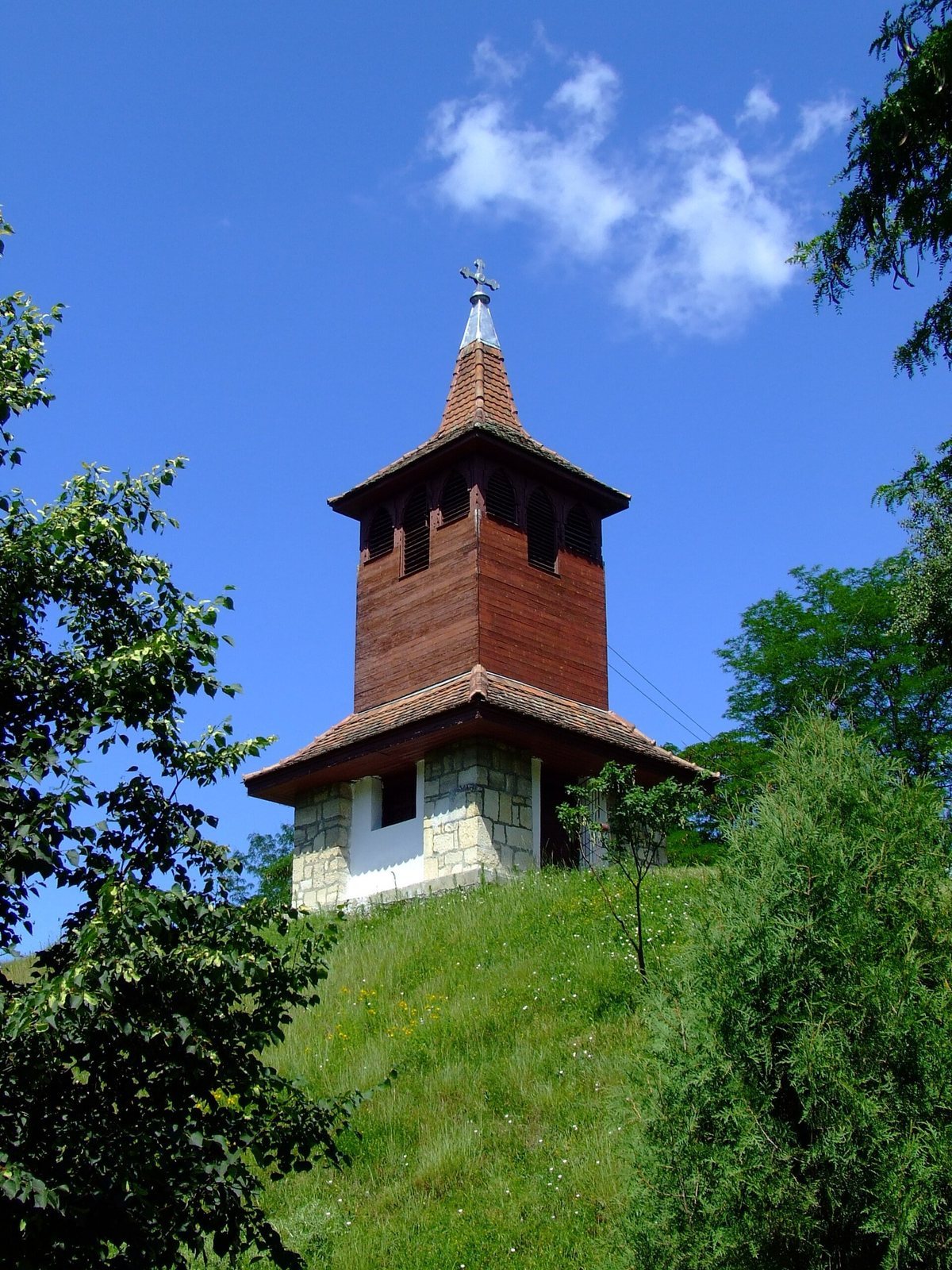
From 1818, much of the abbey’s stone was taken for construction of the Royal Lyceum. With Bishop Alexander Rudnay’s permission, the surviving sanctuary was adapted as a chapel in 1819, and the nave was later rebuilt in Neo-Gothic style. The settlement of Kolozsmonostor, formerly beside Cluj, became part of the city on 1 January 1895. Lightning damaged the roof in 1918 and shifted the main entrance arch; repairs followed, and a lightning conductor was installed. A bell tower designed by Károly Kós was erected in 1922 at the Greek Catholic Church’s request.
On 27 April 1924, the Transylvanian Roman Catholic Status lent the church to the Greek Catholics for religious use for 25 years, through 1 May 1949, while retaining ownership. The Greek Catholic Church was abolished on 1 December 1948, and the Romanian state took over its property. The church then served as a Romanian Orthodox church from 1948 to 1994. Roman Catholics were also permitted to hold services there from 1991 to 1994; in July 1994 the church returned wholly to the Roman Catholic Church.
Restoration after 1994, carried out without state support, received a Europa Nostra heritage-conservation award. On 20 June 1997, Archbishop György Jakubinyi of Alba Iulia reconsecrated the restored church in honor of the Assumption of the Virgin Mary. In 2014, retaining walls around the chapel were strengthened, and drainage and waterproofing work was undertaken. The church now serves the Cluj-Mănăștur parish of Our Lady of Sorrows in the Roman Catholic Archdiocese of Alba Iulia.
Remains
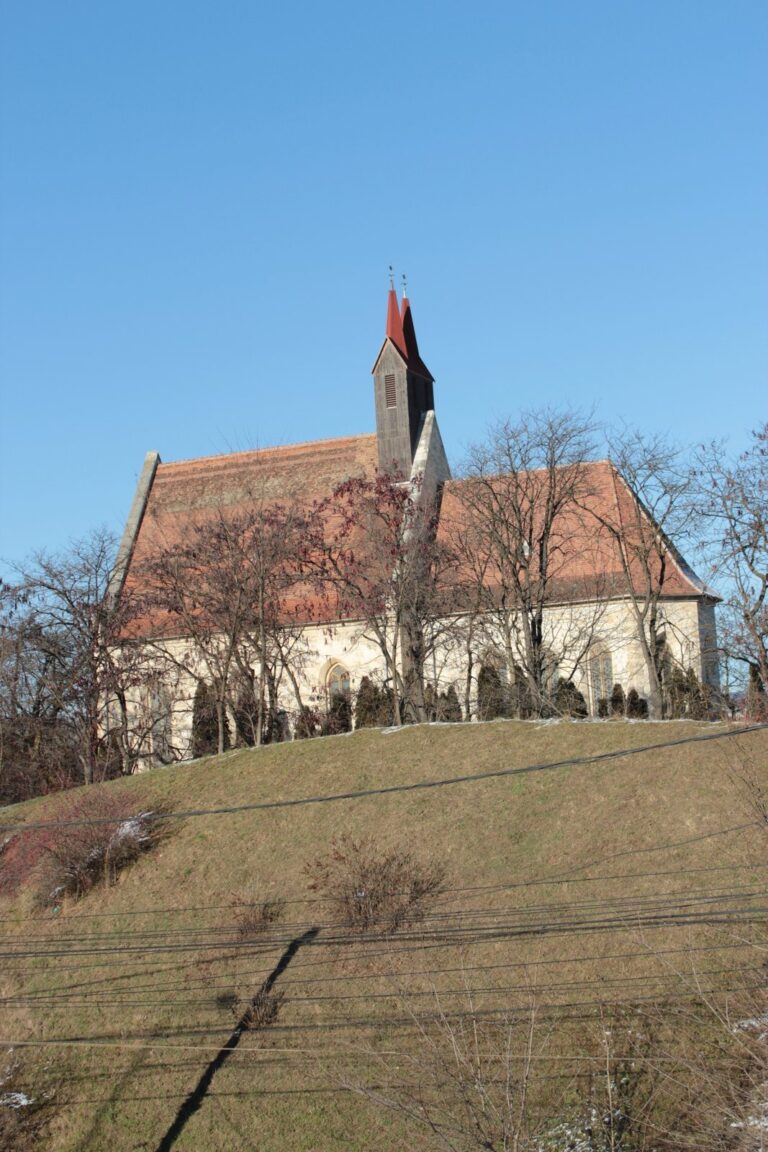
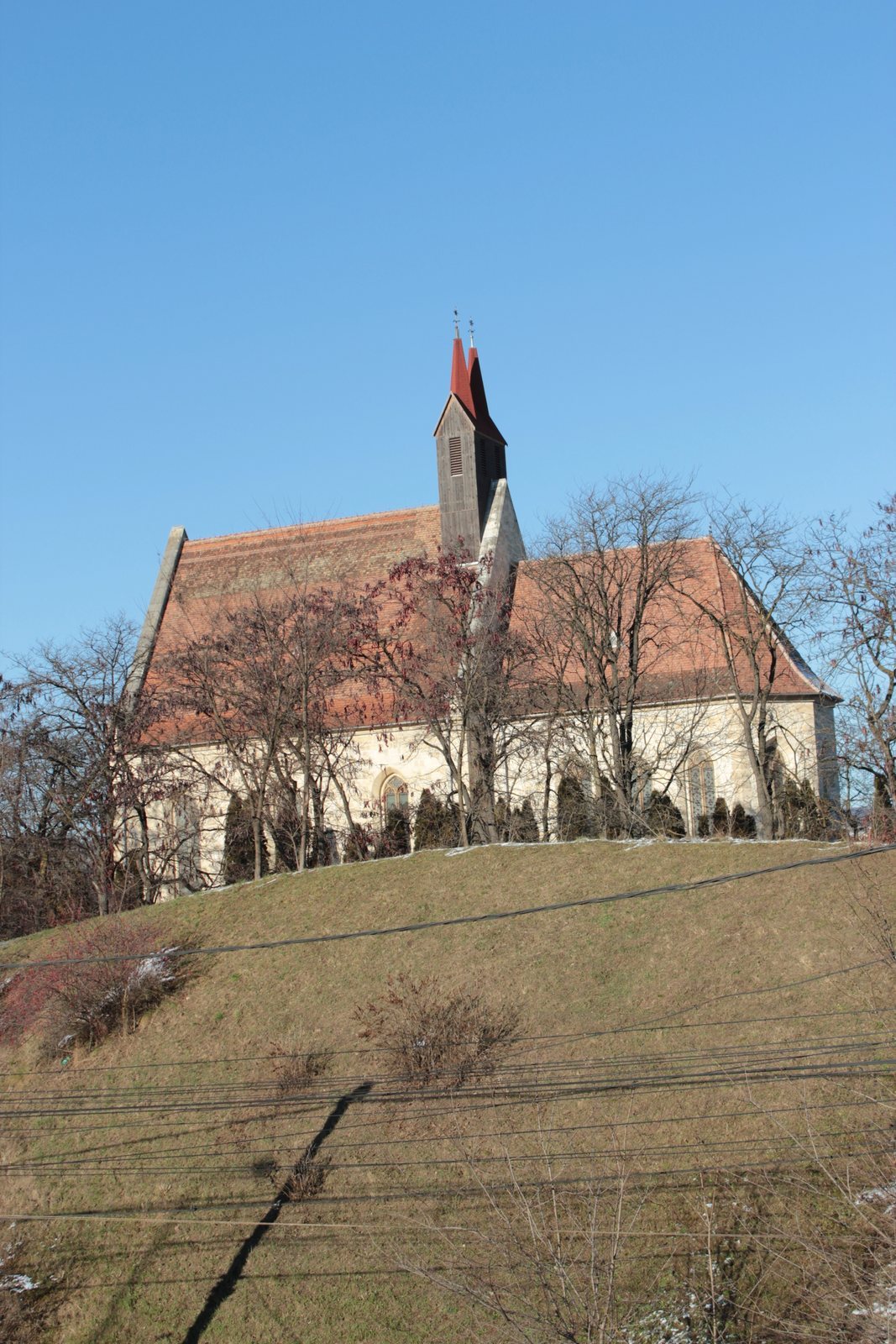
The principal surviving part of Kolozsmonostor Abbey is its church, set within the enclosure of an early medieval earthwork on a rise in western Cluj-Napoca. The site lies beside the road to Oradea, among later apartment blocks and near an overpass built in 1987–1988. The church brings together a medieval sanctuary and later additions, while archaeological remains and a chapel occupy parts of the surrounding enclosure.
The church
Sanctuary
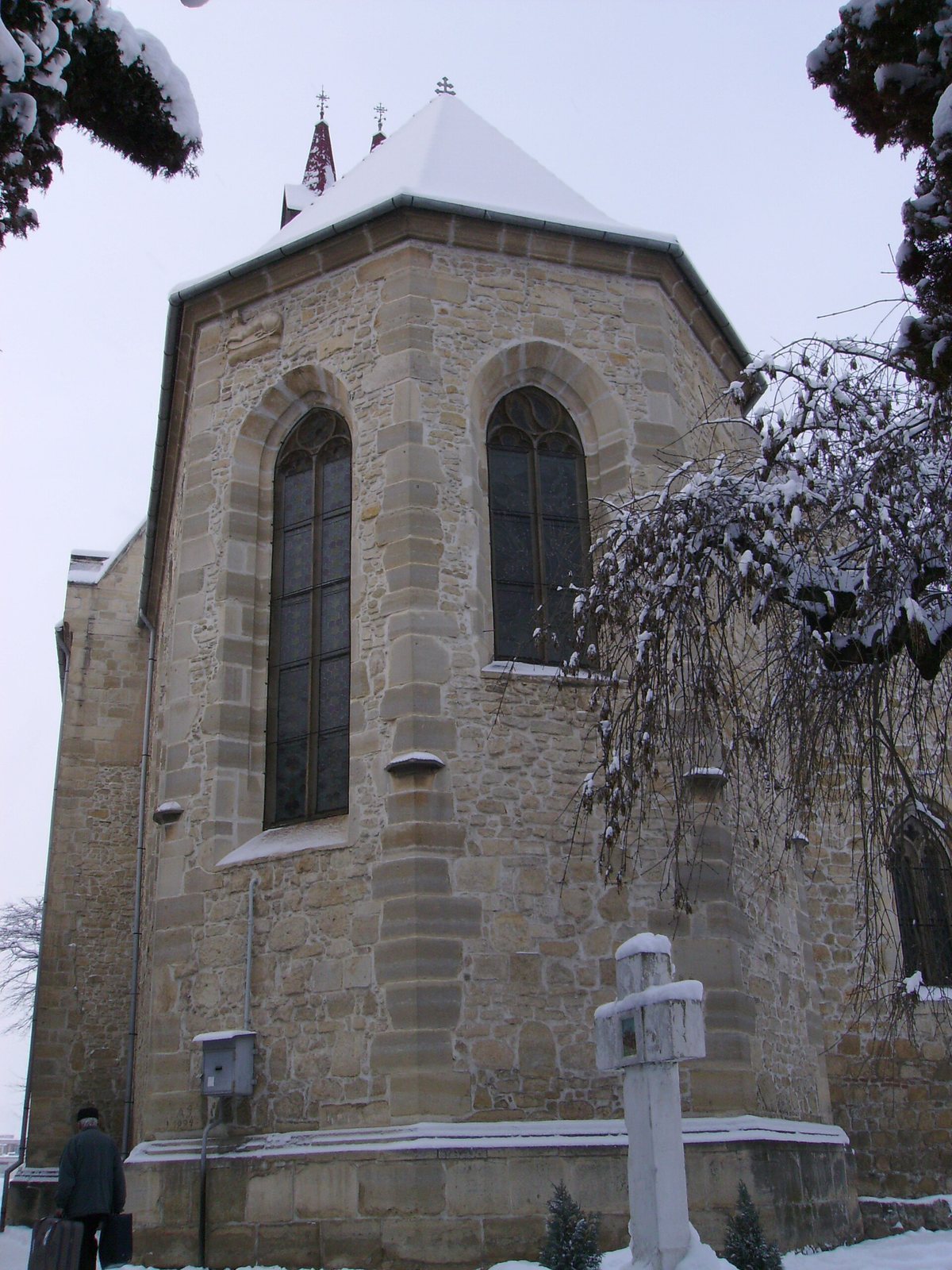
The sanctuary survives from the church rebuilt after the Mongol invasion, although its visible form dates mainly to the second half of the 15th century. It is an early Gothic structure, a medieval style, with plain walls and restrained details. Built of rubble stone, it has no buttresses and ends in three faces of an octagon. Water-shedding ledges mark the corners, while regularly cut ashlar blocks emphasize the edges. Five tall windows pierce the walls. The eastern and southeastern windows are old, and two on the south side date from the 19th century.
A 15th-century sundial with Roman numerals sits on the south wall beneath a stone lintel. Its inscription was considered illegible in the 19th century, and a later interpretation remains tentative. Abbot Antal’s name is associated with the inscription, which may date to his time. A Romanesque lion relief, in the medieval style, is set into the southeastern wall. Its subject recalls the lion motif on the scepters of Hungary’s Árpád dynasty, which ruled until 1301. The relief’s original date is unknown; it was built into the wall during renovation in the mid-1890s.
Nave and western portal
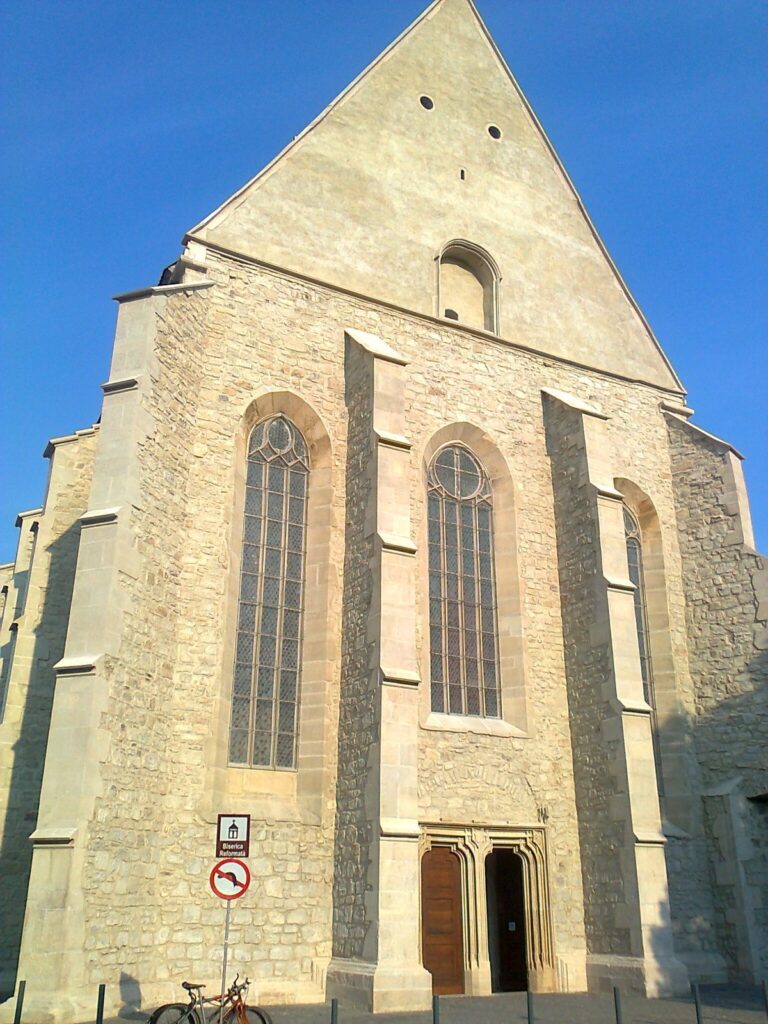
The square-plan nave was built in the 19th century from ashlar, reusing stone from the older abbey building. Its windows echo those of the sanctuary. During work in 1895–1896, the nave’s vaulted ceiling was raised. The western main portal was recarved in the 19th century after the original design; the original portal is held by the Cluj History Museum. Leaves and flowers decorate the pointed gable above the entrance. An eclectic Madonna sculpture by Cluj stonemason Mihály Bertha stands above the portal, while two stone plaques beside the entrance give brief Latin histories of the building.
Sacristy and interior fittings
Adjoining the sanctuary on the north is a sacristy, a room for vestments and sacred objects, considered to date from the 15th century. It has a barrel vault, a continuous arched ceiling. Fourteen bronze reliefs by Jenő Korondi, installed in 2008, depict the Stations of the Cross, scenes recalling episodes of Jesus’ suffering and death.
The church organ was made in 1792 by Samuel Joseph Maetz for a church in Szászdálya. It was dismantled there in 1995 as the Saxon population had dwindled, then placed in the sanctuary during restoration in 1998.
The earthwork and its associated features
Bell tower, chapel, and crosses
At the southeastern entrance to the earthwork, Károly Kós’s bell tower stands to the left and the Calvary Chapel to the right. The tower’s design recalls towers of the Romanian Old Kingdom. The chapel, built in 1831, is Neoclassical, drawing on classical architectural models. Fourteen white stone crosses erected by the Greek Catholic Church line the path to the church and recall the sufferings of Jesus.
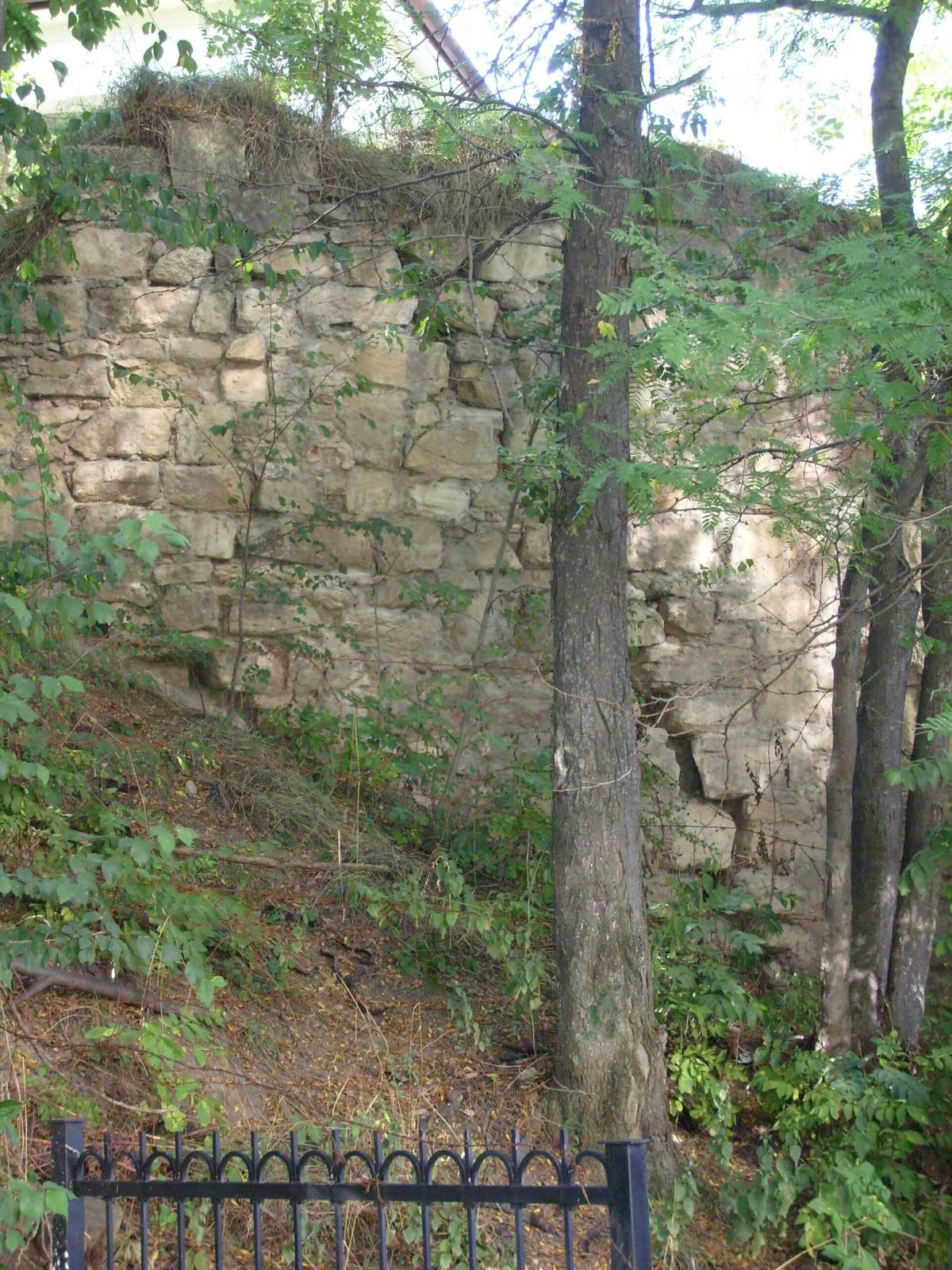
Fortifications and burial ground
Excavations in the northwestern part of the enclosure have uncovered fortification remains. At its northwestern corner, the foundations of a circular tower have also been excavated; the tower probably belonged to the fortification made in 1465. Nineteenth-century grave monuments occupy the southern part of the enclosure. They include a monument to Lieutenant Colonel András Tamás, who was executed in 1849. In 1893, the Transylvanian Roman Catholic Status and the Transylvanian bishopric prohibited further burials there.