Ushirofutago Kofun: A Sixth-Century Keyhole Burial Mound in Japan


Site at a Glance
- Rating
- 4.1
- Popularity
- Very Low
- Country
- Japan
- Primary era
- Medieval
- Eras represented
- Medieval
- Civilizations
- Yamato
- Site type
- Burial
- Remains
- Burial Mound
On this page10 sections
History
Ushirofutago Kofun is an ancient Japanese burial mound in Maebashi, Gunma, Japan, constructed during the latter half of the sixth century. It belongs to the Ōmuro Kofun Group at Nishiōmuro and follows the Shimotsuke-type, a distinctive two-tiered mound form associated with sixth-century burial mounds in the ancient Kenō region.
Construction and regional tradition
The mound formed part of a local tradition also represented by Sho-Futago Kofun and Ōmuro Group No. 1 Kofun. The Kenō region broadly corresponded to the former provinces of Kōzuke and Shimotsuke. Ushirofutago Kofun and the nearby Sho-Futago Kofun were designated together as a National Historic Site in 1927 under the name “Ushirofutago Kofun and Small Kofun.”
Discovery and historical interpretation
The stone chamber was discovered and opened in March 1878. An application later sought recognition of the mound as the tomb of Mimorowake, a king associated with the ancient Kenō region in the Nihon Shoki, an early Japanese historical chronicle. The application was not accepted because sufficient physical evidence was lacking.
Funerary practices and burials
Evidence from the chamber and its entrance indicates that food was cooked during a funerary ritual. Burnt earth at three locations suggests that ritual cooking or a banquet for the deceased took place outside the chamber. Three teeth recovered from the chamber belonged to an adult woman, while eleven earrings found during the Meiji period led to the conclusion that at least six people had been buried in the mound.
Remains
Mound and moat
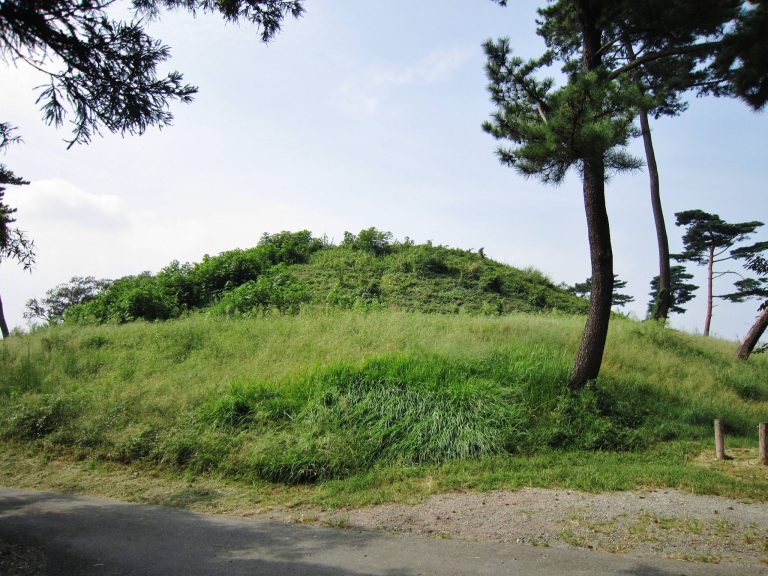
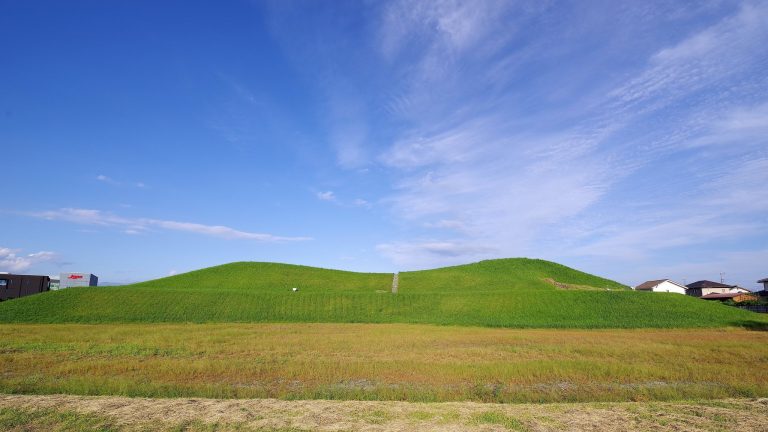
Ushirofutago Kofun is a keyhole-shaped mound, known in Japanese as a zenpō-kōen-fun, with a circular rear section and a projecting square front section. Its principal axis runs approximately 110 degrees northeast. The earthwork measures about 85 meters in length and was built in two tiers. The rear circular section is approximately 48 meters across and 11 meters high, while the front section is about 60 meters wide.
Part of the mound was formed by cutting into the natural ground. Its surfaces were not covered with stone facing. A shield-shaped moat surrounded the earthwork, bringing the combined length of mound and moat to approximately 106 meters.
Stone burial chamber
The burial facility is a semi-subterranean horizontal stone chamber opening to the south. It has a double-sleeved design, meaning that projecting side sections mark the junction between the entrance passage and the main chamber. The chamber measures about 9 meters in its present condition, with an estimated original length of approximately 9.5 meters. It is 2.2 meters high at the rear wall and 2.7 meters wide. Pillar holes at the end of the approach passage are thought to have been connected with funerary rites.
Objects and ceremonial features
Pottery and metal objects
Objects from the chamber include a long sword, horse-harness fittings, earrings, and pottery. The wider group of finds includes Sue ware, a high-fired gray pottery associated with elite sixth-century burials, and Haji ware, a lower-fired earthenware tradition. In front of the chamber, along the approach passage, and on the terraces, the Haji ware comprises 18 cups, one bowl, and one large jar. The Sue ware from these areas includes two pedestal cups and a spouted vessel. A small knife and two pieces of iron slag were also recovered.
Haniwa figures
Approximately 400 cylindrical haniwa, clay funerary objects placed on and around burial mounds, are thought to have stood on the summit and terraces. One distinctive cylindrical example carries attached clay figures of a monkey parent and child, with a dog pursuing them. Haniwa with attached animal figures are known from only three examples in Japan, all identified in Gunma Prefecture.