Ryūtō-ji Temple: Academic Head Temple of Warabioka’s Shugendō Lodges

Site at a Glance
- Rating
- 4.2
- Popularity
- Very Low
- Country
- Japan
- Primary era
- Early Modern
- External website
- Open
- Eras represented
- Early Modern
- Civilizations
- Tokugawa
- Site type
- Religious
- Remains
- Sanctuary
On this page13 sections
History
Ryūtō-ji Temple is a Shingon Buddhist temple in Yuza, Japan, at the foothills of Mount Chōkai. Its foundation is traditionally attributed to the monk Jishō in 807, although no surviving document confirms that date. Formally called Chōkaizan Ryūtō-ji, it became the academic-head temple of Warabioka, formerly the largest center of Shugendō, a Japanese mountain religion combining Buddhist, Shinto, and ascetic practices, around Mount Chōkai.
Origins and competing foundation traditions
Warabioka’s practitioners formed the Warabioka Thirty-Three Lodges, a single mountain institution whose members were also known as the Daishū. Ryūtō-ji served as their academic-head temple. The institution organized religious learning and the mountain practices associated with Mount Chōkai, while its lodges supported practitioners undertaking formal mountain-entry routes.
A different foundation tradition appears in the Chronicle of Mount Haguro, which attributes the temple’s origin to Ennin in 860. Ennin, also known as Jikaku Daishi, was a ninth-century Tendai monk whose reputed journeys and foundations became part of many Japanese temple traditions. In this account, he subdued a blue demon and a red demon, built a Gongen Hall near a place called “Snake’s Mouth” in the summit area of the dragon-shaped mountain, and named the institution Ryūtō-ji, or “Dragon-Head Temple.”
The historical accuracy of this story is unconfirmed. It may preserve a memory of an older Tendai-affiliated center at Sugisawa, and the summit institution described in the tradition may have been separate from the later academic-head temple at Warabioka. Before the early modern period, Sugisawa appears to have been an older and powerful center. Its deputy head lodge controlled the key to the summit Gongen Hall, while its two lodges were incorporated into the Warabioka Thirty-Three Lodges by the beginning of the early modern period.
The Warabioka institution in the early modern period
The first documentary record of the Warabioka lodges dates to 1611, when the names and holdings of all thirty-three were entered into a record. A land-donation document issued by Mogami Yoshiaki in 1612 demonstrates the institution’s close relationship with political authority. In 1683, the Warabioka group was counted as thirty-two mountain practitioners, excluding Ryūtō-ji, the academic-head temple. Regulations written in 1725 set out strict rules for the Thirty-Three Lodges, which included Ryūtō-ji and the two Sugisawa lodges.
Medieval records of Warabioka’s Shugendō activities have not survived, but the institution maintained ties with Mount Haguro Shugendō during the early modern period. Its practitioners had originally belonged to the Shingon tradition and continued to do so even after the Mount Haguro institution adopted Tendai affiliation. Shingon is an esoteric Buddhist tradition centered on ritual, mantra, mandala, and the attainment of buddhahood. During this period, Ryūtō-ji was also known as Kannon-ji.
A record from 1630 identifies the institution as a Shingon center of the Chōkai mountain tradition. It calls the temple Shōgakuzan Kannon-ji and identifies Eleven-Headed Kannon as its principal image, while noting that the name Chōkaizan Ryūtō-ji had recently begun to be used. Another record places the name change after 1655 and associates the temple with the New Shingon tradition.
Authority over Mount Chōkai practice
In 1684, Ryūtō-ji was placed directly under the authority of Daigo Sanbō-in in Edo and continued as a direct branch of the Tōzan branch of Shugendō. The Tōzan branch was a major Shingon-associated organization of mountain asceticism. Ryūtō-ji performed junpō, the ascending-peak mountain practice used by its religious institution.
A regulation issued in 1802 recognized Ryūtō-ji as the leading guide for the ascending-peak pilgrimage to Mount Chōkai. The temple and the leading temple of Yashima, which guided the opposite route, could promote practitioners within their respective mountain institutions and issue appointment documents in addition to those issued by Sanbō-in. These privileges reflect Warabioka’s considerable local influence.
The Warabioka practitioners exclusively administered the summit Gongen Hall dedicated to Ōmonoimi-no-kami, the Shinto deity associated with the sacred identity of Mount Chōkai. They disputed this authority with practitioners from Fukura and Yashima, but settlements generally favored Warabioka. Sugisawa held the second station in the mountain-entry practice, enshrined a Kumano deity, and held a prayer ceremony on April 18.
Separation of religions and later continuity
Ryūtō-ji remained Buddhist after the 1868 decree clarifying the separation of Buddhism and Shinto and the abolition of Shugendō in 1872. From 1892, it belonged to the Chizan branch of Shingon Buddhism. The other Warabioka practitioners converted to Shinto. Following disputes and mediation, Warabioka and Fukura both became entrance shrines of the Mount Chōkai Ōmonoimi Shrine. Later changes in transportation routes contributed to the decline of the area.
The May 3 Ōgohei Festival preserves elements of the former Mount Chōkai mountain-entry practice. Ritual poles are erected before the great hall, and young people perform court-style dance. The observance is designated a national Important Intangible Folk Cultural Property under the name Warabioka Ennen, although local usage does not normally use the word “Ennen.”
In 1994, seventeen lodges remained in Warabioka. Their inhabitants continued to refer to one another using the names of the former lodges, while the settlement pattern and house layouts retained strong evidence of the community’s earlier lodging-temple function.
Remains
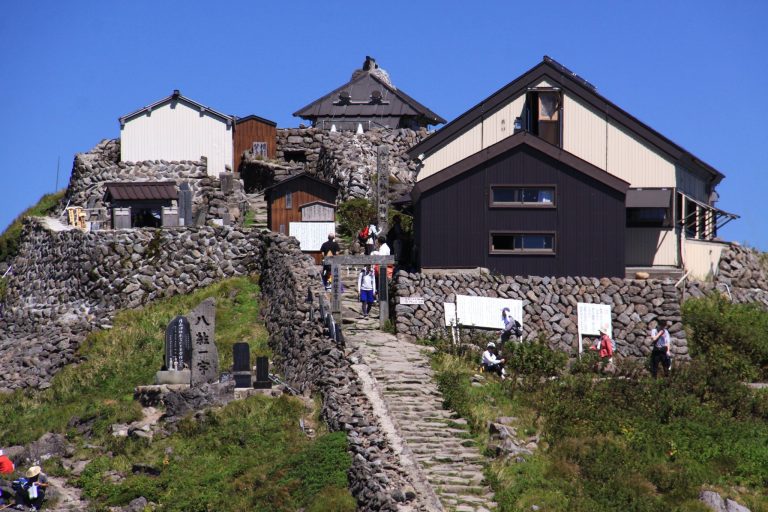
Ryūtō-ji stands on the lower slopes of Mount Chōkai at the southeastern edge of Yuza, on the elevated area historically known as the Upper Temple. The temple is adjacent to the Warabioka entrance shrine complex. Together with the surviving lodging-temple settlement and the shrine structures, the site preserves the physical setting of the former Thirty-Three Lodges and its mountain-entry institution.
Temple and shrine complex
Before the separation of Buddhism and Shinto, the complex was not regarded as a shrine. It was associated with the worship of Eleven-Headed Kannon and Yakushi and was variously called the Great Hall, Kannon Hall, Upper Temple Kannon, the Original-Buddha Hall, the First Prince, and the First Station. These names reflect the complex’s place within the religious organization of the Mount Chōkai route.
Main hall and Buddhist images
The main hall was rebuilt in 1841, according to a ridgepole tablet. Its principal image is a seated statue of Yakushi, the Buddha of healing and medicine. An image of Eleven-Headed Kannon, understood as the original Buddhist manifestation of the First Prince, is enshrined at Ryūtō-ji beside the shrine complex. In premodern religious thought, an “original Buddhist manifestation” meant that a Buddhist figure and a Shinto deity could be understood as different forms of the same sacred being.
Warabioka worship hall
The large worship hall at the Warabioka entrance shrine remains as a substantial surviving structure. It preserves the appearance of the former Shugendō complex and forms part of the physical setting associated with the old mountain-entry institution.
Lodging-temple settlement
The former Warabioka lodging-temple settlement preserves the physical character of the Thirty-Three Lodges. Surviving houses retain older settlement arrangements and interior layouts associated with their role as lodgings for mountain pilgrims. The continued use of former lodge names among the remaining houses also preserves the organization of the earlier religious community.
Sugisawa and the Mount Chōkai landscape
Sugisawa Kumano Shrine
The former Sugisawa Kumano shrine, now called Kumano Shrine, retains a male deity statue from the Kamakura period and a half-lotus-seated, monk-shaped deity statue from the Northern and Southern Courts period. The site also preserves the association of the Sugisawa lodges with the mountain-entry route.
Dragon traditions of the mountain
Mount Chōkai’s landscape is traditionally interpreted as resembling a coiled dragon when viewed from the summit toward the Shōnai side. Numerous water-related place names and traditions connect this imagery with the mountain’s abundant groundwater. Mount Chōkai Lake is said to contain a dragon, and two strips of sand on its western side are interpreted as the dragon’s tracks. Dragon Pond on the mountainside is likewise described as a dragon’s dwelling.