Knivsta Old Church: A Medieval Parish Church in Sweden
Site at a Glance
- Popularity
- Low
- Country
- Sweden
- Primary era
- Medieval
- Eras represented
- Medieval, Early Modern, Modern
- Civilizations
- Swedish
- Site type
- Religious
- Remains
- Church
On this page13 sections
History
Medieval origins
Knivsta Old Church is a parish church in Knivsta, Sweden, built around 1300 in the Gothic style, a medieval form associated with pointed arches and rib vaults. It belongs to Knivsta parish in the Lutheran Church of Sweden and is within Uppsala diocese, an ecclesiastical district, and Knivsta pastorate, a shared grouping of parishes. The church may have been ready for a visit in 1303 by Nils Allesson, a medieval archbishop of Uppsala. It was consecrated during the fourteenth century and dedicated to Saint Stephen, regarded in Christian tradition as the first Christian martyr.
A small stone church in the Romanesque style, associated with rounded arches and substantial masonry, is thought to have stood on the site during the thirteenth century. Some of its stone was later reused in the present building.
Later alterations and restoration
A separate belfry was built in 1756 by Per Persson Holm, and large arched windows were opened in the church during the 1770s. In 1892, a restoration designed by Gustaf Pettersson uncovered and repaired wall paintings. The church’s furnishings were also replaced with new pieces inspired by medieval styles. Harald Thafvelin’s work from 1958 to 1961 removed some of the 1890s additions and introduced new pews.
The church’s organs changed over time. Pehr Strand of Stockholm made an eight-stop instrument in 1808; stops select groups of pipes. An organ made by P. L. Åkerman & Lund in Stockholm followed in 1892 and was rebuilt in 1906 by the same firm at its Sundbyberg works. The present organ was built in 1960. The altarpiece was restored by Alf Nilsson in 1949 and by Elkea Tångeberg in 1982.
Remains
Church fabric and plan
Layout and masonry
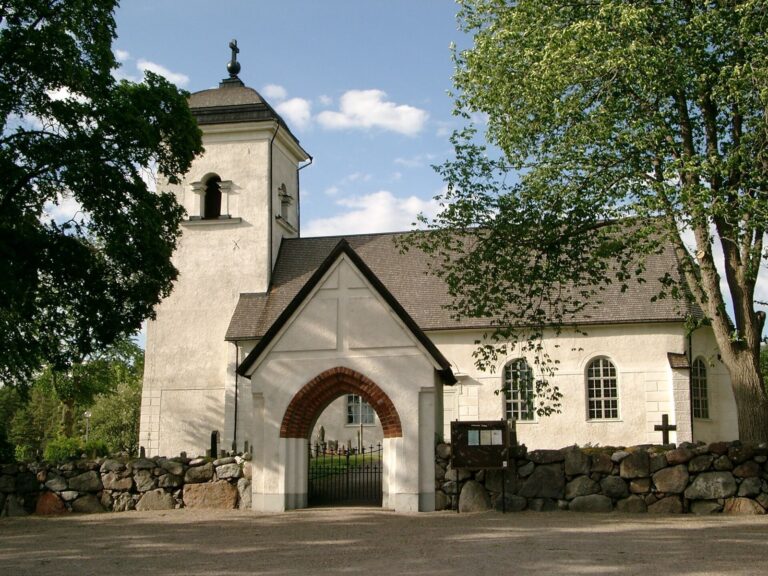
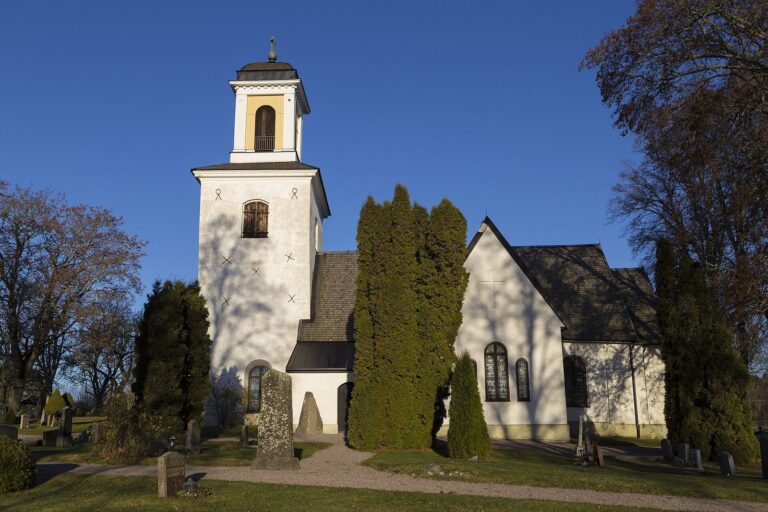
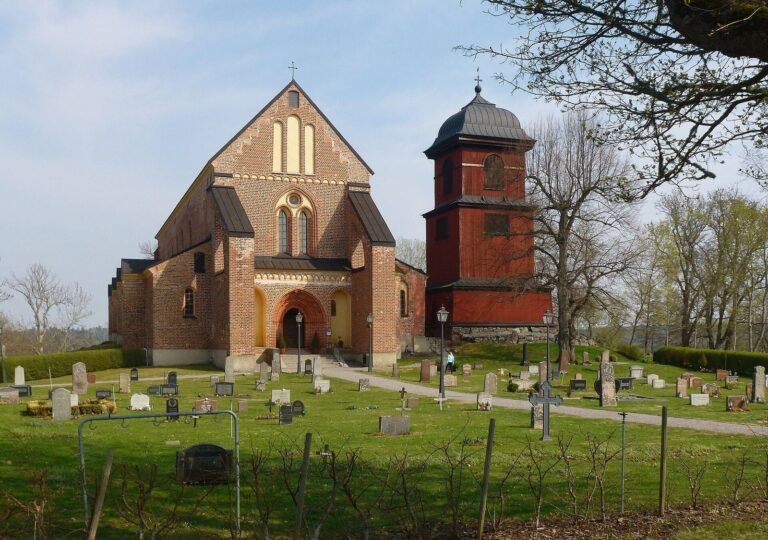
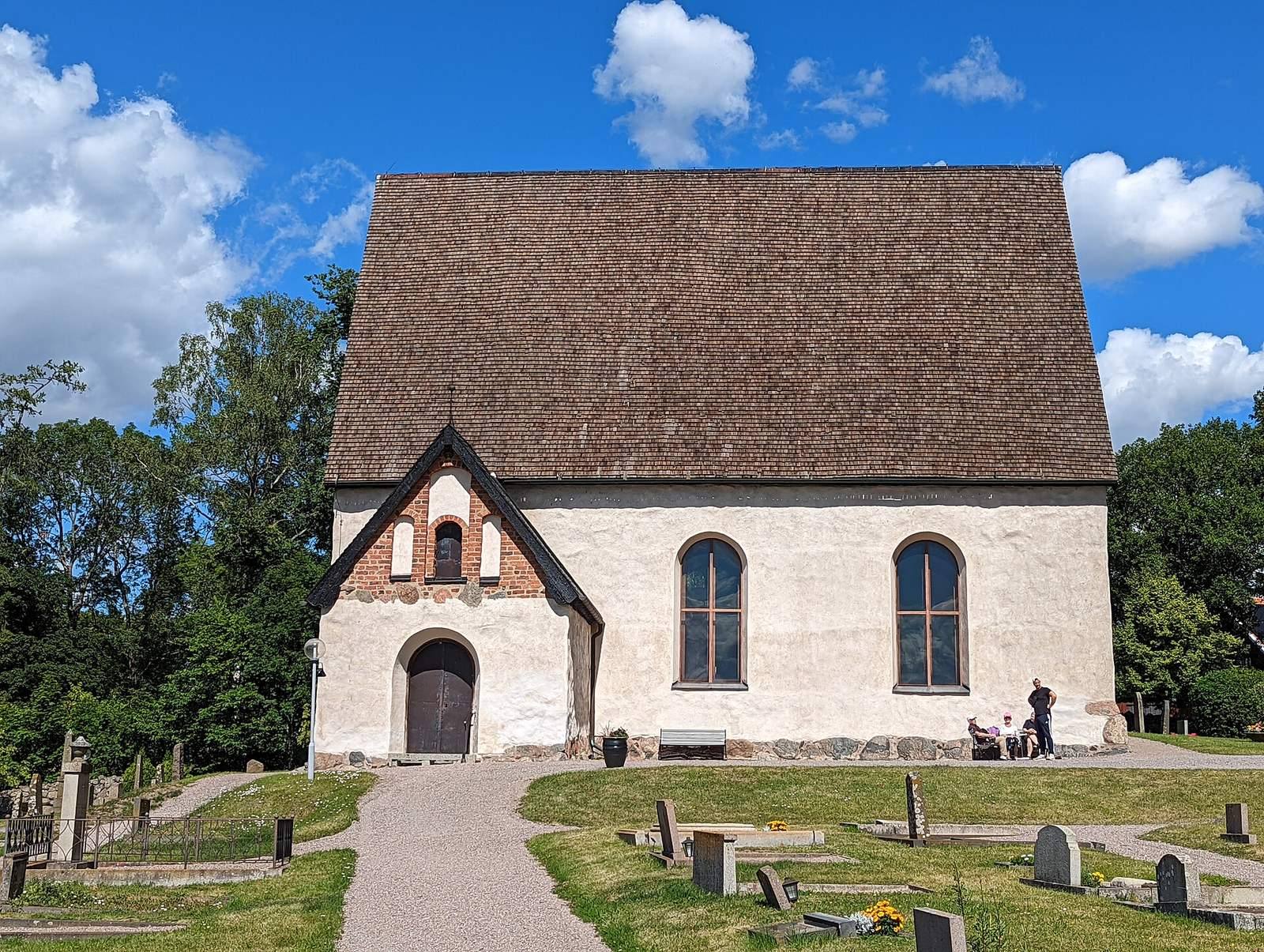
The church is built mainly of grey stone, with brick detailing on its gables, around openings, and at the entrances. Its plan has a single nave, or central worship space without side aisles, and a straight-ended chancel, the area around the altar, at the east end. A sacristy, a room for clergy and church furnishings, adjoins the north side of the chancel. It is the oldest part of the building and probably belonged to the earlier church. The north wall incorporates reused stones from that predecessor. A porch occupies the southwest side of the nave. Shingle-covered gabled roofs shelter the building’s sections.
Entrances, openings, and ceiling
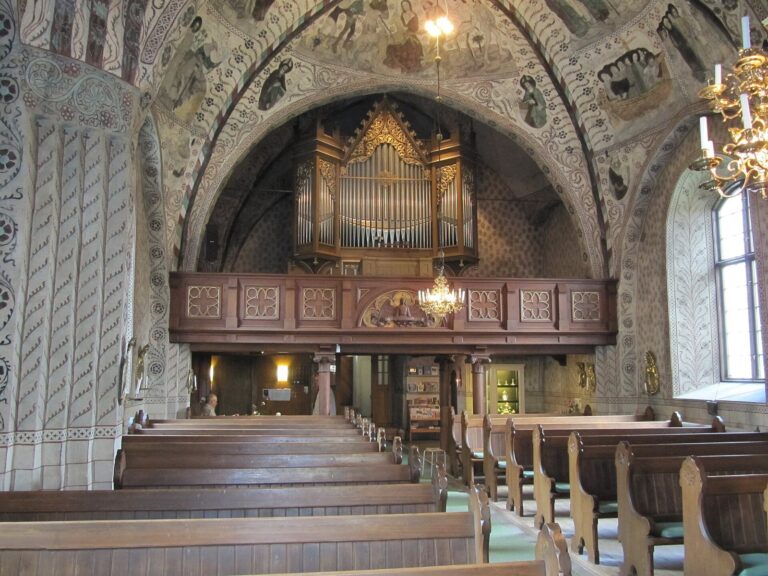
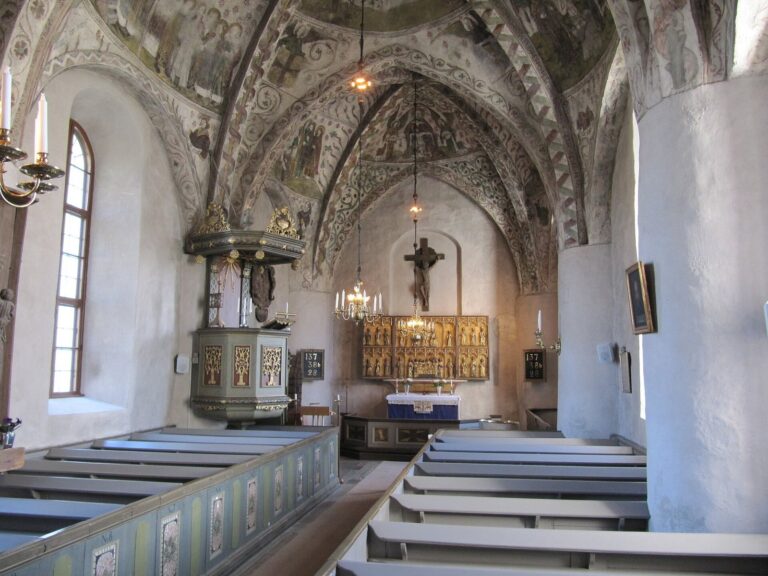
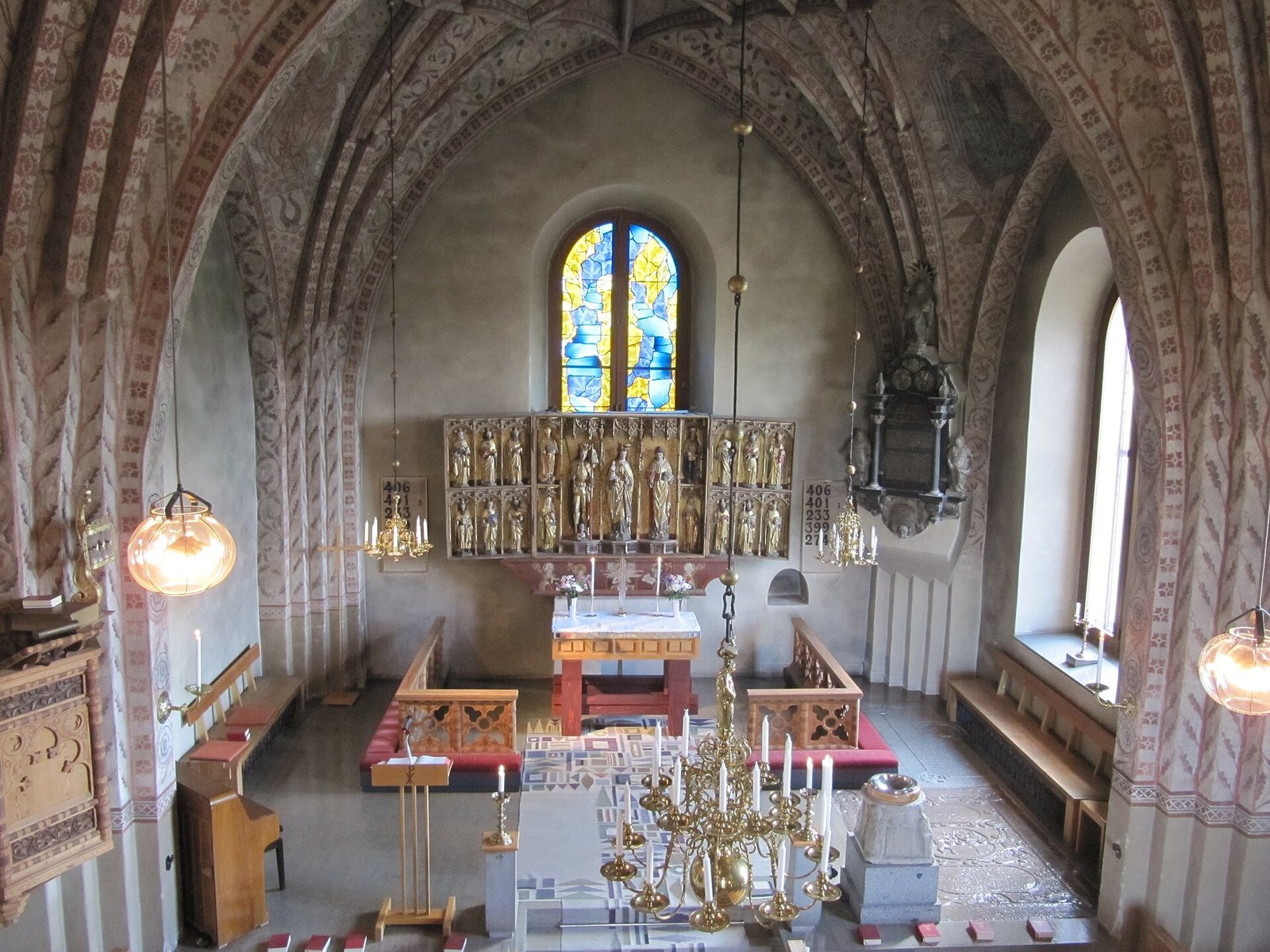
The south doorway is framed by red and black molded brick in a North German style, with painted reliefs above it. The large round-arched windows date from the alterations of the 1770s. Inside, brick vaulting added in the mid-fifteenth century covers the ceiling. The easternmost vault is a net vault, whose ribs form a network; this type is also known from Kimito and a few other churches in Finland. Wall paintings from the 1460s are associated with the Tierp school, a regional style of medieval church painting.
Furnishings and artworks
Altarpiece and Saint Stephen
A Swedish altarpiece from around 1500 stands beside the chancel window. It follows a Lübeck-type design, a winged shrine format associated with the art of Lübeck, with a fixed central section and two wings. A fourteenth-century statue of Saint Stephen, once belonging to the church, is now held by the Swedish History Museum in Stockholm. Inside the church, a copy made by Bertil Nyström in 1960 stands near the lower end, to the right of the door.
Pulpit, organ, and stained glass
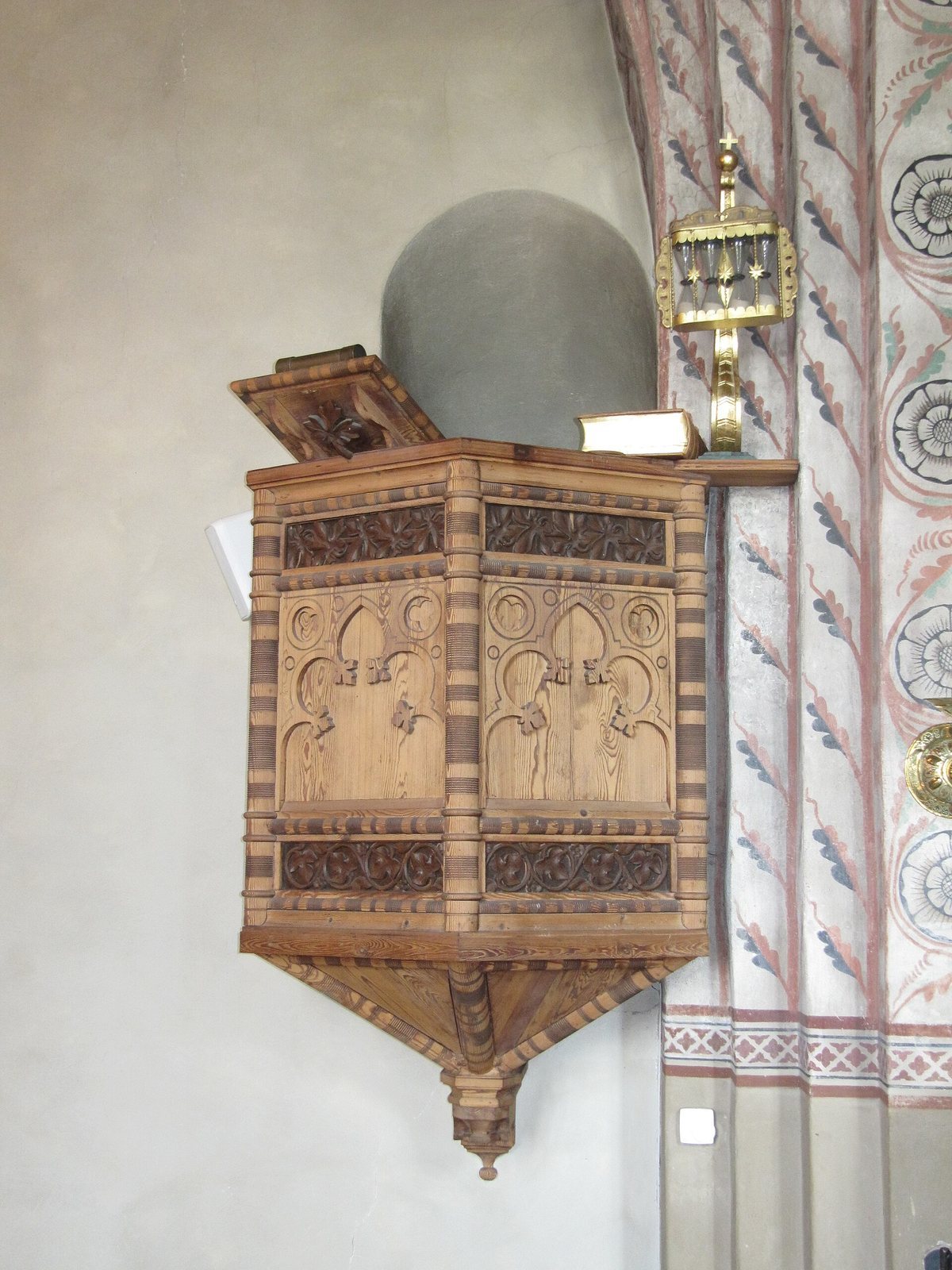
The wooden pulpit, made in 1892, has Neo-Gothic details, a revival style based on Gothic design. Its turned elements resemble those on the gallery and altar rail. The present organ has a mechanical action and slider chests, which regulate airflow to the pipes. Its 54/30 compass means a 54-note manual range and a 30-note pedal range; the facade comes from an earlier organ. A stained-glass window in the chancel, designed by Jochem Poensgen of Düsseldorf, was installed in 1980.
Separate structures and stonework
Belfry and bells
The freestanding belfry stands on a hill just north of the church. It is made of pine timber and has been board-clad since its construction. Two large bells were cast in Stockholm by Gerhard Horner in 1814. A smaller priest’s bell, cast by Johan Fahlsten of Stockholm, was given to the parish in 1756.
Runestone
A damaged runestone, a stone bearing runic writing, is set into the stone wall. It is identified as U470 and bears a cross.