Lagga Church: A Medieval Parish Church in Sweden
Site at a Glance
- Popularity
- Low
- Country
- Sweden
- Primary era
- Medieval
- Eras represented
- Medieval, Early Modern, Modern
- Civilizations
- Swedish
- Site type
- Religious
- Remains
- Church
On this page18 sections
History
Lagga Church is a medieval parish church in Knivsta, Sweden, consecrated around 1300 and now part of the Church of Sweden. It belongs to Lagga Parish in the Knivsta pastorate, an administrative grouping of parishes, within the Archdiocese of Uppsala. The church stands on the lower northern slope of Laggaberget beside an ancient waterway that connected Uppsala with Garnsviken. The parish also includes Mora Meadow, a political assembly site where the Svear, an early Swedish people associated with Svealand, gathered to choose kings.
Medieval origins and decoration
The nave and sacristy were built together in the later 13th or early 14th century. The church visible today dates to the 14th century and may have replaced an earlier building. Around the first half of the 15th century, the original wooden three-lobed ceiling was replaced by four brick vaults, and a porch was probably added around the middle of the century.
The church was redecorated around 1500. An inscription dates a later layer of its paintings to 1498 and associates the work with the workshop of Albertus Pictor, a Swedish painter, or with one of his followers.
Changes from the 17th to the 19th century
A pointed roof turret, shown in a 17th-century drawing, was replaced by a weather vane in 1725. A new bell tower was erected higher on Laggaberget in 1736, taking the place of an earlier tower; its initially open structure was probably enclosed that same year. The large bell was recast in 1736, while the smaller bell was made in 1865. In 1747, the church’s interior walls were whitewashed and its exterior walls rendered. The porch was also whitewashed, while the vault paintings were left untouched.
New pews were made in 1784 by master carpenter Svän Malmström of Funbo Parish, followed by a wooden altar and altar rail in 1786. The first organ was installed in 1835. During major alterations in 1814–1816, a wooden cross decorated with a crown of thorns took the place of the altarpiece. The altarpiece, a separate cabinet with a figure of Mary, and the triumphal cross were moved to the bell tower’s attic. A brick gable was added to the porch in 1870.
Restoration and modern changes
Architect Evert Milles directed a restoration in 1926–1927 intended to recover the church’s medieval interior character, with conservation work by artist Edvin Almgren. The altarpiece, the cabinet with the figure of Mary, and the triumphal cross were restored and returned to the church. A new organ had been installed in 1927; in 1947, Bo Wedrup reconfigured it. That year, the walls and vaults were cleaned, four crosses associated with the church’s dedication were uncovered in the choir, and electric heating replaced the wood-burning stove. A brass basin for washing liturgical vessels was installed in the sacristy in 1957.
A bronze angel sculpture beside the church was inaugurated on 4 October 1959. It copies Carl Milles’s Flute-playing Angel at Millesgården in Stockholm. The present organ was installed in 1978, when the gallery built in 1650 was removed.
Remains
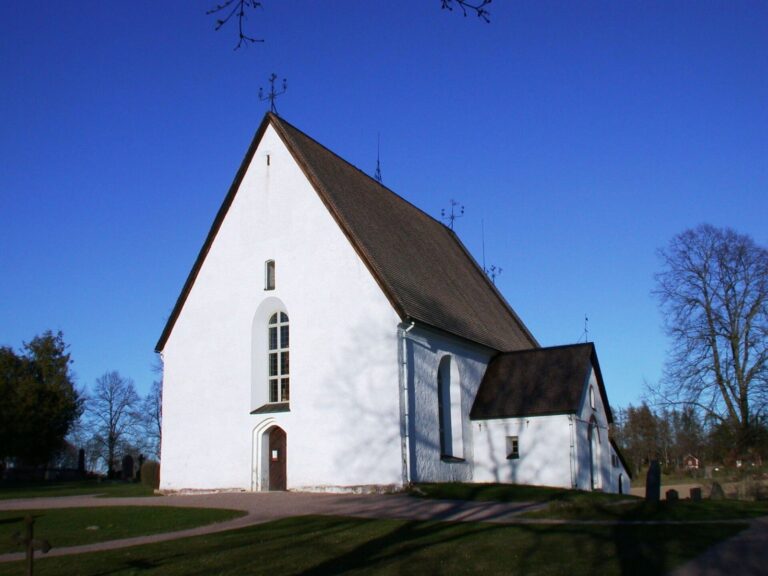
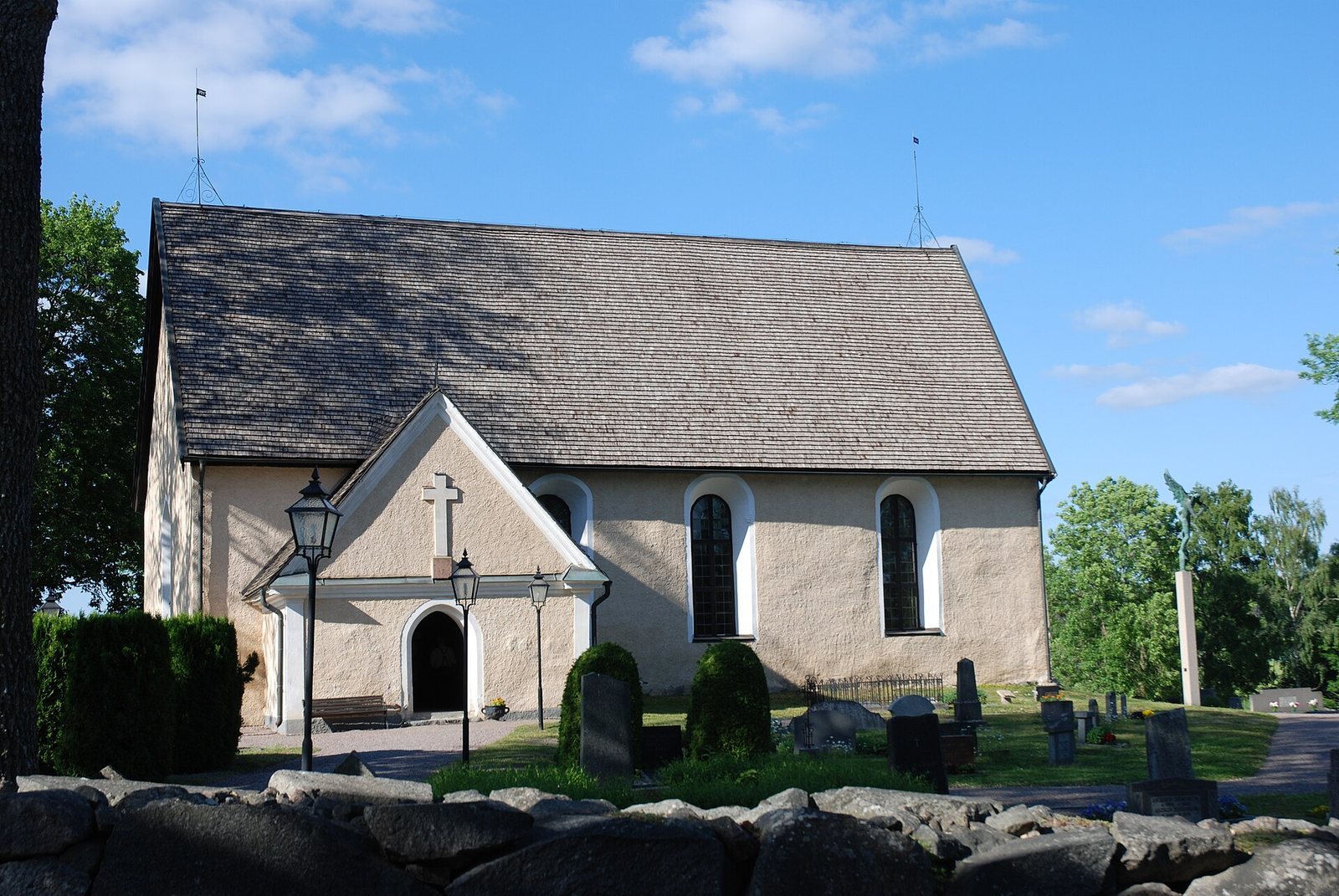
The church is a single-nave building with a rectangular nave and a choir that ends in a straight eastern wall. Its fieldstone walls, brick vaults and openings, and plastered, whitewashed exterior form the main structure. The sacristy projects from the northeast side, while the porch extends from the southwest.
Church fabric and painted interior
Nave, choir, and vaults
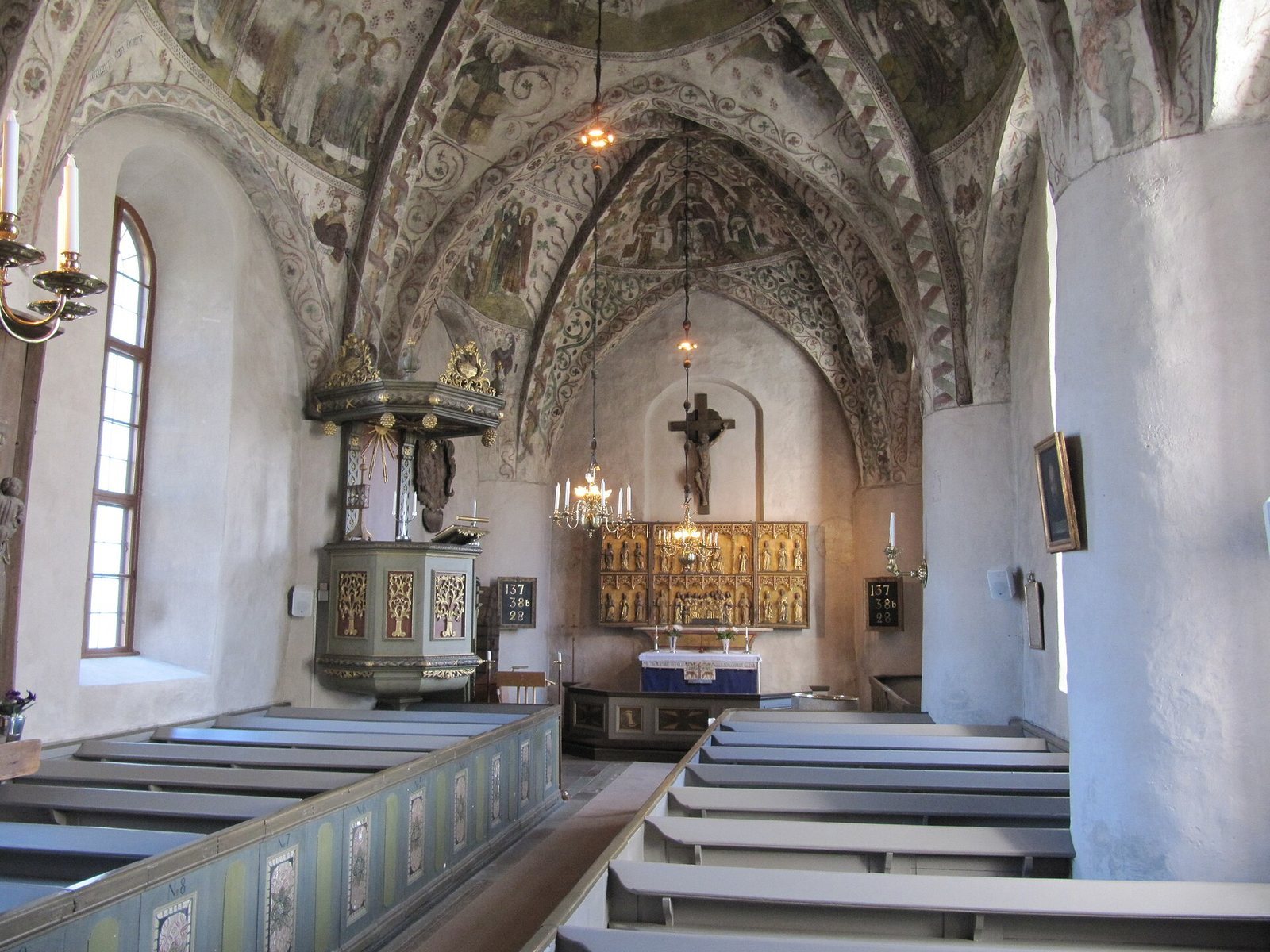
Four brick cross vaults, ceilings formed by intersecting curved sections, cover the church. They sit about 2.5 metres below the earlier wooden trefoil vault, a ceiling with three lobes; its framework remains visible in the attic. The vault paintings survive, and four consecration crosses, marks associated with a church’s dedication, are visible in the choir.
Sacristy and porch
Both the sacristy and porch have plastered walls and gabled roofs. The sacristy stands on a high foundation above a spacious basement. The church entrance is in the porch’s south wall, and the porch has a brick gable. A church basin used to wash liturgical vessels is kept in the sacristy.
Windows
Windows were cut into the north nave wall during the alterations of 1814–1816, and the choir and south nave windows were substantially enlarged. The choir opening cut in 1815 was later sealed during the 1926–1927 restoration.
Furnishings and works of art
Font, cross, and altarpiece
A sandstone baptismal font at the south side of the choir dates to the 12th century and is probably the church’s oldest object. It is decorated with interlaced patterns and animal figures. The wooden triumphal cross, a large crucifix traditionally placed at the entrance to a choir, dates to the first half of the 14th century. It was made by the Dalby Master, an art-historical name for an unidentified medieval artist, and has received a new cross during a modern renovation.
The Swedish-made altarpiece dates to the late 15th century. Its central section depicts the Coronation of Mary above her death, subjects from Christian tradition. A separate cabinet associated with Mary, contemporary with the altarpiece, hangs on the north wall and retains a well-preserved sculpture of her.
Cabinets, pulpit, and carved arms
An oak sacrament cabinet, a cupboard for the consecrated host, stands on the north side of the choir beside the sacristy entrance. Medieval in date, it is 216 centimetres high and has a pointed roof and a pointed door with two locks. A separate medieval table cabinet stands in the porch. The pulpit, made in Stockholm by woodcarver Carl Spaak and delivered in 1718, is beside the north wall. Above the sacristy entrance hangs a 17th-century carved wooden coat of arms belonging to the Swedish nobleman Gustaf Svinhufvud.
Lighting and liturgical objects
The sacristy holds the church’s medieval chandelier. Gustaf Svinhufvud donated the chandelier in the choir in the late 17th century. A two-armed candle holder from the mid-17th century hangs on a south-wall pillar opposite the pulpit. Two pairs of candlesticks are made of silver-plated brass: the smaller pair dates to 1695 and the larger to around 1700.
Other furnishings include a communion vessel and paten, a plate used with a chalice, dated 1717; an octagonal wafer box from the late 17th century; a set for communion to the sick from 1791; and a wine jug from 1795. A black chasuble, an outer vestment worn during services, embroidered with silver was purchased in 1817. A green chasuble with a woven gold-thread forked cross was donated in 2008. The Lagga church sewing association gave the church a brass baptismal dish in 1961. A gilded-silver bridal crown set with amethysts and pearls was made by Uppsala goldsmith Curt Jacobsson and donated to the parish in 1956.
Organ
The first organ, built by Pehr Gullbergson of Lillkyrka, had ten stops, which select groups of pipes, and a façade designed by architect Carl Gustaf Blom Carlsson. The 1927 organ had ten stops, two hand-operated keyboards, and a foot-operated pedal. The current mechanical organ was built in 1978 by Robert Gustavsson Orgelbyggeri. It has slider chests, mechanisms controlling airflow to the pipes, and a façade designed by Mads Kjersgaard.
Churchyard and nearby structures
Bell tower
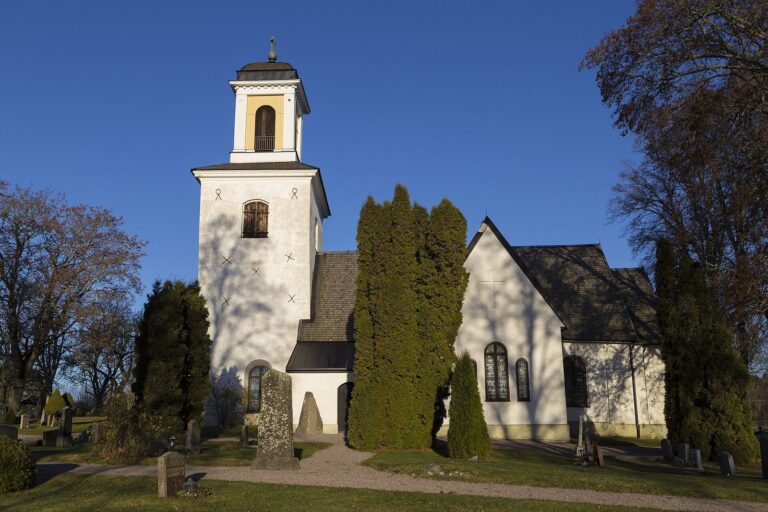
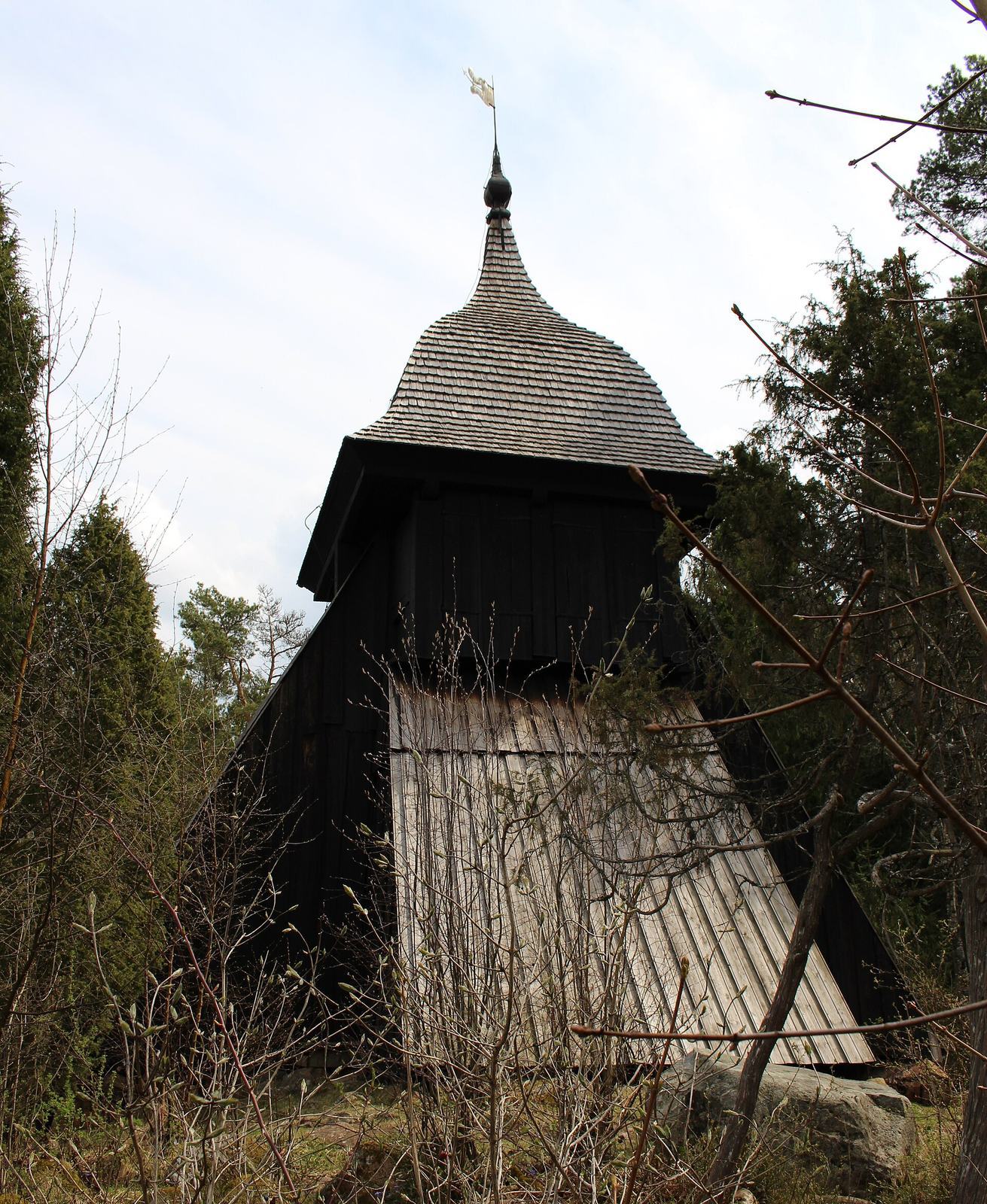
The bell tower stands higher up on Laggaberget. It began as an open structure with a hood, with its braces and sills clad in shingles and boards, and was later enclosed. The large bell was recast by Eric Näsman in 1736; the smaller bell was cast by F. M. Bergholtz in 1865.
Churchyard and rectory
The churchyard slopes steeply to the north and northeast and is enclosed by a wall with entrances on the south and east sides. Both entrances were formerly sheltered by roofed gateways. East of the churchyard stands the old rectory, a group of red-painted timber buildings. Its older building probably dates to the late 17th century and has a hipped roof in the Carolinian style, a Swedish architectural fashion associated especially with the late 17th and early 18th centuries.
Bronze angel
Southeast of the church is a bronze sculpture of an angel playing music. It is a copy of Carl Milles’s Flute-playing Angel at Millesgården in Stockholm.