Anhausen Monastery: A Medieval House of the Pauline Hermits
Site at a Glance
- Rating
- 4.6
- Popularity
- Medium
- Country
- Germany
- Primary era
- Medieval
- Eras represented
- Medieval, Modern
- Civilizations
- German, Holy Roman Empire
- Site type
- Religious
- Remains
- Monastery
On this page8 sections
History
Anhausen Monastery stood in present-day Satteldorf, Germany, as a Catholic community of the Pauline hermits, a Roman Catholic order with a tradition of solitary religious life. It was founded in 1403 on the site of an earlier hermitage.
Hermitage and foundation
A chapel dedicated to the Virgin Mary was first mentioned at Anhausen in 1344. Lupold von Bebenburg had it rebuilt on a larger scale in 1357. Brother Konrad lived beside the chapel from 1359 and secured its separation from the parish church at Gröningen in 1360. In 1390, a Würzburg auxiliary bishop consecrated three altars during the tenure of the hermit Brother Markward.
In 1403, Hermann von Hornburg, his mother Barbara von Merkingen, and Konrad von Bebenburg established the monastery and entrusted it to the Pauline hermits. The bishop of Würzburg confirmed the foundation in 1404, followed by Pope Martin V, head of the Catholic Church from 1417 to 1431, in Konstanz in 1418. The Hornburg family protected the monastery and gave it support through numerous gifts. After the family died out, the Bebenburgs took on that role.
Growth and patronage
The monastery gained income through the incorporation of the parish of Wallhausen in 1436 and Georg von Bebenburg’s donation of the parish of Oberasbach in 1469. A fire destroyed the monastery in 1445, but Georg promptly rebuilt it. In 1480, Wilhelm von Crailsheim endowed the Crailsheim Chapel.
Reformation and dissolution
The Margraves of Ansbach became the monastery’s protectors in 1504. After the Reformation, a sixteenth-century movement that established Protestant churches and divided western Christianity, took hold in Ansbach, Margrave Georg of Brandenburg-Ansbach barred the admission of novices in 1528, intending to bring the community to an end. Following the death of its last prior, Leonhard Löß, the head of the monastic community, Anhausen was dissolved in 1557 and turned into a leased farm. Demolition of the complex began around 1700.
Remains
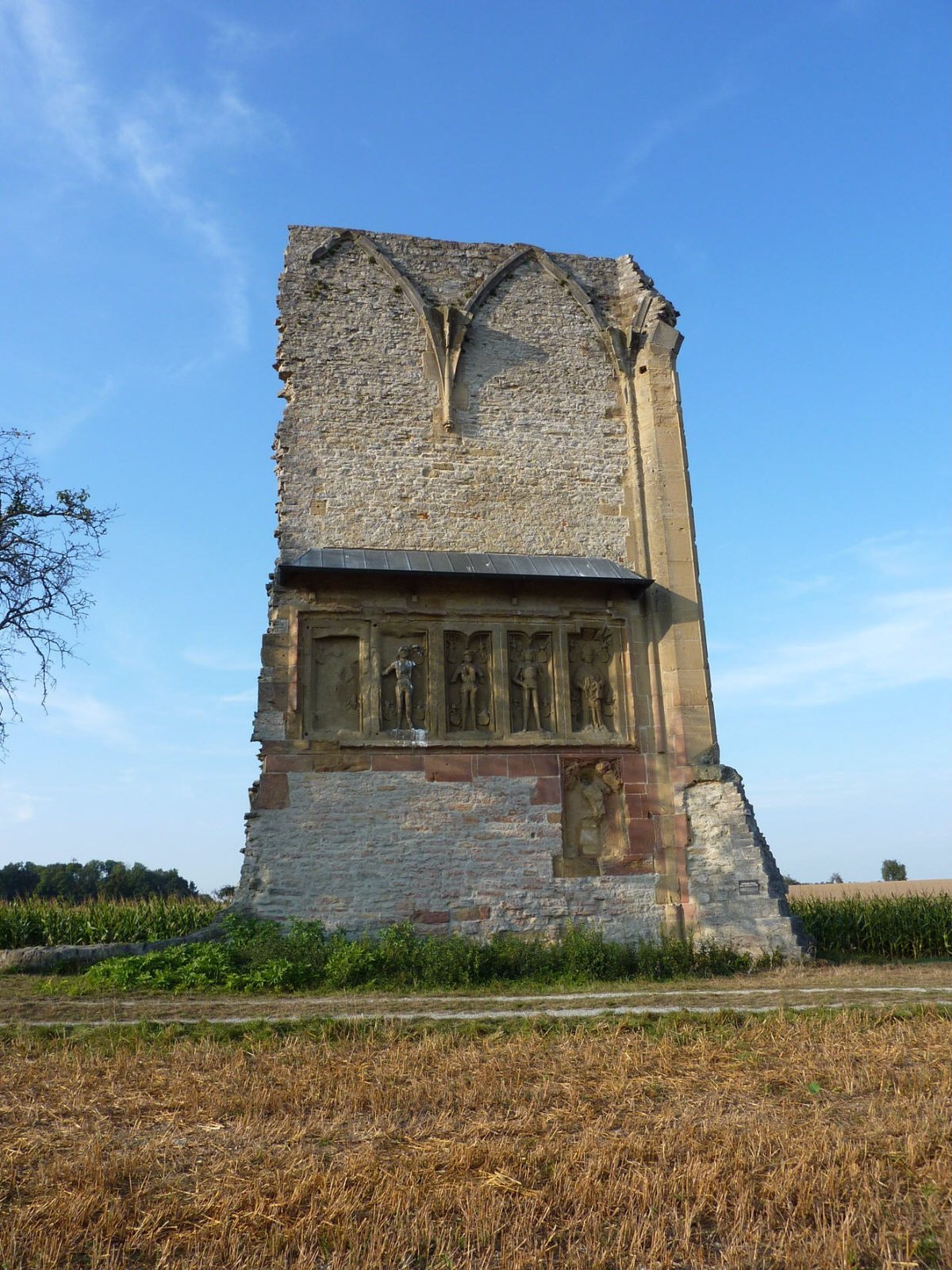
The site’s physical layout is understood through the freestanding chapel wall and traces associated with buildings to its south. The surviving wall is the northern side of the Crailsheim Chapel.
Monastic layout
A chapel dedicated to St Anne stood in the southern part of the complex. Vegetation patterns visible in aerial photographs suggest that the convent house, the prior’s house, and farm buildings also lay south of the surviving wall. Their foundations may still be recoverable through excavation.
The Anhäuser Mauer
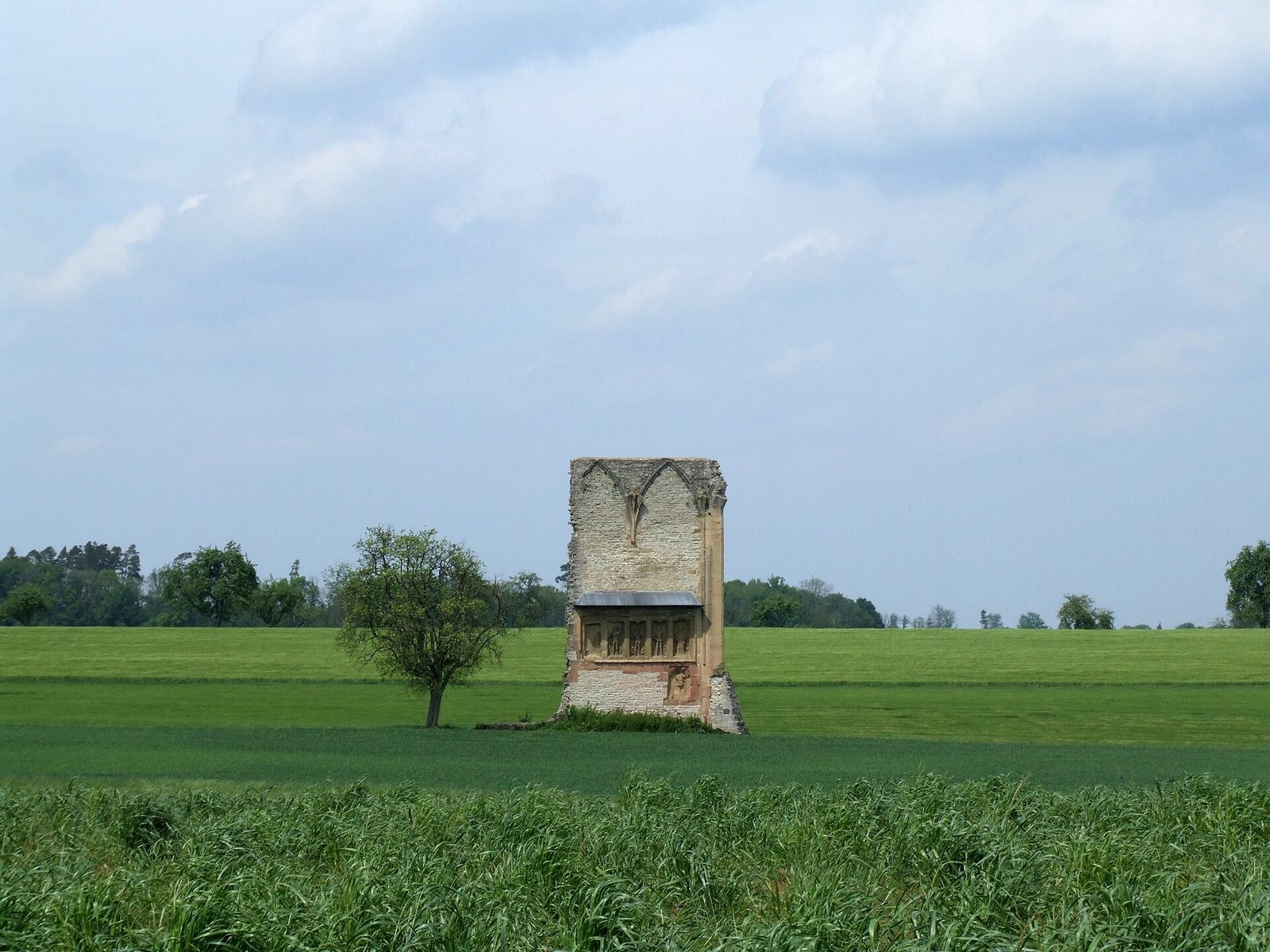
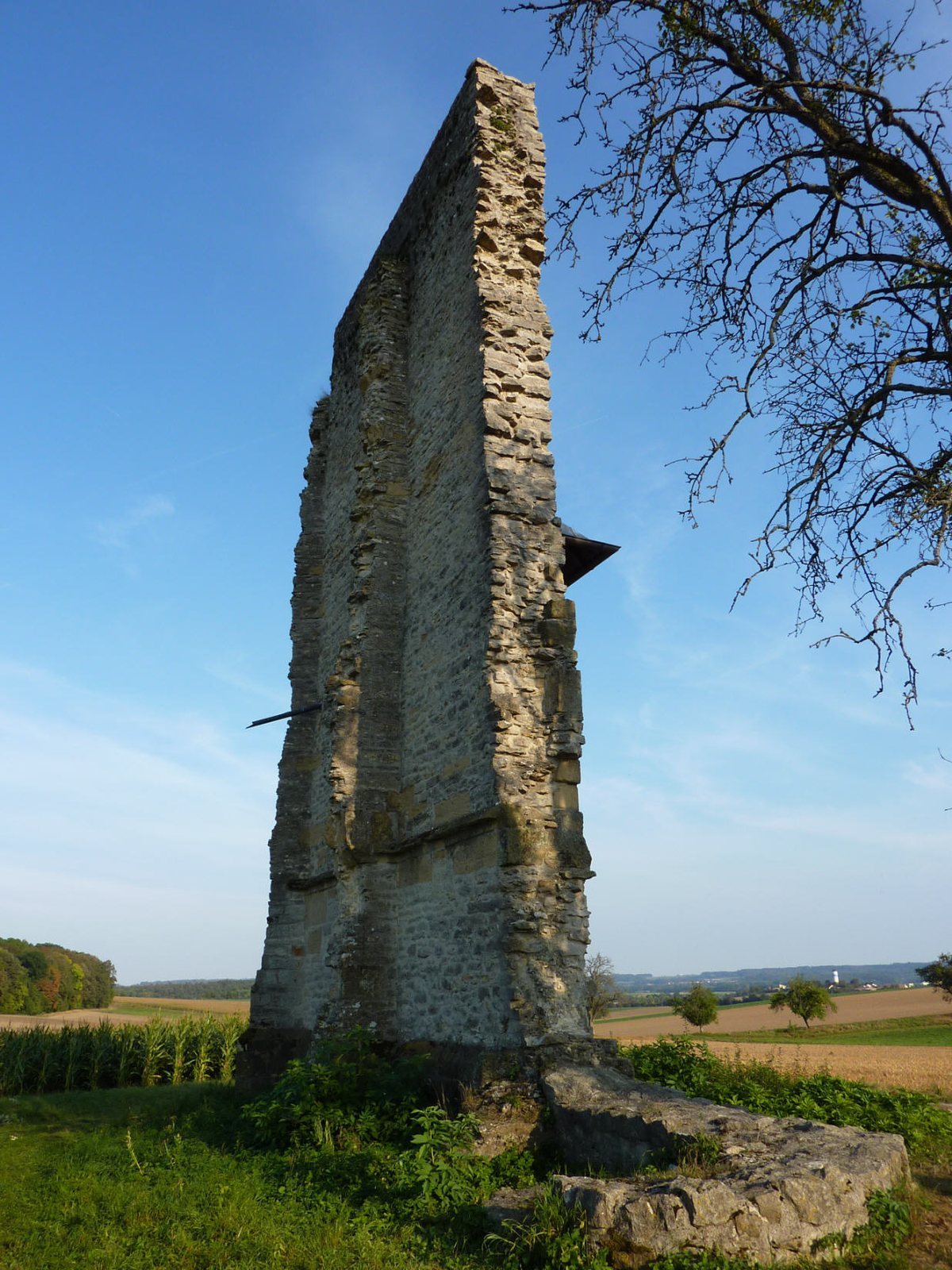
The freestanding wall, known as the Anhäuser Mauer, is about 18 metres high and 10 metres long. It stands roughly 150 metres east of the road between Bölgental and Wallhausen, northwest of Gröningen. In 1925, weathering caused the figure of Georg von Bebenburg to break out of the wall. A protective roof was installed above it afterward and remains in place.
Bebenburg memorial reliefs
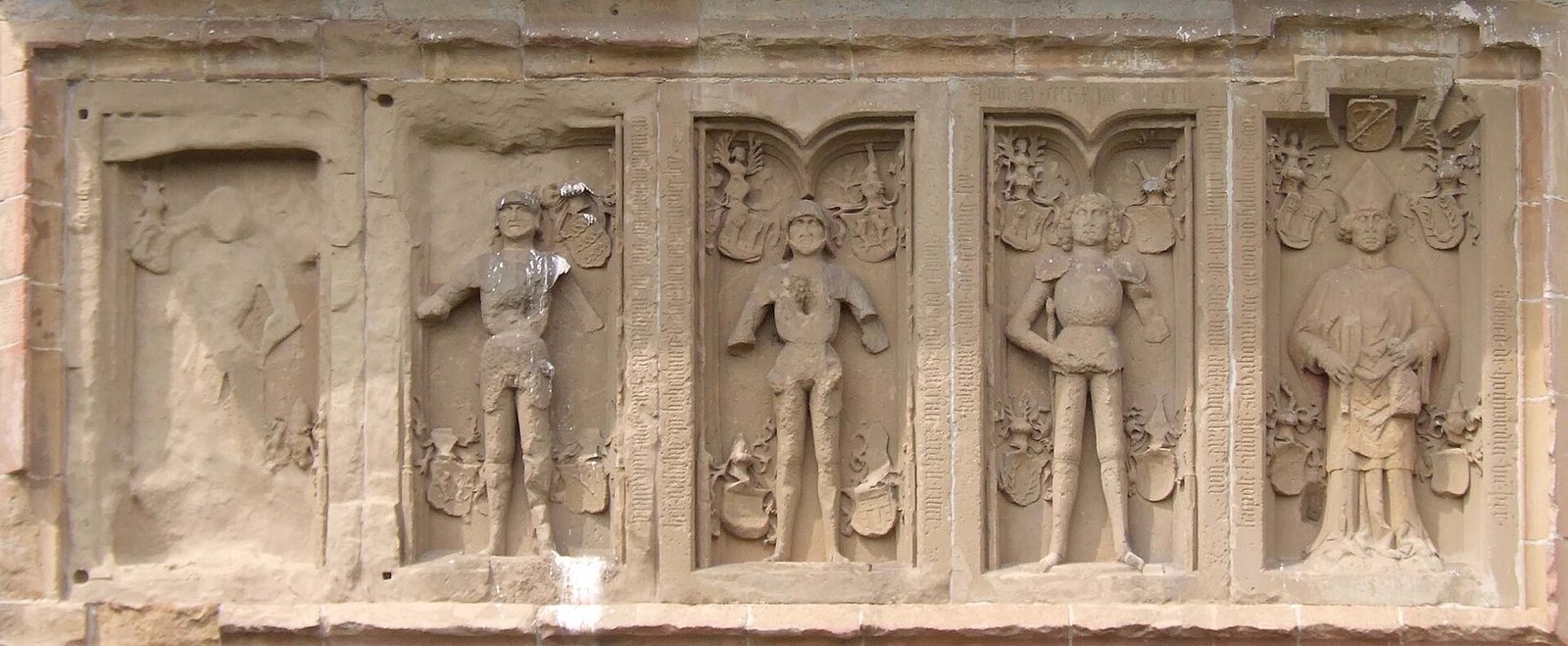
Five memorial reliefs set into the wall portray members of the Bebenburg family. They are carved images rather than tomb slabs, and their condition varies. From right to left, they depict Lupold von Bebenburg, who died in Bamberg on 28 October 1363; Engelhardt von Bebenburg, who died in 1410; Wilhelm the Elder von Bebenburg, who died in 1412; Wilhelm the Younger von Bebenburg, who died in 1416; and Georg von Bebenburg, who died in 1472. Each figure has coats of arms at the corners. Wilhelm von Bebenburg, bailiff of Lobenhausen from 1496 to 1502, probably arranged their installation. Lupold was buried in Bamberg Cathedral.