Kloosterkerk: A Late-Medieval Dominican Church in The Hague

Site at a Glance
- Rating
- 4.5
- Popularity
- Very Low
- Country
- Netherlands
- Primary era
- Medieval
- External website
- Open
- Eras represented
- Medieval, Early Modern, Modern
- Civilizations
- Habsburg, Holy Roman Empire
- Site type
- Religious
- Remains
- Church
On this page13 sections
History
The Kloosterkerk is a late-medieval Dominican church in The Hague, Netherlands, built in Dutch Gothic style between 1397 and 1403. It began as the church of a Roman Catholic convent associated with the Dominicans, also known as the Order of Preachers, and was dedicated to Vincent Ferrer, a Valencian Dominican missionary canonized in 1455. Since 1617, it has been used by Protestant congregations and is now part of the Protestant Church in the Netherlands.
Foundation and Dominican use
In 1393, Albrecht of Bavaria granted the site to the Amsterdam St. Andrew’s Convent. The monks sold it the following year to Jan V of Arkel, who built a castle there. A conflict with Albrecht led to the seizure of the property and the castle’s demolition. Albrecht then gave the land to Dominican friars from Utrecht.
Between 1397 and 1403, the friars established a monastery with gardens and a small church. It was known as the St. Vincentius Convent or the Convent of the Preachers. A major fire damaged the monastery in 1420, but repairs were completed before 1425. The church later became associated with pilgrimage and was dedicated to Vincent Ferrer.
The complex was enlarged around 1540. A side aisle was added on the Voorhout side, and transept chapels were built along Lange Voorhout. During the iconoclasm of 25 August 1566, much of the Catholic decoration was destroyed and most of the monks fled. The remaining Dominicans left in 1574, after Spanish forces had been expelled and the Reformation had gained influence.
Confiscation and industrial reuse
The States of Holland initially planned to demolish the monastery and church, but protests from inhabitants of The Hague led to a decision in 1576 to preserve them. The former monastery was leased and made available to the St. Nicholas Hospital. Demolition nevertheless began in 1583, when warfare had produced a shortage of timber and building stone.
The States of Holland confiscated the church, which stood empty for several years. A cavalry company sheltered there in 1588. In 1589, the choir and nave were converted for military production and storage. The choir housed a cannon foundry, while the nave was separated from it and used for ammunition. The foundry moved to a new gun house in 1665, after which the church returned fully to Protestant worship. The former monastery, however, continued to hold gunpowder and ammunition.
Protestant worship and the Princes’ Church
Part of the church returned to worship in 1617, when the Counter-Remonstrants took possession and began preaching there in July. The Counter-Remonstrants and Remonstrants were opposing Dutch Reformed factions divided chiefly over predestination and free will. Their dispute became a major political conflict during the Dutch Revolt and the early Dutch Republic.
Prince Maurice of Nassau attended a service preached by the suspended minister Henricus Rosaeus, publicly supporting the Counter-Remonstrant position. The church consequently became popularly known as the Princes’ Church. It continued as a second city church alongside the Grote Kerk and remained in use for Dutch Reformed worship during later centuries.
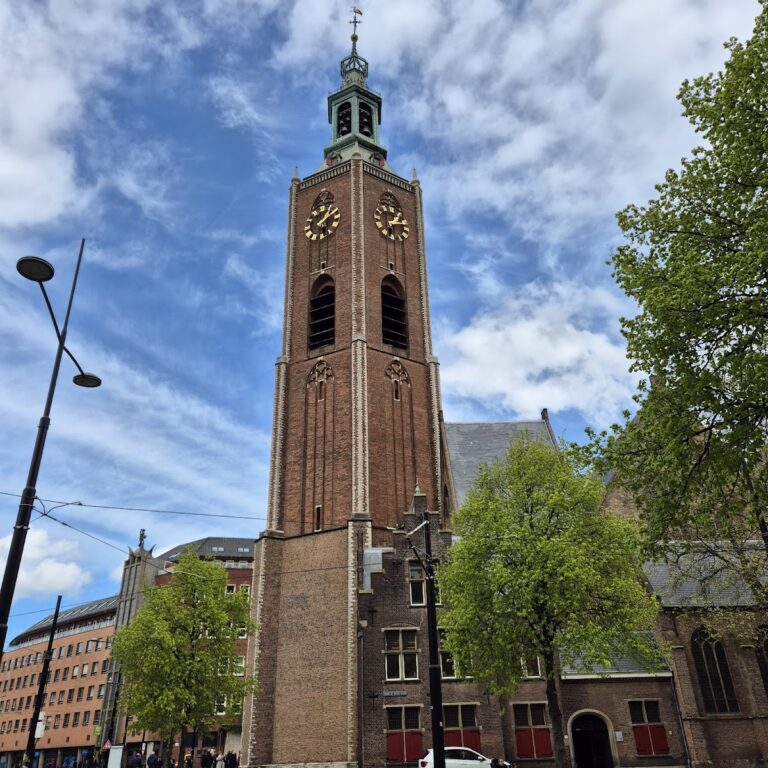
A mechanical clock made by Huyck Hopcoper was added to the tower in 1620. Burials within the church also became an important source of income during the seventeenth century. The church hosted several royal and aristocratic ceremonies, including the marriage of Frederick Henry of Orange and Amalia of Solms in 1625. Other marriages held there included those of Louise Henriette of Nassau and Frederick William of Brandenburg in 1646, and George Frederick of Nassau-Siegen and Mauritia Eleonora of Portugal in 1647.
Members of the Nassau, Orange, and Palatine families were baptized in the church from the seventeenth to the nineteenth century. Queen Wilhelmina took Communion there in 1896, Willem-Alexander made his profession of faith there in 1997, and Princess Ariane was baptized there in 2007. The church’s association with the Dutch royal family has continued alongside its religious use by a wider regional congregation.
Explosion, political change, and later congregations
On 3 November 1690, the powder magazine in the former monastery exploded, destroying the complex and leaving only one monastery wall. The church survived because of its thick walls. The disaster permanently separated the surviving church from most of the convent buildings.
In 1795, after French forces entered The Hague and the Stadholder’s family left for England, a committee met in the church to plan the replacement of the Stadholder’s government. A regiment of Cossack troops was temporarily quartered in the building in 1813.
From the late nineteenth century, the church formed part of the Dutch Reformed Church’s Ward XI. Willem Leonard Welter served as ward minister from 1894 to 1928 and as court chaplain from 1919 to 1928. A first Dutch Reformed liturgical service was held in 1911 under Jan Hendrik Gerretsen, but worship was suspended in 1912 because the building had deteriorated and was considered dangerous. Services resumed in 1914 after the consistory rejected demolition plans and financed restoration.
The Kloosterkerk ceased to function as a neighbourhood church after Ward XI was reorganized in 1939. German occupation further disrupted worship, and no services were held during the winters of 1940–41 and 1941–42. The Duinoordkerk, consecrated in 1920, was demolished in 1942 on the order of the German occupiers to clear land for the Atlantikwall and its associated restricted zone. Its congregation moved into the little-used Kloosterkerk, first temporarily and later permanently. Johannes Arnoldus Kwint, formerly minister of the Duinoordkerk, received special responsibility for the Kloosterkerk in 1952.
Renovation and present status
Thorough renovation took place between 1952 and 1957. The wall that had separated the nave and choir during the cannon-foundry and ammunition-storage phase was removed. Further restorations are recorded for 1988 and 2005, and another interior renovation began in 2026.
The Kloosterkerk became part of the Protestant Church in the Netherlands after the church merger of 1 May 2004. It has a regional function rather than serving a conventional neighbourhood congregation. The building is a Rijksmonument, a site legally recognized by the Netherlands for national cultural or historical importance, under national monument number 17690. That designation dates from 11 January 1967.
Remains
Church layout and construction
The surviving church is built of brick and natural stone in Dutch Gothic style. It measures approximately 43 by 30 metres. The nave, the principal longitudinal space of a church, is about 26 by 12 metres, while the choir measures approximately 17 by 9.5 metres. The central barrel-vaulted aisle, covered by a continuous rounded vault, is about 20 metres high and 11.5 metres wide.
The present fabric developed from the small church built for the Dominican monastery between 1397 and 1403. The enlargement around 1540 added the side aisle on the Voorhout side and transept chapels along Lange Voorhout. The southern transept was added in the early sixteenth century. The church was arranged so that visitors and pilgrims could pass through the worship space while services were held in the central aisle or nave. During its later Dutch Reformed use, the pulpit stood against the north wall.
Monastery wall and burial landscape
The church retained its own fabric when the monastery was destroyed in the 1690 ammunition explosion. One monastery wall survived and was incorporated into later buildings. Architectural-historical investigation rediscovered it before those buildings were demolished, after which the wall was preserved.
The seventeenth-century or earlier burial landscape included graves concentrated in the choir. Many walls and columns were covered with heraldic mourning boards, painted shields displaying the arms of deceased people or families after a death or funeral. A lead coffin containing the embalmed remains of Margaret of Cleves was found in the choir. She had been buried near the high altar in 1411.
Interior furnishings and memorials
Pulpit and organ
The oak pulpit dates from about 1700 and carries Flemish woodcarving of the Four Evangelists. It came from the demolished Duinoordkerk, together with that church’s pews and chandeliers. A new organ made by the Danish builder Marcussen was installed in 1966. Ceiling rosettes are attributed to Gerhard Jansen.
Stained glass and mosaic
A stained-glass window depicting the twelve apostles was made by Lou Asperslagh. It was recovered from storage in the cellars of the Peace Palace and installed in the Kloosterkerk’s Apostles’ Chapel.
Johan Thorn Prikker’s mosaic The Last Supper, made in 1925, was also transferred from the Peace Palace. Weighing 12,000 kilograms, it could not pass through the entrance and was lifted into the church through one of its windows.
Memorial objects
A bell from the Dutch cruiser De Ruyter is displayed in the porch. The ship sank on 27 February 1942 during the Battle of the Java Sea after Japanese cruiser Haguro torpedoes struck it. The wreck was later found and declared a war grave. Four bells were removed from it and later returned to the Royal Netherlands Navy, which has them managed by the Naval Museum in Den Helder.
The porch also contains a memorial plaque for Daniel Gabriel Fahrenheit, who was buried in the church. A bronze commemorative plaque was unveiled in 2002 by the Polish ambassador. A memorial to Jacob Cats remains against a pillar inside the church.
Nearby sites