Ključ Castle: A Medieval Fortified Power Base in Bosnia and Herzegovina
Site at a Glance
- Rating
- 5
- Popularity
- Very Low
- Country
- Bosnia and Herzegovina
- Primary era
- Medieval
- External website
- Open
- Eras represented
- Medieval
- Civilizations
- Kingdom of Bosnia
- Site type
- Military
- Remains
- Castle
On this page9 sections
History
Ključ Castle is a medieval fortified complex in the village of Ključ, Gacko, in Bosnia and Herzegovina. Locally called Stari grad Ključ, or Old Town Ključ, it dates in tradition and historical listings to the twelfth century, although its exact construction date is unknown. The fortress later became a regional power base and residence of Grand Duke Sandalj Hranić, one of the leading Bosnian nobles of the period.
The residence of Sandalj Hranić
By 1426, Ključ was one of Sandalj Hranić’s most important fortified cities and served as his regional centre and capital. He held the title Grand Duke of Bosnia, lived at Ključ, and issued most of his charters there. The fortress therefore functioned not only as a defensive position but also as a place from which political authority was exercised.
Sandalj’s successor, Stjepan Vukčić Kosača, continued to stay at Ključ frequently and received visiting missions there, although the fortress had already lost some of the favour it had enjoyed under Sandalj. Written evidence also places a settlement beneath the stronghold. A lawsuit from August 1434 refers to the suburb below the castrum, a fortified settlement or stronghold. An inscription on a stećak, a characteristic medieval tombstone of Bosnia and neighbouring western Balkan regions, records that Radonja Ratković died beneath the town while serving Duke Sandalj Hranić.
The town, market, and trade route
The settlement below the fortress was known as Podključ, meaning lower town or town beneath. Its market organized local economic activity and is explicitly mentioned in February 1449. That year, Radassin Stanchouich of Sotocliuç entered a four-year apprenticeship with the weaver Vlakota Mihačević, providing a glimpse of the commercial and craft life connected with the fortress.
Ključ appears as Glutsch in 1448 and as Cluz cum castris et partinentiis suis, meaning Ključ with its fortresses and dependencies, in 1454. From the stronghold, the settlement monitored movement along the principal trade route between Dubrovnik and Goražde and supervised neighbouring Cernica. These responsibilities gave Ključ a military and administrative role beyond its walls.
Ottoman expansion and decline
During the Ottoman expansion and the collapse of the Bosnian kingdom, Ključ was among the Herzegovinian residences that resisted siege for a comparatively long period. An Ottoman attack was repelled in July 1463, and the fortress was briefly returned to the territory of Duke Stjepan Vukčić Kosača.
At the end of 1465, Kosača appealed to the government of Dubrovnik for emergency supplies and military assistance for the besieged fortress. Dubrovnik refused, fearing retaliation, and directed the request instead to Hungarian commanders. Kosača’s son Vlatko controlled Ključ directly from 1464 to 1468. In 1469, Ajas Pasha, governor of Herzegovina, captured the fortress. After Vlatko’s later failed attempt to advance into central Bosnia, he withdrew permanently to his fortress at Novi.
After the fall of the kingdom, Ključ lost its strategic importance and began to deteriorate. The Venetian traveller Benedetto Ramberti saw it in a destroyed condition while travelling from Dubrovnik through Ključ in 1533. Before the Austro-Hungarian annexation of 1878, the newly built town of Koriti had assumed the former role of Ključ. The fortress itself remained in use until 1918.
Investigation and protection
Shortly after 1878, engineer Hugo Jedlička investigated the site and directed archaeological excavations. Two cannons recovered from the fortress were transferred to the National Museum in Sarajevo, together with some medieval stećak tombstones from Ćućenica hill south of the town.
The historic area, comprising the old fortress, the Podključ castle town, the Ključ Mosque and its harem, was designated a National Monument of Bosnia and Herzegovina on 28 June 2005. The harem is the enclosed area associated with a mosque and commonly includes its cemetery. The protected historic area is classified officially as a Category II monument.
Remains
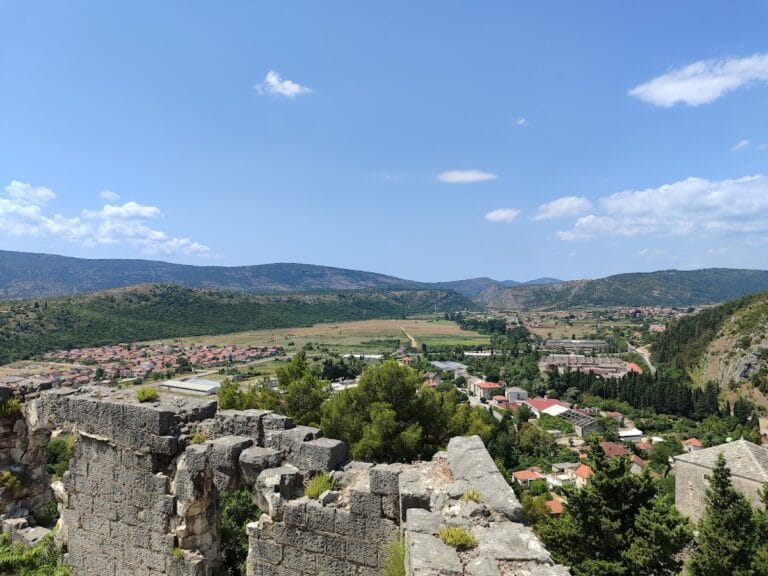
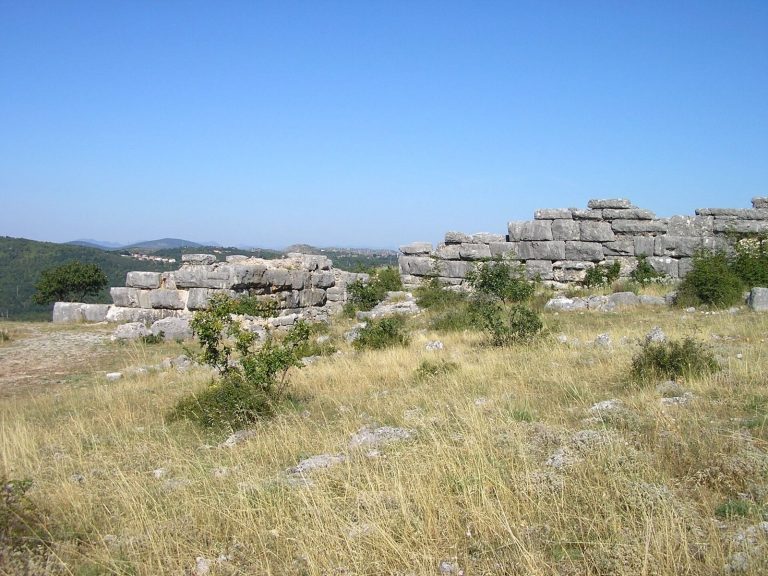
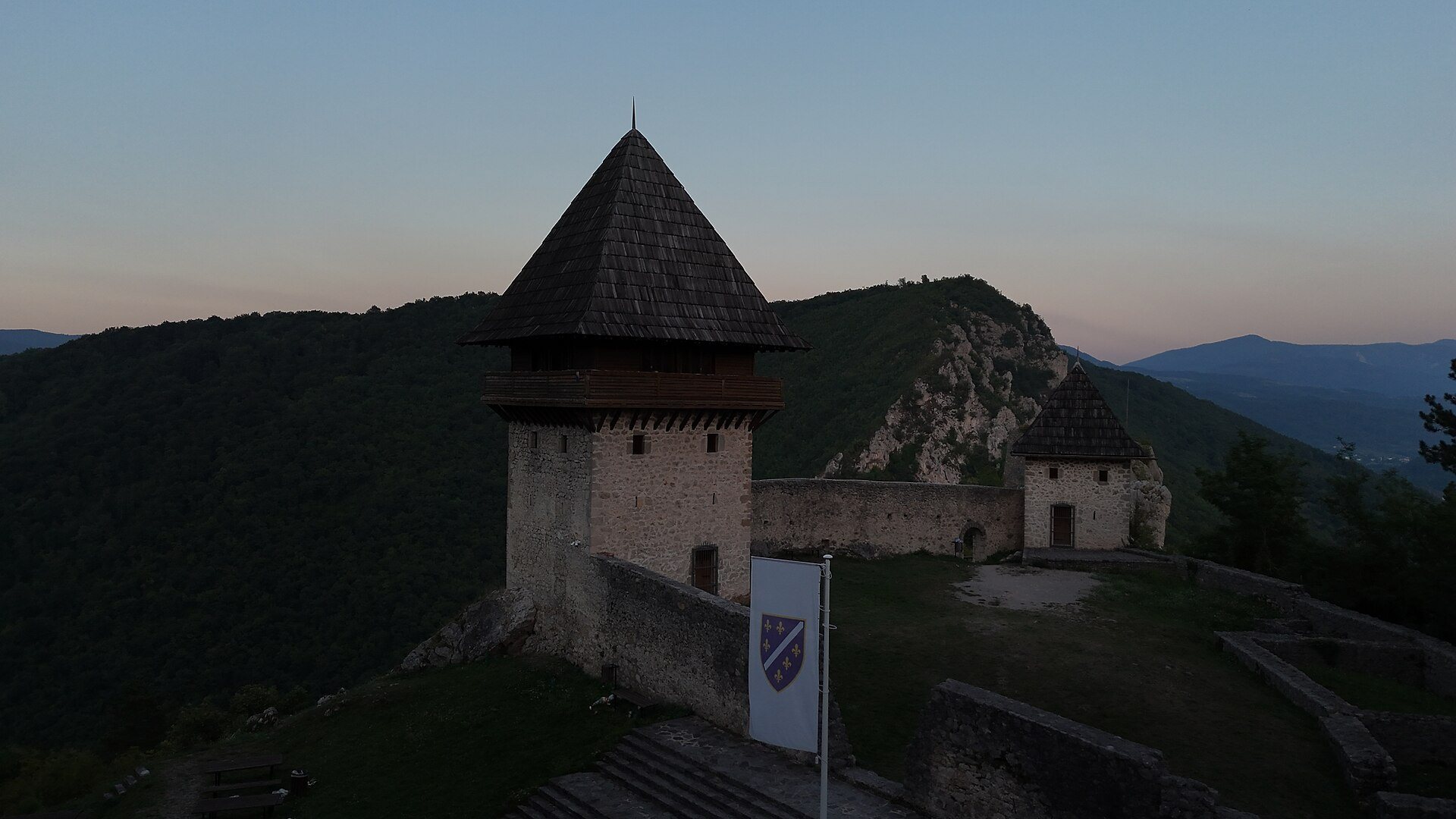
Ključ Castle occupies the extreme southwestern slope of Babe Mountain, below Rudi Hill, whose elevation is given as 1,167 metres. The fortress stands among limestone boulders, and the rocky ground provides especially strong protection along the eastern rampart of the upper town. The historic complex also includes the fortified settlement of Podključ immediately below the fortress and the Ključ Mosque, also known as the Ajnebeg-dede Mosque, the Ključ Captains’ Mosque, or Starica.
Fortress layout and walls
The fortress walls were built principally from limestone using dry-stone walling. Later reinforcement employed irregular masonry made from stones set in lime mortar, known as opus incertum, with rubble filling the spaces between the stones. The outer rampart of the upper town reaches approximately 7 metres in height and up to 3.50 metres in width, an unusual defensive dimension among medieval Bosnian towns.
The entrance doorway measures 1.70 metres high and 0.80 metres wide. The ground in front of the lower threshold was levelled, while steps above the entrance led to the guard path. Access to the main entrance of the upper town passed through a side wall measuring 2 metres and 1.40 metres. Along the route toward the dungeon are the remains of an unidentified residential building.
Towers and defensive features
The interior of the fortress encloses a courtyard approximately 51 by 19.2 metres. On the highest ridge stands the main tower, a quadrangular structure measuring 8 by 8 metres, with walls 1.80 metres thick. It has fewer openings for firearms and close-combat weapons than the northeastern defences.
South of the main entrance is a square tower identified as a dungeon and described as measuring 7 by 40 metres. Its walls range from 0.80 to 1 metre thick, and it had a supervised secret exit leading toward the lower town. Above the northeastern ramparts, cannon openings and numerous loopholes survive. The fortress is currently a ruin.
Podključ and the mosque complex
Podključ formed the fortified settlement directly beneath the upper fortress. The Ključ Mosque and its harem stand on a prominent hill in Begova Bašča, approximately 50 metres from the old town. The mosque is associated with several names, including Ajnebeg-dede Mosque, Ključ Captains’ Mosque, and Starica.
The archaeological material associated with the site includes cannons recovered from the fortress and medieval stećak tombstones from Ćućenica. Some of these tombstones and the cannons are preserved at the National Museum in Sarajevo.