Klein Kasteel, Deurne: Medieval Residence of the Lords of Deurne


Site at a Glance
- Rating
- 4.2
- Popularity
- Very Low
- Country
- Netherlands
- Primary era
- Medieval
- Eras represented
- Medieval, Early Modern, Modern
- Civilizations
- Duchy of Brabant, Dutch, Holy Roman Empire
- Site type
- Military
- Remains
- Castle
On this page12 sections
History
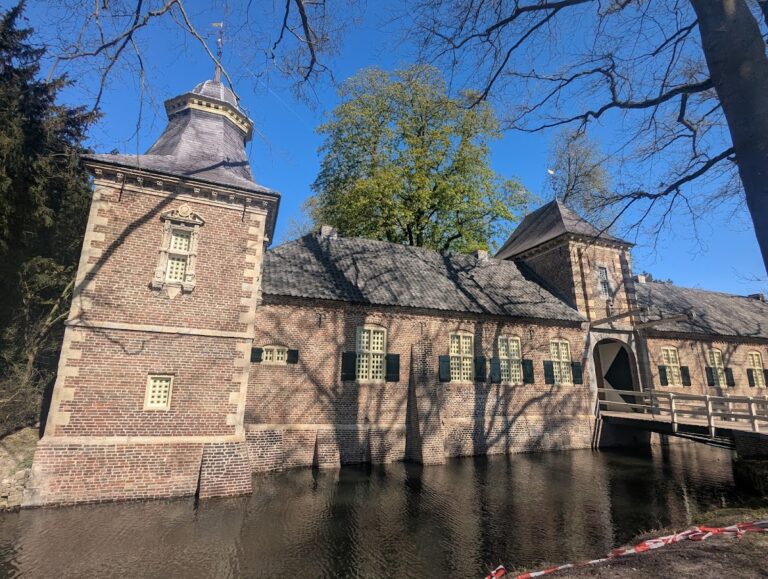
Klein Kasteel, Deurne is a fourteenth-century castle in the Netherlands, built in the valley of the Vlier as the residence of the lords of Deurne. Its oldest surviving part is a square donjon, the principal fortified tower of a medieval castle, combining defensive and residential functions. The castle stands east of Haageind and replaced an earlier residence on the Ter Vloet estate farther downstream in the Kerkeind hamlet.
Medieval lordship
The move from Ter Vloet to the Vlier valley probably took place during the second half of the fourteenth century. The square donjon had been built before 1383, and Gevaert Willemszoon van Doerne is the earliest securely identified lord of Deurne known to have lived there, probably around 1380 to 1390.
A lordship was a territorial jurisdiction held by a lord. Klein Kasteel served as the lordship’s principal residence until the beginning of the sixteenth century. In the Middle Ages it was called Oud Huis, while the names Klein Kasteel and Oud Kasteel came into use later. The Van Doerne family held the lordship until 1456, followed by the De Mol family and then the Taije family.
Klein Kasteel and the adjacent Haageind watermill were fiefs of the lords of Cranendonck until the feudal system was abolished in 1795. A fief was property held from a superior lord in return for obligations of service or loyalty. The watermill is first recorded in 1387, and another mill on the Ter Vloet estate was also attached to Cranendonck. These holdings lay among the most peripheral possessions of that superior lordship.
Transfer of the lordship
At the beginning of the sixteenth century, Everard Hendrickszoon van Doerne acquired the lordship and Klein Kasteel from the Taije family. He also owned Groot Kasteel. After his death, his eldest son inherited Groot Kasteel and the lordship, making that castle the residence of the lordship. Klein Kasteel passed to a younger son and thereafter entered a different phase of ownership.
The property subsequently belonged to various private owners and local officeholders. From the end of the eighteenth century until 1948, it was again owned by the lords of Deurne, who rented it to numerous tenants. Several military families lived there during the French period, when the Netherlands came under French political and administrative control in the late eighteenth and early nineteenth centuries.
Artists and later ownership
Otto van Rees and his wife, Adya van Rees, lived at Klein Kasteel with their family from 1923 to 1927. Both were artists, and their presence inspired Hendrik Wiegersma, a Dutch physician and painter, to take up painting.
Theodore baron de Smeth van Deurne sold the castle to Hendrik Wiegersma in 1948. Wiegersma made it available to his son Pieter, a stained-glass artist who had already lived there since 1942. Pieter later inherited the property from his father, and the northern extension became his studio.
The Nooijen brothers bought Klein Kasteel in 1999. The castle now has a representative function rather than serving as a residence. The grounds are not publicly accessible, while the building can be seen from the public road. In 2008, Deurne’s political authorities unanimously rejected plans for detached guest accommodation behind the castle on archaeological and cultural-historical grounds, although the zoning plan permitted an extension. A new proposal was prepared in 2010, but no decision had yet been taken.
Correcting a nineteenth-century tradition
During the nineteenth century, the historian Adriaan Brock identified Klein Kasteel with a supposed “Castle of Peelland,” and the geographer A.J. van der Aa adopted the claim. Later writers described the building as the gateway to a larger and more majestic castle. Archaeological, historical, and historical-geographical research has rejected this interpretation. Klein Kasteel was never called the “Castle of Peelland,” and its surviving tower was not a gatehouse.
Remains
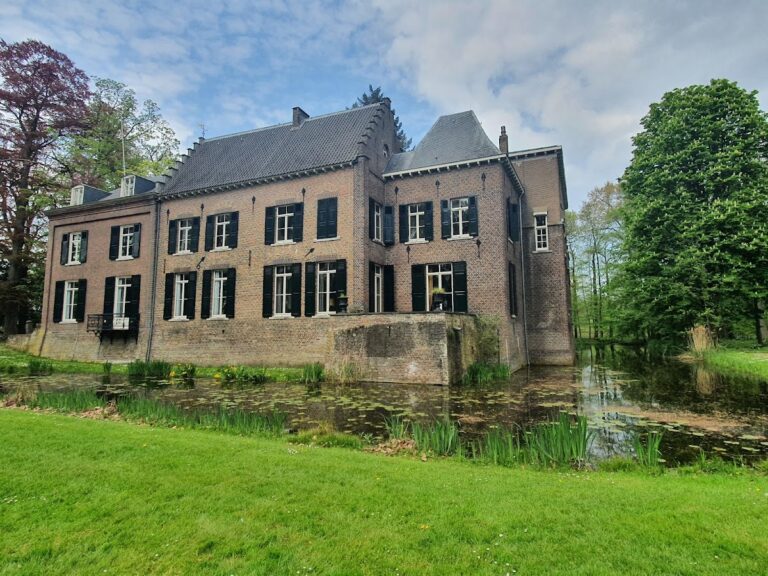
Klein Kasteel occupies the eastern side of Haageind in the Vlier valley. The present complex brings together the medieval fortified tower, a low farm extension from the seventeenth or eighteenth century, and a white manor house attached to the complex in 1857. The arrangement reflects successive changes from a medieval lordly residence to a later agricultural and residential property.
Buildings of the complex
Medieval donjon
The square donjon is the oldest surviving part of Klein Kasteel. Built before 1383, it formed the medieval core of the castle and combined living accommodation with defensive purpose. Its position in the valley of the Vlier links the tower to the former residence’s relocation from the Ter Vloet estate during the later fourteenth century.
Farm extension
A low farm extension was added to the complex during the seventeenth or eighteenth century. Before the nineteenth-century rebuilding, the property also included an old farmyard and a farm building set at right angles to the main building. These agricultural elements formed part of the arrangement that was later altered when the manor house was constructed.
White manor house
The attached white manor house was built in 1857 on the site of the former farmyard. The work demolished the old farm building and an extension connected to the medieval tower. It also changed the approach to the property. Before the rebuilding, access ran through Heerendijk, which is now the driveway to the watermill; during the 1857 alterations, the entrance was moved to the Haageind side.
Northern studio extension
The northern extension later served as Pieter Wiegersma’s studio. Its use connects the physical complex with the artistic history of the twentieth century, when the stained-glass artist lived at Klein Kasteel and worked there after the property came into his family.
Water, meadows, and surrounding landscape
A watermill was built on the Bakelse Aa north of Klein Kasteel during the same period as the medieval castle. Hay meadows extended east of the castle in the Bakelse Aa valley. In 1454, parcels in this area included Sint-Kathelijnenbeemd and Vriezenbeemd, showing how the castle was associated with a managed agricultural landscape as well as with the lordship.
A park with a pond was created in the eastern meadow area during the final decades of the twentieth century for the Heiakker neighbourhood, which had developed east of Klein Kasteel. On 24 September 1944, a fire caused some damage to the castle, but Pieter Wiegersma, then its owner, extinguished it in time.