Kirk of the Canongate: A Church of Scotland Parish Church in Edinburgh
Site at a Glance
- Rating
- 4.4
- Popularity
- Medium
- Country
- United Kingdom
- Primary era
- Early Modern
- Eras represented
- Early Modern, Modern
- Civilizations
- British, Kingdom of Scotland
- Site type
- Religious
- Remains
- Church
On this page10 sections
History
The Kirk of the Canongate (Kirk is Scots for church) is a parish church of the Church of Scotland, Scotland’s national Presbyterian church, in Edinburgh, United Kingdom. Built in the late seventeenth century, it arose after its congregation was displaced from Holyrood Abbey. Work began in 1688, and the congregation moved into the new church in 1691.
From abbey worship to a new church
After the Scottish Reformation, the sixteenth-century movement that established Protestantism in Scotland, the Canongate congregation worshipped in the nave of Holyrood Abbey. In September 1672, the Privy Council ordered the congregation to leave so the king could use the abbey as a Chapel Royal. The congregation was directed to Lady Yester’s Church until another place of worship could be built.
A further displacement followed on 28 June 1687, when James VII ordered the abbey to become a Roman Catholic chapel for the newly founded Order of the Thistle, a Scottish order of chivalry. The Privy Council then arranged for a church in the Canongate. Its construction was financed by a complex redirection of a bequest made in 1649 by Thomas Moodie of Sachtenhall. Moodie had left 20,000 merks, a Scottish monetary unit, for a church in the Grassmarket, but the money had remained unused. After Bishop of Edinburgh John Paterson secured a royal order to redirect it toward an episcopal palace and chapel, another royal letter assigned the funds to the Canongate church. The Earl of Perth presented that letter to the Privy Council on 15 May 1688. A site on the north side of the Canongate was selected, and the congregation entered the church in 1691. Its construction was estimated to have cost 34,000 merks.
The eighteenth-century parish
The church served as a focus for evangelical preaching. In 1741, George Whitefield preached there at the invitation of James Walker, the parish’s principal minister. Whitefield returned in 1748 and preached twice, accompanied by fellow preacher Ralph Erskine. During the Jacobite rising of 1745, an armed campaign led by Charles Edward Stuart in support of the Stuart claim to the British thrones, Edinburgh and the Canongate were occupied by Jacobite forces. The congregation’s governing session, its local decision-making body, could not meet as usual, and the army used the church to hold prisoners captured at the Battle of Prestonpans.
By the end of the century the congregation had outgrown the building. Two chapels of ease, subsidiary churches serving worshippers who lived at a distance from the parish church, opened in 1792: one at Leith Wynd and another at the foot of New Street. Local trade organizations supported the New Street chapel and gained the right to nominate its minister.
Changing population and church life
In the early nineteenth century, new roads diverted traffic away from the Canongate, and many residents moved to Edinburgh’s New Town. Irish Catholic migration also reshaped the parish. In a count made by minister Andrew R. Bonar, 411 families lived in the parish: 45 belonged to a Reformed communion, 70 were Roman Catholic, and 296 had no church affiliation. Bonar, appointed principal minister in 1849, helped lead a revival of liturgical practice among Scottish Presbyterians. He introduced hymn-singing and a choir at the Kirk.
At the Disruption of 1843, a major division in the Church of Scotland over church independence and patronage that led to the Free Church of Scotland, the Kirk’s minister and almost all its congregation remained in the established church. The minister and most members of the Leith Wynd chapel joined the Free Church, and that chapel closed. The New Street chapel became a church parish for religious purposes in 1867, but never received an appointed minister; it was abolished in 1884.
A fire damaged the Kirk in 1863 and probably destroyed its records, which had been organized and bound during John Lee’s ministry. When James McNair became minister in 1869, the congregation reported 500 members and 200 communicants, people who took part in Holy Communion, in a parish of 10,000. Within four years, membership had doubled and communicants had more than tripled. At the session’s request, American evangelists Ira D. Sankey and Dwight L. Moody held meetings at the church during their 1874 visit to Scotland.
In 1882, despite opposition from the Canongate session, the Old Kirk congregation established a church at the foot of St John Street, reducing the parish. That congregation moved to Pilton in 1940, after which the historic Canongate parish was restored. The Kirk’s royal patronage, under which the Crown had a right to nominate a minister, ended shortly after the Canongate ceased to be a separate burgh, a Scottish town with municipal privileges, in 1856. Royal alms for poor Highlanders, distributed at the church in summer, also ended early in Queen Victoria’s reign. The burgh council’s annual Midsummer worship at the Kirk had ceased by the early twentieth century. During George IV’s visit to Scotland, commissioners to the General Assembly, the Church of Scotland’s highest governing body, met at the church before processing to Holyroodhouse.
War, royal ties, and the modern parish
During the First World War, every available man from the Canongate enlisted, and 90 members of the congregation died. The church planned renovation for its 250th anniversary in 1938, but the Second World War delayed the work. Minister Ronald Selby Wright served as an army chaplain during the war. George MacLeod arranged for ministers and assistants from the Iona Community to serve as temporary replacements, and the community established a mainland headquarters in the Canongate manse. Forty members of the congregation died in the conflict.
In 1937, George VI gave the church a Christmas tree from Balmoral, beginning an annual royal gift. Interior renovation began in 1947, the year Queen Elizabeth, later known as the Queen Mother, and Princess Margaret made the first royal visit to the church. On 25 June 1952, Elizabeth II became the first reigning monarch to visit. She and other senior members of the royal family later worshipped there regularly.
Redevelopment from the 1950s brought changes to the Canongate. The Scottish Parliament building opened in 2004, and the University of Edinburgh expanded its presence in the area. The Kirk established student accommodation and a hall and gymnasium in the 1960s. Population decline in the 1970s brought the church close to possible closure, but the minister and congregation continued their work. The opening of the Parliament building was followed by improvement in the area. The Kirk remains an active Church of Scotland parish, including the Palace of Holyroodhouse and the Scottish Parliament; Edinburgh Castle is also within the parish, although separated from its main area. The church was once the regimental chapel of the Royal Scots and now serves the Royal Regiment of Scotland.
Remains
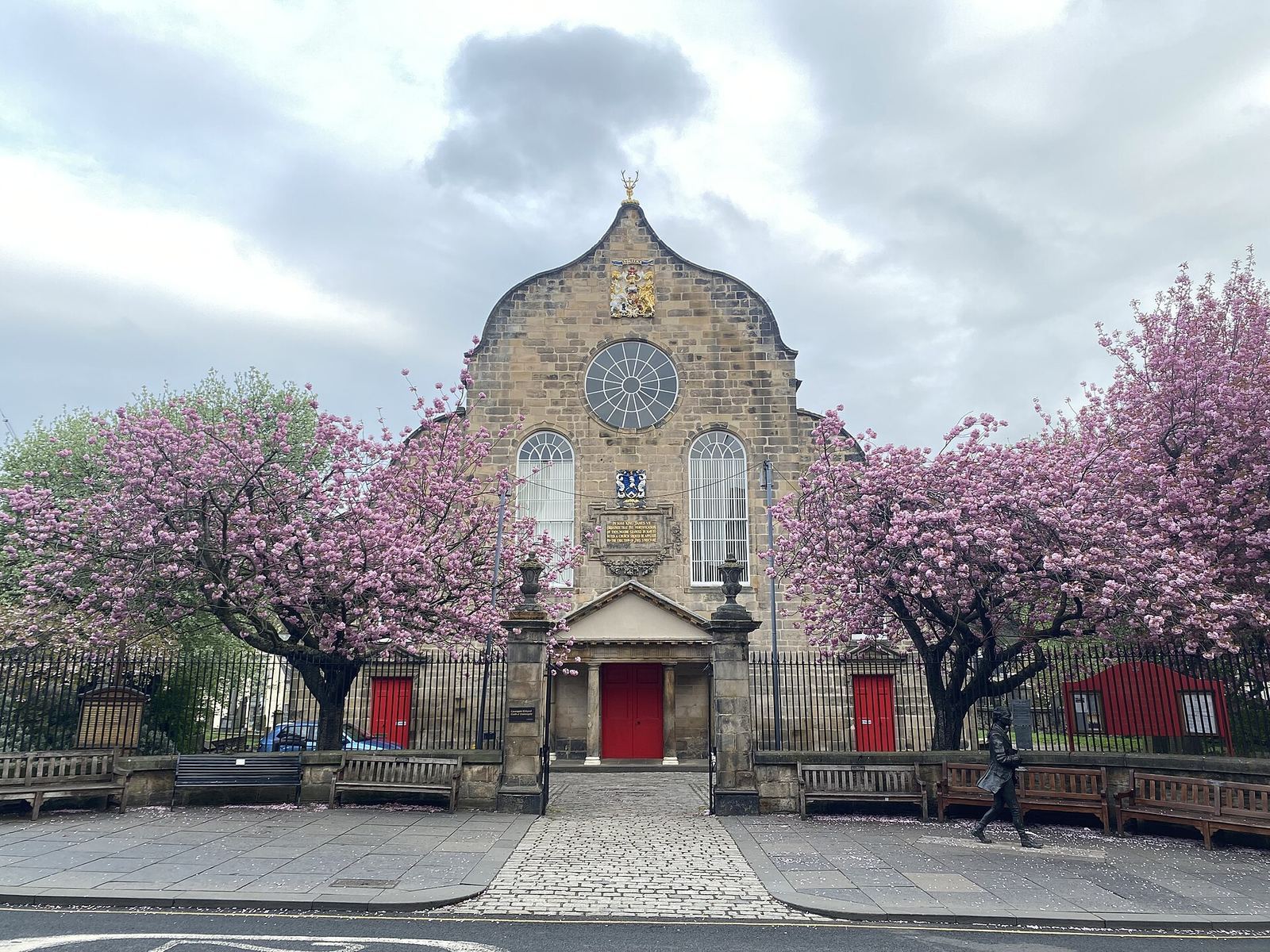
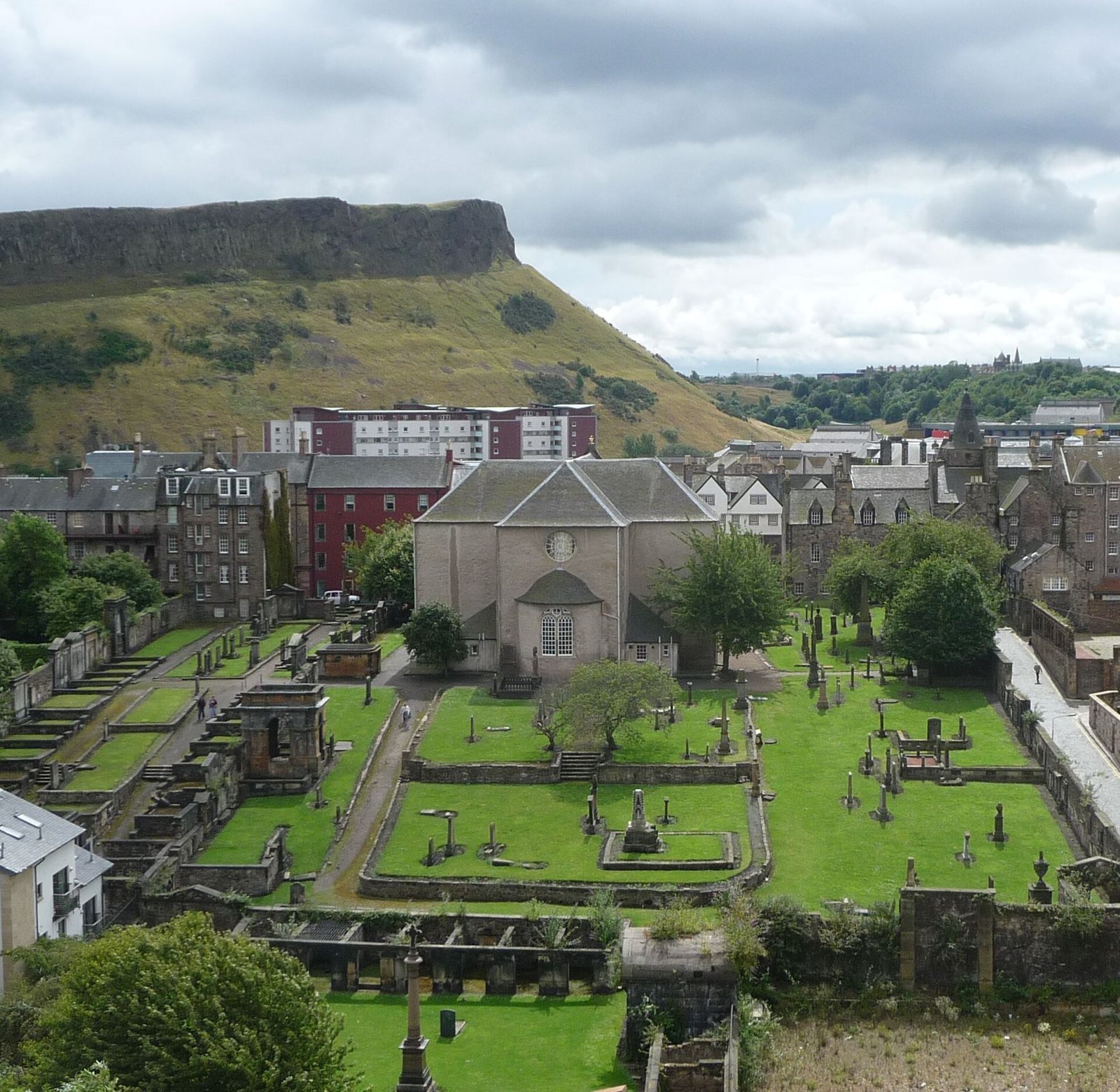
The surviving site brings together the church, its churchyard, and later parish buildings. The church has a cross-shaped interior plan and a Dutch-style exterior, with its main entrance set beneath an end gable.
Church exterior
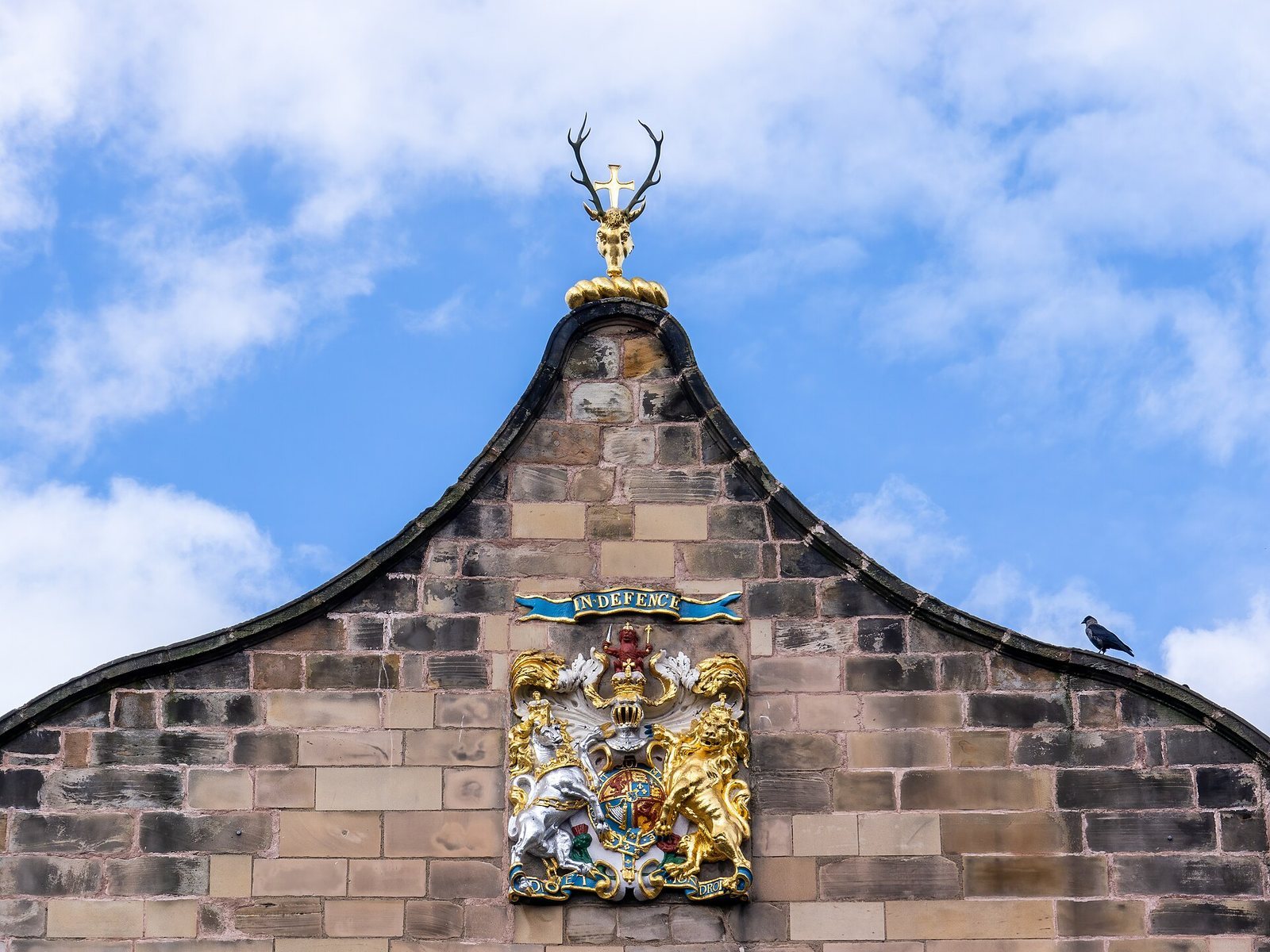
A small entrance porch supported by Doric columns, a plain classical column form, stands against the façade. The front bears the arms of Thomas Moodie. Above it, the end gable carries a golden cross within a pair of antlers, once the Canongate’s coat of arms. The emblem was first set at the roof’s peak in 1824. In 1949, the antlers were replaced by those of a stag shot at Balmoral by George VI.
Interior
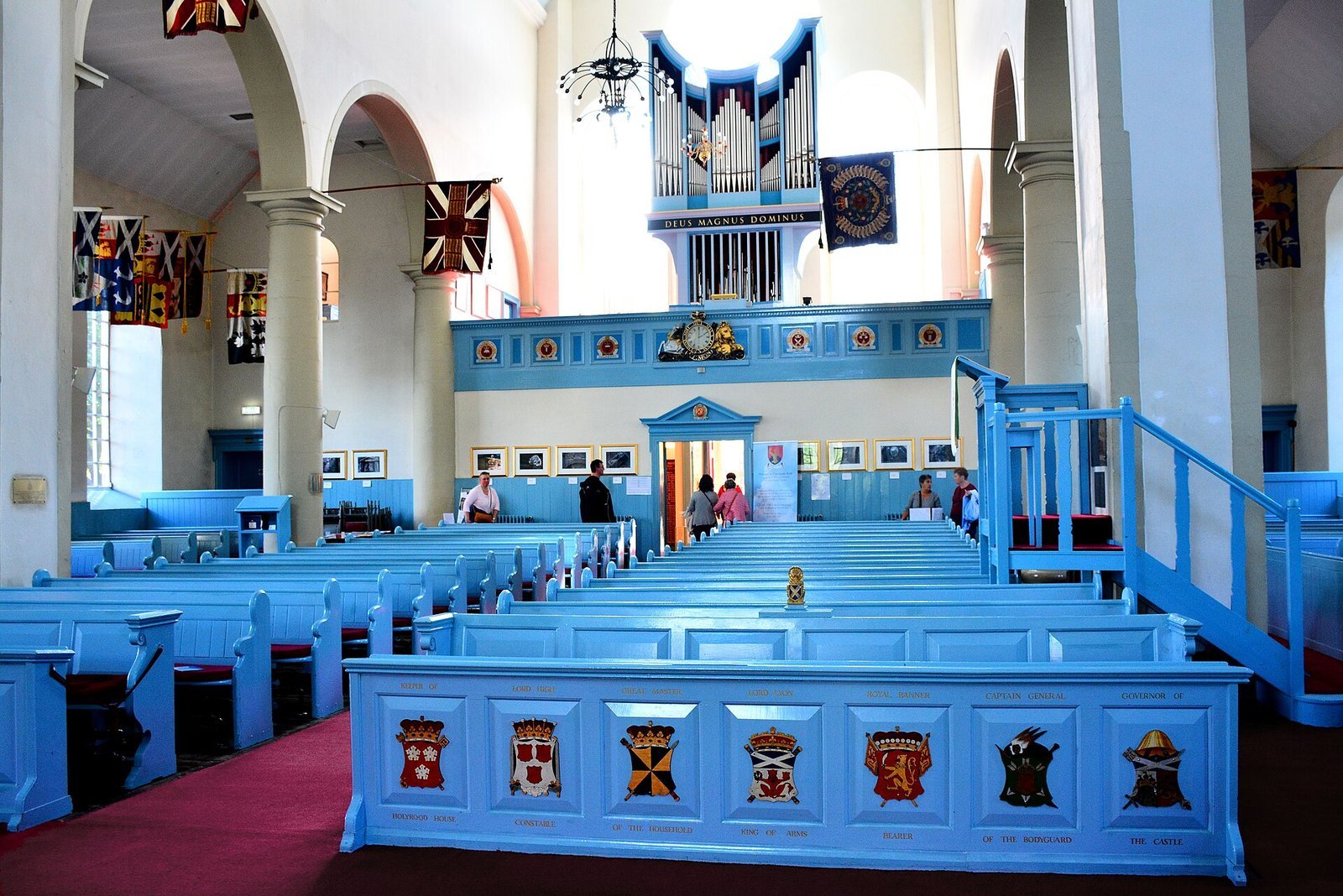
The church’s cross-shaped plan is unusual among Church of Scotland buildings from the period between the Reformation and the Victorian era. A major remodelling in 1882 introduced a central pulpit and pipe organ. The changes and the galleries were removed in the early 1950s, restoring a simpler interior and bringing more light into the church. The building underwent another restoration in 1991. A Danish-built Frobenius pipe organ was installed in 1998 in memory of Ronald Selby Wright; it was the company’s thousandth organ. A Royal Pew and a Castle Pew occupy the front row.
Churchyard and sculpture
The Canongate Churchyard contains the graves of economist Adam Smith, philosopher Dugald Stewart, Agnes Maclehose, poet Robert Fergusson, and Bishop James Ramsay. A local tradition also places David Rizzio, the Italian-born secretary to Mary, Queen of Scots, who was murdered in 1566, among those buried there. Outside the church gate stands a bronze statue of Fergusson by sculptor David Annand.
Associated buildings
Russell House provides student accommodation. Nearby Harry Younger Hall serves as a hall and gymnasium.