Basilica of St. Martin, Tours: A Shrine Built over the Tomb of Martin of Tours


Site at a Glance
- Rating
- 4.6
- Popularity
- Medium
- Country
- France
- Primary era
- Modern
- External website
- Open
- Eras represented
- Classical, Medieval, Early Modern, Modern
- Civilizations
- French, Roman
- Site type
- Religious
- Remains
- Basilica
On this page22 sections
History
The Basilica of St. Martin, Tours, is a Catholic church in France built over the tomb of Martin of Tours, a fourth-century Christian bishop and major saint of Gaul. The present building was constructed between 1886 and 1902 in a Romanesque-Byzantine style, continuing the religious importance of a sanctuary that had drawn pilgrims since late antiquity.
Martin’s burial and the first sanctuary
Martin died at Candes in 397. His body was taken to Tours and buried on 11 November in a Christian cemetery outside the city, beside the Roman road leading west. The burial place soon became the focus of religious devotion. Gregory of Tours associated the earliest shelter with Bishop Brice, who built a wooden structure over the tomb in 437 to protect both the grave and Martin’s cloak.
Bishop Perpetuus later replaced this shelter with a basilica, dedicated around 470. The church became a major Christian pilgrimage destination. In 813, the Council of Chalon gave the pilgrimage the same importance as that of Rome, and the sanctuary later became an important station on the Via Turonensis, the route to Santiago de Compostela.
The first basilica was served by a religious community led by an abbot. Its members practiced laus perennis, or “perpetual praise,” a system of continuous liturgical prayer maintained by groups taking turns. The institution’s wealth and position were closely connected with the pilgrims who visited Martin’s tomb.
From monastery to collegiate church
During the eighth and ninth centuries, the community resisted the imposition of the Benedictine Rule, the monastic code associated with Benedict of Nursia. In 791, a Benedictine establishment was founded at Cormery for those who wished to follow the rule. It was established under Ithier of Saint-Martin and later associated with Alcuin, an Anglo-Saxon scholar and adviser to Charlemagne who served as abbot of Saint-Martin from 796 to 804.
The Council of Aachen in 817 required communities that called themselves monasteries to adopt the Benedictine Rule. The clergy of Saint-Martin responded by taking the status of canons, members of a religious community serving a church rather than monks living under a monastic rule. The sanctuary thereafter functioned as a collegiate church, although its head continued to use the title of abbot.
From 844, the abbacy was held by laymen, meaning that non-monastic rulers or aristocrats controlled the office. It was associated successively with Louis II the Stammerer, Robert the Strong, and the Robertian and Capetian royal families. French kings held the lay abbacy from Hugh Capet until 1789. The abbey also served the Robertians, the Frankish dynasty before the Capetians, as an administrative center for their possessions.
Royal associations and medieval rebuilding
The sanctuary also entered the political history of the Frankish kingdom. In 508, after Clovis I defeated the Visigoths at Vouillé, envoys of Anastasius I, the Byzantine emperor, presented Clovis with the insignia of consul at the church of Saint-Martin. Clovis then travelled on horseback from the basilica to Tours Cathedral and distributed money to the people.
The church suffered a major fire in 558. The Normans burned it on 8 November 853 and again on 30 June 903. After the second attack, the sanctuary was enclosed within a fortified wall separate from the walls of Tours. This enclosure was completed in 918 and protected a settlement that had grown around the church.
An accidental fire in 994 led to another reconstruction under Hervé de Buzançais, treasurer of Saint-Martin. The rebuilt church was consecrated in 1014. A further disaster in 1096 was followed by a major Romanesque rebuilding, which created the principal medieval form of the basilica.
Between about 1175 and 1180, the church underwent a major re-vaulting campaign. Its original barrel vaults were replaced by Angevin rib vaults, ribbed vaults with strongly domed compartments associated with the medieval architectural tradition of Anjou. Later medieval works enlarged and rebuilt the choir and added lateral chapels between the thirteenth and fifteenth centuries.
The settlement around the sanctuary was known as Châteauneuf and sometimes as Martinopolis. It remained distinct from Tours until 1356, when the two settlements were joined within a single enclosure. Louis XI strongly supported the basilica in the fifteenth century, and his funeral took place there on 2 September 1483.
Later medieval decline and destruction
The cloister was partly rebuilt between 1508 and 1519 by Bastien François, a sculptor trained by Michel Colombe, but the work was never completed. During the Wars of Religion, a series of sixteenth-century conflicts in France between Catholics and Protestants, Protestants burned the reliquary of Saint Martin in 1562. Only part of the skull and one arm bone were preserved, while other relics survived elsewhere.
The medieval basilica deteriorated during a prolonged period of inadequate maintenance. In 1793, it was converted into a stable. After structural ironwork had partly been removed, the ambulatory vaults collapsed in November 1797. The municipality ordered the complete demolition of the building as a safety measure, and the demolition was finished in 1803. The church’s monumental organ also disappeared during this period.
The tombs of the children of Charles VIII, placed in the basilica in the early sixteenth century, were transferred to Tours Cathedral in 1834, where they remain visible.
Rediscovery and reconstruction
The surviving medieval remains received protection in stages. The Clock Tower was included in the 1840 designation, the cloister gallery in 1862, the surviving wall was registered in 1946, and the Charlemagne Tower was designated in 1958. Later inventories and designations confirmed or extended these protections.
Léon Papin Dupont, assisted by Pèdre Moisant and Stanislas Ratel, announced the rediscovery of Martin’s tomb on 14 December 1860. The discovery revived devotion to Saint Martin and encouraged plans for a new basilica. A proposal by Alphonse Baillargé led to a dispute over whether the new church should reproduce the former basilica’s position and dimensions, which would have required removing the Rue des Halles.
A compromise reached in 1884 between the municipality and the archbishopric established a smaller church set perpendicular to the medieval building. It would share only the area of the former eastern end above Martin’s tomb. Construction began in 1886 under Victor Laloux. The crypt containing the tomb was inaugurated in 1889, the church in 1890, and the main masonry was completed in 1902. The building opened for worship in 1903.
Cardinal Louis-Joseph Maurin consecrated the church as a basilica on 4 July 1925, and the forecourt was completed in 1928. The basilica belongs to the Catholic Archdiocese of Tours. The President of the French Republic holds the honorary title of canon of the basilica.
Archaeology and modern conservation
Excavations led by Charles Lelong in the 1970s established that the Romanesque basilica lay nearly three metres below the present ground level. They also clarified the survival of substantial medieval foundations and pillars beneath the Rue des Halles and adjoining houses.
In the 1920s, Canon Rutard, a diocesan priest, founded Les Petits Clercs de Saint-Martin de Tours. Its resident seminarians provided daily religious service at the basilica and studied there before attending schools in Tours. The institution supplied about 300 priests to the Diocese of Tours and remained near the basilica until the 1970s.
A public restoration campaign for the basilica and its dome statue began in 2015. The statue was restored and returned to the dome on 15 October 2016. In March 2025, a memorial plaque honoring victims of Bernard Tartu and, more generally, victims of sexual abuse in the Church was installed in the basilica.
Remains
The present basilica is substantially smaller than its medieval predecessor and is oriented north-south, perpendicular to the former church. Designed by Victor Laloux in a Romanesque-Byzantine or Neo-Byzantine style, it is built from limestone, granite, and marble, with a slate roof. A large nave is flanked by two smaller aisles, while the dome rises approximately 51 metres above the building.
The dome and façade
Saint Martin on the dome
A monumental bronze statue of Saint Martin stands at the summit of the dome. Jean-Baptiste Hugues designed it, Victor Thiébaut cast it, and it was delivered in 1889. The statue is more than four metres high and weighs approximately 1.6 tonnes. It represents Martin blessing the city and is supported by a steel structure.
Winter storms weakened the statue and created a risk of falling, so it was removed on 17 February 2014. A lead box found in its right arm contained a bone attributed to Martin, placed there in 1889, together with relics attributed to Bishops Brice, Perpetuus, and Gregory of Tours. The restored statue retained its patinated bronze surface rather than being entirely gilded. Its pallium, a broad ecclesiastical mantle, crown, and crozier, a bishop’s pastoral staff, were gilded before its return to the dome in October 2016.
Portal and decoration
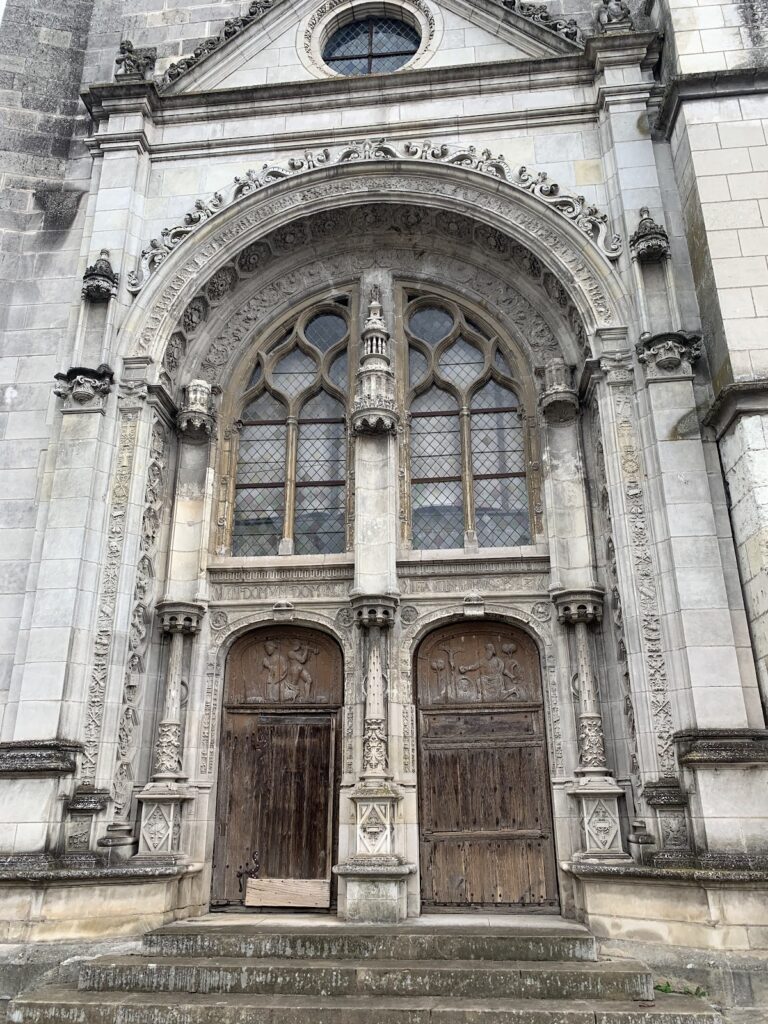
The main portal has a tympanum, the decorated field above the entrance, bearing a Latin inscription translated as “The city of Tours rejoices forever in having Martin as its patron.” The wording is attributed to Paulinus of Périgueux. Carved capitals decorate the façade, which also includes Henri Varenne’s representation of the Charity of Saint Martin.
Pierre Fritel was engaged for the mural paintings, and the decorative work was carried out with the assistance of the painter and decorator Adrien Lavieille.
Crypts and the tomb
Principal crypt
The principal crypt contains the reconstructed tomb of Saint Martin. The tomb is empty apart from a small number of relics and prayer intentions left by worshippers. Two stairways lead down to the crypt, which preserves the central physical focus of the modern basilica.
Secondary crypts
A second crypt near the tomb contains the ruins of an apsidiole, or small apse, from the earlier basilica. It also includes an altar dedicated to Gregory of Tours and a former archaeological museum. Another crypt near the entrance is dedicated to Saint Louis and Pope Urban II and is decorated with a fresco by Robert Lanz.
A gemmail, a decorative image assembled from colored glass elements, entitled “The Kiss of the Leper” was installed in the crypt in 1988.
Surviving medieval complex
Former basilica
The medieval basilica had a sarcophagus behind the high altar containing Martin’s body. A large marble block donated by Bishop Euphronius of Autun marked the tomb. It could be seen from the apse through a small opening in the apse wall. The atrium, an entrance or forecourt associated with a church, was unusually placed behind the building on the apse side.
After the fires of the eleventh century, the church was rebuilt in Romanesque form. Later medieval alterations included the Angevin rib vaults, a choir modeled on Bourges Cathedral, seven chapels added along the north side between 1340 and 1435, and two chapels added along the south side between 1463 and 1478.
Renaissance cloister
The Renaissance cloister stood along the south side of the medieval basilica. Only the ground floor of its eastern wing was completed. Its Gothic structure incorporated Italianate ornament, coffers, and antique-style medallions. Part of the cloister gallery survives.
Towers and chapel
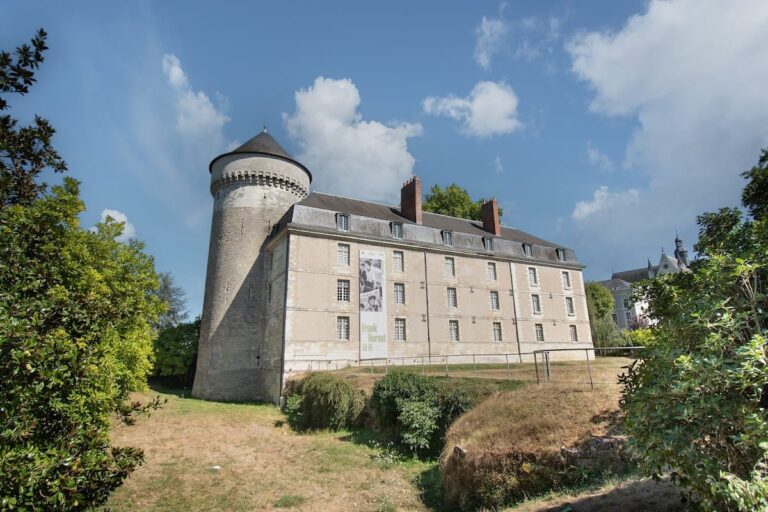
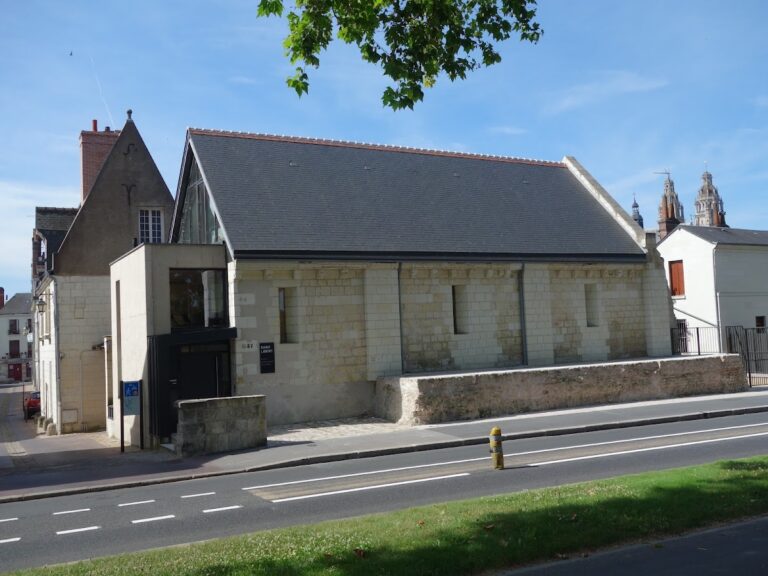
The surviving medieval complex includes the Charlemagne Tower, the Clock Tower, part of the Renaissance cloister gallery, the canon houses, and the Chapel of Saint John. The Charlemagne Tower partly collapsed in 1928. It was stabilized with a concrete framework and restored and reconstructed in 1963 by Bernard Vitry.
At the junction of the Rue des Halles and Rue des Trois Pavés Ronds, the lower Chapel of Saint Nicholas survives approximately four metres below ground. It was formerly beneath the old tower.
Foundations beneath the streets
Foundations and pillars of the Romanesque basilica survive nearly three metres below the Rue des Halles and the houses along it. The positions of the original nave pillars can be traced through paving in the street, while the surviving underground masonry preserves the scale and structure of the earlier church.
Organs and manuscript culture
Organ
The former basilica possessed an organ built by Jean-Baptiste Nicolas Lefevre. It had five keyboards and double 32-foot stops, but disappeared during the revolutionary demolition. The present organ was built in 1843 for the Bon Sauveur hospital in Caen and retains an eighteenth-century case. The city of Tours bought it in 1956. It has two manuals, a pedalboard, 17 stops, and more than 1,800 pipes. Michel Alcouffe restored and modified it in 1977. Joseph Thouvenot served as titular organist for more than fifty years, followed by Philippe Bataille.
Carolingian scriptorium
The former abbey’s important Carolingian scriptorium, a monastic or collegiate writing workshop, produced illuminated manuscripts and helped develop the Tours form of Carolingian minuscule, a highly legible manuscript script of the Carolingian period.
Works associated with this manuscript tradition include the Gospels of Saint-Martin of Tours, the Bible of Vivien, the Gospels of Lothair, the Gospels of Meaux, the Gospels of Du Fay, the Gospels associated with Charles IX, two manuscripts or fragments dating to about 820, and a Bible dating to about 796 to 801. Other associated works include the Bible of Saint-Maur-des-Fossés, also called the Bible of Rorigon, the homiliary associated with Paul the Deacon, the Martinellus, Augustine’s De Doctrina Christiana, the Gospels of Hildegard, other ninth-century Gospels, and Gregory of Elvira’s commentaries.
Nearby sites