Kilnaruane Pillar Stone: Shaft of an Early Medieval High Cross
Site at a Glance
- Popularity
- Low
- Country
- Ireland
- Primary era
- Medieval
- Eras represented
- Medieval
- Civilizations
- Unclassified
- Site type
- Religious
On this page8 sections
History
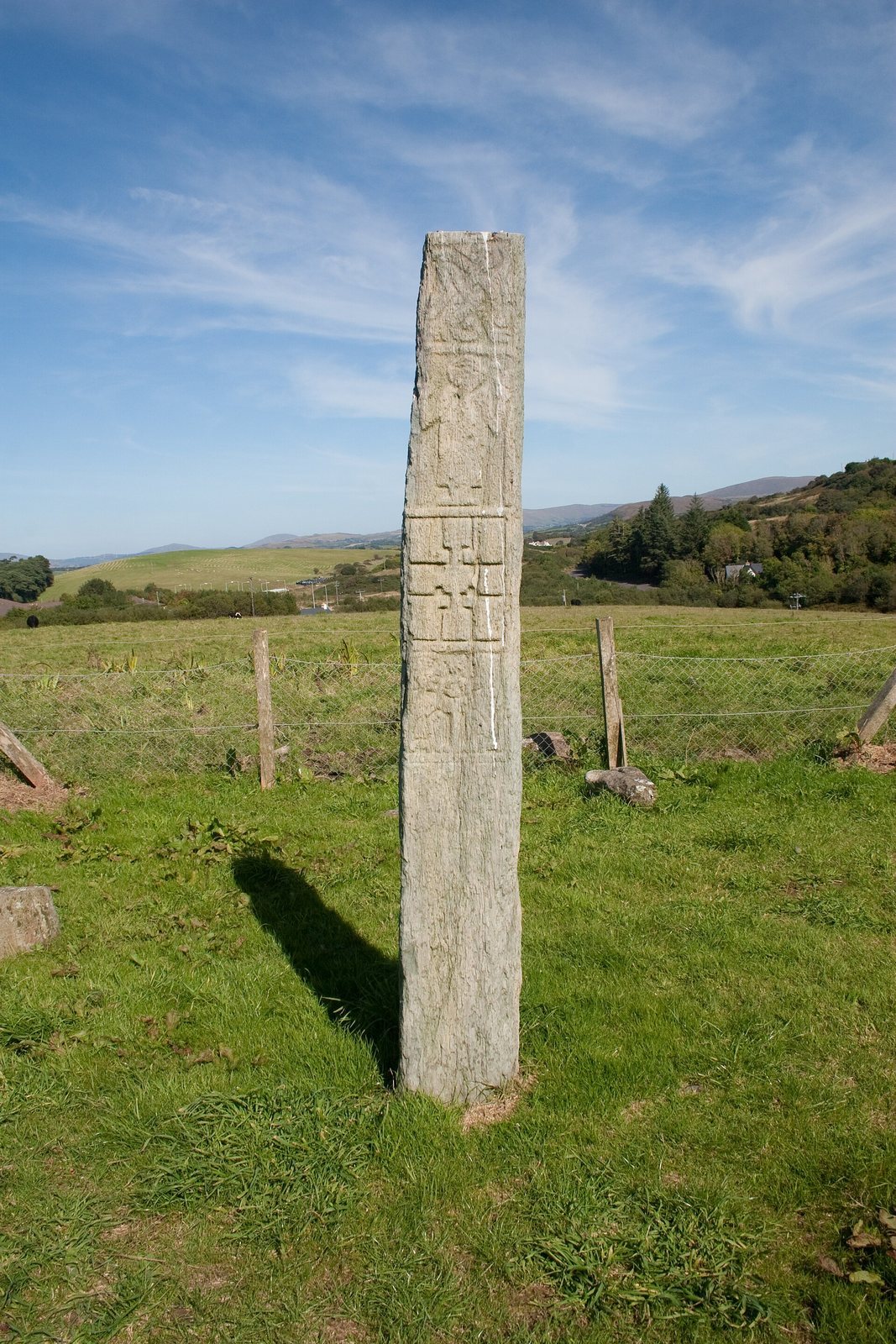
The Kilnaruane Pillar Stone is the surviving shaft of an eighth- or ninth-century high cross at Kilnaruane near Bantry, Ireland. It is also called Bantry Pillar Stone and St Brendan’s Stone, and is a National Monument of Ireland.
Early monastic tradition
A monastery may have been established here in the sixth century by Brendan, an early Irish monastic saint. The settlement may later have been destroyed in a Viking attack.
Cross and religious identity
The place-name may mean “Church of the Romans” and has been associated with a community that followed the Roman method of calculating Easter. The choice of Easter date was disputed in parts of the early medieval church.
Remains
The pillar stands within a square early ecclesiastical enclosure in a field on a drumlin, a rounded hill shaped by glacial movement, about 1.6 km southwest of Bantry near Cappanoloha. The thin schist shaft is approximately 2.1 m high, 0.26 m wide, and 0.15 m thick.
Carved faces
Northeast face
Four panels divide this face. At the top are two inlaid knot patterns, followed by a praying figure and a cross. The heavily weathered lowest panel has been interpreted as showing Paul of Thebes and Anthony with bread at an altar table, or as depicting the two saints meeting in the desert while a raven brings them a loaf. Paul and Anthony were early Christian ascetics whose desert traditions became important to monasticism.
Southwest face
This face has three panels. Part of an inlaid spiral survives in the upper one; the middle shows two pairs of four-legged animals, described as sheep or goats with interlocked horns. These paired animals are now a symbol of the Sheep’s Head peninsula. The lower panel depicts a boat with four oarsmen and a fifth figure at the stern, among crosses. The boat has been identified as a currach (a small traditional Irish boat), while the figure steering it may be Brendan or Cessair, a figure in medieval Irish legend.
Other stones and nearby features
Two bullauns (hollows worn or carved into stone) lie near the pillar; such features are often associated with religious sites. Nearby stone fragments may be parts of a bullaun or the arms of the high cross. Four nearby boulders have deep grooves and may have served as hinges or cornerstones in a structure. Stone rows are also found at Scartbaun, Keilnascarta, and Parkana.