Killaloe Cathedral: A Medieval Church of Ireland Cathedral in Ireland


Site at a Glance
- Rating
- 4.5
- Popularity
- Very Low
- Country
- Ireland
- Primary era
- Medieval
- Eras represented
- Medieval, Modern
- Civilizations
- British, Irish
- Site type
- Religious
- Remains
- Cathedral
On this page12 sections
History
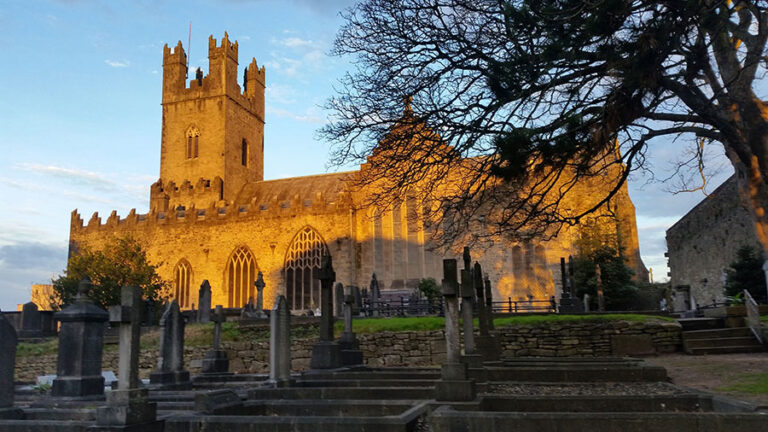
Killaloe Cathedral, also called St Flannan’s Cathedral, is a Church of Ireland cathedral in Killaloe, Ireland. Its present building was constructed between the late twelfth and early thirteenth centuries during the transition from Romanesque to Gothic architecture. Dedicated to Saint Flannan, it stands within a bishopric whose origins reach back to the eleventh century and whose history is closely connected with the rulers of medieval Munster.
The medieval bishopric
Killaloe became a bishop’s see, the territory governed by a bishop, in the eleventh century. Domnall Ua hÉnna is identified as its first bishop. The establishment of the see was promoted by the Munster kings Toirrdelbach Ua Briain and Muirchertach Ua Briain, descendants of Brian Boru, who was born at Killaloe. In 1111, the Synod of Rathbreasail, a formal church council, confirmed the bishopric and assigned it to the newly created Archdiocese of Cashel. Maol Muire Ua Dunáin, previously regarded as the second bishop of Killaloe, became Cashel’s first archbishop.
Between 1192 and 1195, the diocese absorbed the former sees of Iniscathy and Roscrea. This expansion probably increased its revenues and helped make a new cathedral possible. In 1185, Cathal Carragh burned all the churches and houses at Killaloe. A cathedral is also associated with Domnall Mor O’Brien’s victory over the Anglo-Normans in the same year. That building was later destroyed and rebuilt in the fourteenth century.
Construction and ecclesiastical change
The present cathedral developed in stages. The choir was built first, around 1200, followed by the transepts and then the nave. Construction was completed in 1225. Prince John, the future King John of England, stayed at Killaloe in 1197, and Robert Travers became the first Englishman to hold the bishopric in 1217. English influence may help explain the building’s close alignment with contemporary English church architecture.
Killaloe remained the cathedral of the Diocese of Killaloe for centuries. The see was united with Kilfenora in 1752, with Clonfert and Kilmacduagh in 1834, and with Limerick, Ardfert, and Aghadoe in 1976. The cathedral retained its status and is now part of the Diocese of Tuam, Limerick and Killaloe. It was formerly Roman Catholic, but since the Reformation it has belonged to the Church of Ireland rather than the Catholic Church.
During the Elizabethan period, Ennis became the principal town of County Clare, contributing to Killaloe’s decline in importance. The cathedral is now designated a National Monument, a legally protected Irish heritage site of historical or archaeological importance. A restoration project completed in 2001 repaired the Romanesque doorway and reconstructed and re-erected a twelfth-century high cross that had fallen against the cathedral walls in the 1930s.
Remains
The cathedral building
Cruciform plan and medieval fabric
Killaloe Cathedral has a cruciform plan formed by a nave, choir, and transepts, the arms that cross the main body of a church. It has no side aisles or attached buildings, and a tower rises over the crossing, the central junction of the church’s arms. The front carries arabesque ornament. At the southwest corner of the later nave, builders incorporated the Romanesque doorway of an earlier church. Its round-arched form belongs to the Romanesque tradition, while the cathedral as a whole reflects the transition toward Gothic architecture.
Choir and transepts
The choir belongs to the earliest phase of the present cathedral, dating to around 1200. Its large east window has notable similarities to the east window at Kilfenora Cathedral. This resemblance led Leask to suggest that the two buildings may have shared a master builder. The north transept was renewed during the later Middle Ages and enclosed by a wall, leaving access through a single doorway. Repairs took place over subsequent centuries, but the cathedral’s basic structure has remained unchanged.
Central tower and bells
The central tower was raised in two later stages. Bishop William Knox ordered an addition of 4.5 metres in 1795, and a further 1.5 metres was added in 1892 to accommodate church bells. The tower now reaches 24.3 metres. Its bell tower contains eight bells cast by Matthew O’Byrne of Dublin in 1896, with the heaviest weighing slightly more than 500 kilograms.
Earlier religious features and carved monuments
Oratory of Saint Molua
On the north side of the cathedral stands a small oratory or chapel measuring approximately 8.78 by 5.33 metres. It predates the present cathedral and may have been the original sanctuary of the holy man associated with the foundation of the abbey. Saint Molua was an early Irish Christian saint linked with Killaloe. His oratory was built between 1000 and 1150 and originally stood on Friar Island, opposite the town. It was moved during construction of the Ardnacrusha dam in the 1920s.
The oratory has a very deep, high roof built entirely of stone, together with a belfry and doorways on its eastern and western sides. Its survival provides a physical connection between the earlier religious settlement and the later cathedral complex.
Kilfenora Cross
The Kilfenora Cross is a twelfth-century high cross, a monumental Irish stone cross, approximately 3.5 metres tall. It was embedded in the cathedral walls in the 1930s after falling against them. The 2001 restoration made it freestanding and placed it in the nave, where its carved stone form can be seen as an independent monument within the building.
Ogham stone and earlier cathedral elements
The cathedral contains the Killaloe Ogham stone. Ogham is an early medieval script made from groups of lines cut along the edge of a stone. Other surviving elements associated with the earlier cathedral include a Romanesque arch and decorated baptismal fonts, preserving material from the site’s earlier ecclesiastical phases.
Nearby sites