Ki Castle: A Seventh-Century Yamato Mountain Fortress in Japan


Site at a Glance
- Rating
- 4.2
- Popularity
- Medium
- Country
- Japan
- Primary era
- Classical
- External website
- Open
- Eras represented
- Classical
- Civilizations
- Yamato
- Site type
- Military
- Remains
- Fort
On this page9 sections
History
Ki Castle is a mountain fortress in Japan, located near Soja in Okayama Prefecture, built by the Yamato court in the latter half of the seventh century in the kōgoishi tradition of ancient stone-and-earth fortifications. Its exact construction date is unknown, while archaeological evidence places its operation from around the late seventh century to the beginning of the eighth century. A construction date as early as 667 has also been proposed. From its position on Mount Kijōyama, the fortress overlooked the Seto Inland Sea, the principal route for international exchange, trade, and potential invasion.
Defensive construction after Hakusukinoe
The fortress emerged during a period of heightened concern in the Yamato state, the early Japanese imperial government that was consolidating authority across much of the archipelago. In 663, the combined forces of Baekje, a Korean kingdom, and Yamato were defeated at the Battle of Hakusukinoe by the allied forces of Silla and Tang China. Silla was a Korean kingdom, while Tang was the Chinese dynasty that supported it. Emperor Tenji, a seventh-century ruler associated with military and administrative reforms, then ordered extensive defensive construction in response to the perceived danger of invasion.
The Nihonshoki, an early Japanese historical chronicle compiled in the eighth century, lists twelve Korean-style mountain fortifications in western Japan. Ki Castle is considered one possible example of this network, although the identification remains debated. Its strategic position gave it a place within the wider defensive landscape, and contemporary fortifications on Shikoku, including Yashima Castle and Kiyama Castle, were within sight of it.
Abandonment and religious reuse
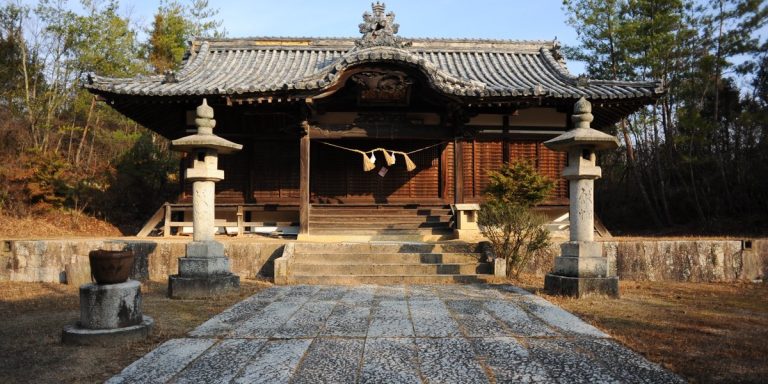
Ki Castle was occupied during the Asuka and early Nara periods, but it appears to have functioned as a fortress for only a relatively short time. After its military use ended, a Buddhist temple was established in the summit area. Religious activity continued there from the Asuka period into the Heian period, creating a later phase of use that is reflected in the Buddhist materials recovered around the building foundations.
Name and legend
The name Ki Castle literally means “demon castle.” Local tradition tells of a demon named Onra or Ura who ruled Kibi Province from the mountain and was defeated by Kibitsuhiko-no-mikoto, the legendary figure associated with the Momotarō folklore tradition. Momotarō is a widely known Japanese hero whose story centers on a campaign against demons. Another explanation links ki to an ancient Baekje word meaning “castle,” after which the character meaning “demon” was assigned.
Archaeology and protection
The first full-scale archaeological survey began in 1978. Government officials formally examined the site in 1999, followed by excavation, research, restoration, and reconstruction that took the surrounding natural environment into account. Portions of the fortress were reconstructed in the early 2000s, including work completed in 2004. The ruins have been protected as a National Historic Site of Japan since 1986, and Ki Castle was included among Japan’s Top 100 Castles in 2006.
Remains
Ki Castle occupies the summit of Mount Kijōyama at the southern end of the Kibi Plateau, near the center of the former Kibi Province, a historical region corresponding broadly to present-day Okayama Prefecture. Stone walls and earthen ramparts form a combined circuit around approximately 30 hectares. The circuit measures about 2.8 kilometers and follows the mountain’s natural topography, with the elevation, trees, and remaining foliage contributing to the defensive system.
Walls, gates, and water controls
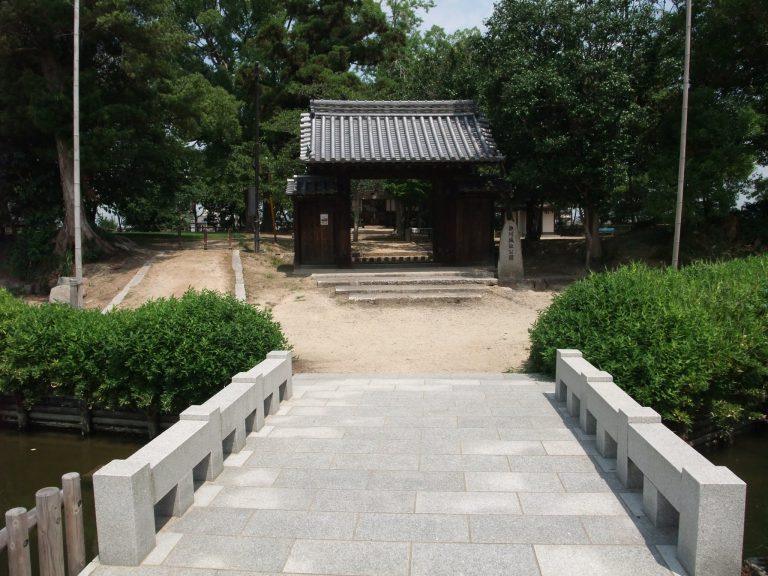
More than 80 percent of the circuit consists of rammed-earth ramparts approximately 7 meters wide and 6 to 7 meters high. Paving stones about 1.5 meters wide line both the inner and outer sides of the wall base. Two projecting sections on the front of the defenses were built with stone walls. Four gates, positioned on the east, south, west, and north sides, controlled movement through the circuit. The west gate was the principal entrance and was protected by a corner tower, while the north gate stood on the rear side of the fortress. The reconstructed Nishimon, or Western Gate, represents part of this restored defensive complex.
Six water-control gates were incorporated into the defenses. Four sluice gates used stone walls extending 2 to 3 meters below the castle walls to create water inlets, with earthen embankments covering the channels. Two additional percolation gates allowed water to pass naturally between the stone walls. Embankment-like remains in two valleys helped protect the fortifications from debris flows and running water while also securing the water supply.
Approach defenses and summit facilities
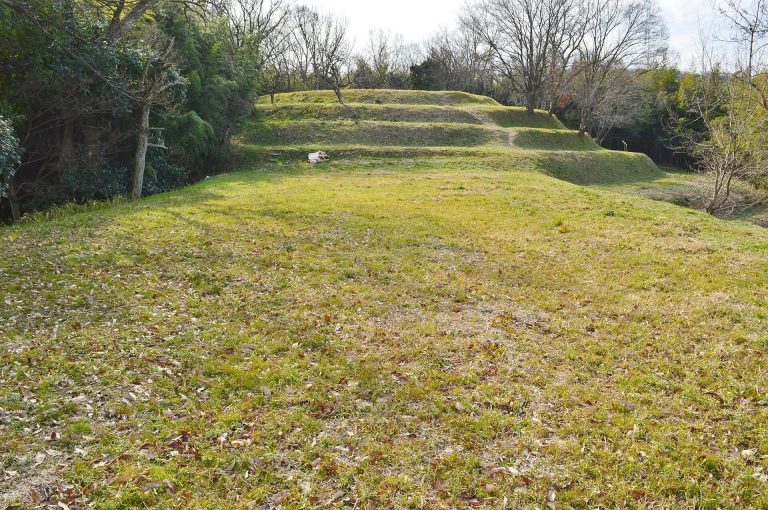
A secondary earthen fortification is believed to have protected the approach road at the southern foot of the mountain. In a rural area where low hills extend north and south, it survives as a mound about 300 meters long, approximately 3 meters high, and about 21 meters wide at its base.
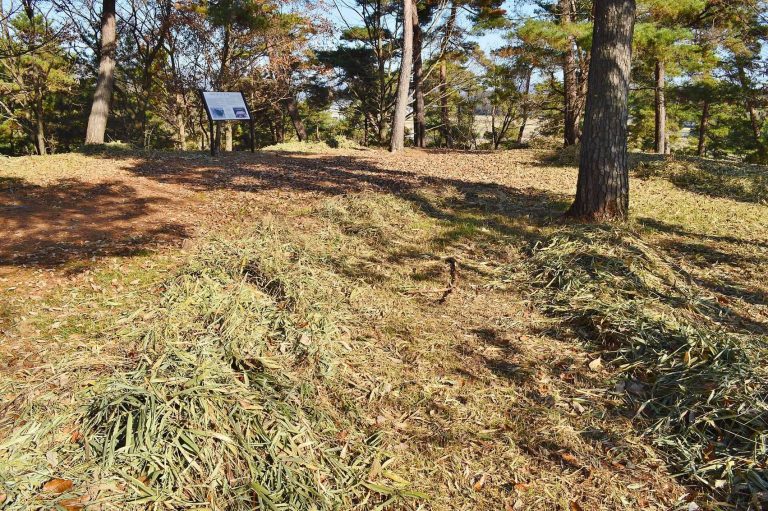
Within the castle were the foundations of seven buildings, a raised-pillar building, a reservoir, a well, twelve forges, and the remains of a blacksmith’s workshop. A raised-pillar building stood above the ground on supporting posts, a form used for storage and other purposes in ancient Japan. The fortress also contained a hearth and a food-storage building, indicating the practical facilities needed for its occupation.
Excavated materials
Wooden objects were recovered from the base of the walls, along with Sue ware and Haji ware pottery, inkstones, whetstones, nails, and other iron objects. Sue ware was high-fired and often gray, while Haji ware was generally unglazed earthenware. Around the building foundations on the summit, excavators found Buddhist-related materials, including tiled pagodas, water vessels, and other vessels. Together, these remains connect the fortified summit with both its short military life and its later Buddhist use.