Tengu-yama Kofun: A Fifth-Century Keyhole Burial Mound in Japan
Site at a Glance
- Rating
- 5
- Popularity
- Very Low
- Country
- Japan
- Primary era
- Classical
- Eras represented
- Classical
- Civilizations
- Unclassified
- Site type
- Burial
- Remains
- Burial Mound
On this page7 sections
History
Tengu-yama Kofun is a fifth-century burial mound in Kurashiki, Okayama, Japan, built during the middle Kofun period. Kofun were large Japanese tombs generally constructed for members of the political and social elite. The mound was built in the latter part of the fifth century, after the decline of the political powers associated with Tsukuriyama Kofun and Sakuzan Kofun.
Political Change in the Kibi Region
The construction of Tengu-yama Kofun belongs to a period of political reorganization in the Kibi region. Its emergence is important for understanding the rise of a local clan later associated with Niman Ōtsuka Kofun and Yada Ōtsuka Kofun. The tomb therefore reflects a changing balance of local power after the decline of the earlier political centers.
Excavation and Protection
The mound was illegally excavated before the Second World War, and burial goods were recovered. Archaeological investigations of Tengu-yama Kofun and nearby Tengu-yama West Kofun, also called Tengu-yama No. 2 Kofun, took place during fiscal years 1997 to 1999 through the Okayama University Archaeology Laboratory. The results were published in 2014.
Tengu-yama Kofun and Tengu-yama West Kofun were designated together as a Kurashiki City Historic Site on December 5, 2005.
Remains
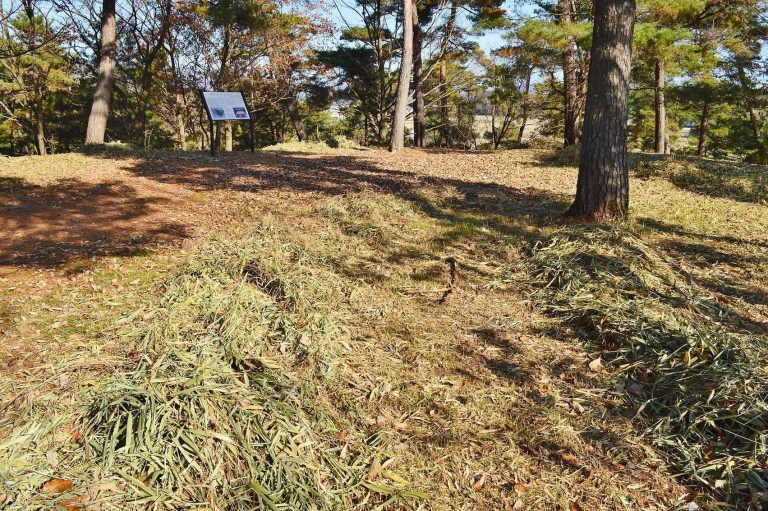
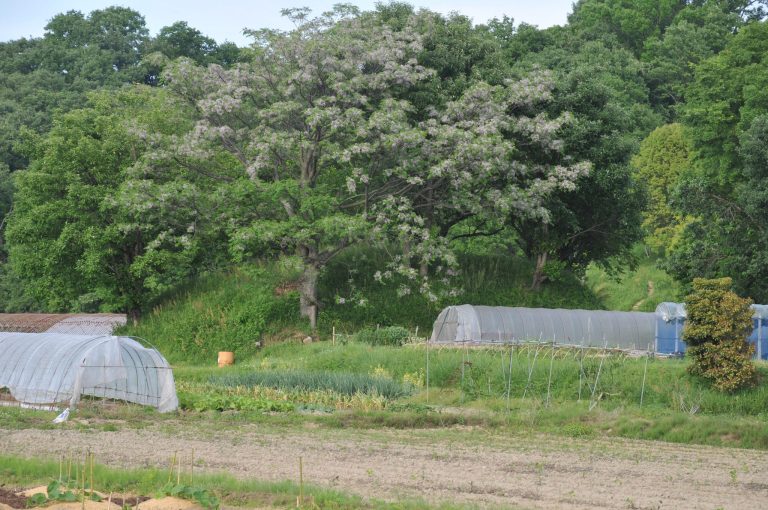
Tengu-yama Kofun stands on a spur of the Minamiyama hills at an elevation of about 90 metres, near the confluence of the Oda and Takahashi rivers in southern Okayama. It is a scallop-shell-shaped keyhole tomb, a form combining a rounded rear mound with a smaller projecting front section. The short front projection points west. The mound is about 60 metres long, reaches approximately 9 metres in height at the rear circular section, and was constructed in two stages. Tengu-yama West Kofun lies to the southwest.
Mound and Outer Enclosure
A shield-shaped moat and an outer bank surround the mound. The bank is approximately 9 metres wide and 2 metres high. Cylindrical, morning-glory-shaped, and umbrella-shaped clay figures were placed on the summit, the terraces, and the outer bank. These clay figures, known as haniwa, served as funerary and architectural markers on and around many kofun. Stone surfacing covered the exterior of the mound.
Burial Chamber and Coffin
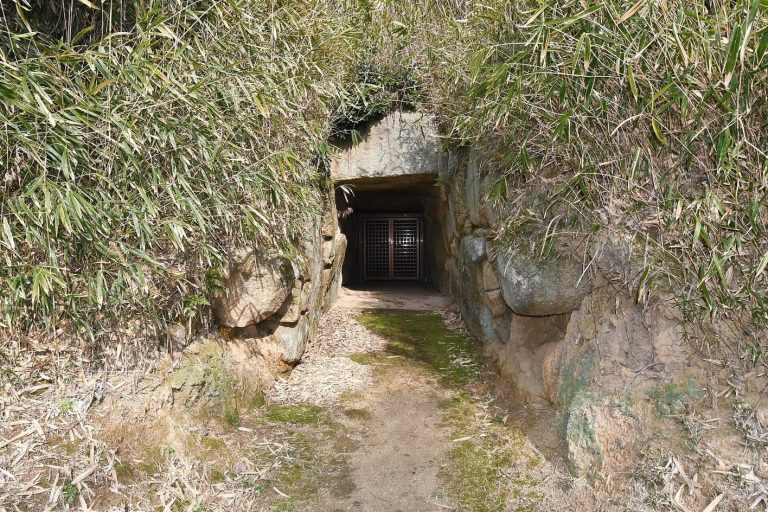
A vertical stone burial chamber lies deep beneath the rear circular mound, about 5 metres below the summit. This type of chamber is a burial compartment enclosed by upright stone walls below the mound, and the chamber at Tengu-yama was probably built before the mound itself. It measures approximately 4 metres long, 1 metre wide, and 0.8 metre high.
The chamber was made by stacking angular stones with clay packed between them. Small rounded stones covered the floor, while red pigment coated all four walls and the ceiling. Its broad proportions, almost vertical walls, white clay packing, small-stone floor, and red pigment distinguish it from ordinary vertical stone burial chambers. The chamber is classified as a Korean Peninsula-influenced vertical stone burial chamber, reflecting connections with burial practices of the Korean Peninsula. Together with Shobuzuka Kofun in Kurashiki, it is regarded as a representative example of this type, which was widely distributed in the Setouchi region during the fifth century.
A composite wooden coffin stood inside the chamber. Metal clamps used to assemble the coffin were identified, and the coffin was placed after the chamber walls had been constructed.
Burial Goods
Numerous objects were recovered from the chamber, including a bronze mirror, weapons, small-lamellar armour, and gauntlets. Small-lamellar armour was made from many joined plates, while gauntlets protected the forearms and hands. The armour and gauntlets provide important evidence for understanding the character of armour during the period. Recovered objects from the kofun are held at the Tokyo National Museum and the Okayama University Archaeological Materials Exhibition Room.