Khodja Doniyor Mausoleum: A Multifaith Shrine in Samarkand, Uzbekistan


Site at a Glance
- Rating
- 4.5
- Popularity
- Low
- Country
- Uzbekistan
- Primary era
- Modern
- Eras represented
- Modern
- Civilizations
- Unclassified
- Site type
- Religious
- Remains
- Tomb
On this page7 sections
History
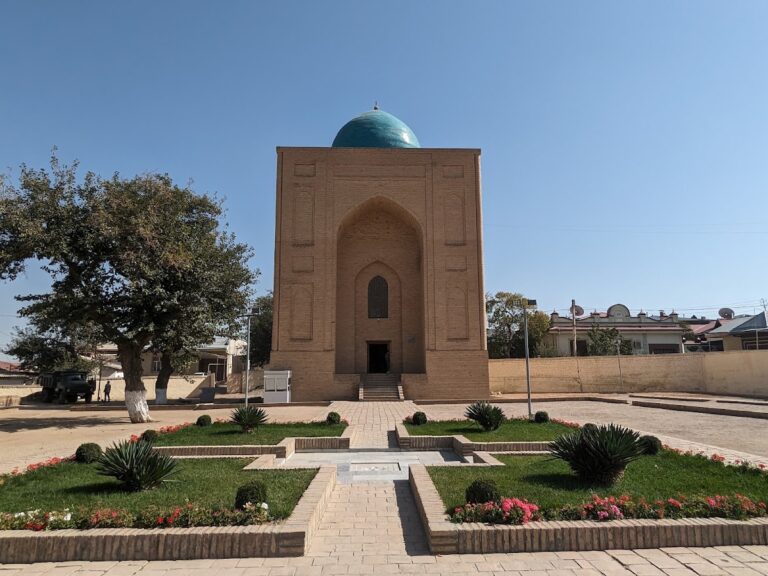
Khodja Doniyor Mausoleum is a revered shrine in Uzbekistan, located in Samarkand beside the Siyob stream. The present mausoleum dates from the late nineteenth or early twentieth century, while the sanctuary is visited by Muslims, Christians, and Jews. Khodja Doniyor, Daniil, and Daniel are names used in Islamic, Christian, and Jewish traditions for a holy figure associated with the shrine.
Competing traditions of origin
The earlier history of the shrine is uncertain. In Abu Tahirkhoja’s Samaria, Khodja Doniyor is described as a companion and associate of Kusam ibn Abbas, an early Islamic preacher traditionally regarded as a cousin of the Prophet Muhammad and associated with the spread of Islam around Samarkand. Other traditions identify the buried remains with Daniel, a biblical prophet who is also recognized in Islam. Graves associated with Daniel are found in places beyond Samarkand, so the identity of the remains at this shrine has not been resolved.
A widespread legend connects the shrine with Amir Timur, the fourteenth- and early fifteenth-century Central Asian conqueror and ruler whose empire was centered at Samarkand. During campaigns in Asia Minor between 1397 and 1404, Timur is said to have brought Daniel’s relics or remains from Susa. According to the tradition, the horse carrying them stopped beside the Siyob, where Timur ordered the burial and established a mosque. The spring beside the tomb is likewise linked in local legend to the imprint of the horse’s hoof.
Another interpretation places the shrine’s beginnings before the arrival of Islam. It holds that a Jewish religious community brought Daniel’s remains to Samarkand and created a place of worship near a spring with the permission of local fire worshippers. A further tradition returns to the identification with a companion of Kusam ibn Abbas rather than the biblical prophet. These differing accounts leave both the identity of the buried figure and the original establishment of the shrine open to debate.
The present complex and later investigations
The current mausoleum was erected over the tomb in the late nineteenth or early twentieth century. Its early twentieth-century construction is attributed to Mahmud Oqsoqol, a master among Samarkand’s soap makers. Khodja Doniyor was regarded as the spiritual patron of that craft, and a Russian merchant and entrepreneur named Miroshnichenko is also said to have helped with the work. The shrine later underwent repeated repairs and reconstructions.
From 1995, extensive building, restoration, landscaping, and improvement works reshaped the area around the mausoleum. The surrounding ground and the channel beside the complex were restored and landscaped. Excavations in 2001 uncovered remains of a fourteenth-century mosque. The mosque was reportedly demolished during the Second World War for unknown reasons. Further digging produced bricks from the late fourteenth or early fifteenth century and the seventeenth century, together with objects dating from the first or second centuries and from the fourth to seventh centuries. Earlier remains near the spring have been connected tentatively with a pre-Islamic sacred place where local Zoroastrians may have performed religious ceremonies, although further archaeological research is needed.
In 1996, Alexy II, Patriarch of Moscow and All Russia, visited the mausoleum and consecrated a nearby pistachio tree. Local tradition holds that the tree revived and later flowered after having partly dried. This account remains a local tradition rather than an officially verified miracle. Samarkand, including the Khodja Doniyor complex and its historical architectural and archaeological monuments, joined the UNESCO World Heritage List in 2001 as “Samarkand – Crossroads of Cultures.” The mausoleum is also recognized as part of Uzbekistan’s tangible cultural heritage.
Remains
Setting and mausoleum
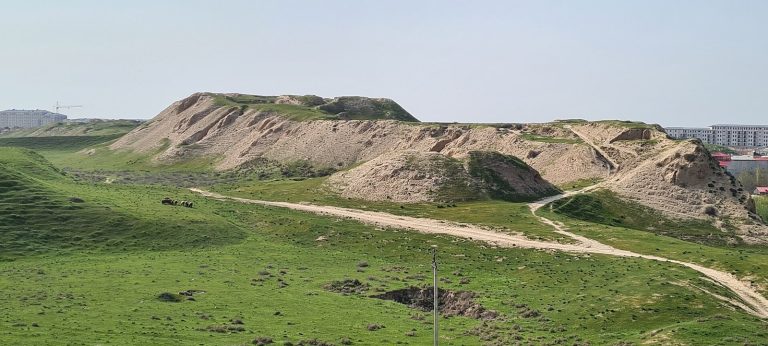
The complex occupies a slight elevation on the eastern or northeastern side of the Afrosiyab archaeological settlement, beside the Siyob stream. A wall encloses the grounds, and a three-part staircase provides the approach. On the route from ancient Afrosiyab, the remains of an entrance gatehouse and porch survive. A prayer porch also stands within the enclosure, while a spring beside the mausoleum is regarded as sacred and healing. Pilgrims drink its water and may bathe in it. Earlier descriptions connect part of the spring’s flow with the nearby Obi Rahmat irrigation channel.
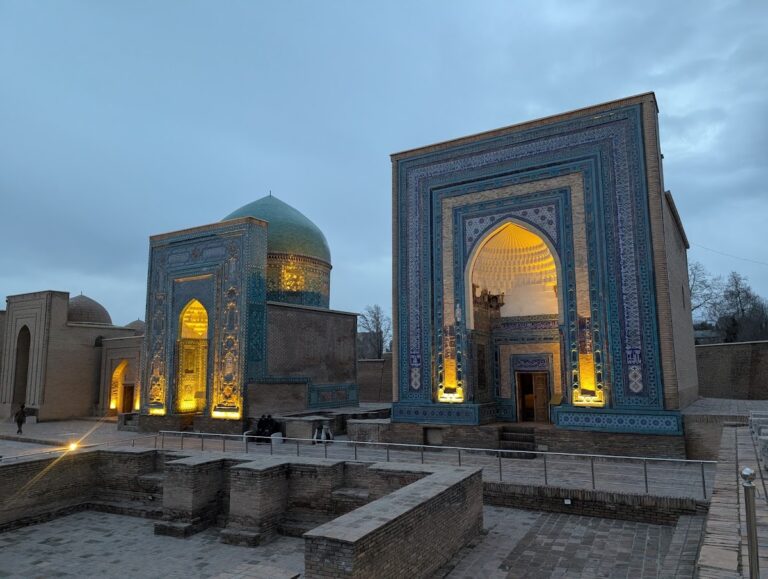
The present mausoleum has an elongated rectangular plan approximately 15 metres long. Its main elements are a northern entrance facade, a room covered by a chain of five low domes, and an elongated dahma, a raised funerary structure, above the tomb. An early twentieth-century photograph shows six domes, while five stand today, indicating that some may have been destroyed and rebuilt during later alterations. The northern pediment and two domed, vase-shaped structures beside it carry carved ganch, a gypsum-based plaster used for architectural decoration in Central Asia. Arched openings or recesses mark the side elevations, and baked-brick domes ornament the upper northern corners in a European-influenced style.
Tomb and ritual features
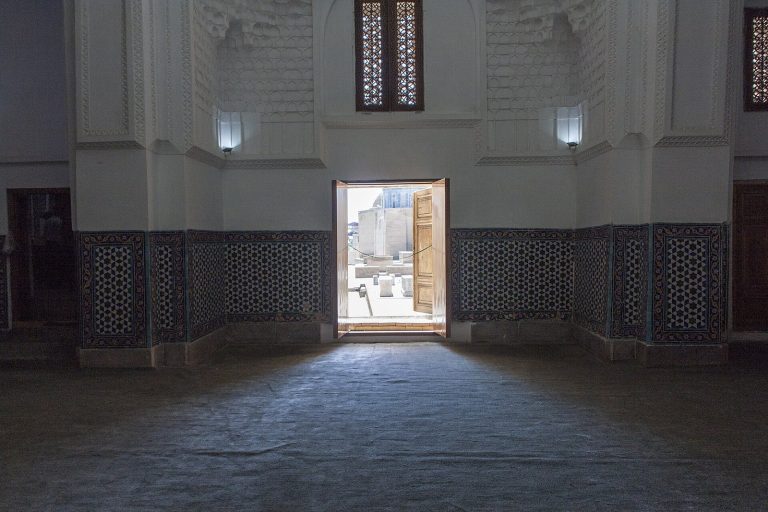
Inside, shield-shaped anchors and arches support the domes. The tomb enclosure is made of fired brick, coated with sand-based plaster, and faced with marble panels bearing Quranic inscriptions. Onyx and black marble cover the area around the tomb. The tomb itself is elongated, measuring about 18 metres in the most detailed description, while another tradition gives a length of approximately 17 metres. It rises from about 90 centimetres at the southern end to 160 centimetres at the northern end. The northern end is wider, reaching about 2 metres, and contains a rectangular enclosure resembling a sarcophagus.
Beside the north-facing window, on the sill opposite the tomb enclosure, lies a small stone with Arabic inscriptions. Local people call it the “intention stone.” Pilgrims traditionally circle the tomb once or three times while making a wish, then try to lift or move the stone. Several traditions explain the unusual length of the tomb. One says that the burial extended along a long grave to deter people with bad intentions from excavating the remains. Another, attributed to the English scholar Stone, calls it a “growing grave” that supposedly lengthened by one cubit, or 72 centimetres, every hundred years.
An earlier depiction shows the tomb covered with river stones and bordered by a small porch and a room used as a mosque. Six ritual banners once stood around it on special stones during ceremonies. The banners have disappeared, but their supporting stones remain. North of the mausoleum stands a pistachio tree said to be about 500 years old. Its partial drying and later reported flowering form part of the local tradition surrounding the complex.
Earlier mosque and archaeological layers
Excavation around the complex revealed a mosque with a prayer niche oriented toward Mecca, a northern porch measuring approximately 25 square metres, and an entrance from that porch. Its walls used a timber-frame technique set on a fired-brick foundation. At the northwestern corner of the porch, two rectangular stone slabs were found, each measuring approximately 80 by 40 by 20 centimetres. They were identified as unfinished pieces intended for gravestones.
The mosque’s prayer wall stood over a considerably earlier wall that supported the side of a ravine. Bricks from the late fourteenth and early fifteenth centuries occurred in this area and beneath the mosque’s southern wall, while seventeenth-century bricks were present in the lower part of that wall. Together with the other excavated objects from the site, these remains preserve evidence of activity extending across several historical periods around the spring and the later mausoleum.