Kellia: An Early Christian Monastic Community in Egypt
Site at a Glance
- Popularity
- Medium
- Country
- Egypt
- Primary era
- Medieval
- Eras represented
- Classical, Medieval
- Civilizations
- Byzantine, Roman
- Site type
- Religious
- Remains
- Monastery
On this page10 sections
History
Kellia was an important centre of early Christian monastic life in Egypt’s Libyan Desert, between the communities of Nitria and Scetis. Monks settled there from the fourth century, and tradition places its foundation around 338. Its Greek name means “the Cells”; it was also called al-Muna in Arabic.
Foundation and early community
Amun, a monk from Nitria, is traditionally credited with establishing Kellia after Nitria became crowded. He is said to have gone farther into the desert with the guidance and company of Anthony the Great. A story in the Apophthegmata of the Desert Fathers recounts that the two prayed in the wilderness and marked the chosen place with a cross.
Monks first learned the desert way of life at Nitria before moving to Kellia. They spent weekdays in separate cells, then gathered at the church on Saturdays and Sundays for worship and shared meals. Most were not priests, though priests served communion. In the late fourth century, Palladius of Helenopolis counted about 600 monks there. A priest led the community with a council of elders, while some groups later came under their own abbots, or monastic leaders. Macarius of Alexandria directed the community during the first three years of Palladius’s stay.
Evagrius Ponticus came to Kellia around 385 after living at Nitria. He wrote most of his works there before his death in 399. Macarius was also among the community’s best-known priests at the close of the fourth century.
Church divisions and new communities
During the first Origenist controversy, a dispute over teachings associated with the early Christian writer Origen, Kellia’s monks supported Origenist views. Around 400, Theophilus, the patriarch of Alexandria, imposed disciplinary measures. Some monks were sent into exile, though they were later permitted to return.
In the early fifth century, the abbot Isaac established a lodging house for pilgrims and people who were ill. Kellia had one church until the middle of that century. Following the Council of Chalcedon in 451, a church council whose decisions contributed to divisions among Christians, the community split. A second church was built so that Chalcedonian and anti-Chalcedonian monks could worship separately.
Expansion, restoration, and decline
From the second half of the fifth century, monks increasingly organized into lauras, settlements where separate cells shared an enclosure. Monastic life became more institutionalized in the sixth and seventh centuries, with monasteries and other shared complexes multiplying as solitary cells became less common. The community may have grown to several thousand monks by the fifth and sixth centuries.
At an uncertain date during the patriarchates of Damian and his successor Anastasius, monasteries at Kellia were destroyed. They were repaired and occupied again in the seventh century under Benjamin I, the Coptic patriarch of Alexandria. Benjamin visited in 631, when he was hiding from Cyrus, the Melkite patriarch aligned with the Byzantine imperial church. During a second visit in the winter of 645–646, Benjamin stayed at Kellia for two days.
Monastic activity diminished in the centuries following the Arab conquest of Egypt in the mid-seventh century. Doctrinal conflicts and raids by nomads from the Libyan Desert also contributed to the decline, although some monasteries remained occupied into the eleventh century. During the rule of Coptic patriarch Alexander II (705–730), Barsanuphian and Gaianite religious groups were present at Kellia. Bishop John of Sa El Hagar brought them into the Coptic Church.
Rediscovery and archaeological work
Early Christian writings, including the History of the Monks in Egypt, the Lausiac History, and John Cassian’s Conferences, preserve accounts of Kellia and monastic life. Annibale Evaristo Breccia carried out trial excavations in the early twentieth century but did not identify the ruins as Kellia. Drawing on the study of ancient texts, Anthony de Cosson made the identification in 1937. Antoine Guillaumont confirmed it in 1964 and surveyed the site.
French and Swiss excavation teams began work in 1965, led respectively by Guillaumont with François Daumas, and by Rodolphe Kasser. After an interruption from 1969 to 1972, excavations resumed; Egypt’s antiquities service also investigated threatened areas from 1970. As irrigation schemes, farming, settlement growth, and a proposed railway put the remains at risk, salvage work and surveys expanded. By 1980, railway construction and the spread of villages and cultivated land had destroyed 40 percent of the area explored by the French team and 60 percent of the Swiss team’s explored area. Renée-Georges Coquin later led the French work, while Swiss investigations continued and expanded to Qouçoûr Hégeila and Qouçoûr ‘Ereima from 1987. The final excavation campaigns took place in the early 2000s. Work between 1964 and 2005 identified about 1,500 monastic structures. Of the 100 square kilometres Kasser mapped from 1965 to 1972, about 2 square kilometres remained preserved in 2023.
Remains
Extent and districts
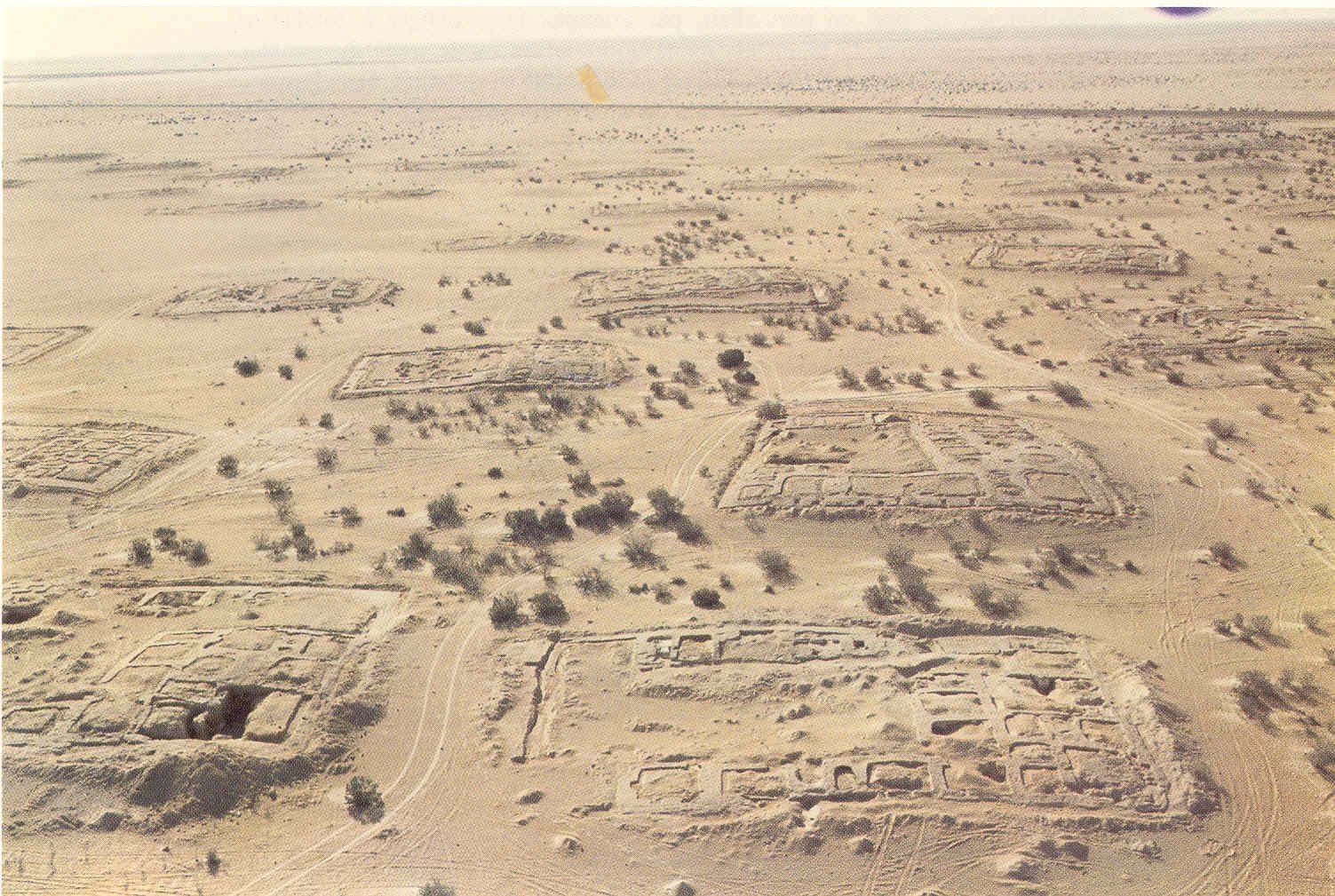
The archaeological area lies in Beheira Governorate, south of the Nubariya Canal. It extends roughly 20 kilometres from east to west and about 8 kilometres across; estimates of its total area range from approximately 100 to 125 square kilometres. Four principal districts, called Qouçoûr, extend generally west to east: Qouçoûr el-Roubaiyât, Qouçoûr el-‘Izeila, Qouçoûr el-‘Abîd, and Qouçoûr ‘Isâ, which lies to the southeast. Qasr el-Waheida is a separate area northwest of the main site.
Kasser estimated that the settlement contained about 1,555 buildings, mainly cells and monastic complexes. More than 800 koms, mounds of debris that mark building locations, were recorded across the four principal districts. French investigations covered more than 600 at Qouçoûr el-Roubaiyât and Qasr el-Waheida; Swiss teams examined about 200 at Qouçoûr el-‘Izeila, Qouçoûr el-‘Abîd, and Qouçoûr ‘Isâ.
Cells and shared enclosures
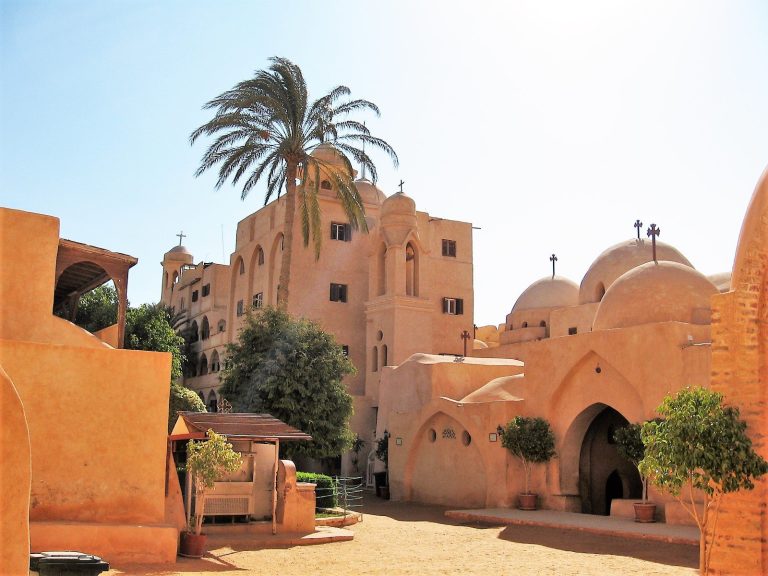
The earliest cells stood at a distance from one another, so that monks could neither see nor hear their neighbours. Built of sun-dried or fired brick, a cell could include rooms for everyday activities, prayer, and food storage, and sometimes a place for a disciple to stay. Each occupied a walled courtyard with a well. In later lauras, several cells shared an enclosure, while churches stood outside it; some enclosures also included storage buildings.
Churches and communal buildings
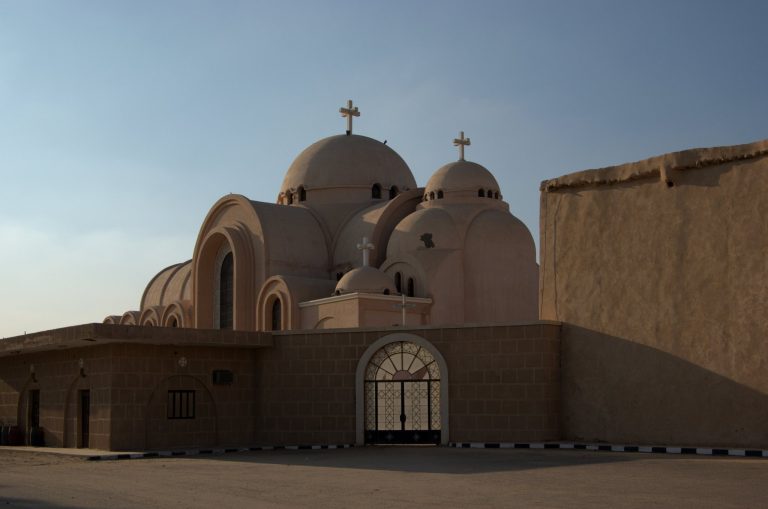
The churches used the same building materials as the cells. At Qouçoûr ‘Isâ, as many as three churches stood together. Qasr Waheida contained a group of buildings for communal services, while Qasr Isa 1 had a church complex. Qasr el-Izeila included a commercial centre.
Surviving structures and finds
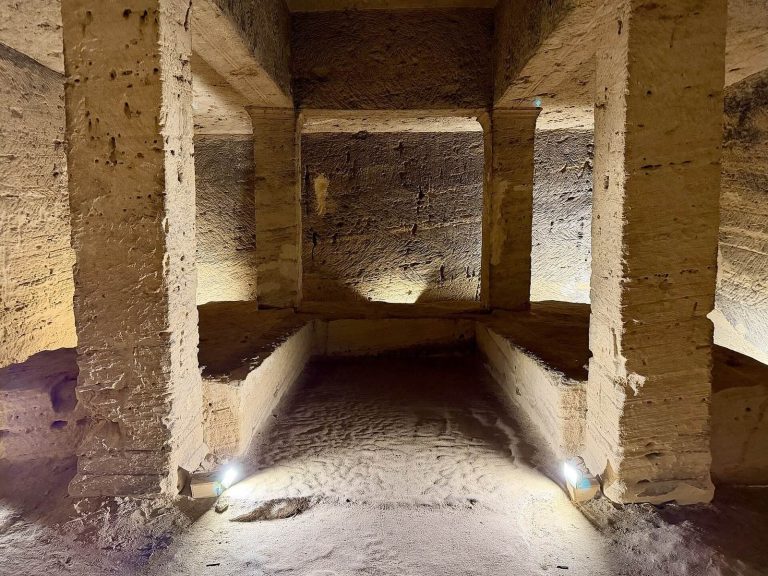
Some buildings remain standing, with their vaulted ceilings intact. Paintings and inscriptions survive on certain walls, and excavations also revealed graffiti. Pottery was among the finds from Kellia. Recovered objects are gathered, and partly displayed, at the Coptic Museum in Cairo.