Kehrdichannichts Lodge: A Leiningen Hunting Lodge in the Palatine Forest
Site at a Glance
- Rating
- 4
- Popularity
- Very Low
- Country
- Germany
- Primary era
- Modern
- Eras represented
- Early Modern, Modern
- Civilizations
- Holy Roman Empire, Kingdom of Bavaria
- Site type
- Domestic
- Remains
- House
On this page10 sections
History
Kehrdichannichts Lodge is an eighteenth-century hunting lodge in the Palatine Forest, west-southwest of Bad Dürkheim, Germany. Built for the House of Leiningen, a German noble dynasty, it began as a wooden hut in 1707. Work on the lodge started in 1717, and it was completed in 1722.
Early use and the name
Deer management in the wooded area near Bad Dürkheim was recorded in 1588. A simpler building may have stood on the lodge’s later site as a noble hunting base, but it probably did not survive the War of the Palatine Succession, a European conflict over claims to the Palatinate fought from 1688 to 1697.
The name Kehrdichannichts was first recorded for the plateau in 1651 and later became the lodge’s name. A local legend links it to a count who, when a servant warned that French troops were moving through the forest, replied with words meaning pay no heed.
Leiningen hunting lodge
In 1707, Count John Frederick of Leiningen had a wooden hunting hut built in response to a neighboring hunting reserve belonging to the Electoral Palatinate, a territory of the Holy Roman Empire ruled by an elector. The hut was intended to help watch the neighboring land and clarify the boundary. Construction of the lodge began in 1717. John Frederick died in February 1722 before it was finished, and his son, Count Frederick Magnus, completed it that year. Frederick Magnus used it as a hunting base until his death in 1756; his successor, Prince Charles Frederick William, then became its owner.
Fire, rebuilding, and later use
After the French Revolution began in 1789 and brought political upheaval in France, its effects reached the Palatinate. The lodge appears to have burned down in 1793. In 1816, while the region was governed by Bavaria, building officer Johann Bernhard Spatz rebuilt the former two-storey building as a single-storey structure. It served as a forester’s lodge until 1891. A private initiative prevented its planned demolition, and it was sold to Fritz Eckel, a Deidesheim vineyard owner who held an honorary commercial title.
The state bought the building back in 1917 and continued leasing it to Eckel’s nephews. From 1927, it again served as a forester’s lodge, while a restaurant operated there until the end of the twentieth century. The building is now inhabited and listed as the residential locality Kehr dich an nichts, Forsthaus.
Remains
Building and setting
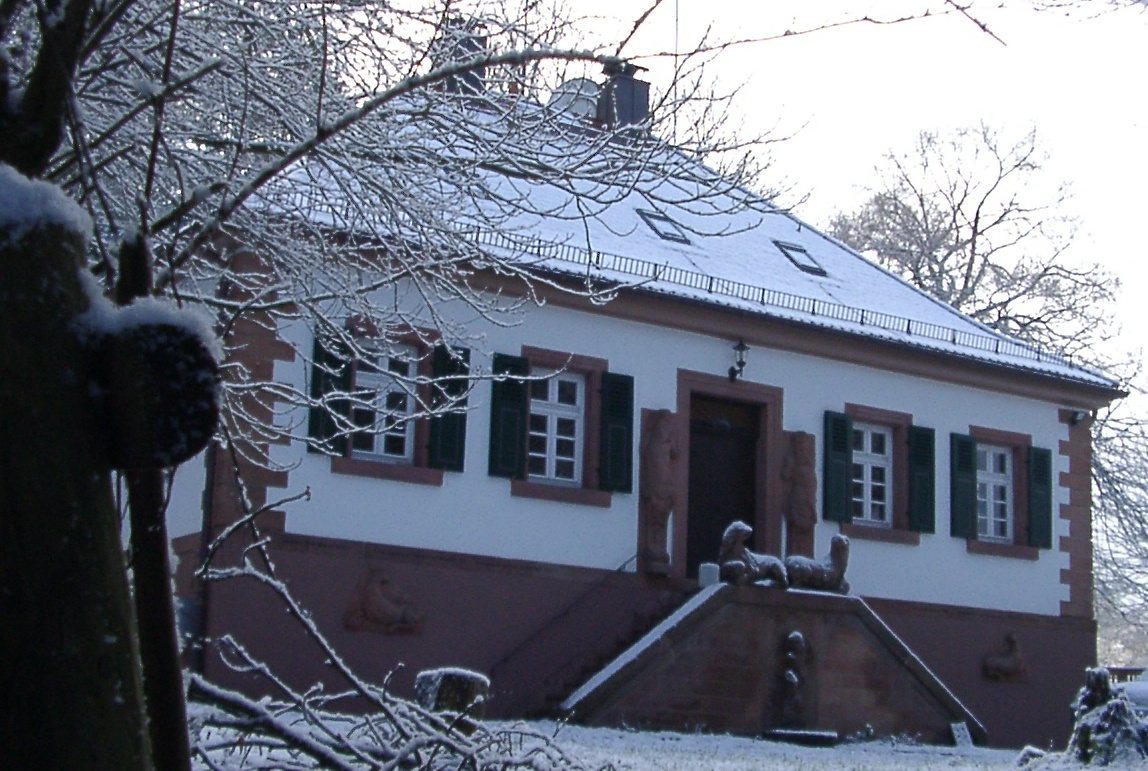
The lodge is a single-storey building with a hipped roof and has changed little since its rebuilding in 1816. It stands in the Palatine Forest at an elevation of 431 m above Germany’s national elevation datum, between the Isenach valley to the north and the Schwabenbach valley to the south.
Sculpture and water features
Stone wall relief
A stone wall at the lodge bears a relief depicting Count Frederick Magnus.
Laubbrunnen fountain
The eighteenth-century Laubbrunnen fountain is fitted with water features.
Entrance sculptures
Two lion sculptures stand at the lodge entrance, and two other sculptures also survive.