Butsugen-ji Temple: A Nichiren Buddhist Head Temple in Japan


Site at a Glance
- Rating
- 4.2
- Popularity
- Low
- Country
- Japan
- Primary era
- Modern
- External website
- Open
- Eras represented
- Early Modern, Modern
- Civilizations
- Japanese, Tokugawa
- Site type
- Religious
- Remains
- Temple
On this page9 sections
History
Butsugen-ji Temple is a Nichiren Buddhist head temple and sacred-site temple in Itō, Japan, founded in 1261 during Nichiren’s exile from Kamakura to Izu. Nichiren was a 13th-century Buddhist monk who founded Nichiren Buddhism, a tradition centered on devotion to the Lotus Sutra and the chanting of its title. The temple bears the mountain name Sea-Light Mountain and is associated with events from Nichiren’s residence in the region.
Nichiren’s exile and the temple’s foundation
During his exile, Nichiren prayed for the recovery of the fever-stricken local lord Ito Sukemitsu. After Sukemitsu was cured, he gave Nichiren a hermitage associated with a Bishamonten Hall. Bishamonten is a Buddhist guardian deity linked with protection and martial power. Nichiren wrote Shion-sho and Kyoki-jikoku-sho at the hermitage.
Shared guardianship in the Edo period
The site was historically called Sodo or Sodo Mountain. Until the Edo period, eight neighboring Nichiren Buddhist temples supervised it in rotation. The Edo period was the era of rule by the Tokugawa shogunate, whose military ruler was the shogun. The participating temples sought official guarantees for the landholdings connected with the site.
A document from 1678 records that Myoryu-ji, which served as guardian that year, went to the head temple Myoman-ji in Kyoto. Through the Honinbo family, it obtained vermilion-seal grants from the shogun for Sodo and the eight participating temples. A vermilion-seal grant was an official authorization bearing the shogun’s red seal, commonly used to confirm land rights or privileges.
During the Genroku era, the rotational system was organized around two halls. Bukkoku-ji, Myosho-ji, Daigyo-ji, Myoho-ji, and Hosen-ji managed the Itchi Hall, while Myoryu-ji, Rensho-ji, and Kosen-ji managed the Shoretsu Hall. Itchi and Shoretsu were labels associated with different doctrinal tendencies within Nichiren Buddhism.
Independence and restoration
After the Meiji Restoration, the site left the rotational system and became independent as Kaikozan Butsugen-ji. It was counted among the 44 head temples of Nichiren Buddhism. A fire in 1875 and the Great Kanto Earthquake of 1923 left the temple in decline, after which it was restored in stages.
In 1951, Butsugen-ji was designated a sacred-site temple, a status recognizing its historical or religious association with an important figure or event. Its resident head priest is affiliated with the Tamasawa lineage and the Seiwa-kai group.
Remains
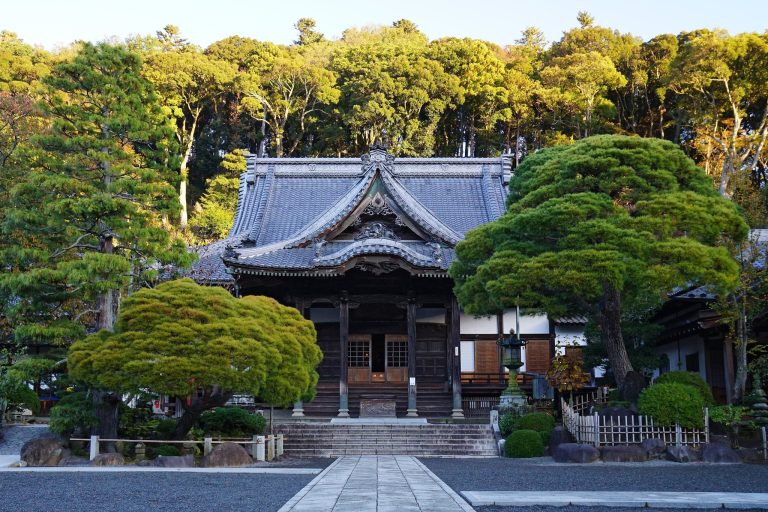
Butsugen-ji’s surviving features include a late Edo-period gate and halls built in 1951. The temple’s principal object of worship is a Ten Worlds Mandala, which represents the ten Buddhist realms of existence and serves as a central object of worship in Nichiren Buddhism.
Temple buildings and worship
Temple gate
The temple gate dates from the late Edo period, the era before the Meiji Restoration. It forms part of the surviving architectural fabric of the temple and predates the later halls built after the temple’s fire and earthquake damage.
Founder’s Hall and Bishamonten Hall
The Founder’s Hall and Bishamonten Hall were built in 1951. Their construction belongs to the postwar rebuilding of the temple and preserves the association between the site and Nichiren’s founding history, including the hermitage connected with Bishamonten.
Ten Worlds Mandala
The principal object of worship is a Ten Worlds Mandala. In Nichiren Buddhism, this mandala represents the ten Buddhist realms of existence and provides the central focus of religious worship at the temple.
Nearby sites