Kashii-gū: A Historic Shinto Shrine in Fukuoka, Japan


Site at a Glance
- Rating
- 4.4
- Popularity
- Medium
- Country
- Japan
- Primary era
- Early Modern
- External website
- Open
- Eras represented
- Early Modern, Modern
- Civilizations
- Japanese, Tokugawa
- Site type
- Religious
- Remains
- Sanctuary
On this page14 sections
History
Kashii-gū is a Shinto shrine in Japan, located in Fukuoka on the southwestern foothills of Mount Tachibana. Its origins are traditionally placed in the eighth century, when a mausoleum associated with Emperor Chūai and Empress Jingū was established at the site. The shrine’s distinctive architectural form and its long relationship with the imperial court have given it an important place in the religious history of Kyushu.
From palace tradition to imperial mausoleum
Early chronicles connect Kashii with Emperor Chūai’s temporary western headquarters, known as Kashihi Palace. They state that Chūai died there during a campaign against the Kumaso, a people identified in early Japanese tradition with the southwestern regions of the archipelago. A later tradition says that Empress Jingū ordered a mausoleum to be built in AD 200. The historical tradition surrounding the present institution, however, places the establishment of the mausoleum in the eighth century.
Shrine tradition dates the beginning of construction to a divine oracle received on February 6, AD 723. The foundation of a new mausoleum followed on December 20, AD 724, and the mausoleum’s existence is regarded as certain by AD 728. The tradition describes two originally parallel mausoleums. Chūai’s spirit was first enshrined at the site of the former temporary palace, while Jingū’s spirit was placed in the new mausoleum founded in AD 724. Together, the two places became known as Kashii Mausoleum, or Kashii-byo.
The earliest secure documentary reference comes from November AD 728, when three officials visited Kashii Mausoleum and composed poems there. Another old tradition holds that travelers entering Chikushi first paid their respects at the site. Although it was later treated as a shrine, Kashii was initially regarded as a mausoleum rather than as an ordinary Shinto institution. It began to be administered more like a shrine around the middle of the tenth century.
Imperial service and changing religious affiliations
From the eighth century onward, the court repeatedly sent offerings to Kashii Mausoleum. These rites accompanied relations with Silla, imperial accessions, natural disasters, foreign threats, and other major events. Because the site was classified as a mausoleum, it did not initially possess the recorded system of divine-rank promotions used by ordinary shrines. When the complex was damaged by fire, the court could also order periods in which normal official business was suspended.
The site held a status comparable to that of the imperial tombs. The tenth-century Engishiki, a compilation of court laws and ceremonial regulations, lists a mausoleum administrator, a palace attendant, and a guard household at Kashii rather than the officials normally assigned to a shrine. From the late tenth century, a chief shrine administrator was appointed, and the institution increasingly entered ordinary shrine administration. During the Heian period and afterward, it ranked in Kyushu second only to Usa Shrine. It was also counted among four principal shrines of Japan together with Ise, Kehi, and Iwashimizu Hachimangu.
Kashii maintained close connections with Buddhist institutions as well as with the court. The monks Ennin and Enchin performed recitations of Buddhist scriptures for the Kashii deity in AD 847 and AD 852. This relationship reflected shinbutsu-shugo, the historical combination of Buddhist and Shinto practices. Before the nineteenth century, sixteen Buddhist temple establishments were reportedly located around the shrine. By the Edo period, only Gokokuji remained. Many of the surrounding Shingon temples, belonging to a major school of esoteric Buddhism, were destroyed after the nineteenth-century policy of shinbutsu-bunri, which formally separated Buddhism and Shinto. A small Benzaiten temple survives nearby.
Medieval control and wartime destruction
In the medieval period, rights in Kashii’s estate passed successively to Iwashimizu Hachimangu, authorities connected with Dazaifu, and Rengeo-in, the Lotus King Hall. Control returned to Iwashimizu Hachimangu in 1197. From around the Mongol invasions, administration of the shrine came under the Otomo family, a powerful warrior house in Kyushu.
Tachibana Castle was built behind the shrine and became involved in the conflicts of the late sixteenth century. The Shimazu attacked the castle in 1586, during their expansion through Kyushu, and the shrine buildings burned in the invasion. Toyotomi Hideyoshi then confiscated the shrine estate, causing further decline. Kobayakawa Takakage later donated rice-field land and rebuilt shrine buildings, but Kobayakawa Hideaki subsequently confiscated the estate again.
Edo patronage and modern status
The Kuroda lords of the Fukuoka domain supported Kashii during the Edo period. Kuroda Mitsuyuki donated an estate producing 30 koku of rice in 1683, while Kuroda Tsugutaka provided 70 koku in 1744 and Kuroda Narikiyo provided 50 koku in 1820. The main hall and worship hall burned in 1637 and were rebuilt in 1644 under Kuroda Tadayuki. Kuroda Narikiyo oversaw another rebuilding of the main hall in 1801, producing the structure that survives as the central architectural expression of the shrine.
After the Meiji Restoration, the new state classified Kashii-gū as a National Shrine of the Middle Rank in 1871. It was promoted to a Kanpei-taisha, or Grand Imperial Shrine, in 1885. After the Second World War, it became a Beppyo Jinja, a category of especially prominent shrines recognized by the Association of Shinto Shrines.
Kashii-gū is also a Chokusaisha, a shrine with a special relationship to the imperial court that receives an imperial envoy bearing ceremonial offerings. The envoy ceremony was interrupted during the Kamakura period, revived in 1744, and was initially held every sixty years. Its interval changed to ten years in 1925. The ceremony is held on October 9, while the annual regular festival takes place on October 29.
Ritual observances connected with Chūai and Jingū continue through monthly rites on the sixth and seventeenth days for their respective memorial dates, as well as the Old Palace rite on March 6. The spring parish festival includes a procession every other year in which three portable shrines travel to the temporary palace and return over two days. The procession is said to reproduce Jingū’s military array. Interrupted after the Meiji Restoration, it was revived in 1873. Lion music is performed at the spring and autumn parish festivals. Its origin is uncertain, although a performance was recorded when the imperial envoy ceremony was revived in 1744. Kashii-gū’s lion music became a Fukuoka Prefecture intangible folk cultural property in 1961.
The shrine’s main hall was designated a national Important Cultural Property in 1922, and eight ridge-end plaques were added to the designation in 1966. The enshrined identities have also developed through several traditions. They have variously been described as Jingū alone, Chūai alone, Jingū with Ōjin and the Sumiyoshi deities, or Jingū with Takeuchi Sukune, Ōjin, and the Sumiyoshi deities. Chūai’s spirit was transferred from the former shrine of the Old Palace and joined to the main sanctuary in 1915. Since then, four enshrined entities have been recognized: Chūai, Jingū, their son Ōjin, and the Sumiyoshi deity or deities.
Remains
Principal shrine buildings
Main hall
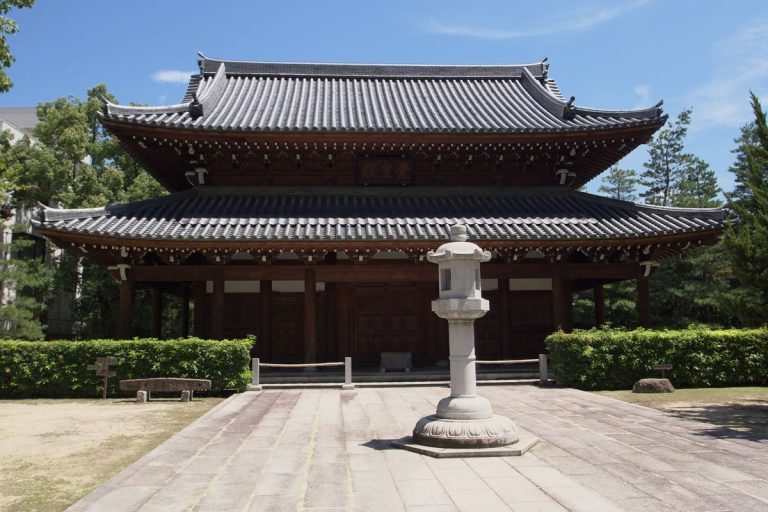
The principal complex is arranged around the main hall, offering hall, and worship hall. Facing south, the main hall represents the rebuilding of 1801. Its central building measures three bays by three bays and carries an irimoya roof, a form combining a hipped lower section with gabled parts. A projecting gable marks the front, while carriage porches extend at the sides. One-bay porches stand at the front and on both sides, and the roof is covered with cypress bark.
Inside, the three-bay depth is divided into an outer sanctuary, inner sanctuary, and innermost sanctuary. A one-bay Lion Chamber stands on each side of the outer sanctuary. The origin of this arrangement is unknown, but the form is distinctive to Kashii-gū and is called Kashii-zukuri. The main hall is not open to general access.
Offering and worship halls
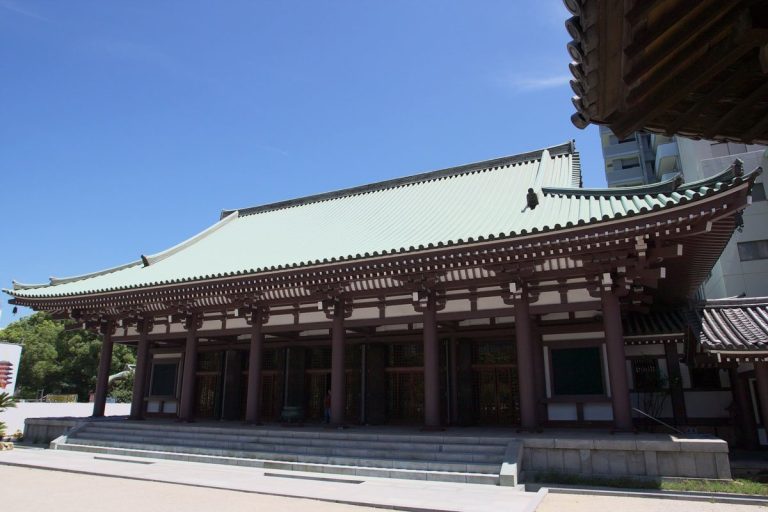
The offering hall stands before the main hall and fulfills the function usually assigned to a shrine’s worship hall. It is called the offering hall because imperial envoys traditionally presented cloth offerings there. Openwork fences extend from both sides and enclose the main hall.
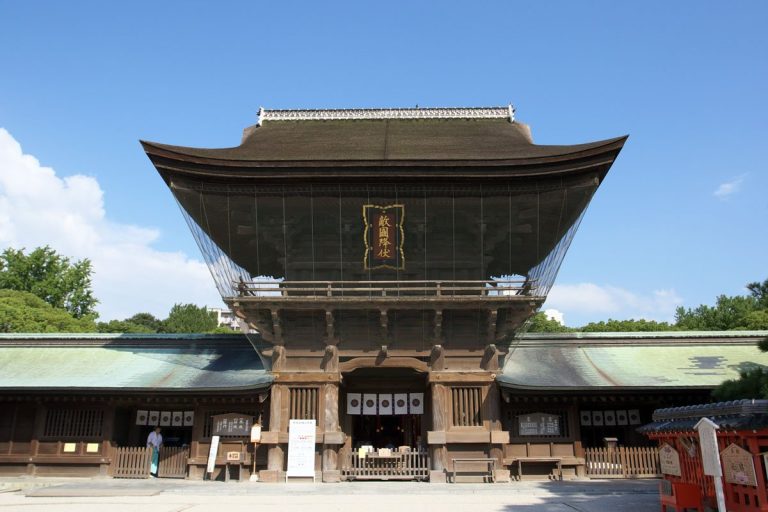
The worship hall stands in front of the offering hall and has an earthen floor. A large imperial plaque bearing the name Kashii-gū hangs above its front. The middle gate and its attached corridors stand before the three principal halls. Buildings immediately connected with the main hall were rebuilt around 1898, while the gate tower at the foot of the hill was rebuilt in 1903.
Associated buildings and precinct features
Within the middle gate are a music pavilion, a storehouse for portable shrines, and a food-offering hall. Outside the gate are the lodging used by the imperial envoy, an ema hall for votive wooden tablets, and other shrine buildings. Two branch shrines stand within the precinct. Takeuchi Shrine lies west of the main hall beyond its surrounding fence and enshrines Takeuchi Sukune. Makio Shrine lies east of the main hall and enshrines Nakatomi Ikatsu. Both figures are traditionally described as ministers of Chūai and Jingū.
Eight subsidiary shrines also stand within the precinct: Inari, Keiseki, Kuchise, Hirano, Inyaku, Kobei, Hayatsuji, and Benzaiten. Their associated deities include Uke Mochi, an unidentified deity at Keiseki, Hata no Yashiro Sukune, Emperor Nintoku, Soga no Ishikawa Sukune, Takeuchi Sukune Ujitsura, Otomo no Takei, Kiyohara no Ujisada, and Ichikishima-hime. Keiseki Shrine is traditionally associated with protection for chickens and children.
The Old Palace and western landscape
Old Palace monument and temporary palace
The Old Palace monument recalls the tradition that Chūai’s headquarters or temporary palace occupied this area. The temporary palace used in processions lies on a hill west of the main shrine near the Chokushi Road railway crossing. A shrine and worship hall existed there before the medieval period, but the place later deteriorated and processions ceased. A permanent shrine was built in 1907, and the site was also known as Kashii-gū’s seaside hall.
Three monuments bearing poems from the Manyoshu were erected at the temporary palace in 1888. Their inscriptions carry the calligraphy of Sanjo Sanetomi and commemorate three poems associated with the visit to Kashii Mausoleum in November AD 728. The current biennial spring procession travels between the main shrine and this temporary-palace precinct.
Chokushi Road and coastal features
Chokushi Road runs westward from the shrine through the temporary-palace area and past Hamao Shrine toward the coast. It is an avenue of camphor trees approximately one kilometre long. Its present planting developed after camphor saplings were donated in 1926. The former shoreline lay near the temporary palace and Hamao Shrine, although reclamation later altered the coast. A shore gate stands opposite Mijima, a coastal rock associated with Jingū.
Several places along the route preserve traditions connected with Jingū, including mounds associated with her helmet, armour, and ears. Their connection survives as local tradition. Hamao Shrine, an external subsidiary shrine with no specified enshrined deity, stands near the temporary palace along the former coastal route. Mijima Shrine occupies the flat offshore rock called Mijima and enshrines Watatsumi, a Shinto sea deity. Tradition identifies the rock as the place where Jingū tested the truth of divine instructions, and its August 15 festival includes sending food offerings into the sea.
Other affiliated shrines
In addition to the branch and subsidiary shrines within the main precinct, Kashii-gū administers four other shrine establishments. Najima Shrine enshrines a Munakata deity, Ohmiwa Shrine enshrines Ōmononushi, Kawakami Shrine enshrines Toyohime, and Watatsumi Shrine, also called Ryu-o Shrine, enshrines Watatsumi. Together with the temporary-palace precinct, Chokushi Road, the coastal rock, and the named ritual and commemorative features, these places form the historical landscape associated with Kashii-gū.