Medzhidi Tabiya: An Ottoman Fortification at Silistra, Bulgaria


Site at a Glance
- Rating
- 4.6
- Popularity
- Medium
- Country
- Bulgaria
- Primary era
- Modern
- External website
- Open
- Eras represented
- Modern
- Civilizations
- Ottoman
- Site type
- Military
- Remains
- Fort
On this page7 sections
History
Medzhidi Tabiya is an Ottoman fort in Bulgaria, south of Silistra, built between 1841 and 1853 as part of the final Ottoman fortification system around the city. It formed part of the defensive quadrilateral linking Silistra, Varna, Shumen, and Ruse, and protected an important position on the lower Danube.
From Durostorum to Ottoman Silistra
The fortress of ancient Durostorum, the predecessor of Silistra, had already served in 971 as a refuge for Kievan Grand Prince Sviatoslav I after he lost the eastern part of the Bulgarian Empire to the Byzantines. Silistra came under Ottoman control in 1595 and became a military base.
Russian troops captured the fortress in 1811, but Russia returned Silistra to the Ottoman Empire under the Treaty of Bucharest in 1812. During the Russo-Turkish War of 1828–1829, a conflict between Russia and the Ottoman Empire, Russian forces besieged and captured the city again in 1829. Silistra was returned to Ottoman rule under the Treaty of Adrianople in September of that year.
The nineteenth-century fortification system
Following these conflicts, the Ottomans developed a new defensive system around Silistra between 1841 and 1853. Its plans were prepared by Helmuth von Moltke, a German military officer and engineer, after his visit to Silistra in 1837. Bulgarian builders from Dryanovo and the Silistra region directed the work, which involved more than 300 Bulgarians in forced labor.
Sultan Abdülmecid I, the Ottoman ruler from 1839 to 1861, visited the construction site in 1847. The fort was named in his honor. In the spring of 1854, during the Crimean War, the wider conflict in which the Ottoman Empire, supported by Britain and France, fought Russia, Russian forces besieged Silistra from April to June. The Ottoman garrison defended the city with assistance from British and French military advisers. Russian troops eventually withdrew after Austria threatened to intervene in the Balkans.
War, continued military use, and private ownership
Russian forces surrounded Silistra again in 1877 during the Russo-Turkish War of 1877–1878. After Russia’s victory, Ottoman troops evacuated the fortress in February 1878. The Treaty of Berlin ordered the fortifications to be demolished, although they were still standing around 1889.
Medzhidi Tabiya survived because it continued to serve as a military base. German forces used it during the Second World War, and after the war the citadel remained in use by the local Bulgarian military academy until 1956. Following the political changes of 1989, the complex was sold in 2003 to a weapons collector, who has operated it privately since then.
Remains
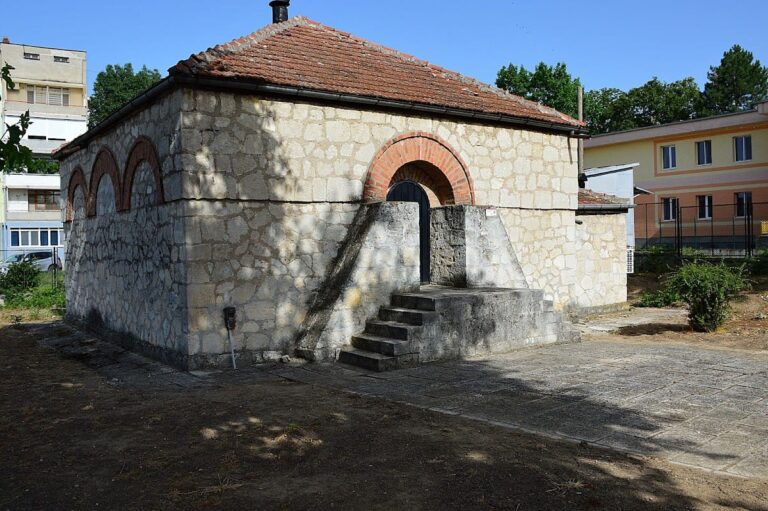
Medzhidi Tabiya stands south of Silistra on the right bank of the Danube, where the river is approximately 2.5 kilometers wide. It is the surviving fortification of the former system that encircled the city with 11 detached forts. The fort has a compact hexagonal plan, walls rising to 8 meters, and a ditch beside the walls that served both as an obstacle and as camouflage.
Defensive layout
The fort’s outer defenses form a polygonal system. Two caponiers, covered defensive passages or projecting works designed to protect a ditch from attackers, occupy the front side, while a third stands on the rear side. Together with the ditch and high walls, these elements shaped the fort’s defensive arrangement.
Casemate and powder magazines
The interior includes a casemate, a fortified chamber protected by thick masonry or earth and used for shelter, storage, or weapons. Two powder magazines form part of the complex. These structures belong to the nineteenth-century fortification built during the reconstruction of Silistra’s defenses.