Karamatsu Shrine: A Historic Women’s Protection Shrine in Japan


Site at a Glance
- Rating
- 4.6
- Popularity
- Low
- Country
- Japan
- Primary era
- Early Modern
- External website
- Open
- Eras represented
- Medieval, Early Modern
- Civilizations
- Ashikaga shogunate, Tokugawa
- Site type
- Religious
- Remains
- Sanctuary
On this page17 sections
History
Karamatsu Shrine is a Shinto shrine in Daisen, Akita Prefecture, Japan, traditionally dated to 982 and associated with the late Heian period. Its principal deities are Okinaga-Tarashihime-no-Mikoto, Kagu-tsuchi-no-Kami, Toyouke-hime-no-Kami, Takamimusubi-no-Kami, and Kamimusubi-no-Kami. The shrine is revered as a protector of women throughout life, especially in traditions concerning matchmaking, conception, and safe childbirth.
Origins and foundation traditions
The shrine’s origins combine historical memories with older legends. A tradition preserved in Mononobe family records says that Nakasayo, a son of Mononobe no Moriya, fled east after the destruction of his lineage. With the help of Totori no Ohaya, he reached Sakai, where a chest they were carrying could no longer be moved. An elderly man identified the place as Karamatsu Forest, where Okinaga-Tarashihime-no-Mikoto was worshipped, and Nakasayo is said to have restored the shrine there.
A Mononobe genealogy places the family’s settlement at Sakai in 982, after a member moved there from the area of present-day Omori in Yokote. The family first enshrined deities associated with creation, heaven, and earth, and later added its clan deity Kagu-tsuchi in 996. Kagu-tsuchi is a Shinto deity associated with fire, while Toyouke is linked with food and nourishment, and Takamimusubi and Kamimusubi are primordial deities of generative creation. A copied foundation tablet names several of these deities, although the original tablet no longer survives.
The name Karamatsu-no-Miya is traditionally connected with Ikuwi no Muraji, who is said to have founded a shrine in honour of Empress Jingu’s campaigns against the Korean states. In the same tradition, Ikuwi presented the pregnant empress with an abdominal band. The band later became a sacred treasure transmitted by the Akita Mononobe family. The name Karamatsu Shrine begins to appear in records from 1509. The origin of Karamatsu itself remains uncertain. It may preserve an old place-name associated with a Golden Pine, or refer to a type of pine popularly called karamatsu.
Warrior traditions and the Buddhist-Shinto complex
During the late Heian period, the shrine developed into Karamatsu Mountain Kounji, a religious complex combining Buddhist and kami worship. This arrangement, known as Shinbutsu-shugo, was common in Japan before the formal separation of Buddhism and Shinto in 1870. The complex enshrined a seated Fukukenjaku Kannon attributed to Jocho and later became the eighteenth station of the Thirty-Three Kannon pilgrimage of Akita’s six districts during the Edo period.
Another tradition links the shrine with Minamoto no Yoshiie during the Former Nine Years’ War, a conflict in which he pursued remnants of the Abe family. Near the shrine, Yoshiie is said to have been rescued by a warrior who revealed himself as an incarnation of Kagu-tsuchi. Yoshiie reportedly restored the shrine and donated about 72 cho of rice land. A surviving roof plaque records a restoration in 1063, giving historical support to a restoration associated with him, although the account of his visit remains partly traditional.
Yoshiie is also said to have appointed a Mononobe family member as a practitioner of Shugendo, an ascetic mountain discipline combining Buddhist, kami, and local religious traditions. The practitioner received the religious name Kounji Myoju. This episode is associated with the formation of Karamatsu Mountain Kounji as a Buddhist-Shinto institution.
Tradition also connects Yoshiie with the origin of the shrine’s snake-head kagura, a ritual performance of music and dance offered to kami. After praying for victory in the Later Three Years’ War, Yoshiie was said to have granted the Yamakita area as a designated sphere for itinerant performances from 1087 and authorized performances of snake-head kagura. The tradition remains part of the shrine’s ritual heritage.
Patronage and women’s worship
The shrine was revered by the Onodera and Satake families and supported by a confraternity whose worshippers extended throughout Akita. Although it had received aristocratic and warrior patronage, it did not have the backing of a local great family from the medieval period onward. Individual devotees helped sustain its following into the early modern period.
In the early eighteenth century, a daughter of Satake Yoshizane who had married into the Kuroda family of Akizuki is said to have prayed to the Princess Deity of Karamatsu during a difficult childbirth and safely delivered a son. She later reportedly dedicated a lion head to the shrine. Yoshizane subsequently designated Karamatsu as the domain’s sole deity protecting women throughout their lives. Women of his household formed the Karamatsu confraternity, also called the Eighth-Day confraternity, to pray for conception and safe childbirth.
The confraternity eventually spread beyond Akita throughout Japan. Around 1926, it reportedly included about 35,000 households, and it continued until the period before the Second World War. The traveler and antiquarian Sugae Masumi described Karamatsu as one of Dewa’s foremost deities of childbirth, with benefits believed to reach worshippers who prayed from distant regions. He suggested that the cult may have been transferred from Harima, while also preserving traditions that the sanctuary had been moved two or three times.
Relocation and Edo-period rebuilding
A member of the Mononobe family moved from Terayashiki in Arakawa to Sakai around 1660 and established the associated deputy temple Kensho-in. In 1680, Satake Yoshizane restored the Karamatsu Mountain complex, and the worship hall was moved from Mount Karamatsu to the lower site it occupies today. A popular story attributes the move to divine punishment after Yoshizane ignored a sign instructing him to dismount. The relocation is considered more likely to have followed the domain’s forced resettlement of farmers during the development of post towns along the Ushu Highway.
A roof plaque from 1680 identifies the institution as the Karamatsu Mountain Kounji Atago Shogun Jizo Gongen shrine in Sakai, Dewa Province. In that year, Neda Jurobei built the main sanctuary. Onozaki Sakubei built the worship hall in 1682, a second torii was erected in 1683, and a third followed in 1699. The first torii is assigned both 1697 and 1698 in the chronology, and the duplication remains unresolved. A resident of Sakai built a purification hall in 1697.
Parishioners rebuilt the offering hall in 1708. In 1711, seven-day public viewings were held at the shrine and at Yabashi Bishamondo in Kubota. The buildings listed for the complex included the main hall, worship hall, kagura hall, bell tower, and a hall dedicated to the Shinto sun deity, while the torii were rebuilt. The bell tower and Kensho-in were also rebuilt around this period.
Kounji burned in 1721, destroying sacred treasures and records. Further seven-day public viewings took place in 1751 at the shrine, a temple in Yabashi, and a Koshin hall in Yamasaki, with six locations repaired as in 1711. In 1762, age, strong wind in the previous year, and heavy snow had damaged the roof and surrounding eaves. Because the parishioners were impoverished, permission was sought for additional public viewings in regional towns.
Performances of lion dance were authorized at 81 locations in the three districts of Senboku, Hiraka, and Ogachi around the two annual festivals in 1782. A shrine to the sun deity was also established that year. Kensho-in received formal permission to use the name Kounji in 1801, followed by further appointments and confirmations of its temple status in 1808 and 1825.
Modern religious status
The Buddhist-Shinto complex was dissolved when the government ordered the separation of Buddhism and Shinto in 1870. At first, Atago Shrine on Mount Karamatsu became a village shrine, while Karamatsu Shrine was treated as a private Mononobe family shrine. In 1878, Karamatsu Shrine was designated a village shrine and Atago Shrine became a tutelary shrine. The change also involved renaming Atago Shrine as Karamatsu Shrine. The Mononobe family later preserved the identity of Atago Shrine by enshrining it within its household shrine.
Kounji burned during the Boshin War in 1868, and the Mononobe family office was destroyed by fire in 1895. A building associated with Kounji was completed in 1901. The shrine in the Mononobe family garden was rebuilt in 1914, its garden was completed in 1932, and Karamatsu Shrine and the associated shrine were registered as religious corporations in 1949. Karamatsu Shrine is designated a village shrine, while the adjacent garden shrine serves as the family’s ujigami, or tutelary deity.
The site’s heritage includes a prefecturally designated inner sanctuary, a prefecturally designated wooden lion head, a prefecturally designated cedar avenue, and Daisen-designated snake-head kagura. These designations were made in 1973, 1975, and 1993.
Remains
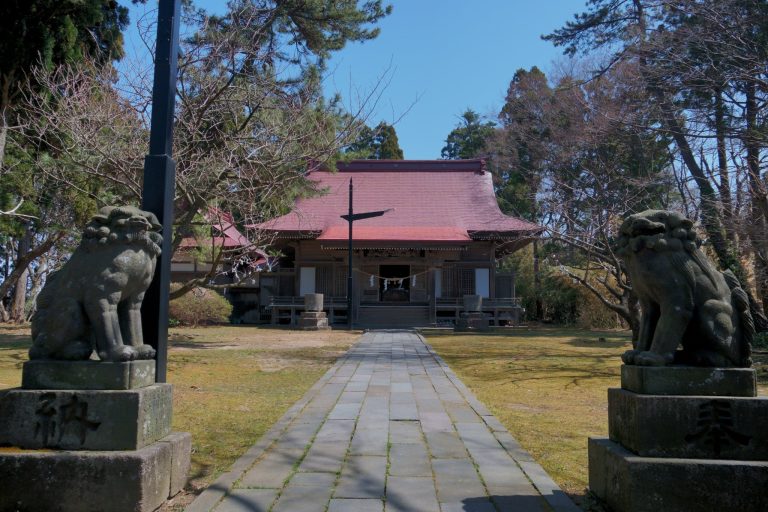
Karamatsu Shrine preserves a lower shrine precinct containing the worship hall and inner sanctuary, while the former mountain complex on Mount Karamatsu was maintained separately after the 1680 relocation. The historic complex included halls for worship, offerings, purification, and kagura, as well as a bell tower and several torii. Surviving buildings, ritual objects, trees, and performances preserve parts of this long development.
Lower shrine precinct
Worship hall and inner sanctuary
The main worship hall stands at the lower site and contains the inner sanctuary. The inner sanctuary is regarded as a surviving Muromachi-period building and is designated an Akita Prefecture tangible cultural property. The worship hall itself belongs to the rebuilding phase associated with the 1680 relocation, while the complex’s main sanctuary was built in that year and the worship hall followed in 1682.
Cedar avenue and torii
The approach is lined with cedars traditionally said to have been planted when the shrine moved downhill in 1680. The avenue is designated an Akita Prefecture natural monument. The complex’s later construction included a second torii in 1683 and a third in 1699. Records place the first torii in either 1697 or 1698, preserving two unresolved dates for the same structure.
Wooden lion heads
Three wooden lion heads are preserved at the shrine. One is considered a work of the Muromachi period and is traditionally associated with a dedication by the Onodera family. It is designated an Akita Prefecture tangible cultural property. Lion-head objects also relate to the shrine’s early modern performing traditions, including the lion dances authorized across three districts in 1782.
Ritual and archaeological heritage
Snake-head kagura
Snake-head kagura is a traditional performing art associated with the shrine’s medieval origin tradition. It belongs to a regional form of kagura involving lion-head masks or heads and itinerant performances. Daisen designates the shrine’s snake-head kagura as an intangible cultural property.
Surviving historical records
A roof plaque from 1063 records an earlier restoration associated with the tradition of Minamoto no Yoshiie. The copied foundation tablet for 982 does not survive, and the 1721 fire destroyed Kounji’s sacred treasures and records. The surviving plaque therefore preserves an early written reference to the complex’s restoration history.
Mononobe family garden shrine
Associated shrine
The adjacent shrine in the Mononobe family garden is Karamatsu Mountain Amatsu Hino Miya, a shrine associated with the family and with the heavenly sun deity. Its 1914 reconstruction uses Shinmei-zukuri, a shrine-building style with exposed timber surfaces, and is said to reproduce a shrine formerly built in the Yamato region. The associated shrine worships Nigihayahi-no-Mikoto, Tomiyahime-no-Mikoto, Tamahoko-no-Kami, and Aiko-no-Kami. Nigihayahi is associated in Japanese mythology with descent from heaven and the Mononobe lineage, while Aiko-no-Kami is identified in the shrine tradition with a protective manifestation of Kagu-tsuchi.
Sacred stones and garden
Several tens of thousands of natural stones donated by members of the Karamatsu confraternity and other worshippers form the stonework around the associated shrine. The garden was completed in 1932. Behind the shrine are three sacred stones connected with the concerns for which Karamatsu is revered: a male-holding stone associated with conception, the Tamahoko Stone associated with matchmaking and safe childbirth, and a female stone, also called the Child-Blessing Stone, associated with conception.
The ritual associated with these stones follows a prescribed circuit repeated three times while worshippers state their wishes. Men proceed clockwise and touch the Tamahoko Stone. Women proceed counterclockwise and touch both the male-holding stone and the Tamahoko Stone. The arrangement preserves the shrine’s distinctive connection with prayers for relationships, conception, and childbirth.