Schloss Walchen: A Historic Castle and Children’s World Museum in Austria

Site at a Glance
- Rating
- 4.4
- Popularity
- Very Low
- Country
- Austria
- Primary era
- Early Modern
- Eras represented
- Medieval, Early Modern
- Civilizations
- Habsburg, Holy Roman Empire
- Site type
- Domestic
- Remains
- Castle
On this page8 sections
History
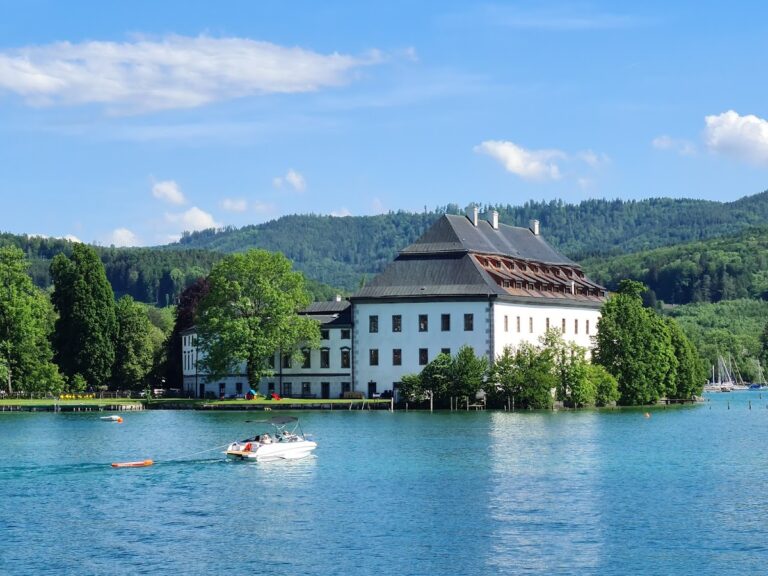
Schloss Walchen is a historic castle in Austria, in the Walchen district of Vöcklamarkt, whose present building was erected for Hans Christoph Geymann in 1590. It replaced an earlier castle and became the centre of a lordship whose history reaches from medieval noble families to modern collecting and museum work.
Early Walchen and the Geymann lordship
The name Walchen is linked with “the Welschen,” a term derived from Old Germanic usage that was formerly applied to the Celts. Bavarian settlers encountered a Roman settlement in the area, and the regular divisions of Roman fields can still be traced in the surrounding landscape.
The Walhen family appears in records from the Attergau in 1040 and in the Schaunberg land register of 1371. Around 1380, Ulrich von Walhen held Walchen as a princely fief. In 1583, Hans Christoph Geymann, also recorded as Geumann, acquired the lordship. Seven years later he replaced the earlier castle with the building that forms the core of Schloss Walchen.
Confessional conflict and changing ownership
The castle’s early modern history was shaped by the religious and political conflicts of the seventeenth century. During the aristocratic revolt, Hans Christoph Geymann’s son Ortolf occupied Kogl Castle for the Protestant estates, aristocratic political bodies aligned with the Protestant cause in the Holy Roman Empire. After the Bavarian invasion, Ortolf fled to Prague to join Frederick V, Elector Palatine, the “Winter King,” who briefly ruled Bohemia before losing his crown during the opening phase of the Thirty Years’ War. Ortolf’s stepbrothers supported the emperor, allowing Walchen to remain with the family.
In 1632, Franz Christoph Khevenhüller bought the lordship from Hans Paul Geymann’s son. Khevenhüller sold it in 1638 to Nikolaus von Gurland, a councillor and treasurer of Emperor Ferdinand II. The Gurland counts died out within a short period in 1736, possibly during an epidemic of plague or cholera. Their inheritance passed to Count Leopold Christoph von Schallenberg through his mother, Dorothea Juliana, a Gurland countess.
A local legend connects Dorothea Juliana’s grief at the loss of her family with the figure of the “White Woman,” said to haunt the castle. In 1766, Christoph von Schallenberg sold Walchen to Count Johann Gottlieb von Clam. The estate then passed to Baron Christoph von Aretin in 1786, Josef Preuer in 1802, and Josef Klemens von Weichs in 1821, replacing Preuer’s wife Rosalie as owner.
The estate in the nineteenth and twentieth centuries
Under the Weichs-Glon family, Walchen became a meeting place for an artists’ circle associated with Felix von Pausinger, the Austrian painter and owner of nearby Kogl Castle. Rudolf von Alt, known for landscape and architectural painting, was associated with this circle. The Schaumburg-Lippe family later owned the estate. Princess Walpurgis zu Schaumburg-Lippe was the family’s last owner, and the German writer and thinker Friedrich Georg Jünger and the philosopher Martin Heidegger visited the family at Walchen.
A series of owners followed Georg von Aichinger’s acquisition of the estate from the Weichs-Glon siblings in 1881. Otto von Steinbeis held it from 1889, Felix Freiherr von Thon-Dittmer from 1903, Georg Kaisinger from 1914, and Anton Gartner-Romansbruck from 1916. Friedrich and Emma Waldeck and Otto and Ernst Mitteiswicz, from 1917, also owned the estate before it subsequently returned to the Schaumburg-Lippe family.
Pauline Hanreich-Ludwig acquired the castle and its estate in 1959 as a setting for her collection of antique furniture. She came from a Viennese imperial-royal court cabinetmaking family. Her daughter, Eugenie Hanreich, later developed a large collection of equipment, toys, and other objects connected with children’s lives in the near and distant past. The collection became the foundation of the present Children’s World Museum in the castle’s farm complex.
Restoration and renovation brought important features to light. Work between 1960 and 1970 revealed the evangelical chapel, while renovation in 1961 uncovered a painted late-sixteenth-century coffered ceiling. The facade restoration received the Upper Austrian Handicraft Prize in 2001. Bankruptcy proceedings against Friedrun Hanreich, Eugenie Hanreich’s daughter and heir, opened on 20 July 2016. The castle subsequently passed to a new owner, Hans Peter Kaindl.
Remains
Castle building and historic interiors
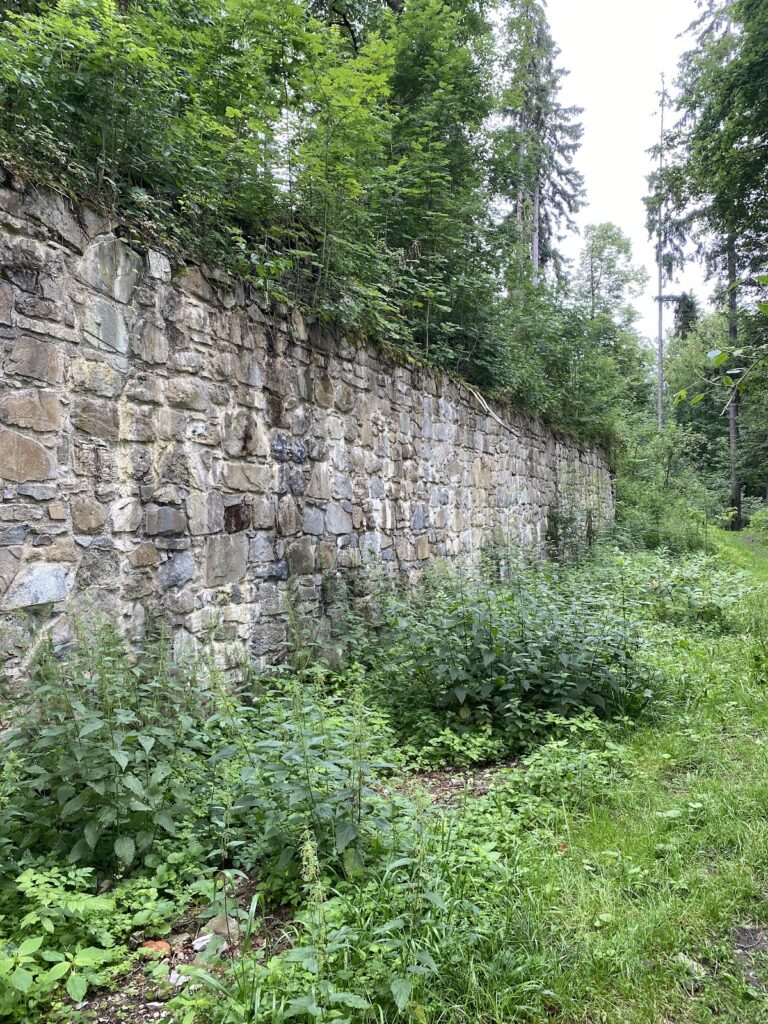
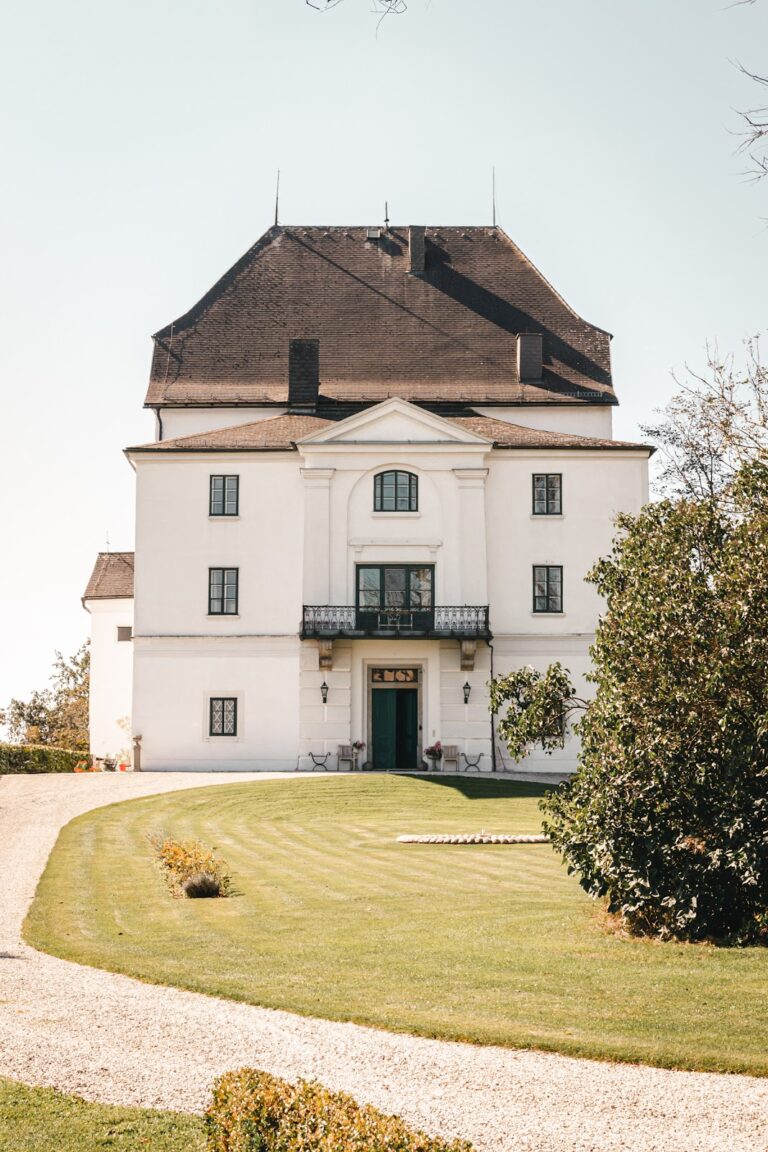
Schloss Walchen is a three-storey building with a broken hipped roof and a two-storey wing attached on the left. A clock occupies the triangular gable above the entrance gate, with a coat of arms beneath it that is attributed, though not certainly, to the Geymann family. The entrance consists of a simple stone portal with a segmental arch and a projecting central stone. A clock tower shown in a 1674 engraving by Vischer no longer survives, and the wall that once enclosed the castle has disappeared.
The second floor contains the library and other representative rooms. Its painted coffered, or dowel-wood, ceiling is formed from framed wooden panels and dates from the end of the sixteenth century. Other ceiling paintings show biblical scenes, hunting scenes, and the four seasons. Baroque stoves from Losensteinleithen Castle form part of the historic interior furnishings.
Chapels
Two chapels survive within the castle. The Baroque Catholic chapel forms the eastern end of a sequence of rooms. Its flat ceiling carries stucco work from 1750 to 1770, while the gallery room contains an eighteenth-century Rococo altar. The chapel also contains a statue of Saint John of Nepomuk from 1760 to 1770 and late-Gothic glass windows dating from the third quarter of the fifteenth century. Saint John of Nepomuk was a fourteenth-century Bohemian priest whose veneration spread through Central Europe.
The simple evangelical chapel was found on the ground floor when rooms formerly used as a coal cellar were cleared during restoration between 1960 and 1970. It probably belongs to the period when the present castle was built. A wrought-iron closing grille has a diamond pattern corresponding to the design of the painted coffered ceiling. Frescoes include the Baptism of Christ in the Jordan and are probably connected with the Protestant Geymann family.
Avenue, park, and farm complex
The castle estate includes a linden avenue planted in 1822 by Baron von Walchs, which is recognized as a natural monument. The park contains late-Baroque stone figures of Saint Donatus and Saint Florian, Christian saints commonly represented in devotional sculpture.
The castle’s farm complex houses the Children’s World Museum. Its collections include historical equipment, toys, and objects associated with children’s worlds and everyday lives in the near and distant past. The complex therefore preserves the collecting work begun by Eugenie Hanreich alongside the architectural remains of the estate.