Kaminoyama Castle: A Mogami Stronghold and Domain Seat
Site at a Glance
- Country
- Japan
- Primary era
- Early Modern
- Eras represented
- Early Modern, Modern
- Civilizations
- Japanese, Tokugawa
- Site type
- Military
- Remains
- Castle
On this page10 sections
History
Kaminoyama Castle in Japan was built at Tenjinmori in 1535 as a hirayama-style fortress, combining defenses on a rise with protection in the surrounding lowland. Mogami retainer Takenaga Yoshitada built it after retaking Takadate Castle from the Date clan. The fortress became the Mogami clan’s southernmost stronghold and a focal point in conflicts with the Date and Uesugi clans.
Early castle and Mogami frontier
A castle occupied the site by the early Muromachi period, an era governed by the Ashikaga shogunate. The Tendō clan controlled the area, and the Kaminoyama clan, a branch of the Tendō, held the local castle before the Date seized it in 1508 and sent Koyanagawa Sadanori there as a retainer.
In 1535, Yoshitada, son of Kaminoyama Yoshifusa, established the new castle at Tenjinmori. The surrounding settlement grew into a castle town, and the fortress was also known as Tsukioka Castle.
Conflict among the Mogami and Date
During a Mogami family conflict in 1574, Kaminoyama lord Mitsukane first supported Mogami Yoshiaki. He then allowed Date forces, aligned with Yoshiaki’s father, Mogami Yoshimori, to pass through the area. Mitsukane later made peace with Yoshiaki, as did the Mogami Eight Shields, an alliance of local warrior families, although tensions continued.
In 1580, Yoshiaki persuaded the retainer Satomi Minbu to change sides and attack the castle. Mitsukane was killed, and Satomi took the lordship under Mogami rule. On September 17, 1600, during the Keichō Dewa campaign, Uesugi forces advanced against Satomi’s much smaller garrison. The defenders charged out through the gate and fought nearby, while Satomi’s troops, concealed outside the castle, attacked the Uesugi from behind. The Uesugi were routed, their commander was killed, and many soldiers died. Satomi reportedly sent more than 400 heads to Yoshiaki. The defeated force could not join the main Uesugi army fighting at Hasedo Castle.
Satomi’s relationship with Yoshiaki later soured. Minbu became involved in a plot concerning Yoshiaki’s eldest son, Yoshiyasu, including plans to disinherit and kill him. On August 16, 1603, Minbu fled with his family, and Yoshiaki’s fifth son took over as lord of the castle.
Domain headquarters and dismantling
The castle remained standing under the 1615 One Castle per Province order, a shogunal rule restricting castles to one per province. After the Mogami clan lost its lands in 1622, Matsudaira Shigetada received a fief assessed at 40,000 koku, a measure of rice yield used to express a lord’s income and a domain’s size. He established Kaminoyama Domain, making the castle its headquarters, and improved the town and nearby roads.
Gamō Tadatomo took over in 1626 with a 40,000-koku fief. After his transfer the following year, Yamagata lord Torii Tadamasa administered the domain temporarily. Toki Yoriyuki became lord in 1628, initially with 25,000 koku, later increased to 35,000. Under the Toki family, the castle was developed as an early-modern fortress and the town prospered.
When the Toki lord was transferred in 1692, the shogunate ordered the castle dismantled, including its three-tier keep. Kanamori Yoritoshi succeeded him and built a residence in the second bailey, an enclosed section of the castle grounds. In 1697, Matsudaira Nobumichi became lord. His family ruled the domain until the Meiji period, which began with the restoration of imperial government. Nobumichi repaired part of the main bailey and some gates.
End of the castle and later changes
During the Boshin War, a civil conflict associated with the end of shogunal rule and the restoration of imperial government, government forces entered the castle on September 18, 1868. The next day, troops from the Satsuma and Yonezawa domains entered Kaminoyama as part of the campaign against the Shōnai domain.
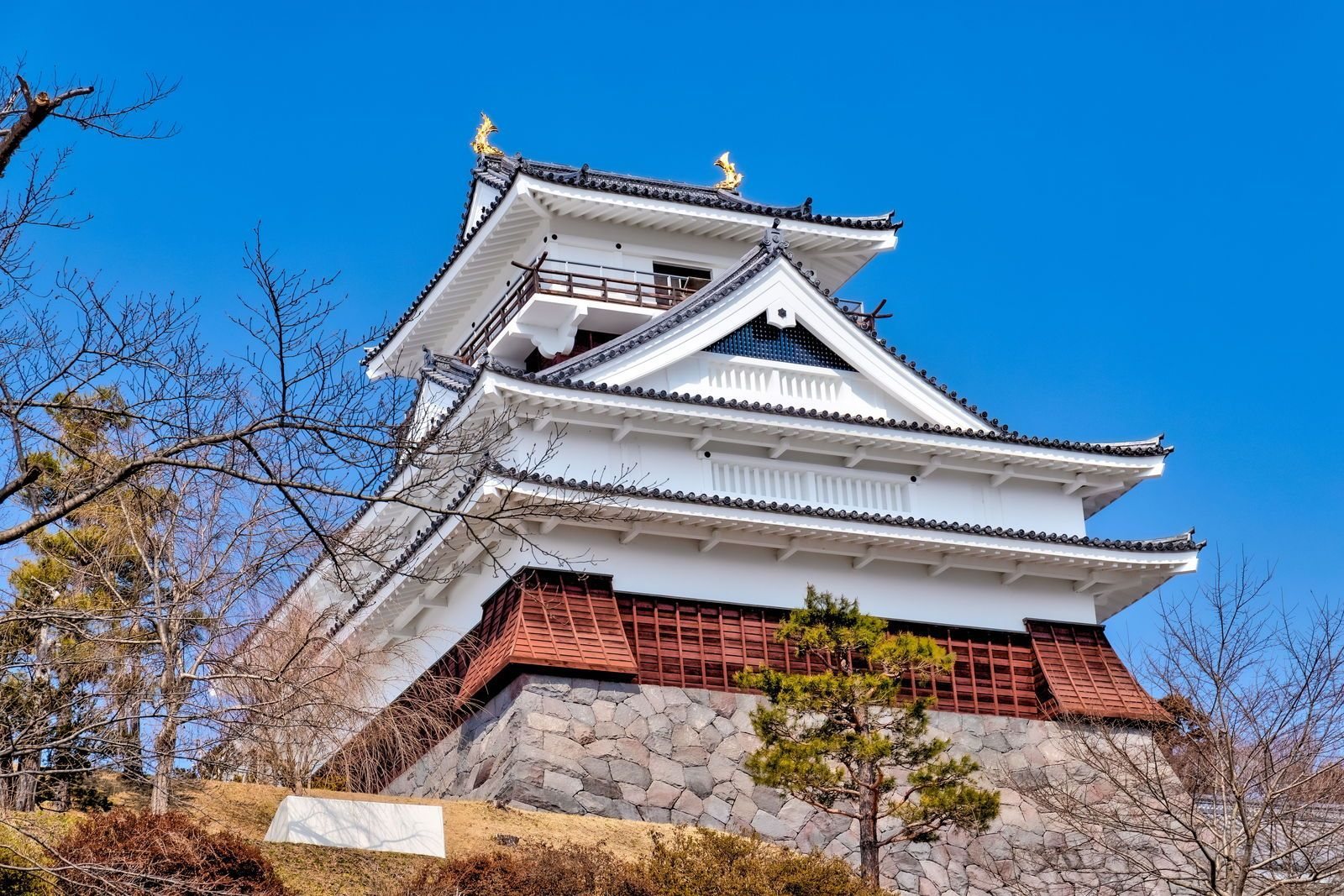
After the domain system was abolished in 1871, Kaminoyama Domain became Kaminoyama Prefecture. The government acquired the castle grounds, which became a park in 1872, and the castle was dismantled under the 1873 Abolition of Castles order. Tsukioka Shrine was built on the grounds in 1878, and Tsukioka Park was later laid out. The remains received municipal historic-site designation in 1957. In 1982, a simulated keep was erected on the second-bailey site to house a local history museum; rebuilding the castle’s appearance with a keep prompted considerable debate.
Remains
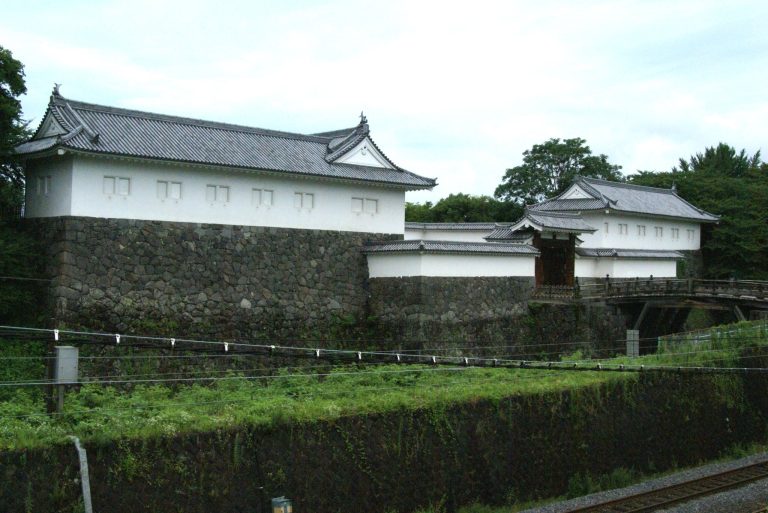
The castle stood on a moderate rise, with a main bailey, a lower second bailey around it, and an outer moat. Its former defenses included a three-tier keep and turret-gates, gatehouses with an upper defensive storey. The main bailey’s western inner moat survives, along with sections of earthen embankments and stone walls and a garden. Tsukioka Shrine and Tsukioka Park occupy parts of the former castle grounds.
Museum tower
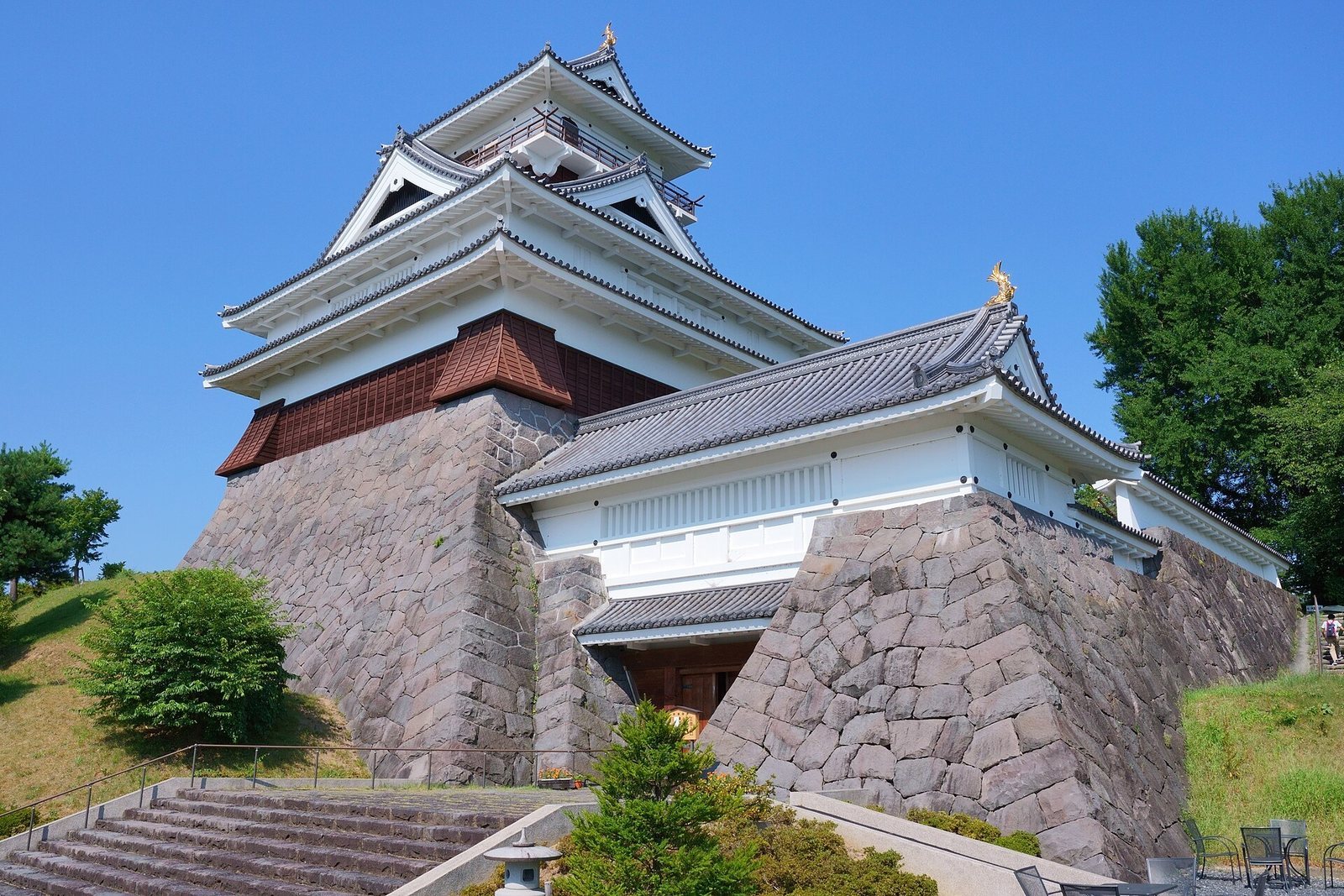
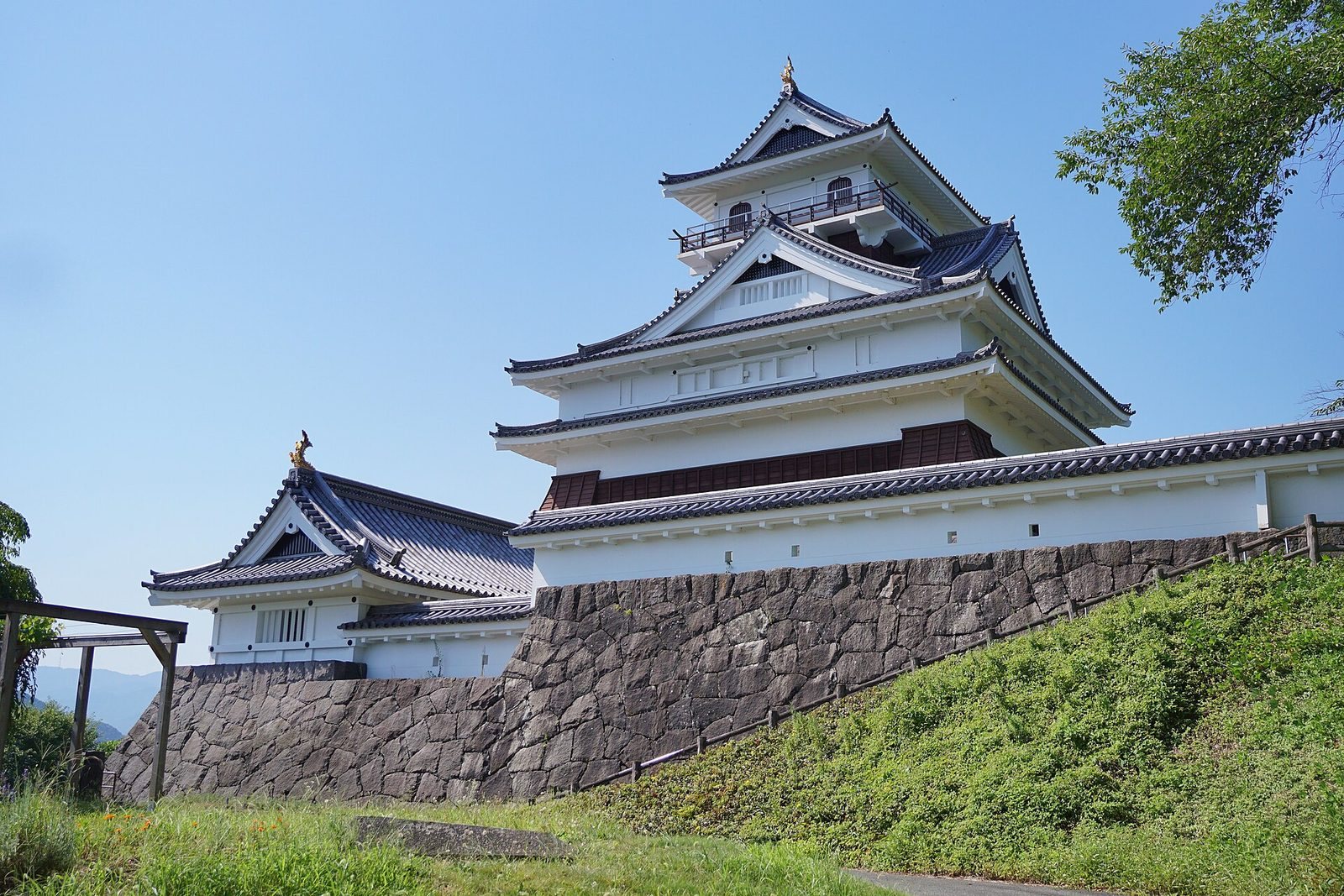
The simulated keep built in 1982 stands on the second-bailey site. It is a reinforced-concrete building with three tiers and five stories, topped by a lookout-style structure. Its design draws on a generalized Edo-period castle tower rather than reproducing the demolished historic keep. The building houses a local history museum. Its first floor covers 1,695.55 square metres, the mezzanine 256.18 square metres, the second and third floors 239.66 square metres each, and the fourth floor 49.03 square metres.
Relocated structures and site records
Gate and granary
A former castle gate of yakuimon form, a traditional design with a roof supported by four posts in front and rear pairs, was moved to an inn in Nanyo City, Yamagata Prefecture. A granary once used to store military rice provisions was relocated to the Suzuki family home in Kaminoyama.
Map, stele, and school site
The museum periodically displays a copy of the 1644 Map of Kaminoyama in Dewa Province, originally submitted to the shogunate. A stone stele on the grounds records a teaching of Takuan Sōhō, a Zen Buddhist monk and teacher. An explanatory sign marks the site of Meishinkan, the domain school, and describes the former arrangement of its rooms.