Jagdschloss Rehefeld: A Saxon Royal Hunting Lodge in Germany


Site at a Glance
- Rating
- 4.5
- Popularity
- Very Low
- Country
- Germany
- Primary era
- Modern
- Eras represented
- Modern
- Civilizations
- German
- Site type
- Domestic
- Remains
- Elite Residence
On this page12 sections
History
Jagdschloss Rehefeld is a royal hunting lodge in Germany, located at Rehefeld-Zaunhaus within the city of Altenberg in Saxony’s Erzgebirge. Crown Princess Carola purchased about 5,000 square metres of land there in 1870, and during the Franco-Prussian War of 1870–1871 she commissioned a hunting lodge, a cavaliers’ house, and ancillary buildings as a gift for her husband, Crown Prince Albert of Saxony. She formally transferred the property to him on 19 July 1873.
Royal hunting estate
Additional parcels acquired during the 1880s expanded the estate to roughly 6,700 square metres. Its insurance value reached 76,000 marks, and the property continued to serve as a hunting retreat into the twentieth century. The lodge also contained objects associated with the royal couple. Gifts presented to the childless Carola and Albert for their silver wedding anniversary in 1878 included several valuable paintings.
Carola was Crown Princess of Saxony and later became queen, while Albert succeeded to the Saxon throne as King Albert. Their connection with Rehefeld gave the property a place within the residential and recreational world of the Saxon royal family.
Cooperative convalescent home
In 1924, Friedrich August III, the last king of Saxony, sold the hunting lodge to the Schwerter Cooperative for 72,000 Reichsmarks, with a further 6,650 Reichsmarks paid for furnishings and ancillary buildings. The Reichsmark was Germany’s currency from 1924 to 1948. The cooperative was an auxiliary organization of the Dresden Masonic lodge Zu den drei Schwertern and Asträa zur grünenden Raute. Freemasonry is a fraternal movement organized through local lodges.
The cooperative converted the royal property into a convalescent home for its members and established a conference centre. It invested 87,000 Reichsmarks in the complex, adding a dining hall and kitchen and installing electricity, central heating, and drainage.
Pressure under the National Socialist regime
The National Socialist regime’s hostility toward Freemasonry forced the Dresden lodge to lease the property to Stahlhelm in 1933. Stahlhelm was a German veterans’ organization founded after the First World War. Under its manager, Walter, the lodge operated as a Stahlhelm veterans’ home.
After the lodge was banned on 31 July 1935, the Schwerter Cooperative was compelled to offer the property back to the former royal family. Prince Friedrich Christian of Saxony repurchased it on 1 October 1935 for 65,000 Reichsmarks, plus 15,000 Reichsmarks for the furnishings. These sums were substantially below the property’s actual value.
Friedrich Christian initially ran Rehefeld as a boarding house and retained Walter as manager. In 1936 he planned to create an exclusive hunting hotel. A partial conversion took place in autumn that year, in advance of the German Ski Championships held at Altenberg in February 1937. The successful result led to a complete conversion. Plans by Ulrich and the Garmisch painter Heinrich Bickel guided the four-month project, and the property reopened as an exclusive hunting hotel on 28 July 1937.
The hotel subsequently received members of the European high nobility, National Socialist leaders, and other prominent guests. Management difficulties soon followed. Tensions between Walter and Meinert, a director appointed as a representative of the margravial administration, intensified in December 1937. On 31 December, while the hotel was full during the winter high season, Friedrich Christian dismissed Walter from his lease and terminated Meinert’s employment without notice. Dr Schmid and the administrator Poeschmann managed the property temporarily.
The Jagdschloss Rehefeld Hotel Operating Company was founded on 5 February 1938. A new lease was then concluded and a new director appointed, after which the hotel business continued to prosper.
Military hospital and later uses
On 6 February 1942, the Wehrmacht Inspectorate IV in Dresden requisitioned the property as a reserve military hospital for 120 wounded soldiers. The Wehrmacht was the armed forces of Nazi Germany from 1935 to 1945. The requisition followed the winter campaign in the Soviet Union, which created an urgent need for additional hospital capacity. The hotel director and most of the staff were required to continue working at the hospital.
After expropriation in 1945, the complex became a holiday home. Following German reunification, it was used as a training and conference facility by the Saxon State Police School, now the Police Training and Further-Education Institute of Saxony, based in Bautzen.
On 1 January 2003, the State Property Office of Saxony took over the property and put it up for sale. The building complex then stood vacant and deteriorated increasingly as repeated sales attempts failed. A private individual from Radebeul bought it in April 2012. The intended future use of the main building, the connecting building added around 1930, the garages, and the two-storey residential house at the entrance was not known at the time.
Remains
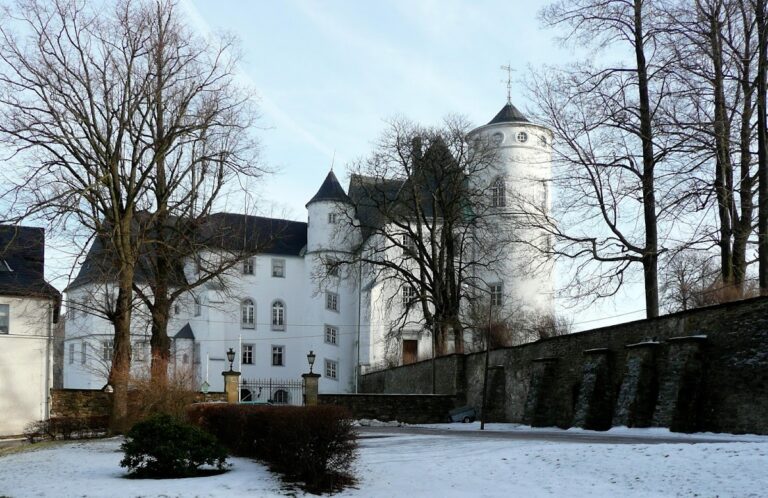
Jagdschloss Rehefeld stands high above the right bank of the Wilde Weisseritz, at the edge of a forest. The complex is organized around the principal lodge and a group of later or ancillary buildings. The main structure has a rectangular plan, two and a half storeys, and a hipped roof, while a taller tower projects from one of its narrow sides.
Principal lodge
Main building
The long side facing the valley forms the principal facade. Its centre projects outward and is marked at upper-floor level by two small rectangular oriels set diagonally against the corners of the projection. Each oriel has a pointed pyramidal roof. Between them, a dormer with a clipped-hipped roof and decorative trusswork reinforces the central axis. A three-storey tower attached to one narrow side is also covered by a pointed pyramidal roof.
Interior rooms
The ground floor originally contained a dining hall and a smoking room decorated with Oriental paper. On the upper floor were a reception room and the cabinet of Crown Princess Carola, later Queen Carola. Paintings and other valuable gifts presented to Carola and Albert for their silver wedding anniversary in 1878 were displayed within the lodge.
Chapel and later buildings
Chapel
A small chapel was constructed on the property in 1879 according to plans produced by a Munich art institution. It formed part of the royal estate established around the hunting lodge.
Later building complex
A connecting building added around 1930 links the later phases of the complex to the principal lodge. The property also includes garages and a two-storey residential building constructed at the entrance at approximately the same time. Together, these additions formed the building group that remained associated with the lodge when it was sold in 2012.
Nearby sites