Jagdschloss Friedrichsmoor: A Mecklenburg Hunting Lodge in Germany


Site at a Glance
- Rating
- 4.4
- Popularity
- Low
- Country
- Germany
- Primary era
- Early Modern
- External website
- Open
- Eras represented
- Early Modern, Modern
- Civilizations
- Holy Roman Empire
- Site type
- Domestic
- Remains
- Elite Residence
On this page8 sections
History
Jagdschloss Friedrichsmoor is a half-timbered hunting lodge in Germany, in the Friedrichsmoor district of Neustadt-Glewe. The present building was commissioned in 1791 by Friedrich Franz I, the first Grand Duke of Mecklenburg-Schwerin, and built between 1791 and 1793 as part of the princely hunting landscape of the Lewitz.
The first hunting lodge
The Lewitz is a low-lying region of wetlands, forests, and meadows whose sparse settlement and woodland made it suitable for hunting by the dukes of Mecklenburg. Around 1704, Friedrich Wilhelm I of Mecklenburg ordered a hunting lodge on the site. The engineer-captain Jacob Reutz is traditionally associated with its design, although that attribution remains uncertain. Blacksmiths’ accounts show that the building had been completed by 1709.
The original lodge was a log structure made from superimposed timbers. Moss sealed the joints, while oak boards painted in a Swedish manner covered the outer walls, and wooden shingles protected the roof. It included a two-storey central block and two single-storey wings. Life-size portraits of the duke’s former hunters decorated the dining hall, painted to resemble their subjects closely.
The late eighteenth-century lodge
Friedrich Franz I replaced the earlier hunting seat with the present lodge. Johann Christoph Heinrich von Seydewitz, the court master builder, directed its construction between 1791 and 1793. The building continued to serve the ruling house’s hunting activities exclusively until 1918.
During the twentieth century, the red deer rut in September formed the main event of the annual hunting season. The lodge was occupied for roughly four to six weeks each year. Before the season began, it was cleaned and its interior walls were whitewashed with lime. Chief foresters were responsible for maintaining the building and its grounds. Among the notable guests associated with the lodge were Kaiser Wilhelm I, Kaiser Wilhelm II, and Reich Chancellor Otto von Bismarck.
Forestry and twentieth-century reuse
A forestry office had operated at Friedrichsmoor since 1709. By around 1770, the Lewitz had been almost completely deforested, creating a shortage of timber when the later lodge was built. The foresters responded by arranging reforestation over the following decades.
From 1957, the building housed the Free German Youth camp “Meliorationsobjekt Lewitz.” The Free German Youth was the official youth organization of the German Democratic Republic, while melioration involved improving and regulating agricultural land through drainage and related water-management works. The Institute for Land Improvement at the University of Rostock later became the institution legally responsible for the palace. Until German reunification, the building served as a school facility and office building for the state-owned VEB Meliorationsbau.
After extensive restoration carried out according to monument-preservation standards, Jagdschloss Friedrichsmoor operated as a restaurant, café, and hotel from 1991 until the end of 2023.
Remains
The present complex and setting
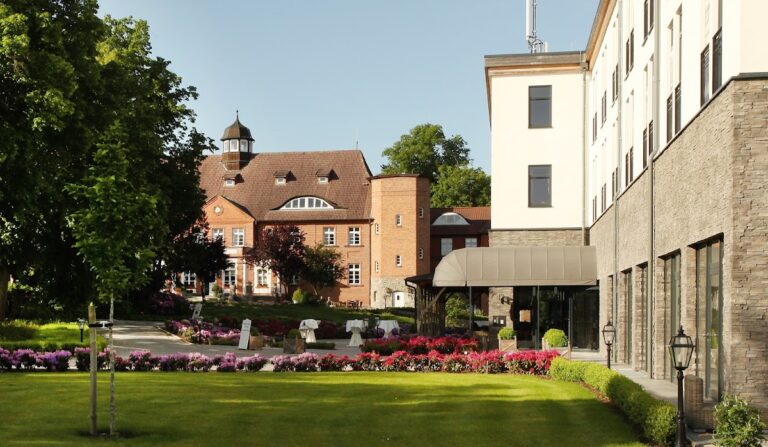
The surviving hunting lodge is a single-storey, three-wing half-timbered complex. Its three ranges form an open courtyard, while the centre of both the courtyard façade and the garden façade is marked by a three-axis roof dormer with a semicircular false gable. Old oak trees surround the building. The Breite Graben runs north of the lodge, and deciduous woodland borders the grounds.
Landscape connections
Four straight avenues once extended from the hunting lodge as clearings through the surrounding landscape. They are no longer recognizable as avenues. A largely preserved, perfectly straight connection runs for 15 kilometres from Friedrichsmoor to the residential palace at Ludwigslust.
Hunting wallpaper
The middle room with the garden staircase contains the scenic wallpaper La chasse à Compiègne, or “The Hunt at Compiègne.” Produced in Paris around 1815 by Jaquemart and Bernard after designs by Antoine Charles Horace Vernet, a French painter and designer associated with military and hunting imagery, it presents five scenes of an aristocratic red-deer hunt in a forest.
The wallpaper is probably the only surviving example of its kind. Friedrich Franz I acquired it through a Hamburg company in 1816, after it had hung at Jagdschloss Friedrichsthal northwest of Schwerin. Its distinctive red hunting coats were associated with the Napoleonic period and were banned after Napoleon’s fall in 1815. Following renewed restoration, the wallpaper returned to the walls of the garden hall at Friedrichsmoor in 2004.
Nearby sites