Jacobikerk: A Medieval Gothic Hall Church in Utrecht


Site at a Glance
- Rating
- 4.4
- Popularity
- Low
- Country
- Netherlands
- Primary era
- Medieval
- External website
- Open
- Eras represented
- Medieval, Early Modern, Modern
- Civilizations
- Holy Roman Empire
- Site type
- Religious
- Remains
- Church
On this page13 sections
History
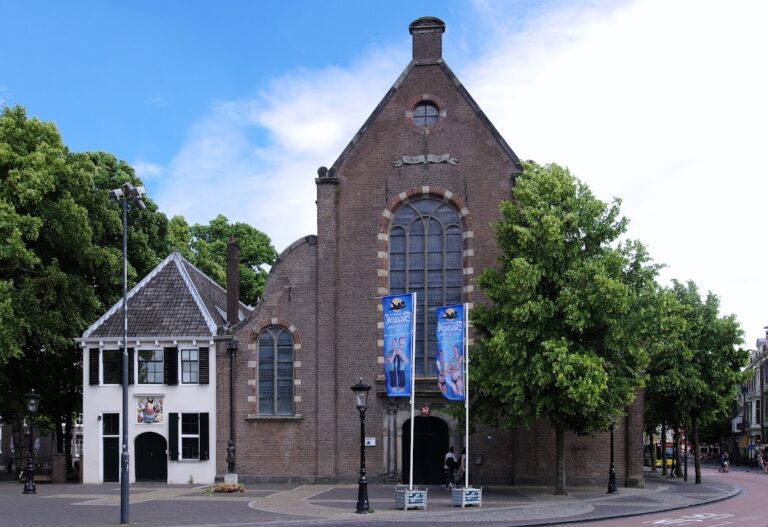
Jacobikerk is a medieval church in Utrecht, Netherlands, whose present building was begun at the end of the thirteenth century in the Gothic period. It originated in a small trading settlement on a branch of the Rhine, north of Stathe, Utrecht’s trading district, which was incorporated within the city walls during the twelfth century. First mentioned in 1173, the church became one of Utrecht’s four medieval parish churches, alongside the Buurkerk, Nicolaïkerk, and Geertekerk.
Medieval Parish Church
The church was dedicated to Saint James the Greater, one of the Twelve Apostles of Jesus. James was traditionally associated with Santiago de Compostela, a major Christian pilgrimage destination in northwestern Spain, and Jacobikerk became a stopping place for pilgrims travelling there. Its continuing connection with the Dutch pilgrimage route to Santiago is recalled by the scallop shell, James’s principal pilgrimage emblem.
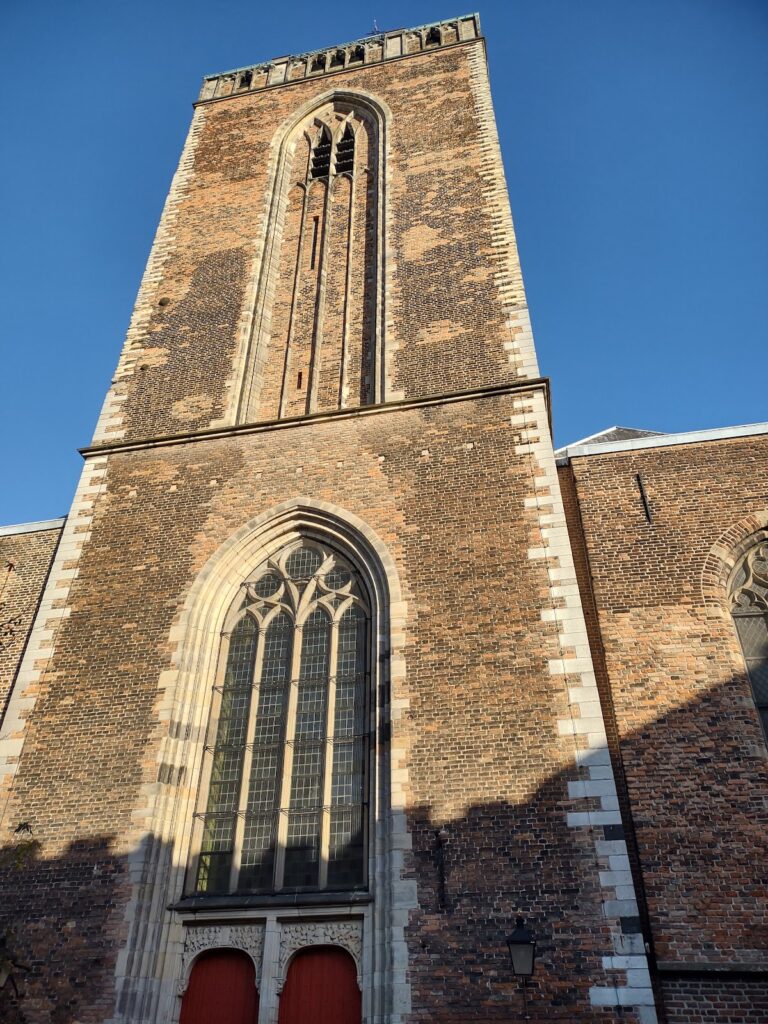
Population growth led to successive enlargements between 1330 and 1460. Around 1400, the tower was built into the surrounding aisles, and a tall spire was added in 1410. Between approximately 1460 and 1490, Alyt Ponciaens lived as an anchoress in a cell within the church. An anchoress was a religious recluse permanently enclosed in a cell attached to or incorporated into a church. Her cell survives within Jacobikerk.
Reformation and Conflict
Iconoclasm reached Jacobikerk in 1566, during the Protestant Reformation, the sixteenth-century movement that established Protestant churches and transformed many formerly Catholic churches in northern Europe. Shortly before this upheaval, the church had commissioned a new Renaissance choir screen from Jan de Clerk, a brass founder from Antwerp. The Reformation resulted in the replacement of only the main choir screen.
The church was caught up in the Dutch Revolt and the siege of Vredenburg Castle in 1576 and 1577, when Spanish troops were besieged there. Bombardment damaged the south and west sides of the tower, and a cannon was installed in it and aimed at the castle. Hubert Duifhuis, a former Catholic pastor, served as pastor of the Jacobikerk congregation during this unsettled period. The church became definitively Protestant by 1580 and is now used by the Jacobikerk district congregation of the Protestant Church in the Netherlands, within the tradition of the Dutch Reformed Church and the Gereformeerde Bond, a conservative Reformed movement within that church.
Storm Damage and Later Changes
During a summer storm on 1 August 1674, the approximately 80-metre spire collapsed. Its fall destroyed the carillon made around 1650 by the Hemony brothers and brought down the roof and stone vault. The vault was not rebuilt, and the lost spire was replaced by a low tent roof. In 1812, that roof was flattened so the tower could serve as a signal post for the French army.
A new and considerably lower spire was built in 1953, bringing the tower to its present height of 63 metres. Major restoration and renovation took place during the 1970s, including work in 1975 and 1976 carried out with five other historic churches in Utrecht. Jacobikerk continues to hold weekly Sunday services and is also used for weddings, concerts, and cultural activities. It is a nationally protected monument in the Netherlands, registered as Rijksmonument number 36148.
Remains
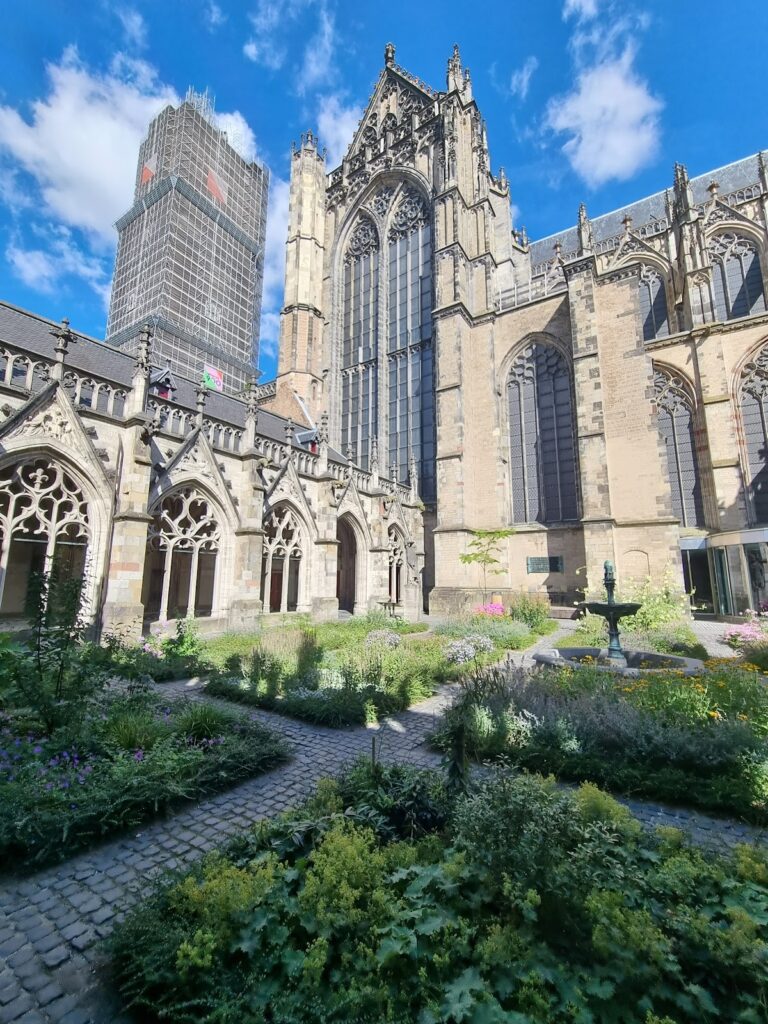
Jacobikerk survives as a Gothic hall church, with a unified interior formed by a nave and aisles of approximately equal height. The oldest parts date from the thirteenth century, while the building’s present form developed through the medieval expansions and is composed of halls vaulted entirely in stone. The tower is enclosed by the surrounding nave aisles, and its present spire is much lower than the one lost in 1674.
Tower and Exterior Features
Tower and Bells
The 63-metre tower contains five bells. The largest is the 4,000-kilogram Salvator, cast in 1479 by Steven Butendiic. It measures 182 centimetres in diameter. The four other bells date from the twentieth century. A weather vane shaped as a scallop shell stands on the tower, while numerous scallop-shell motifs throughout the church express its connection with the pilgrimage to Santiago de Compostela.
Sundials
A sundial dated 1463 is positioned on the south side of the church. It is described as the oldest surviving sundial in the Netherlands and as one of the oldest surviving sundials in Europe. A second sundial, dating from the eighteenth century, is located on the southern upper gable of the transept.
Anchoress’s Cell
A small anchoress’s cell is preserved within the cavity of the transept’s south wall. Its survival preserves the physical setting associated with Alyt Ponciaens’s residence in the church between approximately 1460 and 1490.
Choir Screens and Furnishings
Choir and Chapel Screens
Several choir screens and other metalwork remain inside the church. The late Gothic screens before the north Our Lady’s Choir and the south Holy Cross Choir date from 1516 to 1519 and were made by Jan van den Ende, a brass founder from Mechelen. The central screen before the main choir is a sixteenth-century Renaissance work by Jan de Clerk.
The screen before the Andrew Chapel was also made by Jan van den Ende. It was painted in the colours of the Panthaleon van Eck family arms and depicts Psalm 22 in wood and iron. An interior painting by Pieter Saenredam depicts Jacobikerk.
Pulpit and Baptismal Font
The oak pulpit dates from around 1560. A chalice-shaped baptismal font by the Utrecht sculptor Pieter d’Hont was installed in 1976. The church has between 600 and 800 seats.
Organ
The oldest parts of the organ date from approximately 1510 and were made by Gerrit Pietersz. Rudolf Garrels replaced much of the pipework in 1742, and the organ case in its present form is mainly the work of Abraham Meere, dating from 1819 to 1823. The instrument has 33 stops, with 13 in the main division, 15 in the rear positive, and 5 in the pedal division.