Gokuraku-ji Temple: A Shingon Buddhist Pilgrimage Temple in Naruto, Japan


Site at a Glance
- Rating
- 4.2
- Popularity
- Low
- Country
- Japan
- Primary era
- Early Modern
- External website
- Open
- Eras represented
- Early Modern
- Civilizations
- Tokugawa
- Site type
- Religious
- Remains
- Temple
On this page21 sections
History
Gokuraku-ji Temple is a Kōyasan Shingon Buddhist temple in Naruto, Japan, traditionally founded during the eighth-century Nara period and associated with the monk Gyōki. Shingon Buddhism emphasizes esoteric ritual, mantra, meditation, and sacred imagery. The temple’s principal Buddha is Amida Nyorai, the Buddha of the Western Pure Land, and Gokuraku-ji is Temple 2 of the Shikoku 88-temple pilgrimage. It also belongs to the eastern Awa Saigoku 33 Kannon pilgrimage and the Awa Hokurei Yakushi pilgrimage.
Traditional Foundation and Kūkai
The foundation of Gokuraku-ji is traditionally attributed to Gyōki, a major Buddhist monk of eighth-century Japan associated with establishing temples and spreading Buddhism among local communities. The precise foundation date is not securely established, but the tradition places the temple in the Nara period, or more broadly in the eighth century.
In 815, Kūkai, also known as Kōbō Daishi and the founder of the Shingon school, is said to have recited the Amida Sutra at the site for 21 days. On the final day, he experienced a manifestation of Amida Nyorai and carved an image based on what he had seen. That image became the temple’s principal object of worship.
Legends and Religious Associations
One foundation legend explains the temple’s mountain name, Nisshōzan, as “Mountain of the Sun’s Light.” The light radiating from the sacred image was believed to reach as far as Naruto and prevent local fishermen from catching fish. According to the tradition, the fishermen built a hill in front of the Main Hall to block the light, giving rise to the name.
Gokuraku-ji is also associated with conception and safe childbirth through traditions connected with Kūkai. A woman from Naniwa who experienced difficult labor is said to have given birth safely after receiving Kūkai’s ritual blessing. In gratitude, she donated a wooden image of Kūkai, which is now associated with the Daishi Hall.
A second childbirth tradition belongs to the Meiji period. A woman from Sumiyoshi prayed for a safe delivery and, after receiving an omen, undertook the Shikoku pilgrimage. She later donated a statue of the ascetic Kūkai in gratitude for the birth of her son. These traditions continue to shape the temple’s religious identity, including prayers for conception and childbirth, childbirth amulets, and maternity belts.
Destruction, Rebuilding, and Pilgrimage
Gokuraku-ji was burned in 1582 during the military campaign of Chōsokabe Motochika, a ruler who expanded his power across Shikoku. The temple was later rebuilt under the patronage of Hachisuka Mitsutaka, the daimyō, or major feudal lord, of the Tokushima domain. Much of the surviving architectural group belongs to this subsequent period and its later development.
The temple was included in Japan Heritage in 2015 together with the other 87 temples of the Shikoku pilgrimage. Its associated cultural properties include an Important Cultural Property, a prefectural cultural property, and a Naruto City natural monument. Gokuraku-ji continues to serve as a place of pilgrimage and worship devoted to Amida, Kannon, Yakushi, Jizō, Benzaiten, and childbirth-related forms of Kūkai devotion.
Remains
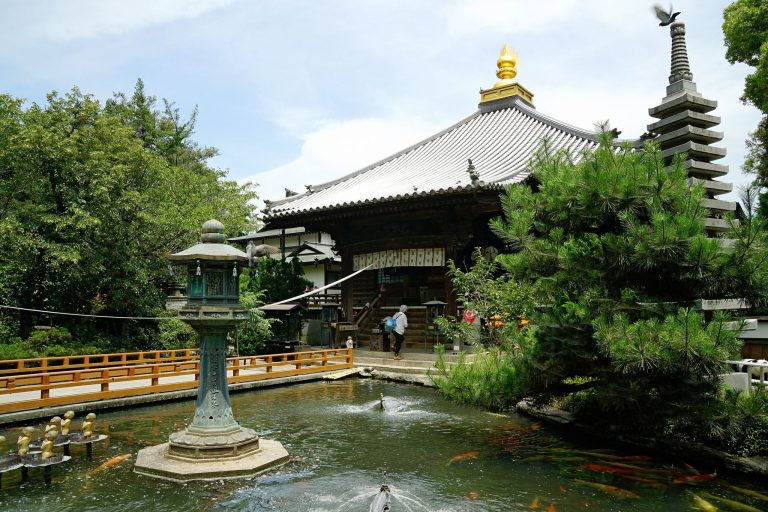
Gokuraku-ji is arranged around the Japanese garden called Unkai no Jōdo, with a sequence of gates, devotional images, halls, steps, and garden features leading toward the Main Hall and Daishi Hall. The buildings and objects combine Buddhist worship spaces with pilgrimage-related monuments, wooded grounds, and later devotional additions.
Entrance and Garden Approach
Niōmon Guardian Gate
The approach begins at a vermilion Niōmon, a guardian gate. It is a two-story structure with an irimoya roof, a hipped-and-gabled roof form, and houses a pair of Kongō Rikishi guardian statues. A hand-washing basin stands just inside the gate to the right. A haiku inscription describing a butterfly departing while clinging to Amida’s palm is positioned to the right after the entrance.
Unkai no Jōdo and Devotional Features
The route through Unkai no Jōdo turns from the group of one thousand Mizuko Jizō images toward the stone steps. Mizuko Jizō is associated with memorial rites for miscarried or stillborn children. Before the steps stands a Buddhist footprint stone. The One-Wish Water-Pouring Fudō and the Kannon Hall are to the right, while the Yakushi Hall is to the left. The Main Hall is reached at the top of the steps, and the Daishi Hall stands beyond it to the right.
Other devotional features distributed through the grounds include a stone image of Amida, a stone image of Shaka, the historical Buddha, the Child-Giving Daishi, and wish-granting Jizō. Cast images include the childbirth ascetic Daishi, the One-Wish Water-Pouring Fudō, Dainichi Nyorai, the central cosmic Buddha of Shingon Buddhism, Kannon Bosatsu, and Koyasu Jizō, a form associated with childbirth and the protection of children.
Hugging Jizō and Mizuko Jizō
The Hugging Jizō, popularly called Omokaru-san, is connected with a weight-divination practice. A person who feels the image to be light is believed to have a wish granted. The thousand Mizuko Jizō images form a group used in memorial rites for miscarried or stillborn children. The site of this group is traditionally said to have held the Main Hall before the early Edo period.
Main Worship Buildings
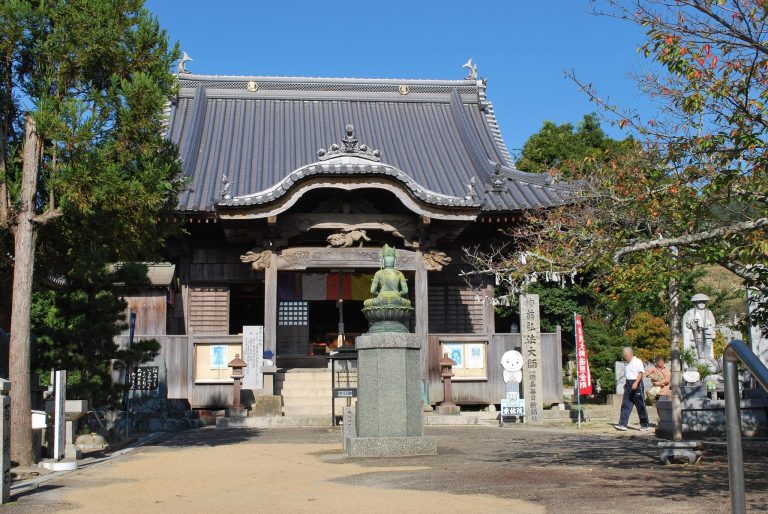
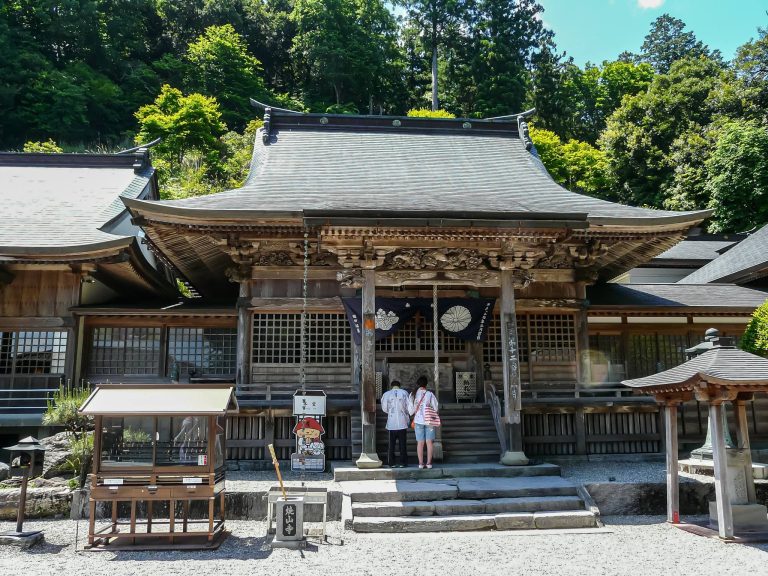
Main Hall
The Main Hall was built in 1659, during the early Edo period, the era of Tokugawa rule conventionally dated from 1603 to 1868. Behind the hall, a storage chamber cut into the slope holds the hidden principal image. A secondary image is installed inside the hall, with a seated Amida image on the right side altar and a standing Yakushi Nyorai, the Buddha of healing, on the left. A painting of hells and paradises hangs on the left interior wall.
Daishi Hall
The Daishi Hall was also built in 1659. It houses the wooden image of Kūkai associated with the temple’s childbirth traditions and is consequently known for its childbirth Daishi devotion. A second inscribed stone stands on the slope between the Main Hall and the Daishi Hall.
Kannon Hall
The Kannon Hall dates from the middle Edo period and houses a statue of Senju Kannon, the thousand-armed form of Kannon, a bodhisattva associated with compassion. The hall serves as Gokuraku-ji’s station in the eastern Awa Saigoku 33 Kannon pilgrimage.
Yakushi Hall
The Yakushi Hall was built during the late Edo period. Its principal image is a standing statue of Yakushi Nyorai, and the hall serves as the temple’s station in the Awa Hokurei Yakushi pilgrimage.
Sacred Images and Cultural Properties
Hidden Amida Image
The hidden principal image is a seated wooden Amida Nyorai from the Kamakura period. The lacquered and antiqued image is 84.0 centimeters high and was designated an Important Cultural Property in 1911. A larger stone Amida image on the grounds matches the hidden image in form, while the hidden figure is life-sized and lacks the swastika mark on its chest.
Mandala of the Two Realms
A silk painting of the Mandala of the Two Realms measures 157 by 107 centimeters. A mandala is a geometrically organized sacred diagram used in Buddhist ritual and meditation. This work represents the two principal mandalic worlds of Shingon Buddhism and was designated a prefectural cultural property in 1973.
Tree, Shrine, and Pilgrimage Markers
Chōmei-sugi
Chōmei-sugi is a large Japanese cedar traditionally believed to have been planted by Kūkai. It is said to be more than 1,200 years old, with a trunk circumference of 4.65 meters and a height of 15 meters. The tree is a Naruto City natural monument and is associated with longevity and prayers for safe childbirth.
Benzaiten Shrine and Bell Tower
A shrine dedicated to Shōfuku Benzaiten and a bell tower stand within the temple grounds. Benzaiten is associated with water, music, eloquence, and good fortune. Stone Buddhist images and other devotional features are distributed around the halls and garden.
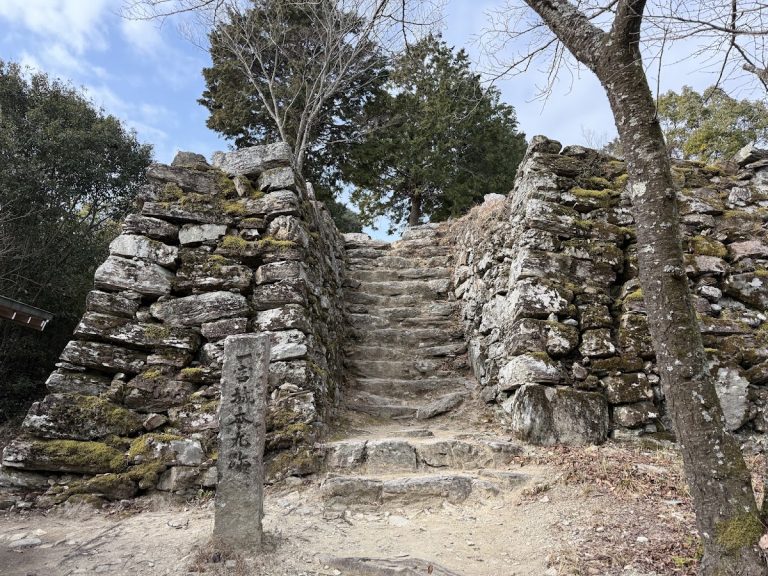
Stone Pillar Gate
Outside the temple grounds, a stone pillar gate stands on the pilgrimage path. An Osaka pilgrimage association donated it in December 1922, adding a modern pilgrimage marker to the approach to Gokuraku-ji.