Itterburg: A Medieval Hilltop Castle in Germany


Site at a Glance
- Rating
- 4.1
- Popularity
- Very Low
- Country
- Germany
- Primary era
- Medieval
- Eras represented
- Medieval
- Civilizations
- Holy Roman Empire
- Site type
- Military
- Remains
- Castle
On this page7 sections
History
Itterburg is a medieval hilltop castle in Germany, established by the Lords of Itter during the eleventh century at Thalitter, now part of the municipality of Vöhl in Hesse. It was one of three sites known as the Itterburgs, together with Steuerburg and Obere Burg, and stood at the centre of the medieval Lordship of Itter.
Origins and feudal affiliations
The surrounding Ittergau was associated with the “Haupthof Ittera,” first mentioned in 793. The Lords of Itter probably established the castle on this site in the eleventh century. Itterburg first appears in a record from 1126, when Riclind and Frederun of Itter, nieces and heirs of Folkmar of Itter, transferred the inherited allodial portions of the lordship to Abbot Erkenbert of Corvey as a fief. Corvey was a major Benedictine abbey and imperial religious institution in medieval Saxony, while a fief was land held in return for defined feudal obligations.
Around 1190, Archbishop Philipp I acquired the castle and 200 hides of land from Wittekind II of Schwalenberg for 200 marks on behalf of the archbishopric of Cologne. A hide was a medieval measure of land based on productive capacity rather than a fixed modern area.
Lordship between Mainz and Hesse
The Lords of Itter preserved their position between stronger neighbouring powers by accepting their protection. Heinrich III of Itter opened the castle to Landgrave Henry I of Hesse and received it back as a castle fief. In 1342, Heinemann III of Itter allowed Archbishop Henry III of Mainz and his successors to use Itterburg against the enemies of the archbishopric, with the exception of Landgrave Henry II.
Heinemann III, the last Lord of Itter known to have lived at the castle, died in 1356. An older claim that a relative stabbed him at Itterburg is not supported by surviving records. At that time, the Lordship of Itter included Dorfitter, Thalitter, Obernburg, Hof Lauterbach, Oberwerba, Vöhl, Basdorf, Asel, Marienhagen, Herzhausen, Harbshausen, Kirchlotheim, Schmittlotheim, Altenlotheim, Ederbringhausen, Niederorke, Oberorke, and Buchenberg.
After Heinemann’s death, Mainz and Hesse jointly took possession of most of the lordship in 1357. Each paid his widow, Margarethe, 900 marks of refined silver. Mainz pledged its share to Count Otto II of Waldeck in 1359, and Otto later pledged it to Thile Wolff von Gudenberg in 1381. The Hessian landgraves pledged their share to Thile in 1383, placing the castle and nearly the entire lordship in his pledged possession.
Decline and later ownership
Thile moved his residence to Vöhl, where he built a castle south of the village that later became Vöhl Castle. Itterburg began to decay from the middle of the fifteenth century after the Wolff von Gudenberg family moved its seat. The castle was completely destroyed during the Thirty Years’ War, the European conflict of 1618 to 1648 that caused widespread military destruction in the German lands. Heinemann’s brother Adolf and his descendants retained smaller portions of the Lordship of Itter until Erasmus of Itter died in 1443.
The Waldeck family redeemed its pledge in 1542, followed by the Hessian landgraves in 1562. In 1567, the division of the Landgraviate of Hesse assigned the lordship and Itterburg to Philip II of Hesse-Rheinfels. After his death in 1583, the territory and the already disused castle passed to his brother Louis IV of Hesse-Marburg, who later acquired the remaining portions that had not belonged to the landgraves.
In 1661, George III, the second son of Landgrave George II of Hesse-Darmstadt, received the former Lordship of Itter as a Paragium, a territorial allowance for a member of a ruling dynasty that provided income and a residence without creating an independent state. He lived at Hof Lauterbach north of Vöhl and at Vöhl Castle, and intended to turn Itterburg into a residence, but died before the work was finished.
Landgrave Ernest Louis transferred the castle remains into private ownership in 1715 by giving them to Ludwig Balthasar Müller, the mining inspector in Thalitter. Gustav IV Adolf, the former king of Sweden who had been deposed in 1809 and was living in Switzerland, bought the ruin in 1815 and later used the titles Lord or Count of Itterburg. From 1837, ownership belonged to his son Gustav, Prince of Wasa, an Austrian field marshal lieutenant.
Extensive excavations began in 1820 and exposed the surviving structures. The municipality of Vöhl purchased the castle grounds in 1951 for 18,000 Deutsche Mark. Itterburg remains a ruin and is distinct from Steuerburg, which was a former small outwork. The name Löwensteiner Burgsitz referred instead to a residential building immediately south of the castle that had probably already been demolished in the sixteenth century.
Remains
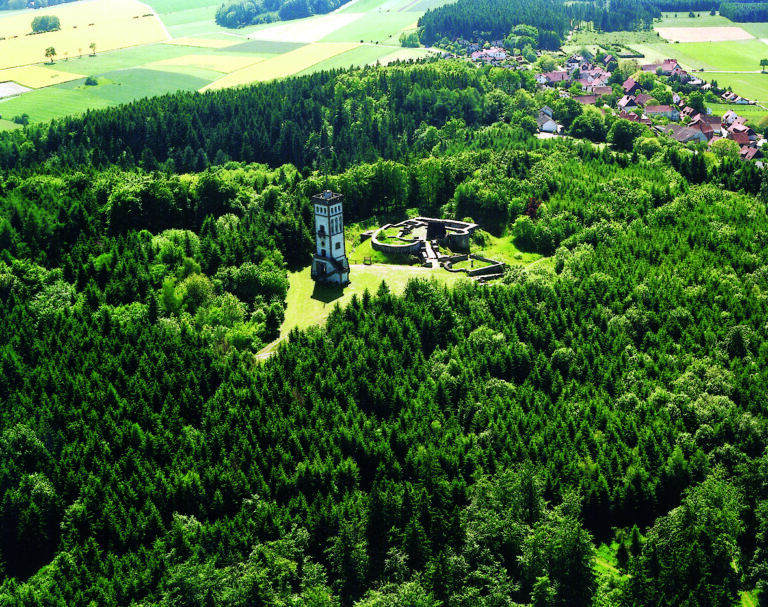
Itterburg occupies a long mountain ridge at 375 metres above sea level, north of and above Thalitter. The castle stood in a spur position and covered approximately 8 hectares. Its fortified complex had a square ground plan enclosed by an oval outer defensive enclosure, while about 3 hectares of surrounding pasture belonged to the Thalitter dairy farm and were used by it.
Fortified enclosure
The surviving site preserves the castle as a ruin within the former oval outer enclosure. The square internal plan expresses the main organization of the fortified complex, while the enclosure surrounded and protected its central buildings. Considerable masonry survives, although the broader castle is preserved in ruined form.
Residential tower
The probable keep also served as a residential tower. It had a ground plan measuring 11 by 11 metres, with walls approximately 2 metres thick. Substantial masonry from this tower remains among the visible structures exposed by the excavations begun in 1820.
Nearby sites