Isenburg: The Ruins of a Medieval Hill Castle in Germany


Site at a Glance
- Rating
- 4.7
- Popularity
- Low
- Country
- Germany
- Primary era
- Medieval
- Eras represented
- Medieval
- Civilizations
- Holy Roman Empire, Margraviate of Meissen
- Site type
- Military
- Remains
- Castle
On this page8 sections
History
Isenburg is a ruined medieval hill castle in Germany, located above the confluence of the Wildbach and the Zwickauer Mulde between Hartenstein and Wildbach in the Western Ore Mountains of Saxony. Built during the settlement of the Ore Mountains, the fortified site already existed in the twelfth century, as archaeological finds indicate. Its position on a rocky spur gave it a defensible setting above the river valley.
Origins and destruction
The name Isenburg derives from Eisenburg, meaning “Iron Castle.” It may have referred to nearby iron mining, or it may have expressed the idea of a castle as strong and impregnable. Later traditions also called the site the Robber Castle or Old Castle, but these names come from oral tradition rather than medieval documents.
Very little is known about Isenburg’s medieval history. No verified medieval documentary references to the castle survive, and the first recorded description dates from 1738. The castle was destroyed in the fourteenth century and was never rebuilt. From the fifteenth to the seventeenth century, the ruins were probably used as shelter by local inhabitants during periods of armed conflict.
Reuse, investigation, and local tradition
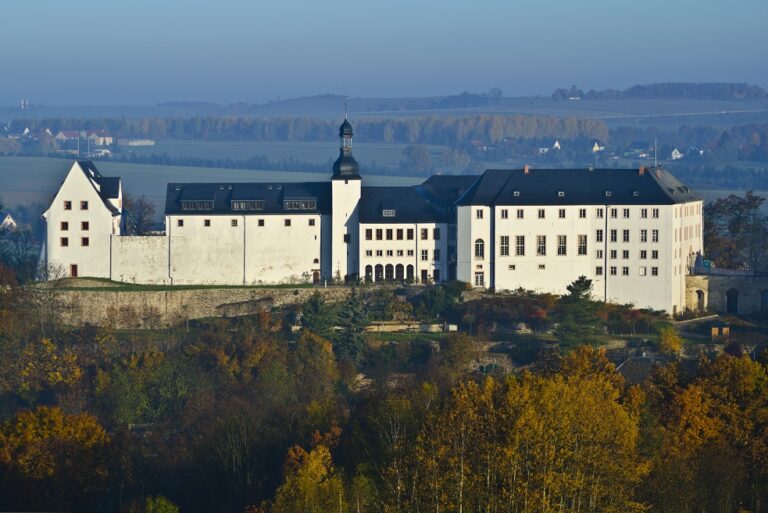
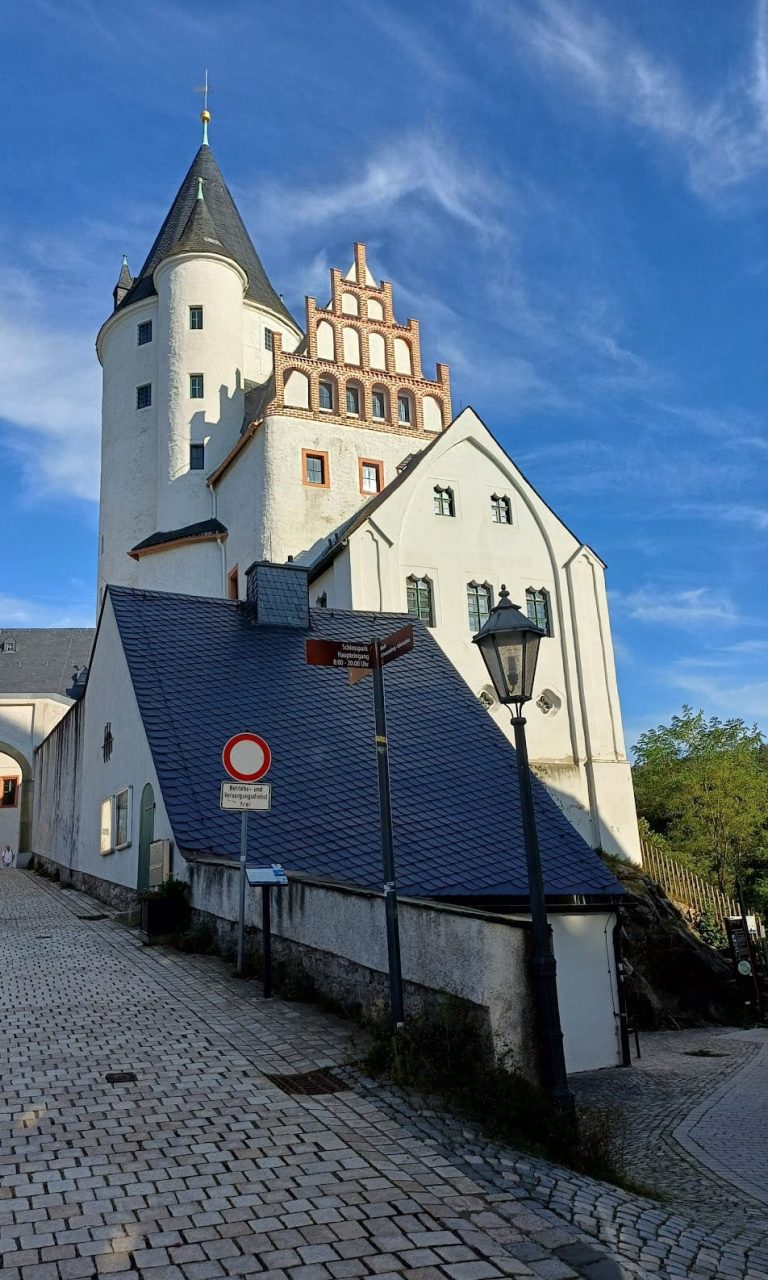
Around 1750, the remaining masonry was blasted apart so that the stone could be reused in the construction of the Wildbach church. An engraved view dated 1755 appears to be the only known historical depiction of Isenburg. It shows the castle as a ruin labelled “Eisenberg,” within a scene otherwise dominated by Stein Castle and the Zwickauer Mulde.
Werner Radig and Siegfried Sieber carried out the first recorded surveys in the summer of 1933. In 1934, members of the Reich Labour Service, a state labour organization in Nazi Germany that undertook public-works projects, exposed surviving sections of the rampart system. The foundations of the ring wall and the remains of the round bergfried, the principal defensive tower of a medieval German castle, were restored in 1993.
Several local legends became associated with the already ruined castle. One tradition tells of a white woman, sometimes described as an ancestral or enchanted figure, who supposedly fled a defeated Hussite group during the Hussite incursions. The Hussites were followers of the reformer Jan Hus, whose military campaigns affected parts of Central Europe during the fifteenth century. According to the story, the woman later protected the inhabitants of nearby Stein and was known as Andjola Wallenta. This account is legendary rather than documented history.
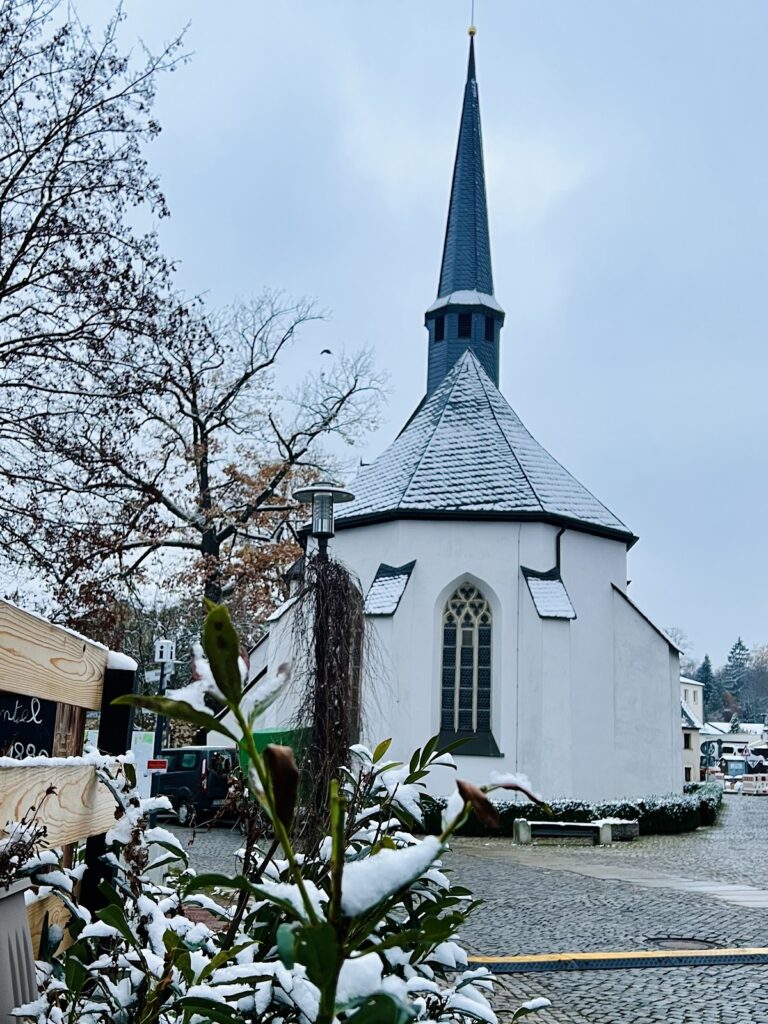
Another legend links Isenburg with Konrad von Kauffungen, described as a fourteenth-century robber knight associated with Stein Castle. According to the story, he was condemned after death to frighten visitors to Isenburg in the form of a dwarf. A supposed underground passage between Stein Castle and Isenburg has not been found. In 2019, the white-woman tradition was commemorated by an approximately two-metre-high oak sculpture by woodcarver Jesko Lange. The sculpture was installed at the Heimatstube on the church square in Wildbach as part of a local heritage presentation of the legend.
Remains
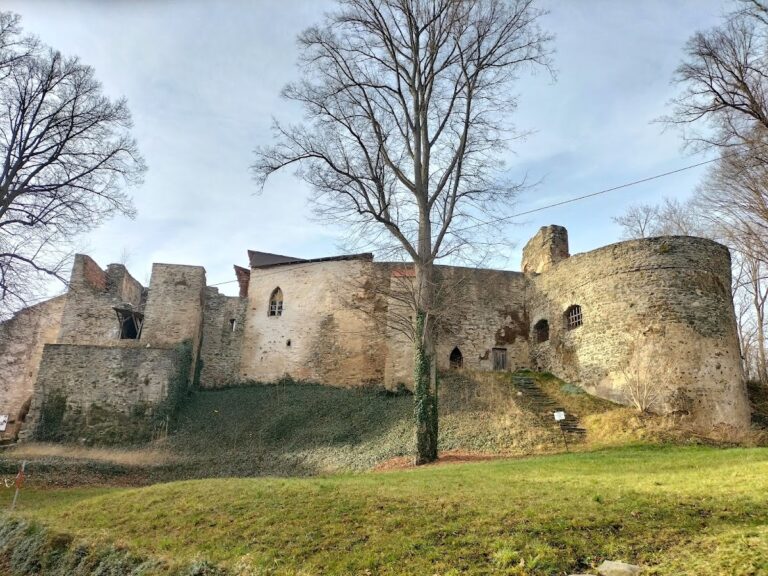
Isenburg occupied a rocky spur high above the Zwickauer Mulde. The fortified area measured approximately 51 by 33 metres and was divided into an outer bailey, a lower bailey, and an upper bailey. A cistern formed part of the complex. Its western side was the only easily accessible approach and was additionally defended by a ditch.
Castle defenses and masonry
Ramparts and ring wall
The surviving ruins include sections of the rampart system and the foundations of the ring wall. The castle walls were built from rubble stone. Their inner and outer faces used horizontally laid courses, while the wall core contained opus spicatum, a masonry technique in which stones are arranged in a herringbone pattern. These remains preserve evidence of the construction methods used in the fortified enclosure.
Round bergfried
The round bergfried had a basal diameter of approximately 9 metres and walls about 3 metres thick. Such a tower served primarily as a strong defensive refuge rather than as a permanent residence. The surviving remains of the tower were restored in 1993 and form one of the principal visible elements of the site.
Nearby fortifications and mining features
Approximately 200 metres east of Isenburg, near Niederschlema, lies Vogelherd, a small medieval spur castle on the western bank of the Zwickauer Mulde. It stands lower than Isenburg above a bend in the river, and its purpose remains uncertain. It may have protected an “iron ford” or “iron bridge” across the river. Shallow prospecting pits nearby have been interpreted as traces of attempts to mine iron. On the eastern bank, opposite Isenburg and Vogelherd, the Prinzenhöhle preserves an old mining adit.
Nearby sites