Stein Castle: Medieval Fortress and Museum in Saxony
Site at a Glance
- Rating
- 4.4
- Popularity
- Low
- Country
- Germany
- Primary era
- Medieval
- External website
- Open
- Eras represented
- Medieval, Early Modern
- Civilizations
- Holy Roman Empire
- Site type
- Military
- Remains
- Castle
On this page13 sections
History
Stein Castle is a medieval fortress in Germany, in Stein, a district of Hartenstein in Saxony. Construction probably began around 1200 during the medieval settlement of the Ore Mountains, and the complex developed through successive rebuilding phases. Its upper castle may have served as an outer fortification for nearby Hartenstein Castle, while a river crossing below it supported movement across the Zwickauer Mulde.
Medieval origins and lordship
The castle was first mentioned in 1233, when it stood under the authority of the Burgraves of Meissen together with the County of Hartenstein. Its first known owner was Heidenreich of Grünhain, also called Heidenreich of Stein, a member of the lesser nobility who was probably a feudal tenant, or holder of land in return for obligations to a superior lord, of the Meinheringer. The farming villages of Langenbach and Wildbach owed service to the castle.
The Zwickau patrician Egerer family probably held Stein from 1305 to 1350. In 1372, the Bohemian Crown confirmed the Wettins’ possession. The Wettins were the ruling dynasty that controlled Saxony and related central German territories. Fourteenth-century lords of Stein acquired a reputation for raiding, and a 1320 document accused Conradus de lapide of numerous misdeeds.
Hans von Kaufungen held the castle in 1388, followed by Hans von Tettau from 1402 to 1406. In 1406, the Schönburgs received Stein and Hartenstein as pledges from the Burgraves of Meissen. Because the pledge was not redeemed, both castles eventually became permanent Schönburg possessions. Schönburgs or their feudal tenants then controlled Stein, including Heinz von Remse the Elder in 1411 and the Trützschler family from 1450 to 1632.
Conflict and transformation
Stein was drawn into the kidnapping of the Saxon princes Ernst and Albrecht in 1455. Kunz von Kaufungen, who believed that Elector Frederick the Gentle had treated him unjustly, carried out the abduction. Ernst was hidden in a nearby cave later called the Prince’s Cave. Kunz was captured and beheaded at Freiberg on 14 July 1455.
During the German Peasants’ War, the large uprising of 1524 and 1525, the castle was besieged by its farming tenants while their lord, Ernst II of Schönburg, was away. The siege ended when he returned with troops from the Battle of Frankenhausen. The rebels were severely punished, and many were executed.
From the late fifteenth into the early sixteenth century, the Trützschlers established a more accessible lower castle beside the river. In 1632, Stein reverted to its feudal lords. The Lordship of Stein separated from the County of Hartenstein in 1701 and 1702, making the castle the seat of an independent lordship that included Stein, Wildbach, Langenbach, Fährbrücke, the abandoned villages of Oberopritz and Niederopritz, and the Rüsdorf court with Kuhschnappel.
Schönburg rule and later history
Stein was unsuitable as a Baroque residence, so Ludwig Friedrich, Count of Schönburg-Stein, had Schloss Rüsdorf built near Lichtenstein. That manor house no longer survives. In 1740, the Schönburgs recognized the sovereignty of the Wettin ruling house over their previously immediately imperial lordships, including Waldenburg, Glauchau, Lichtenstein, Hartenstein, and Stein. Schönburg rule continued until 1878, when the territories were fully incorporated into the Kingdom of Saxony. Stein and the lesser County of Hartenstein were then assigned to the Zwickau district administration.
A major fire destroyed the lower castle in 1762. It was partly rebuilt in 1798 and renovated in 1846, when the hall on the second upper floor received a Classicist painted interior. In 1813, Prince Otto Victor I of Schönburg transferred the lordships of Stein and Hartenstein to his three younger brothers. He later became a co-owner again after two brothers died without children, and his son, Prince Otto Friedrich of Schönburg-Waldenburg, succeeded him in 1859.
The castle remained with the Princes of Schönburg-Waldenburg until its expropriation during the socialist land reform of 1945. Its last pre-1945 head of household was Günther, Prince of Schönburg-Waldenburg, who generally lived at Waldenburg. Stein Castle survived the Second World War undamaged, unlike nearby Hartenstein Palace, which was almost completely destroyed by American bombing on 20 April 1945. The modern steel-arch bridge at the river crossing was blown up by the SS in 1945, and a concrete bridge replaced it in 1950.
Museum and preservation
Since 1954, the upper castle has housed Hartenstein’s Castle and Local History Museum. During the East German period, the newer part of the lower castle became a convalescent home, and the complex was designated a House of Culture in 1956. The museum presents the castle’s feudal history and the history of the surrounding region, including material on Paul Fleming, a seventeenth-century German poet and physician.
After German reunification, Alfred, Prince of Schönburg-Hartenstein, reacquired the castle and part of the former family property from the town of Hartenstein in 1996 and undertook extensive renovation. The castle remains privately owned, with part of the complex open through the museum. Stein Castle and the former siegeworks known as Ur-Stein are protected archaeological monuments. Ur-Stein received protection in 1958 and Stein Castle in 1971. Finds from the castle area made before 1983 date from the thirteenth to fifteenth centuries. The former villages of Oberopritz and Niederopritz were probably destroyed during the Hussite Wars, fifteenth-century religious and political conflicts in central Europe, while nearby Isenburg Castle was destroyed in 1320.
Remains
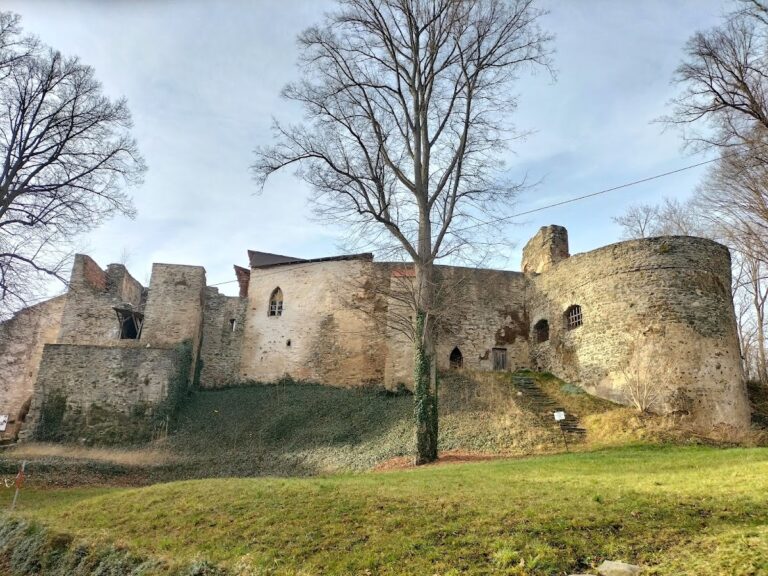
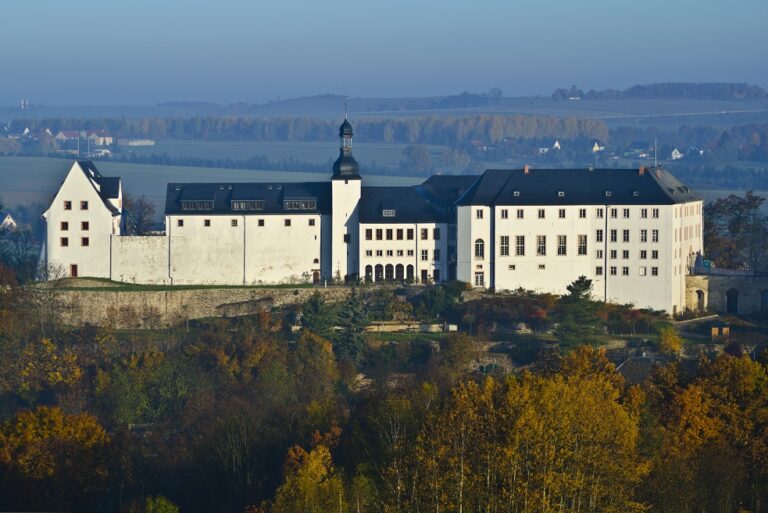
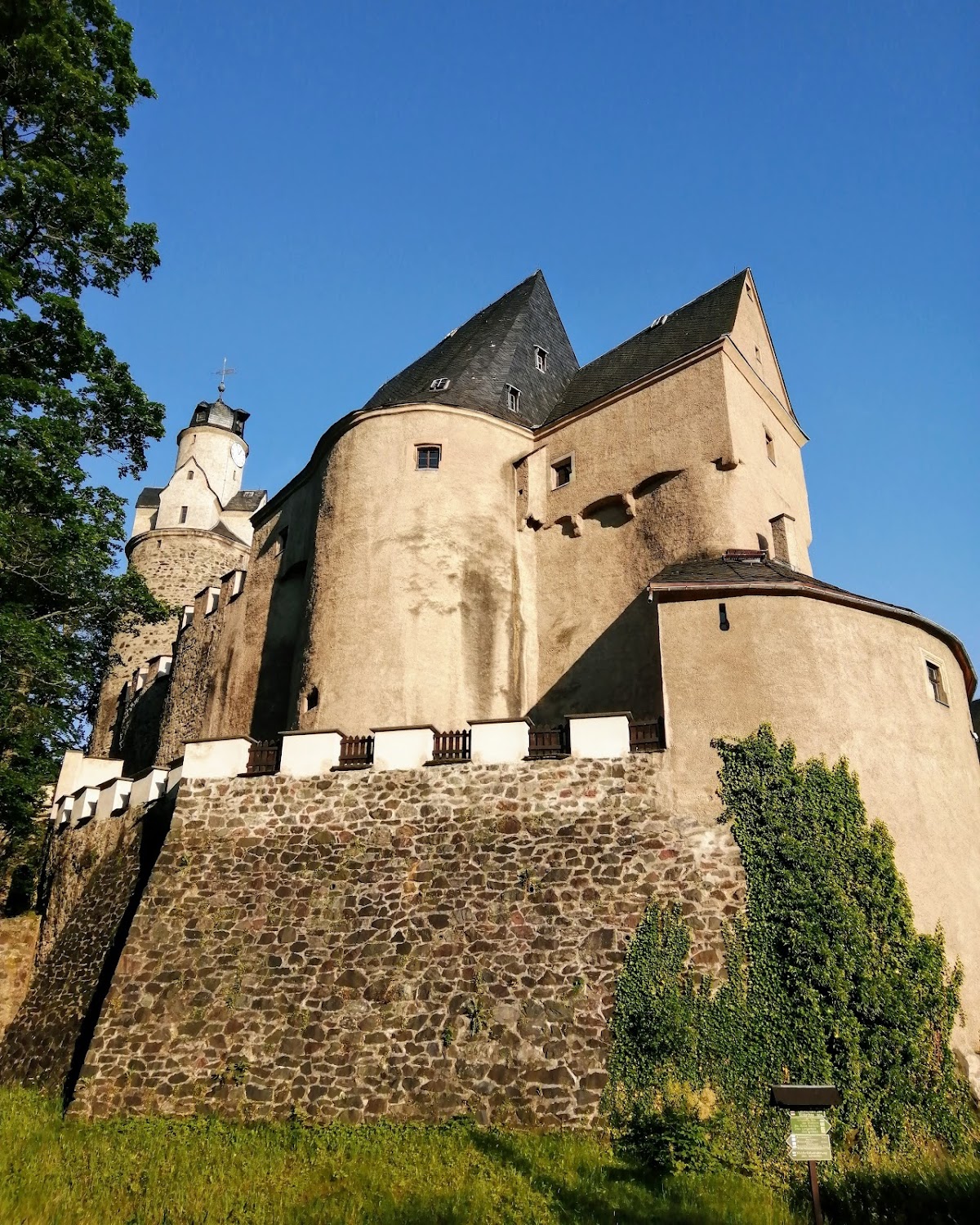
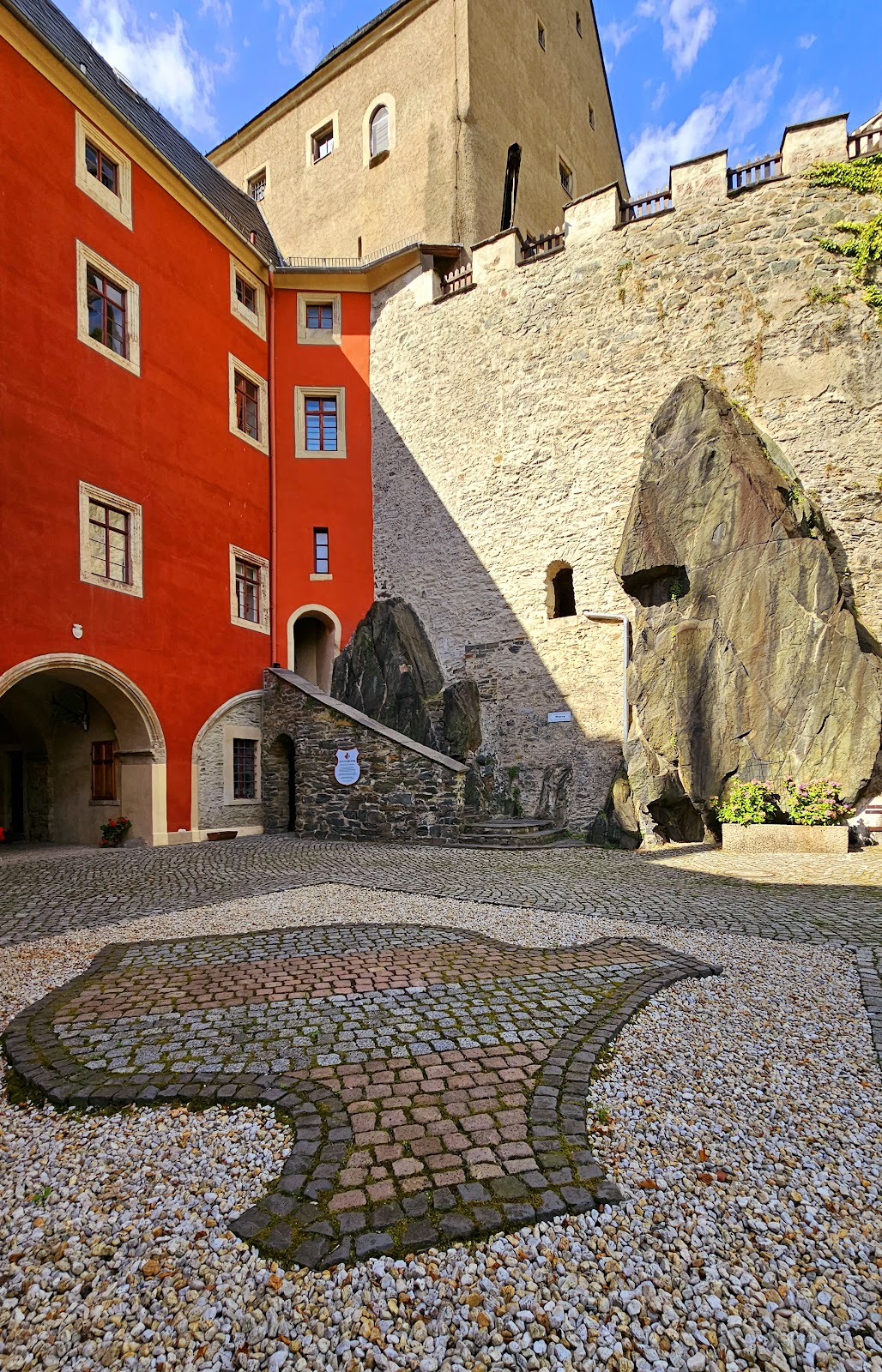
Stein Castle is a largely preserved lowland castle built on a hornblende rock outcrop beside the Zwickauer Mulde. The upper castle occupies the rock, while the lower castle extends southwest toward the river. The complex originally relied on the river, moats, walls, and earthworks for defense. A ford, later a ferry and a series of wooden and stone bridges, served the crossing below the castle, and bridge tolls continued until 1924.
Upper castle
Bergfried
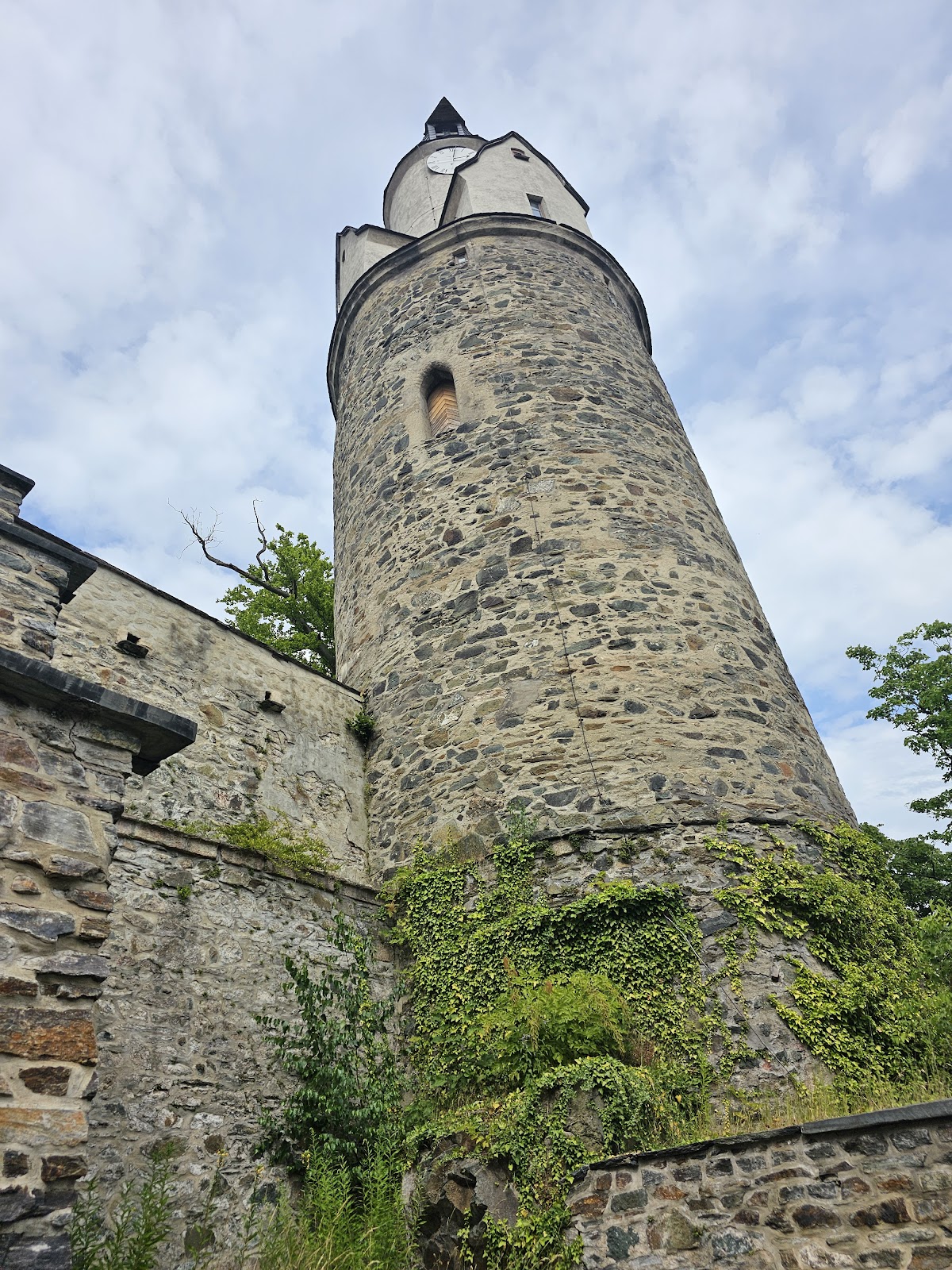
The upper castle is the oldest part of the complex and retains late Romanesque characteristics. Its circular bergfried, the principal defensive tower of a medieval German castle, rises approximately 50 metres. A high entrance is set halfway up the tower. The sixteenth-century upper structure has a gabled crown with four small gables and keel-arched roofs, while an eighteenth-century Baroque hood completes the tower. A dungeon cut into the rock is traditionally said to lie inside it, but the tower is not open to visitors.
Palas and chapel
The palas, the castle’s main residential and representational building, stands on a strong round bastion that protected the lower-castle gate. An original spiral staircase survives inside it, made from roughly hewn firwood planks. A substantial oak door with carved ornament dates from the late fifteenth or early sixteenth century.
The upper castle was initially defended by a water-filled moat and two lines of walls. Since the river protected only the southern side, water-filled ditches and earthworks later surrounded the entire complex, making it effectively a water castle. The ditches and ramparts were subsequently levelled, although older views preserve indications of their arrangement, and the modern road around the castle probably follows part of an earlier rampart.
A single-nave late Gothic chapel once stood on the rock beside the bergfried. It had a large pointed-arch window with tracery. Fire badly damaged the building in 1844, and structural decay led to its demolition in 1886. Small remains still survived in the upper-castle garden around 1981. An eighteenth-century view also shows a slimmer tower beside the bergfried, probably a stair tower linking the courtyard with the rock level, upper-castle garden, and chapel. No remains of this tower were visible in 2019.
Lower castle
Southwest tower and wings
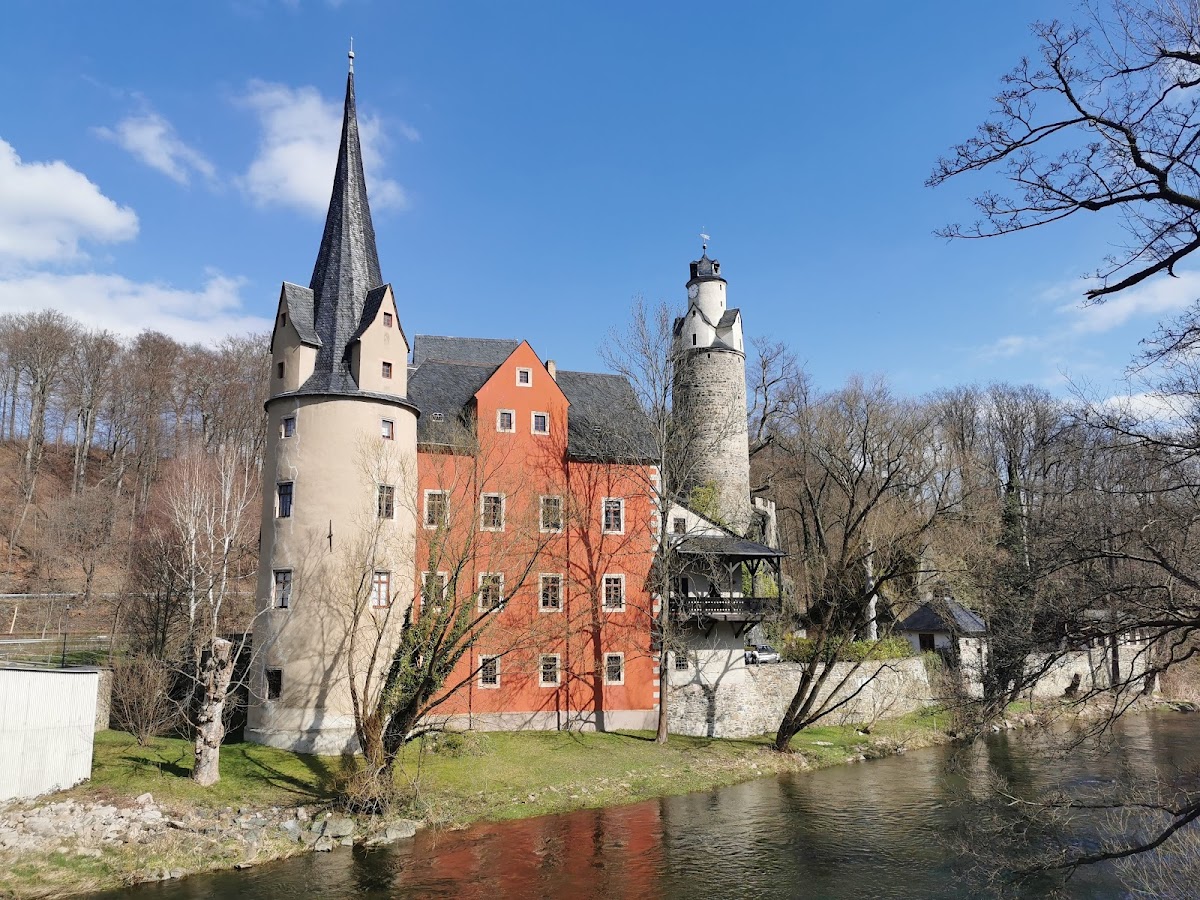
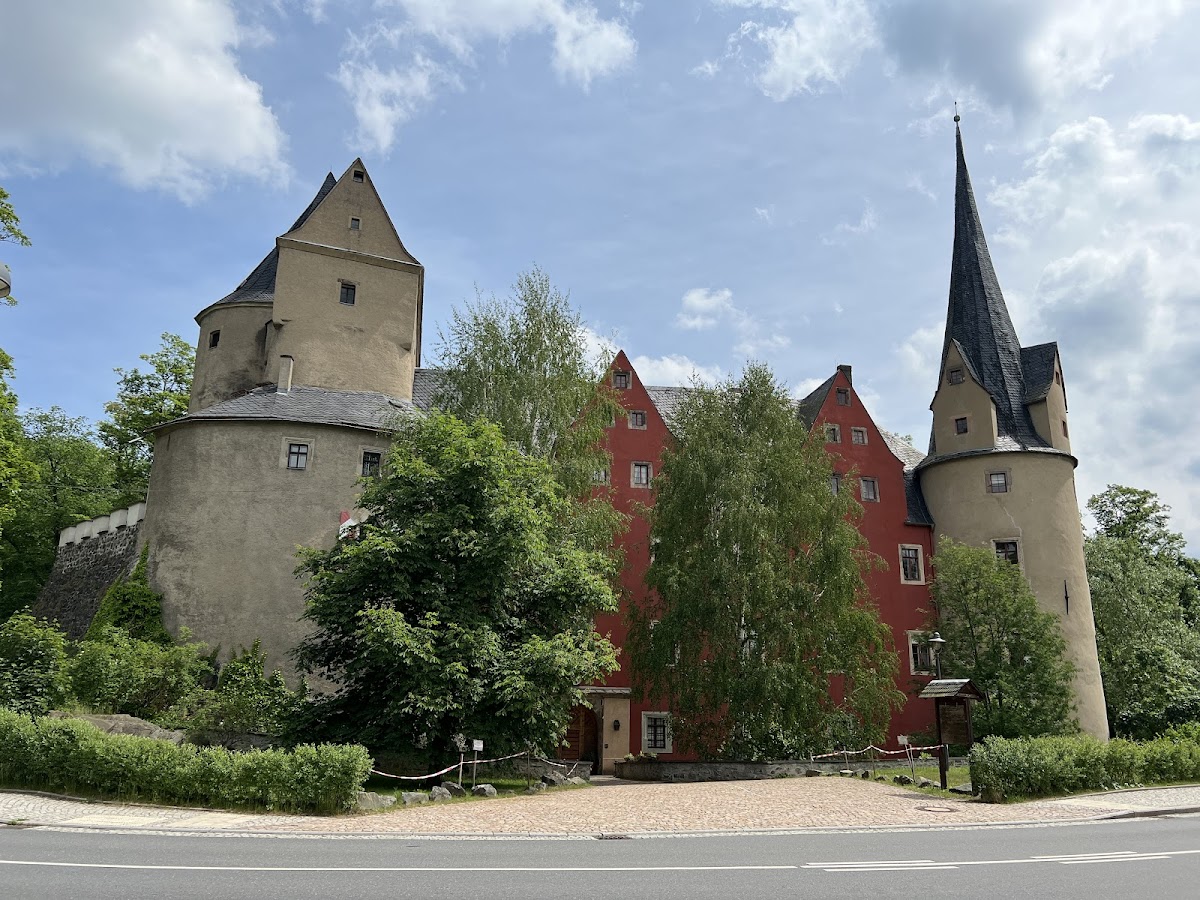
The pointed round tower at the southwest may date from the fourteenth century. It rises 32 metres and carries a tall, pointed conical roof; battlements formerly stood below it. Most of the other lower-castle buildings were constructed at the end of the fifteenth century. Three wings originally enclosed an almost quadrangular courtyard together with the upper castle. The southern wing, parallel to the Mulde and dating from the sixteenth century, was once twice its present length.
The west wing contains the entrance passage to the courtyard and reaches the upper-castle rock. A defensive wall-walk extended from the lower castle toward the rock, with farm buildings attached. An 1835 view shows a former courtyard tower, probably positioned between the east and south wings, but it no longer survives.
Outer bailey and interiors
An outer bailey west of the lower-castle gate was demolished around 1850. Its service buildings included a forester’s house, a sheep farm, and a bone mill. A low round tower with a Baroque hood and lantern stood at its corner and connected to the castle by a wall and arched gate. The surviving bridge in front of the lower-castle gate once linked this outer bailey with the castle.
The lower castle contains a ceremonial hall and a late Gothic net vault, a ribbed vault whose ribs form a net-like pattern, in the southwest corner tower. The lower castle is used for forestry administration and private residential rooms, while the hall and tower vault host concerts, weddings, and other events. Former residential rooms in the upper castle house the museum, whose displays include edged and ranged weapons, torture instruments, hunting equipment, suits of armour, and everyday objects.
The castle museum also preserves a life-sized, brightly painted wooden figure of the court jester Abel or Heben Streitenberger. He served at Hartenstein under Otto Ludwig of Schönburg-Hartenstein, and the figure was made after his death. The claim that he served at Stein Castle and was its last court jester remains unproven. The former Schönburg arms collection included crossbows, matchlock, wheellock, and flintlock firearms, air guns, percussion guns, and needle guns. Most of that collection was later transferred to the Dresden State Art Collections.
Medieval siegeworks
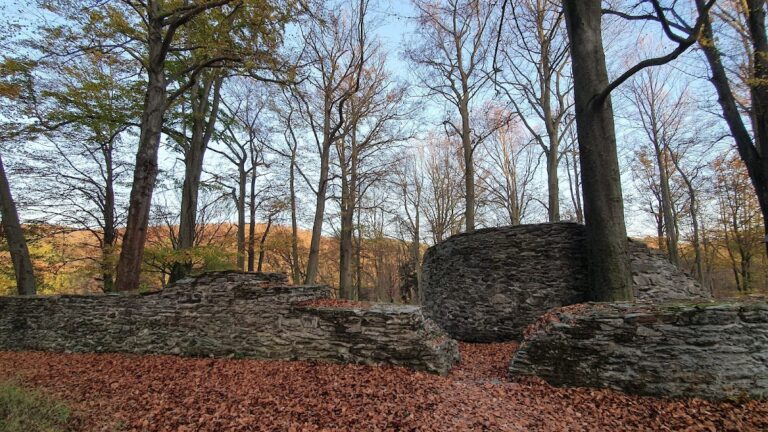
Northwest of Stein Castle, above Hartenstein station, lies a medieval fortification on a circular mound approximately 30 metres in diameter. It has an inner ditch 10 to 12 metres wide and about 2 metres deep, a rampart approximately 5 to 8 metres wide, and an outer ditch. Earlier interpretations identified the earthwork as a motte-and-bailey predecessor called Ur-Stein. More recent research identifies it as the remains of a medieval siegework. The site has also been associated with the historical names Türmelberg, Eichleithe, and Eichlehde.