Latrun Castle: A Crusader Fortress in Israel


Site at a Glance
- Rating
- 4.5
- Popularity
- Low
- Country
- Israel
- Primary era
- Medieval
- Eras represented
- Medieval, Modern
- Civilizations
- Crusader, Kingdom of Jerusalem, Knights Templar
- Site type
- Military
- Remains
- Castle
On this page10 sections
History
Latrun Castle is a Crusader fortress in Israel, built during the medieval period as part of a defensive system protecting the road to Jerusalem. Its first tower was constructed in 1132 or 1137, and the site passed to the Knights Templar in 1141. This medieval military-religious order was founded to protect Christian pilgrims and territories in the Holy Land.
Crusader foundation and destruction
After taking control of the site, the Knights Templar built a larger fortress called Le toron des chevaliers, meaning “Tower of the Knights.” Local usage gradually corrupted this name into “Latrun.” Saladin’s forces destroyed the fortress in 1187 after Saladin, the Muslim ruler and commander who had unified much of the region, defeated the Crusader army at the Battle of Hattin.
The Crusaders recaptured Latrun in 1229 during the Sixth Crusade. That thirteenth-century campaign restored several Crusader territories through diplomacy and agreement rather than through a major military conquest. It remains uncertain whether the fortress was rebuilt after its recapture. By the middle of the thirteenth century, the Crusaders had been driven from the fortress.
Twentieth-century military history
During the Israeli War of Independence, the 1948 Arab-Israeli War, a position of the Jordanian Legion occupied the fortress. The Jordanian Legion, also known as the Arab Legion of Transjordan, held military positions in the area. Israeli forces unsuccessfully attempted to capture Latrun during the Battles of Latrun. The site was captured during the Six-Day War, the Arab-Israeli war of June 1967.
Remains
Hilltop setting
The fortress stands on Latrun Hill at an elevation of 261 metres above sea level, approximately 250 metres southeast of the Monastery of the Silent Monks, which it overlooks. The monastery is a Trappist community belonging to the Cistercian Order of the Strict Observance, a Catholic monastic order associated with contemplation and silence. Olive groves belonging to the monastery occupy parts of the hill and its slopes, while Nahal Nahshon runs through the valley south of the fortress. The summit provides views toward the Jerusalem Hills, the Judean Lowlands, Highway 1, Sha’ar HaGai, the Modi’in area, the Dan metropolitan area, and the southern coastal plain.
Fortress remains
Keep and cellar
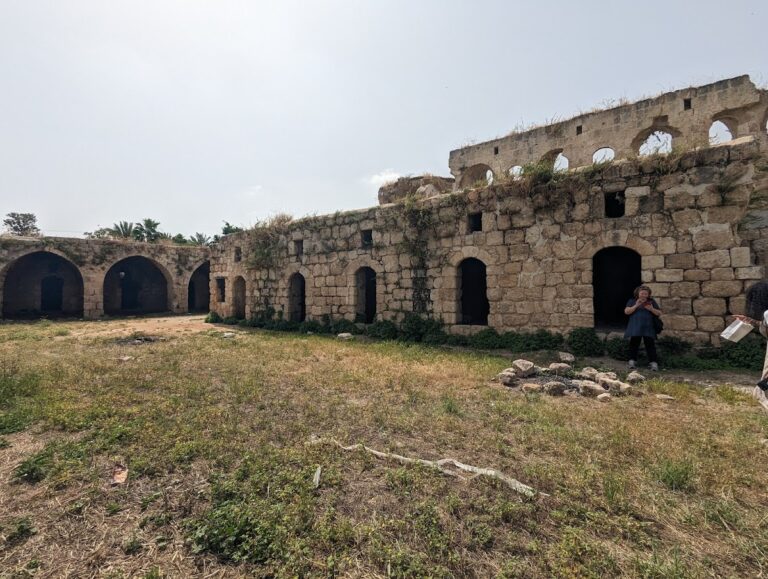
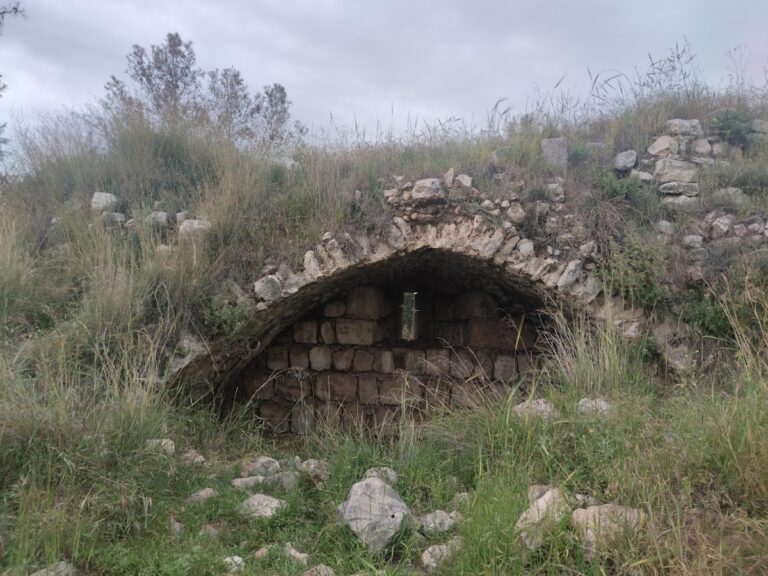
Archaeological surveys exposed the fortress keep and a cellar. These remains form part of the surviving evidence for the medieval stronghold on the hilltop.
Walls, arches, towers, and church
Surveyed remains also include fragments of a wall, arches, towers, and a church. Together, these features identify several elements of the former fortress and its associated religious architecture.
Jordanian military position
Remains of the Jordanian military position are visible around the fortress, including communication trenches that remain in the surrounding ground. They preserve physical evidence of the site’s later military use.
Memorial
The Sa’ar Formation Memorial stands east of the fortress remains.
Nearby sites