Immaculate Conception Church in Busko-Zdrój: A Historic Parish Church


Site at a Glance
- Rating
- 4.6
- Popularity
- Low
- Country
- Poland
- Primary era
- Modern
- External website
- Open
- Eras represented
- Medieval, Early Modern, Modern
- Civilizations
- Kingdom of Poland, Polish–Lithuanian Commonwealth, Russian
- Site type
- Religious
- Remains
- Church
On this page11 sections
History
Foundation and Norbertine association
The Immaculate Conception church in Busko-Zdrój, Poland, is the town’s oldest parish church originating in the historic Norbertine complex. Its first church was founded around 1166 by Dzierżko, a knight who owned part of the Busko lands and was the brother of Wit of Chotel, bishop of Płock.
Between 1180 and 1186, Dzierżko established an adjacent convent for Norbertine nuns, also known as Premonstratensians, a Catholic religious order founded in the twelfth century. The convent was a filial house of the community at Witów, and the church remained linked with the monastery until the order was suppressed.
Around 1190, before leaving for the Third Crusade, Dzierżko made a will concerning the future of the community. He provided that his wife would enter the Busko convent after taking religious vows and bring his entire estate to it as her dowry.
Medieval church and reconstruction
A new church replaced the original building in 1470. It was destroyed by fire in 1590, after which reconstruction continued from 1592 to 1621. Cardinal Jerzy Radziwiłł, a Polish-Lithuanian nobleman and Catholic cardinal of the Radziwiłł family, dedicated the church while it was still under reconstruction in 1595.
During this rebuilding, a chapel was added on the south side. It was dedicated to Saint Anne and is now the chapel of Our Lady of Częstochowa. The church later underwent further changes in 1804, when its facade was remodeled and the interior received a new high altar.
Suppression, fire, and parish use
A tsarist decree suppressed the Norbertine order in 1819. The following year, a major fire destroyed Busko, including the church and the adjoining monastic buildings. The church was rebuilt soon afterward and became a generally accessible parish church after the convent was dissolved.
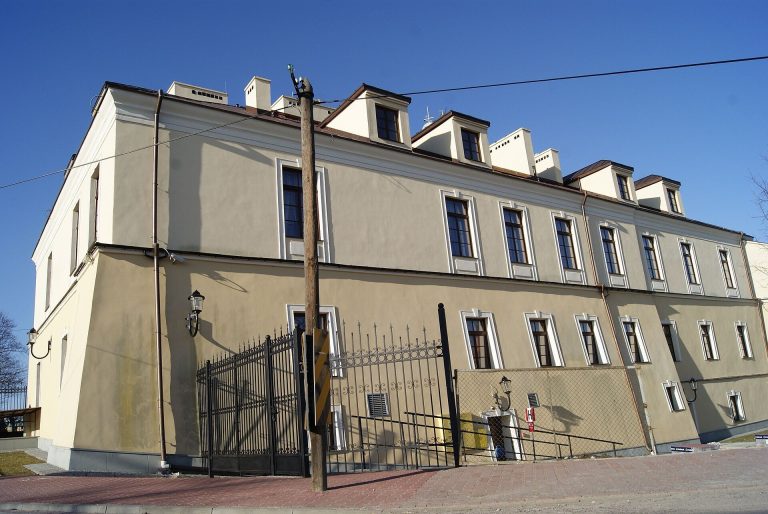
The rebuilding after 1820 changed the building’s internal arrangement and its relationship with the adjacent street. The principal entrance was placed toward the street, while the church’s orientation was reversed. The altar was moved to the west wall, the new presbytery, the area around the high altar traditionally reserved for clergy, occupied the former nave, and the nave occupied the former presbytery. As a result, the present nave is narrower than the presbytery.
The church is a Roman Catholic parish church dedicated to the Immaculate Conception of the Blessed Virgin Mary. The church and the former Norbertine monastery complex are entered in the heritage register under registration number A-17/1-3, with entries dated 1947, 1958, and 1967.
Remains
Surviving medieval and later fabric
Gothic west wall
Only the west wall of the original Gothic church survives. Its most distinctive medieval feature is a now-blocked pointed-arch portal. The other medieval architectural elements and the medieval interior decoration were destroyed during the building’s later history.
Our Lady of Częstochowa Chapel
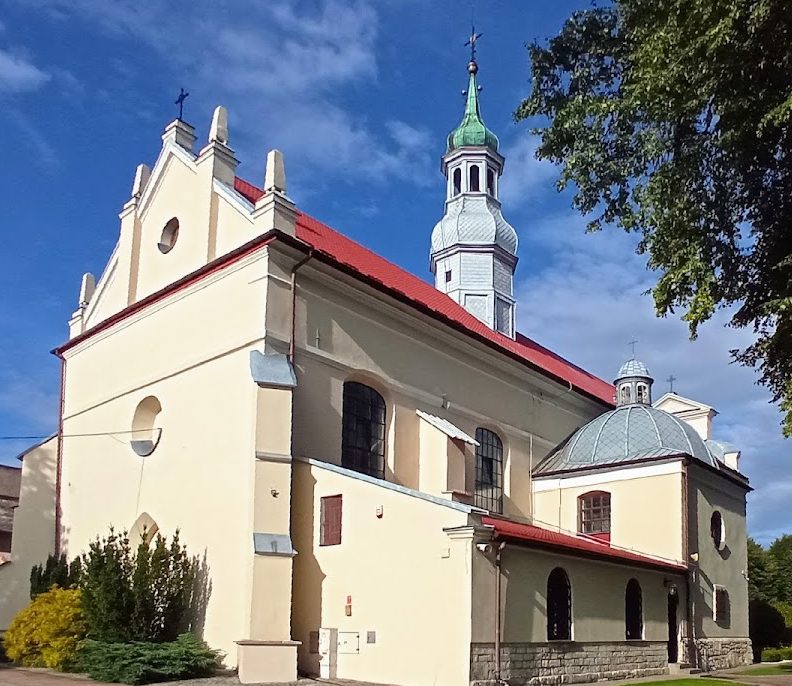
The former chapel of Saint Anne, built on the south side during the reconstruction of 1592 to 1621, has a square plan and a dome topped by a lantern, a small raised structure or opening that can provide light to the space below. It is now dedicated to Our Lady of Częstochowa.
The chapel preserves memorial and foundation features connected with its early history. Its east wall contains a stone epitaph for Anna Kowalkowska née Korycińska, the wife of the Sandomierz starost, who died in 1606. On the south wall, a Mannerist foundation tablet identifies Zygmunt Urbański as the chapel’s founder. An altar concealed the tablet for many years, until it was uncovered again in 2009.
Baroque-classicist facade and high altar
The east side of the church received a prominent Baroque-classicist facade during the rebuilding after the 1820 fire. The high altar installed in 1804 contains a painting of the Virgin Mary attributed to Franciszek Smuglewicz, an eighteenth- and early-nineteenth-century Polish-Lithuanian painter known for religious and historical works.
Twentieth-century painting
At the altar-side corner of the chapel of Our Lady of Częstochowa, on the left side of the nave, hangs Adolf Hyła’s Jesus, I Trust in You. It is a twin copy of the better-known image of the Merciful Jesus that Hyła painted in 1944 for the convent chapel of the Congregation of the Sisters of Our Lady of Mercy in Kraków-Łagiewniki. Hyła was a twentieth-century Polish painter especially known for representations of the Merciful Jesus.
Church square and bell tower
The church square contains a statue of the Immaculate Conception of the Blessed Virgin Mary, mounted on a column and dated 1738. A bell tower built in the late nineteenth century also stands beside the church.