Hunting Lodge in Promnice: A Neo-Gothic Hunting Residence in Poland



Site at a Glance
- Rating
- 4.6
- Popularity
- Medium
- Country
- Poland
- Primary era
- Modern
- External website
- Open
- Eras represented
- Early Modern, Modern
- Civilizations
- Kingdom of Prussia
- Site type
- Domestic
- Remains
- Elite Residence
On this page7 sections
History
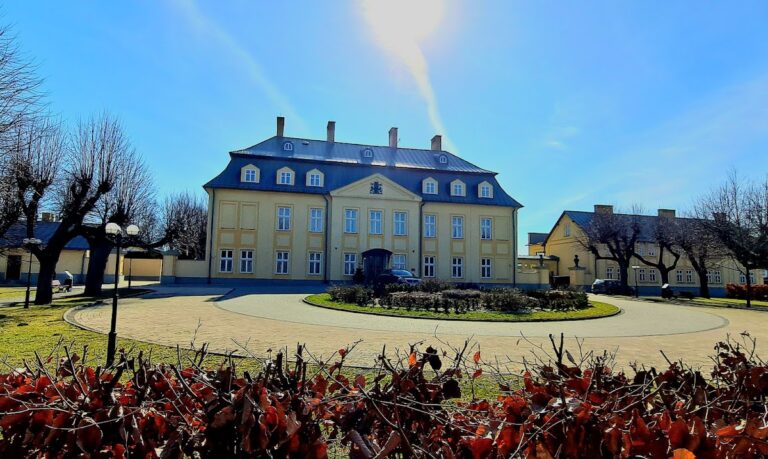
The Hunting Lodge in Promnice is a nineteenth-century hunting residence in Kobiór, Poland, built in 1861 in the English Neo-Gothic style for the Hochberg family. It stands near the southwestern part of Paprocany Lake and was created for distinguished guests invited to hunt in the Pszczyna Forest.
The Promnitz Estate
The site first held a palace built between 1760 and 1766 by the Promnitz family, then owners of the Duchy of Pszczyna, historically known in German as Pless. Jan Adam Promnitz initiated the project, while the family court architect Jan Jahne of Żary near Żagań designed the building. By the nineteenth century, the Promnitz manor had deteriorated.
The Hochberg Hunting Lodge
Hans Heinrich XI Hochberg commissioned a new lodge on the site of the old manor. His court architect, Olivier Pavelt, designed the building with English Neo-Gothic forms, a nineteenth-century revival of medieval Gothic architecture, combined with visible German influences.
The lodge burned on 24 September 1867 in circumstances that remained unexplained. Reconstruction followed in 1868, with Pavelt supervising the work and preparing designs based on the original form. The rebuilding was insured through the Fire Insurance Society and cost 3,600 gold marks.
The residence welcomed prominent hunting guests, including Wilhelm I, King of Prussia, and Wilhelm II, German Emperor. Maria Theresa Cornwallis-West, the wife of Hans Heinrich XV Hochberg and known as Princess Daisy, also favored the lodge. After Hans Heinrich XI died, she altered the interiors by introducing lighter furniture and pale wall finishes. A small service lift for food, electricity, steam heating, and richer interior decoration were added during the lodge’s later development.
Ownership and Preservation
The Hochbergs retained ownership until 1938, when the lodge was transferred to the state as part of an inheritance-tax settlement required of the sons of Hans Heinrich XV Hochberg after his death. The property later came under the administration of the State Forests, mining companies, and mining associations. Ownership returned to the State Treasury in 2003.
In 2003, the lodge hosted a meeting of the presidents of Poland, Hungary, Slovakia, and the Czech Republic. In 2018, the State Treasury transferred the property to the Pszczyna Castle Museum. The lodge had entered the heritage register on 13 April 1963 under number 702/63.
Remains
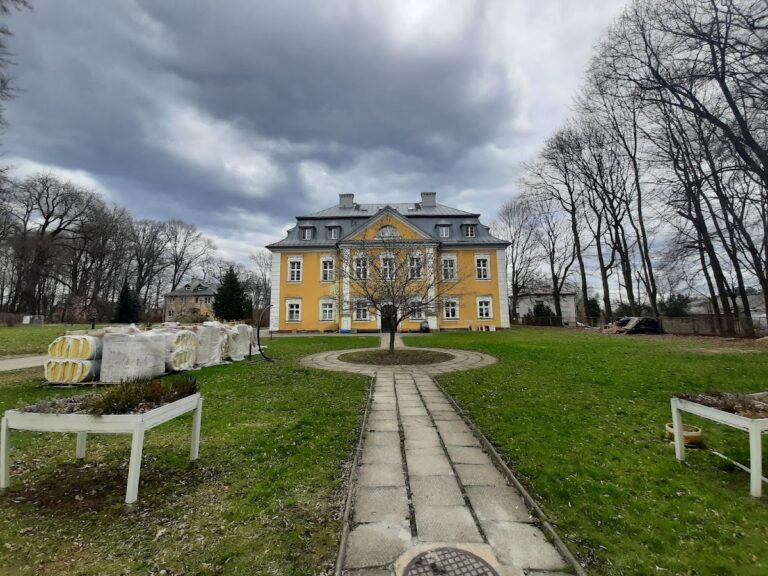
The lodge complex combines a three-storey, partly wood-clad half-timbered building with gabled roofs, dormer windows, a carriage house, and stable buildings. A half-timbered structure uses a timber framework with the spaces between the beams filled with other materials. The building follows a cruciform plan, and before 1878 an avenue connected it with the park of Pszczyna Castle.
The Lodge Building
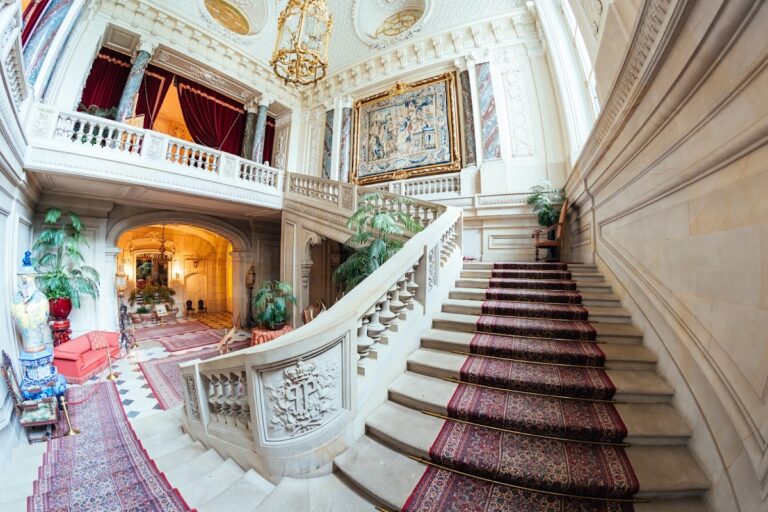
The 1868 rebuilding gave the ground-floor rooms bay windows and added further towers. Inside, a large ceremonial spiral staircase forms part of the surviving arrangement, while some rooms retain wallpaper, wooden paneling, and hunting-trophy decoration. The hunting hall contains a Neo-Gothic fireplace. Wooden ceilings, staircases, doors, and floors survive in an almost unaltered condition. Inventory records counted 34 hunting trophies in 1865 and 450 in 1927.
Courtyard Sculpture
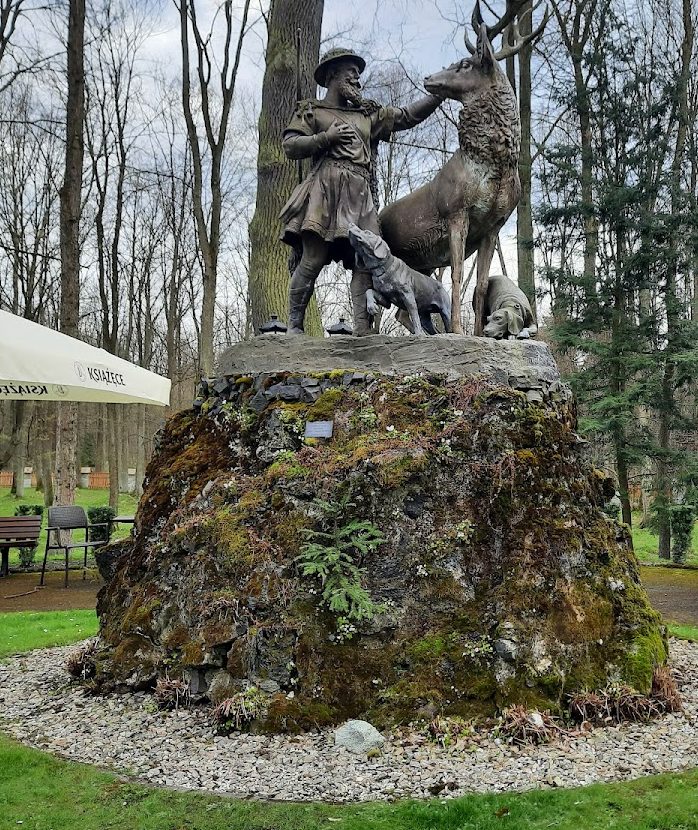
A statue group of St. Hubert, the Christian patron saint traditionally associated with hunters, with a deer and two hounds, was installed in the courtyard in 1864. St. Hubert wears a tunic and bear skin and carries a hunting bag and bow. The composition drew on the figure of Hans Heinrich XI Hochberg and was created in Potsdam by the court artist Johann Janda as a colossal bronzed-zinc cast. A cross that had stood between the deer’s antlers had been stolen by the 1940s.
On 30 July 2000, a branch more than 20 metres long fell from a 300-year-old oak and destroyed the weathered sculpture group. The statue was conserved at the Ars Met workshop in Krakow under Elzbieta Nosek and returned to its pedestal in July 2001.
Nearby sites