Huapalcalco: An Archaeological Site in Mexico
Site at a Glance
- Popularity
- High
- Country
- Mexico
- Primary era
- Classical
- Eras represented
- Stone Age, Classical
- Civilizations
- Unclassified
- Site type
- Settlement
- Remains
- City
On this page15 sections
History
Early occupation and Classic-period florescence
Huapalcalco is an archaeological site in Mexico with evidence of human occupation extending back about 13,000 years. It is regarded as one of the region’s earliest known occupied places and the oldest known human-occupation site in Hidalgo. The site flourished especially during the Mesoamerican Classic period, a broad archaeological era whose dates vary by region. At Huapalcalco, this period is placed at about 100 to 650 CE, when the settlement is thought to have served civic, religious, and urban functions.
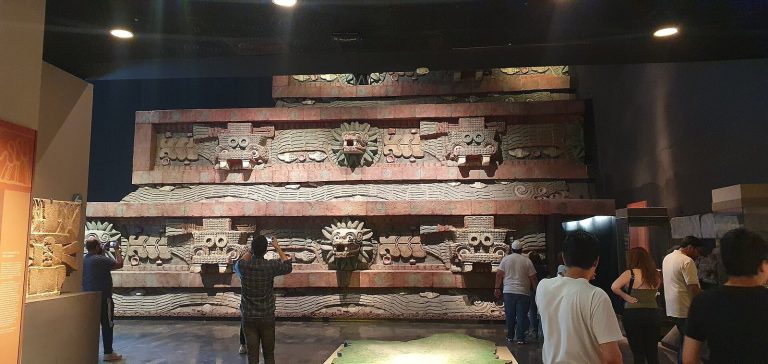
The people who built Huapalcalco have not been identified. The site was connected with Teotihuacan, a major city and cultural centre in central Mexico, and its culture also reflects Gulf Coast influence, particularly from the Olmeca-Xicalanca, a distinct group from the earlier Preclassic Olmec civilization.
Toltec traditions and local legend
Tradition associates Huapalcalco with the second Toltec Empire, a traditional account of Toltec political history, before its centre shifted to Tula. One story places Topiltzin Quetzalcoatl, a legendary Toltec figure linked to the feathered-serpent deity Quetzalcoatl, at Huapalcalco before he ruled at Tula. Another tradition says that Quetzalcoatl established an ascetic dwelling there, described as a turquoise house made of boards, and arrived in the year 2 Rabbit.
A local legend says the gods buried the city after its people failed to defend it against invaders, who then built over it. The legendary settlement was said to cover about 10 square kilometres, from Huapalcalco to Trapiche de Abra, Santiago de Anaya, and Acatlán. According to the story, the curse could be broken only at midnight on 24 June, when a bridge would appear above the main pyramid between the Coapalcallico hills. A person of the purest and bravest soul could cross, find a golden chain, and restore the buried city.
Archaeological investigation and continuing use
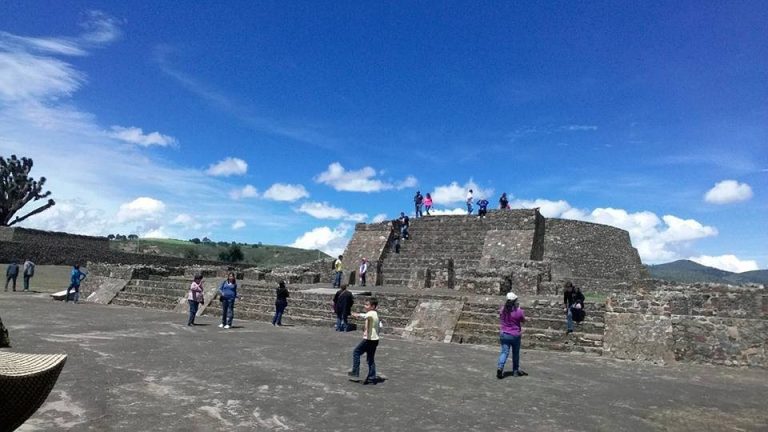
Archaeologists Florencia Jacobs Müller and César Lizardi Ramos began investigating the site’s northwestern sector in 1954. In nine expeditions ending in 1959, they uncovered a pyramid complex and its associated plaza. Huapalcalco has had multiple periods of human occupation and remains little studied. Mexico’s National Institute of Anthropology and History (INAH) is responsible for the archaeological zone, although its oversight and maintenance have been inadequate. Stones from pre-Hispanic ruins have also been reused in local house construction.
Ritual activity continues at Huapalcalco. Observances include rites seeking spiritual favor, the spring-equinox festival Enlace Huapalcalli, a Toltec New Year celebration, and a carnival honoring the Earth.
Remains
Setting and layout
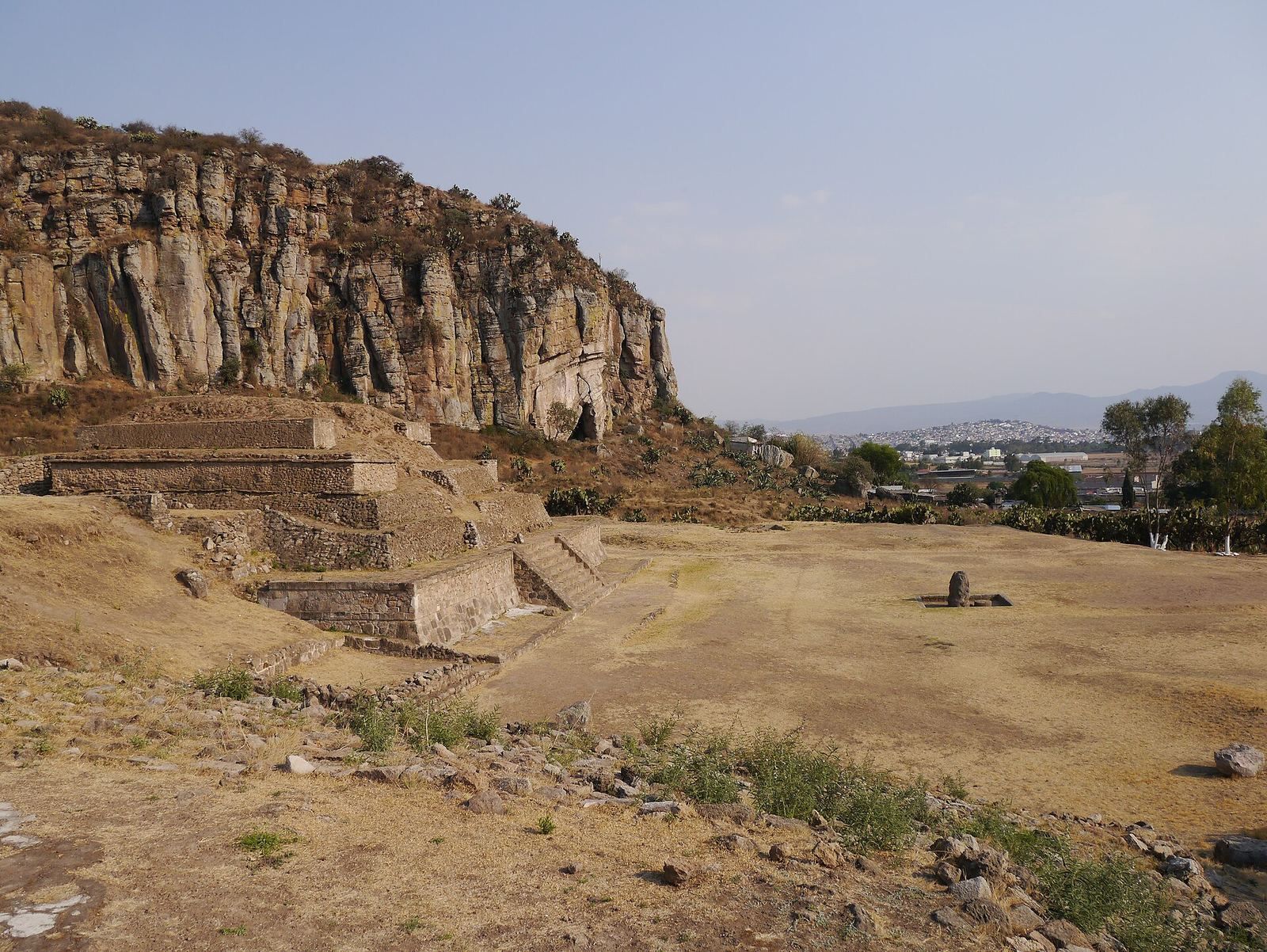
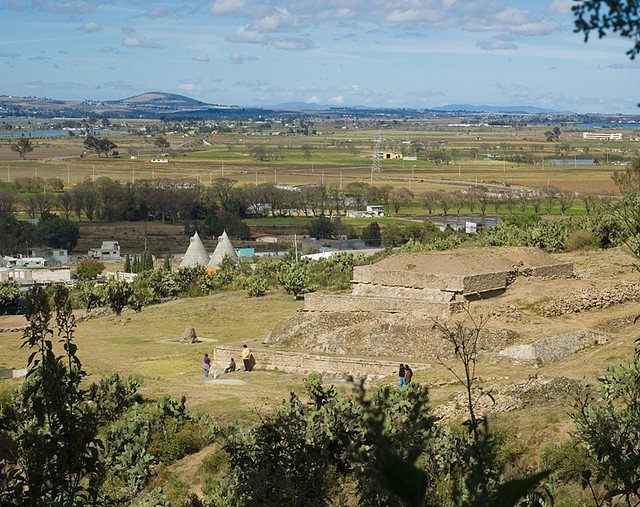
Huapalcalco occupies the western slope of Tecolote Hill. A ravine runs east to west across the slope, separating the remains into two sectors at the hill’s foot and two higher up. The site covers about 39 hectares, and more than 55 families live within it; the officially bounded archaeological zone encloses four hectares. Its physical features include pyramids, a plaza complex, stone-and-stucco construction, caves, and rock art.
Bernardino de Sahagún, a Franciscan friar and chronicler of central Mexico, described clear-water cascades in the ravine and stones at their base, where women washed clothes and children swam.
Pyramids and built features
Prominent pyramid and altar
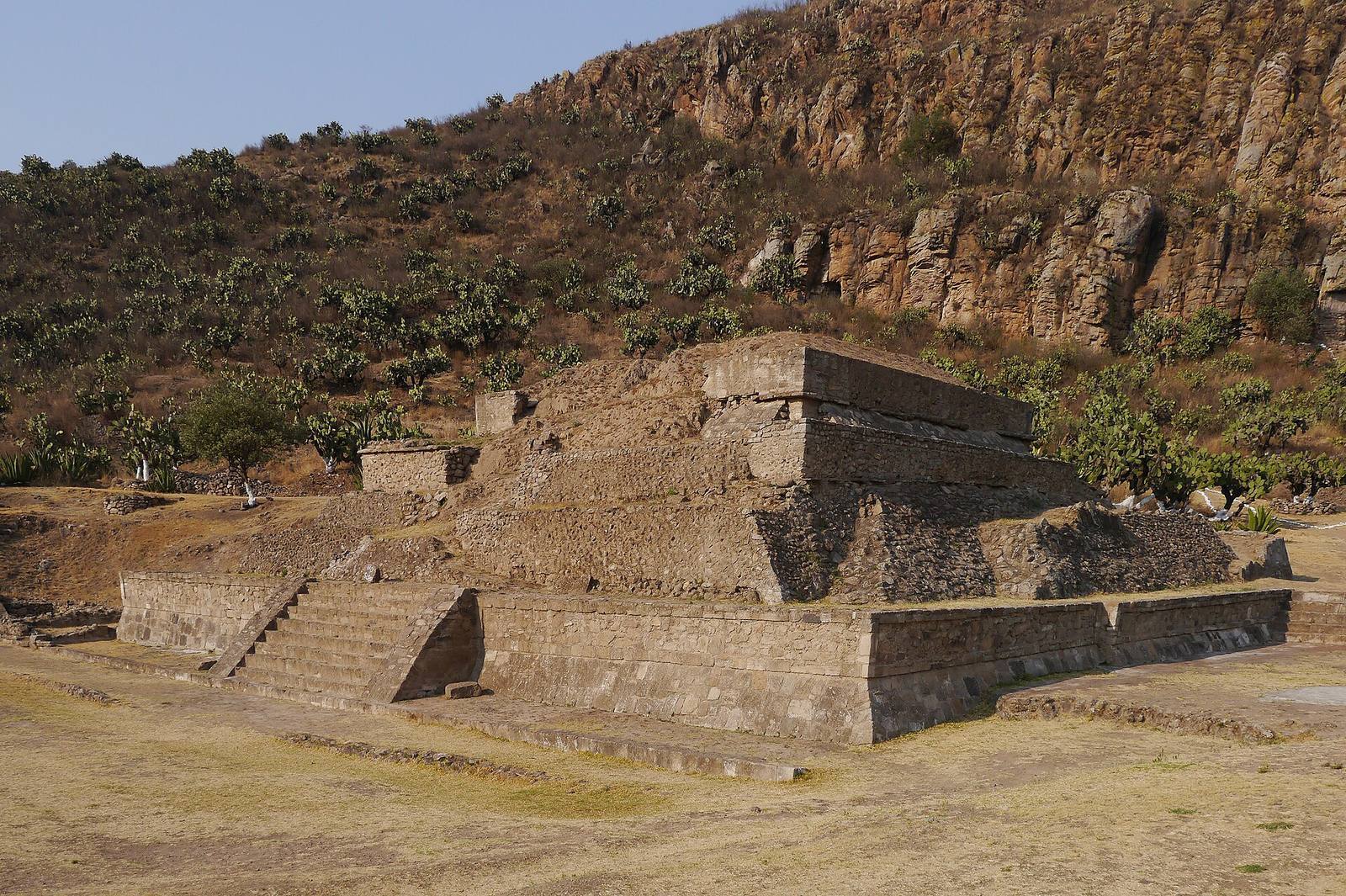
A prominent pyramid has a base measuring 12 metres and stands 8 metres high. Its form shows Teotihuacan influence. An altar associated with it may have received offerings, possibly including sacrificial offerings. A stairway at the site is described as being in the Toltec style.
Northwestern pyramid complex and plaza
The excavated complex in the northwestern sector has clear Teotihuacan features and includes a plaza. Finds from the plaza include an upright stone monument with apparent Maya influence, stone objects known as Totonac yokes, and a round altar. A sculpture of the Teotihuacan fire god was also found at the site.
Upper-slope and ravine structures
Foundations of another pyramid lie at the highest point of Tecolote Hill, in its southeastern corner. The structure was made of stone slabs finished with stucco. A separate symmetrical monument stands on the northeastern side of the ravine, at a place called Iglesias Viejas.
Buried mounds and wooden buildings
About 28 small buried pyramids, also described as knolls, occur across the site. Evidence also points to wooden structures. One may have served as a telpochcalli, a youth-training institution; possible activities associated with such a structure include military training, the administration of justice, and teaching dance or music.
Rock paintings, glyph, and cave finds
Rock paintings and marked stones
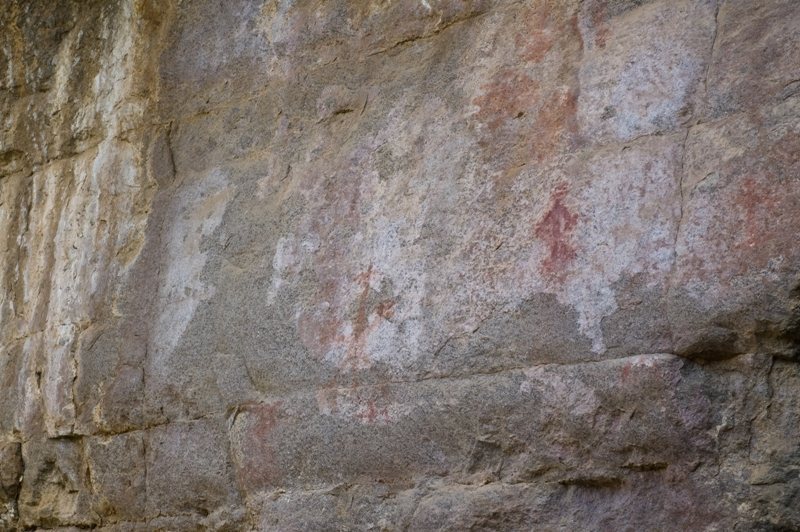
Rock paintings appear on Huiztle Hill and the Huapalcalco plateau, on stones along the ravine, and especially at Cerro La Mesa behind the pyramid. Their imagery includes human figures, schematic outlines, astronomical forms, geometric designs, and a lizard. One scene shows a person throwing a large dart with an atlatl, a lever used to propel a dart. Red pigment dominates some paintings. The images are prehistoric and have been dated to around 9000 BCE or earlier. Modern graffiti, soot from bonfires, and other vandalism have damaged them, making many difficult to distinguish; some damage has also been attributed to alleged negligence by site staff.
Local residents have painted white crosses on some rocks, believing they ward off witches and nahuales, beings in regional Indigenous belief associated with shape-shifting.
Huapalcalco glyph
The Huapalcalco glyph depicts a wooden building with three doors and battlements, raised sections along the top of a wall. Its image differs from the more common glyph for a house and represents a house made of boards. The name Huapalcalco comes from Nahuatl words for board or small beam, house, and a locative ending, giving the meaning ‘place of the wooden house.’
Caves and prehistoric finds
Several caves lie among the rocky crags, and residents sometimes place altars in them to honor the dead. Remains of a prehistoric person found in front of Tecolote Cave have been dated by radiocarbon analysis to about 10,000 years ago; they are now in the Prehistoric Room of the National Museum of Anthropology in Mexico City. A Clovis-type projectile point was found in the cave. A prehistoric hand axe came from a burned cave in the cliffs of Tecolote Hill.
Deep layers within one building yielded Meserve-type arrowheads, prehistoric projectile points associated with cultures that preceded pottery use. They date to around 7000 BCE.