Huaca del Dragón: A Chimú Religious and Administrative Monument in Peru
Site at a Glance
- Rating
- 4.4
- Popularity
- Medium
- Country
- Peru
- Primary era
- Medieval
- Eras represented
- Medieval
- Civilizations
- Chimú
- Site type
- Religious
- Remains
- Temple
On this page15 sections
History
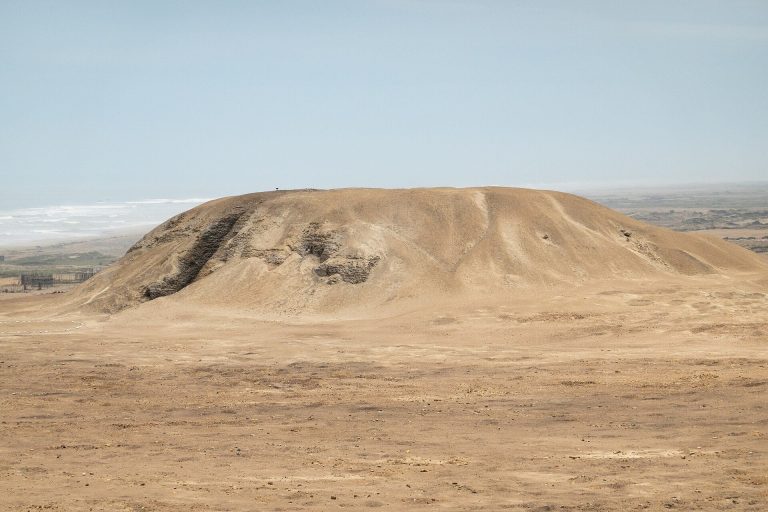
Huaca del Dragón is a Chimú archaeological monument in La Esperanza District near Trujillo, Peru. Built during the Early Chimú period, probably in the eleventh century, it served as a sacred monument, ceremonial center, administrative center, and place for collecting and storing supplies. The Chimú were a major civilization of Peru’s northern coast, whose political center was Chan Chan and whose achievements included monumental adobe construction, organized administration, metalwork, textiles, and elaborate relief decoration.
Early Chimú construction and use
The monument’s date and cultural affiliation have been debated. Earlier interpretations connected it with the Moche or the Middle Horizon, while another attribution placed it between approximately AD 800 and 1000 and associated it with the Sicán culture. Architectural and iconographic studies identify it with the Early Chimú period, a conclusion supported by the dimensions of its adobe blocks and by its construction techniques.
Huaca del Dragón was probably abandoned around AD 1450. Its alternative name, Huaca del Arco Iris, refers to the repeated double-headed rainbow figures decorating its walls. The articulated forms on the perimeter walls also gave it the local name Huaca Ciempiés, meaning “Centipede Huaca.”
Looting, excavation, and preservation
During the colonial viceroyal period, treasure seekers extensively looted and damaged the structure. A treasure hunter named Neira discovered the monument in January 1943, and his activities destroyed part of the site. Soon afterward, the archaeologist Horkheimer photographed several relief-decorated walls and observed traces of red and yellow paint.
Between 1948 and 1950, students from the Institute of Anthropology of the National University of Trujillo carried out large-scale cleaning and archaeological work. The American archaeologist Richard Schaedel directed scientific investigations with students. The work ended in December 1950 after additional funds supplied laborers and tools. Excavations revealed shell objects, ceremonial metalwork, textiles, wooden artefacts, ceramics, and human burials, including the remains of approximately 40 to 50 individuals, most of them adolescents, as well as an intact child burial in one of the platforms.
In the 1960s, the Peruvian archaeologist Francisco Iriarte Brenner led a major consolidation and restoration program. The Trujillo Archaeology Board completed a restoration of the temple in 1963, stabilizing the walls and making the reliefs accessible. Huaca del Dragón is administered within the archaeological circuit associated with Chan Chan and is recognized as Cultural Heritage of Peru. Principal excavated movable finds are held in museums, including wooden sculptures decorated with mother-of-pearl and Spondylus inlays at the Chan Chan Site Museum.
Remains
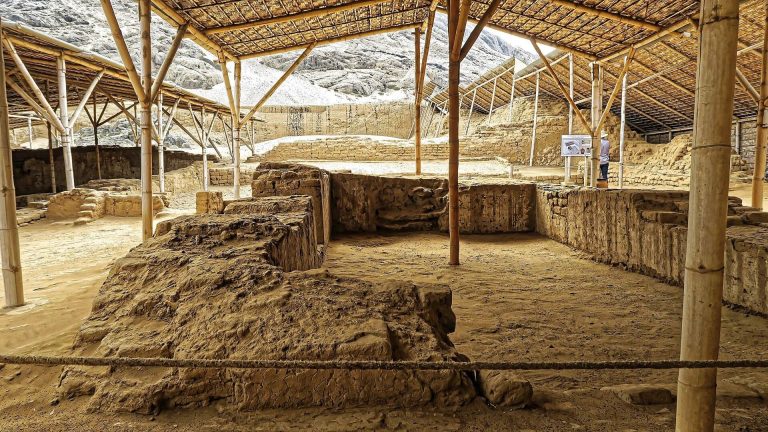
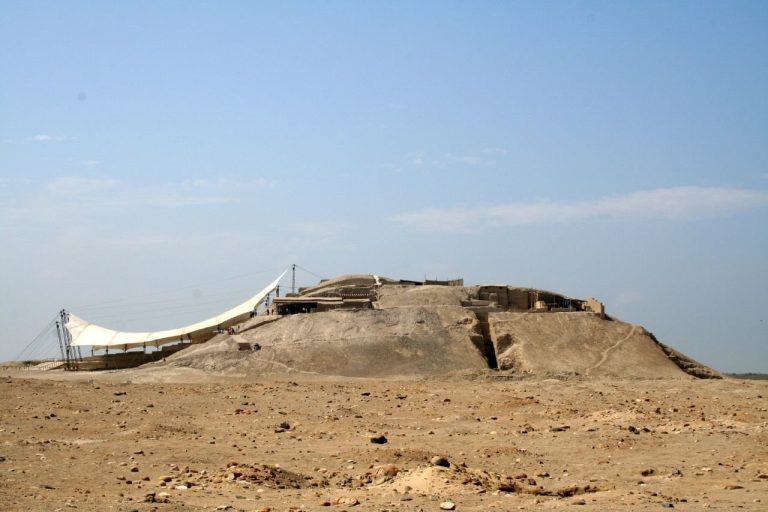
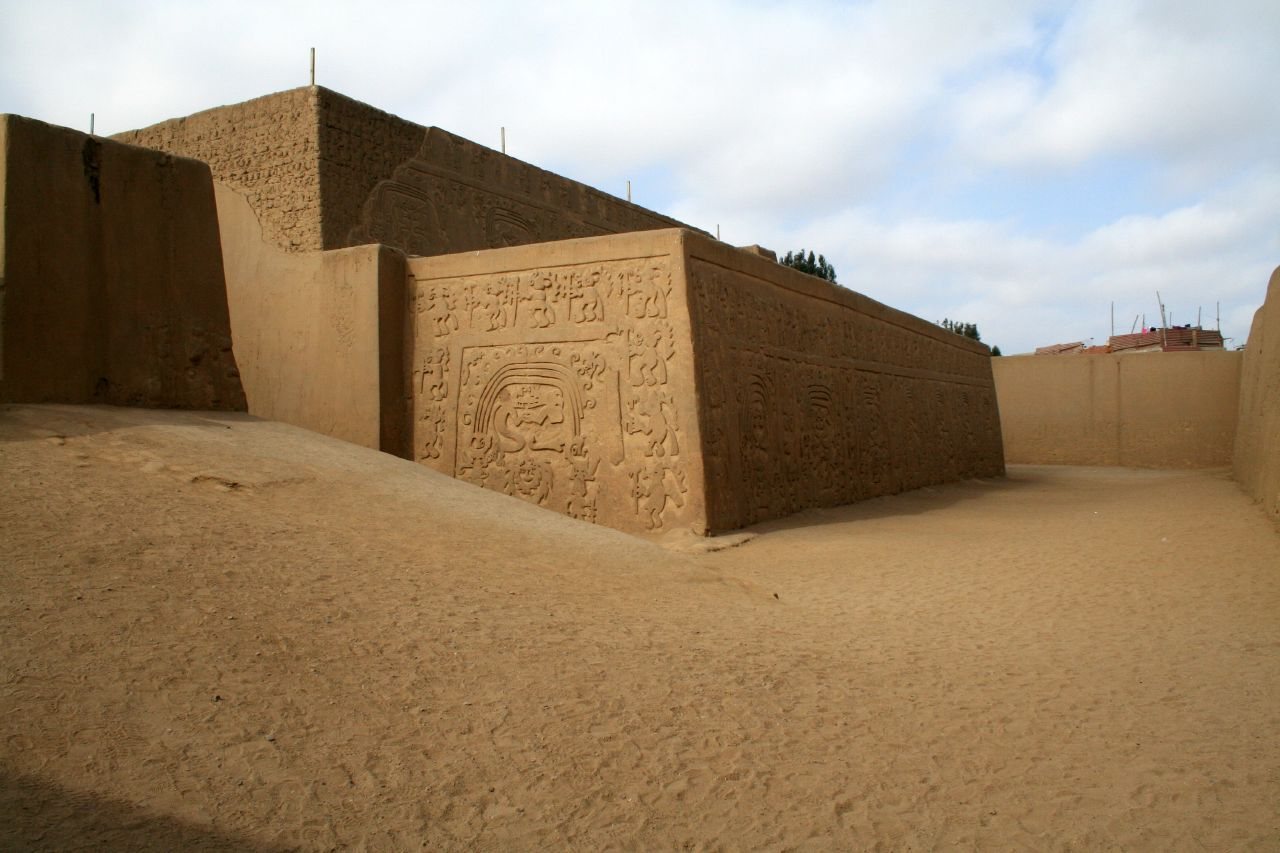
Huaca del Dragón occupies approximately 3,240 to 3,245 square metres. It is an L-shaped pyramidal complex formed by two stepped platforms within an independent adobe enclosure measuring about 60 by 54 metres. A single entrance pierces the western side. The complex combines raised ceremonial spaces, access ramps, storage chambers, and richly decorated exterior walls.
Enclosure and platforms
Perimeter wall
The enclosure was built of adobe and coated with a thin clay layer. Its eastern wall is about 4.4 metres high, with a base approximately 2.9 metres thick and a top about 2 metres thick. The western wall reaches roughly 3.4 metres in height, with a base 2.6 metres thick and a top 1.7 metres thick. These walls surround the stepped interior and define the approach through the western entrance.
Lower platform and access ramps
The first platform covers approximately 366 square metres and rises 3 metres above the surrounding level. A principal ramp leads to it and continues onward to a small hall. A second, smaller ramp connects the hall with the upper platform. The hall’s foundation was made from stone set in mud mortar, while the complex was otherwise built primarily from adobe blocks.
Upper platform and storage chambers
The principal upper platform measures approximately 777 square metres and stands 4.5 metres high. Fourteen cells, or storage chambers, of varying sizes line three of its sides. The largest measures about 4 by 2.6 metres, while the smallest measures approximately 3.6 by 2.6 metres. These rooms held subsistence goods, food, and ceremonial offerings, linking the platform’s religious purpose with the complex’s administrative and storage functions.
The builders used rectangular, cornice-shaped, and trapezoidal adobe blocks. Rectangular blocks were used mainly on inner wall faces, while cornice-shaped blocks were used largely in the exterior walls and core. Undecorated interior faces received a clay coating about 1 centimetre thick.
Relief decoration
Rainbow and animal figures
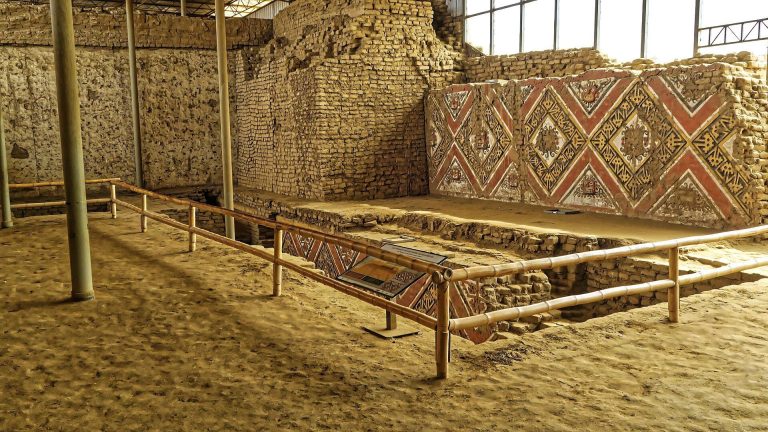
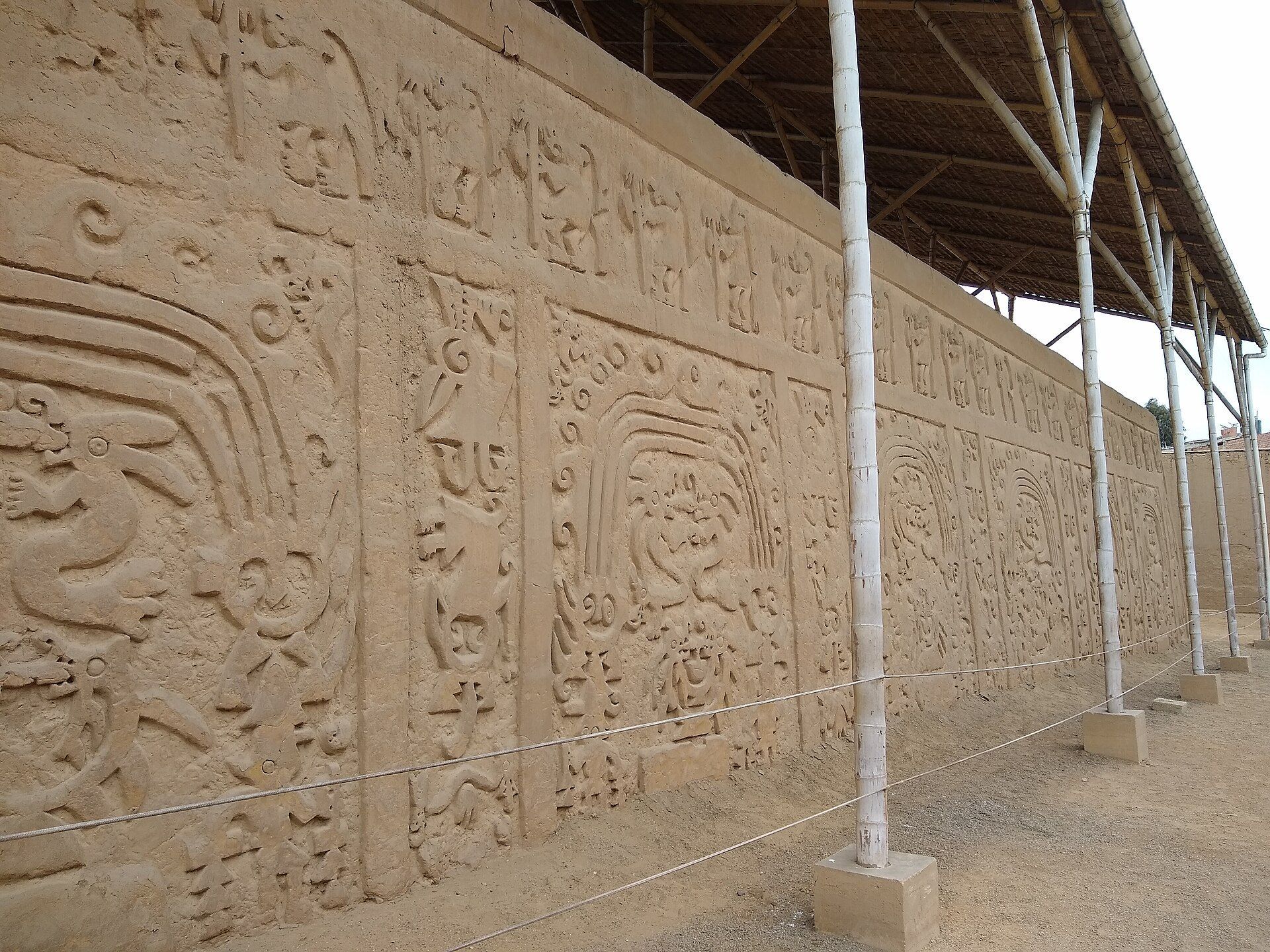
The outer faces of the platforms and the exterior walls of the storage cells carry repeated high-relief figures and clay friezes. Reliefs appear on the northern, southern, and western outer faces of the principal platform, as well as on the inner face of its southern wall. High relief is sculpture that projects strongly from a surface, while subtractive carving removes material and additive modelling builds up a design with applied material. Both approaches formed part of the monument’s decorative program.
The principal image is a stylized double-headed rainbow, repeated seven times. Volutes decorate its outer curve, and toothed zoomorphic heads terminate both ends. Beneath the heads are human figures wearing conical headdresses and holding stepped, conical objects. Other designs show feline or dragon-like beings with open mouths, seahorse-like figures, and two joined S-shaped serpents.
Ceremonial and human imagery
One double-headed figure stands on a small platform or ceremonial altar and holds a tumi, a ceremonial knife associated with sacrifice and ritual authority, between its jaws. Other human figures include dancers with zigzag headdresses and staffs, crowned figures with one raised arm and inverted feet, and figures oriented toward the entrance.
The reliefs were formed in clay and carried a limited polychrome scheme described principally as ochre and white. Horkheimer observed additional traces of red and yellow pigment during the early investigation. The repeated bodies and articulated shapes on the perimeter walls contributed to the name Huaca Ciempiés.
Excavated objects and burials
Ceramics and shell objects
Excavations recovered 638 ceramic fragments, including smoothed black pottery with relief decoration and oxidized, fired pottery with smoothed surfaces and incised designs. Other fabrics included polished black, tempered black, white, red, black-and-white, sandy, polished orange, brown, and unclassified wares. No intact vessel was recovered.
The shell assemblage contained 1,563 pieces, mostly Strombus and Spondylus. The objects ranged from unworked shells to beads, pendants, and inlay pieces. Spondylus, a brightly coloured marine shell used for ornaments and offerings, was also incorporated into some of the wooden sculptures now held at the Chan Chan Site Museum. Thirty-five mother-of-pearl objects were recovered as well.
Wood, textiles, and metalwork
Wooden finds included idols and tools. The idols were made from algarrobo or from a wood resembling balsa, and some carried shell or feather inlays. Large quantities of Nectandra seeds were found throughout the temple. Perforated for use as necklace beads, they were buried with the dead or placed with them as funerary offerings.
Textile fragments occurred throughout the temple. They included closely woven coarse white cloth, medium-weight brown cloth, gauze-like white fabric, and patterned textiles combining brown and white warp and weft threads. Some edges carried coloured designs, especially yellow and red. A shirt, a sling, a feather headdress, and painted cloth with traces of yellow pigment were also recovered.
Metal objects were made of silver-copper alloy or silver and functioned as ornaments or rivets. Most were perforated for attachment. The finds also included 29 bells, a small spoon, and tubular plates intended to cover a staff or to serve as bodily ornaments.
Human remains
Human remains were found throughout the temple. Approximately 40 to 50 individuals were buried there, most of them adolescents, and one platform contained an intact child burial. The burials, together with the shell, textile, wooden, ceramic, and metal objects, reflect the ceremonial activities associated with the complex.