Hotié de Viviane: A Neolithic Funerary Monument in France
Site at a Glance
- Popularity
- Medium
- Country
- France
- Primary era
- Unclassified
- Eras represented
- Unclassified
- Civilizations
- Unclassified
- Site type
- Burial
- Remains
- Tomb
On this page11 sections
History
The Hotié de Viviane is a Neolithic funerary coffer, or stone-built burial chamber, at Paimpont, France, dating broadly to 3500–2500 BC. The Neolithic was the later part of the Stone Age, associated in many regions with farming and megalithic monuments. The site later became linked to Arthurian legend.
Neolithic origins
Charcoal from the site has been radiocarbon dated to 3355–2890 BC, providing a narrower estimate within the broad dating of the monument and its associated finds. The place may have seen temporary or longer-term habitation before the burial chamber was built.
Legend and changing names
The monument was once called Tombeau des Druides, meaning Tomb of the Druids. Over time, Hotié de Viviane became its established name; House of Viviane and Tomb of Viviane are also used. Before 1850, local legend placed Viviane’s tomb near Merlin’s Tomb and the first location assigned to the Val sans retour, or Valley of No Return, in the Marette valley. In 1850, the legendary valley was relocated in local lore to Rauco valley, and the nearby megalith by Gurvant valley acquired the name Hotié de Viviane.
Blanchard de la Musse first connected the monument with Arthurian legend, the medieval literary tradition surrounding King Arthur and his companions. In these stories, Viviane, a fairy associated with Merlin, made the monument her refuge and held Merlin, an enchanter and prophet, in a prison of air. Another tradition identifies the site as Merlin’s esplumoir, a mysterious retreat associated with him. Félix Bellamy and later writers repeated the Arthurian connection.
Later attention and archaeological study
By 1929 the monument had become a landmark for walkers and officer cadets from the nearby Coëtquidan camp. They left graffiti and made small, superficial excavations.
Following repeated forest fires, prehistoric monuments in the Forest of Paimpont were rediscovered. A wider scientific survey of the forest’s monuments took place from 1982 to 1985, and the coffer was excavated in 1982–1983 as part of a rescue program for the Val sans retour.
Remains
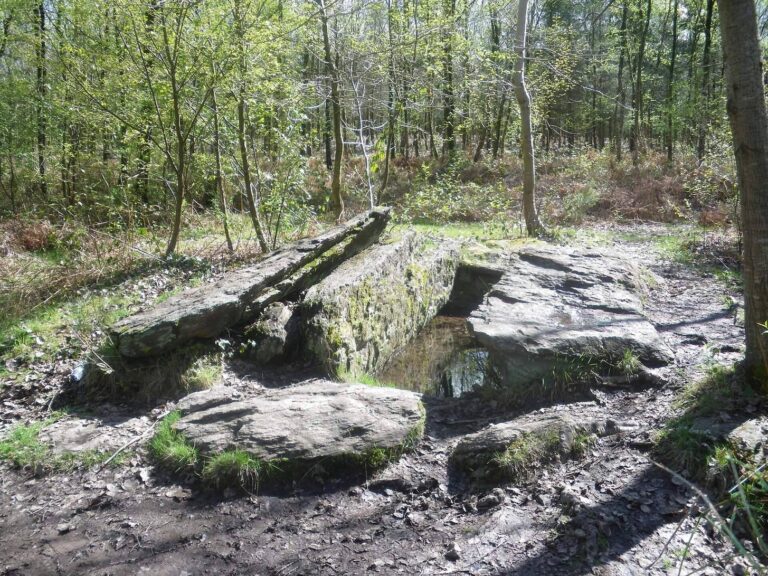
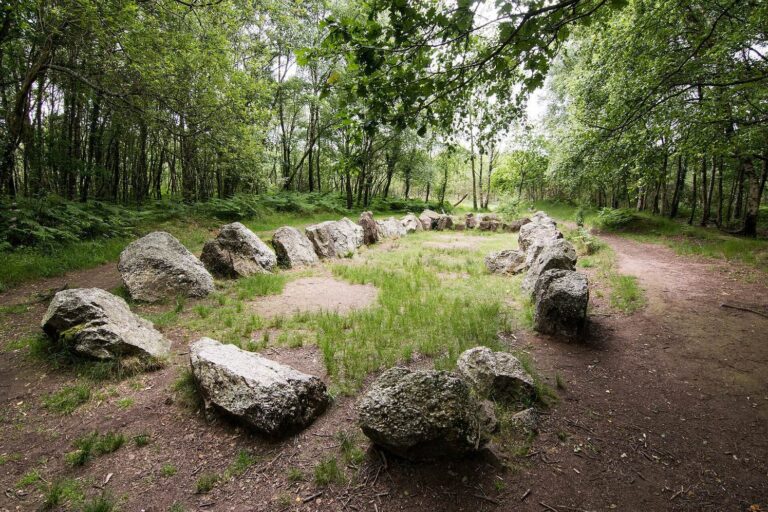
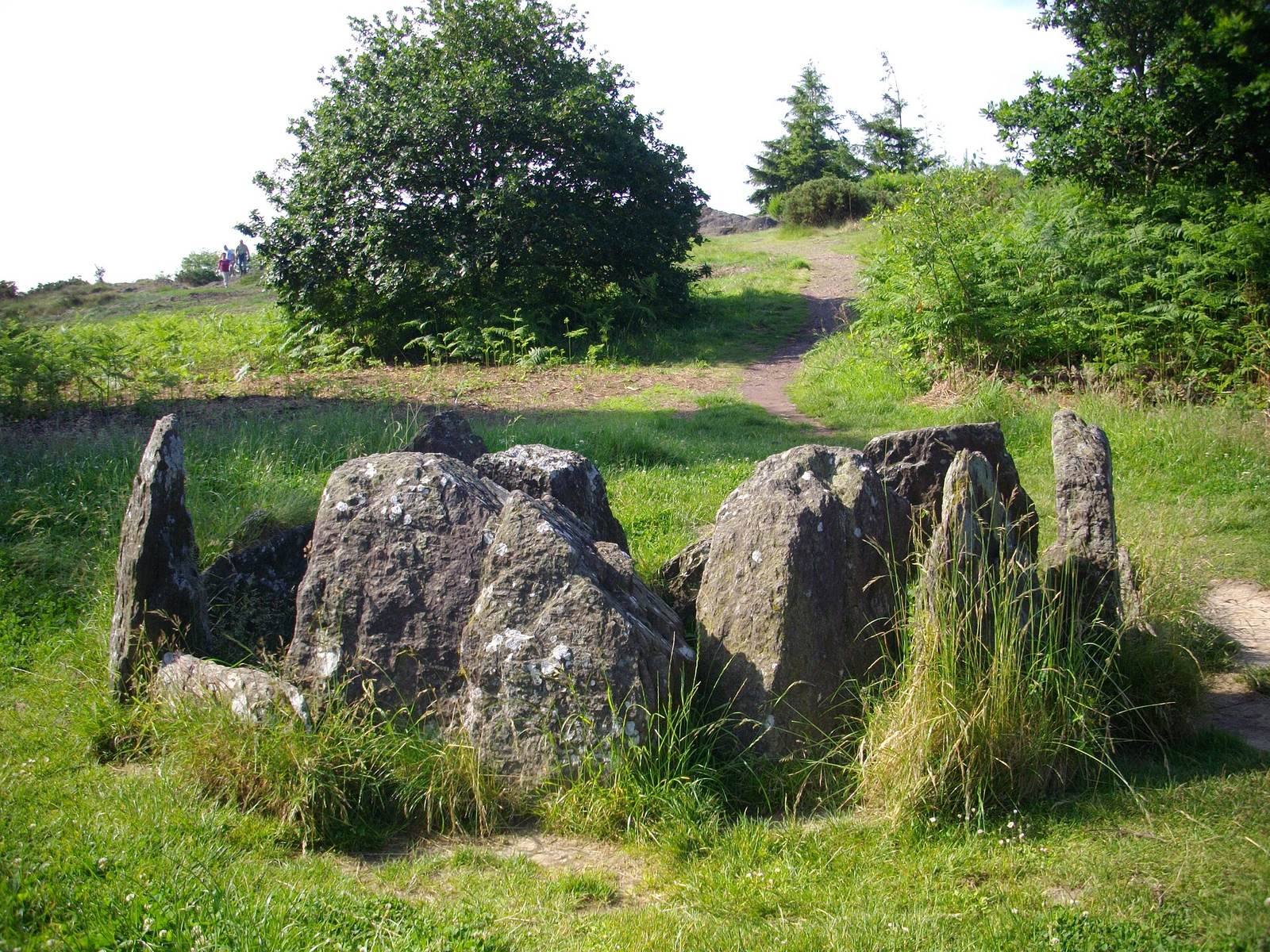
The monument occupies a small hollow on the Rauco moor, southwest of the Forest of Paimpont, overlooking the Val sans retour. It stands in a woodland clearing near La Guette, below a ridge about 191 metres high. The soil here is deep enough to hold upright megalithic slabs. Merlin’s Tomb and a nearby small stone-lined burial chamber called the La Guette cist are also part of the local landscape. The Hotié is a burial chamber beneath a stone mound, an uncommon form in a region where tombs of the same period were usually passage tombs, with a passage leading into the burial room.
Stone structures
The cairn
The cairn, a mound of stones, measured about 10 metres across and reached up to a metre high. It was built from small schist slabs, with a central packing of smaller stones and an inner enclosure around the coffer. Larger stones, about 0.6–0.8 metres long, formed the outer edge. They were set diagonally at roughly 45 degrees and driven about 15 centimetres into the ground. The mound may once have been higher, but its recorded profile reached only about halfway up the chamber slabs. An exposed area around 15 metres across contained small, broken schist slabs. The cairn is now reburied to protect it from visitor-related deterioration.
The burial coffer
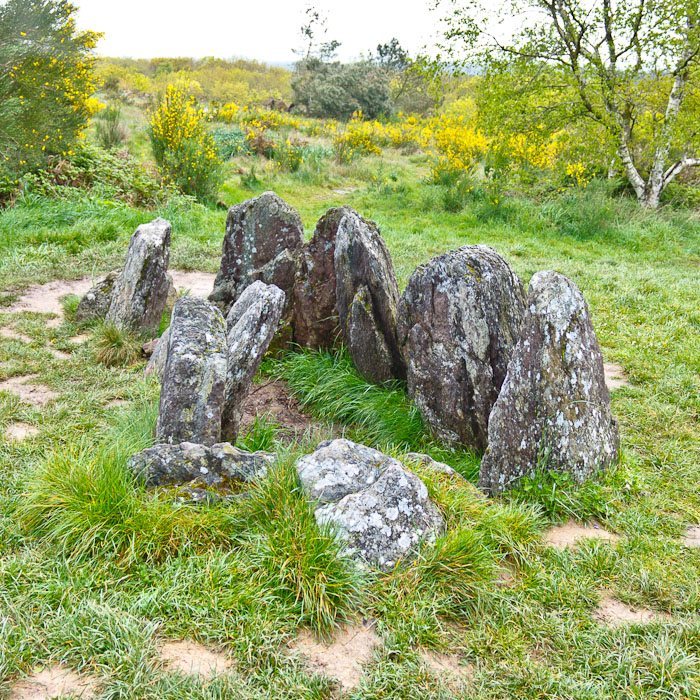
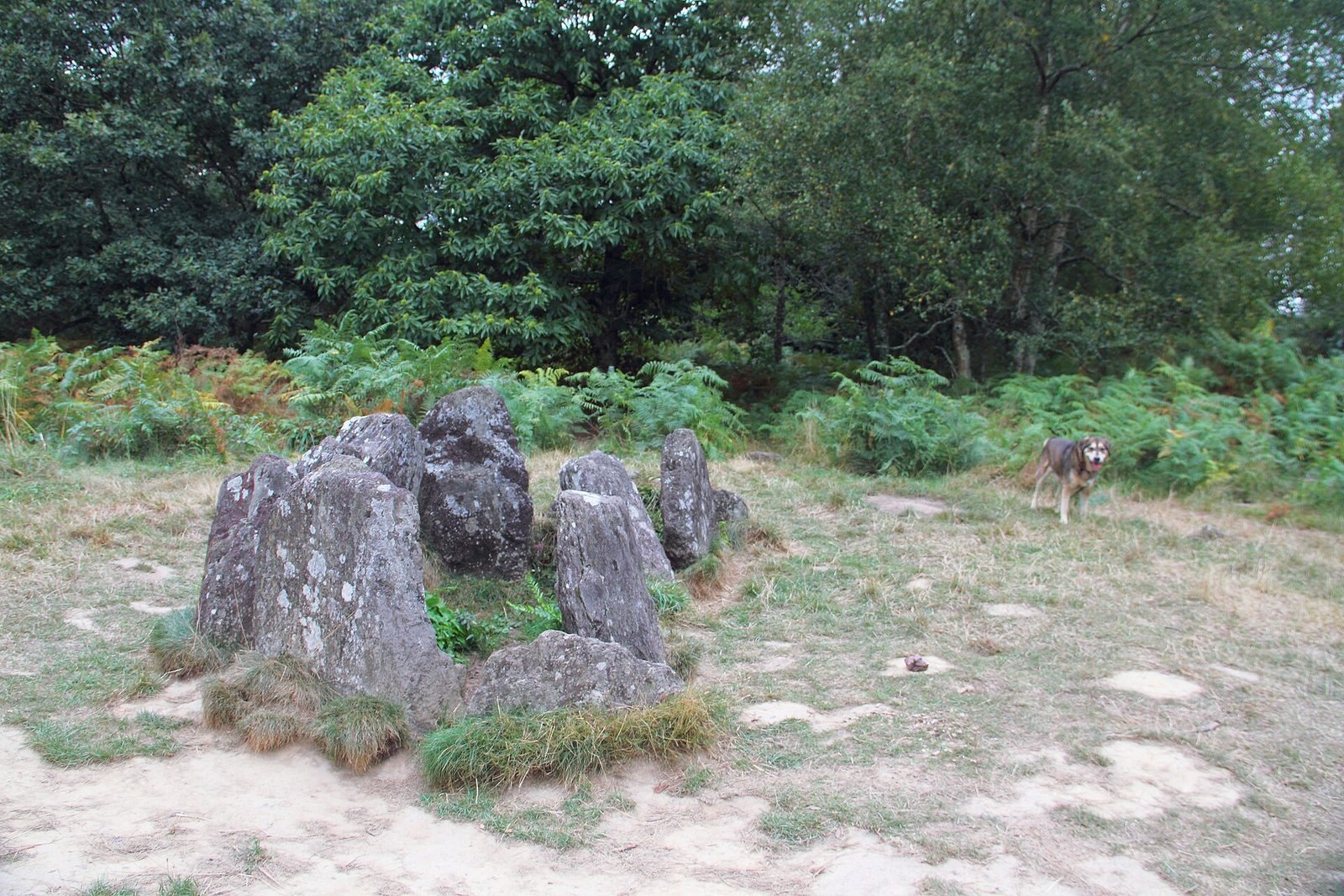
The chamber is formed from twelve locally sourced red-schist slabs, set about half a metre into the ground and braced with stone packing. It measures 2.9 metres long, 1.1–1.6 metres wide, and up to 1.4 metres high. A lower slab probably provided access, although its position is uncertain. The largest slab, on the west side, has rounded hollows on its outer face. These may be natural marks left after small stone nodules weathered away.
Félix Bellamy’s 1896 plan showed eleven upright slabs and gave the chamber’s dimensions as about 3 by 1.1 metres. In 1929, Paul Banéat described a pit about 3 metres long, 1.05 metres wide, and 0.4–0.5 metres deep, bounded by eleven stones. He gave the tallest stones’ dimensions as 1.35 by 1.10 metres. A small earth mound against the north wall may be spoil from earlier digging.
Archaeological finds
Burial finds
Coarse pottery sherds were found inside the chamber, including fragments in its inner corners, along with the butt of a polished dolerite axe. Dolerite is a hard, fine-grained igneous rock. Finds from the cairn included two polished dolerite axes, a transverse-edged arrowhead, a barbed arrowhead with a narrow attachment stem, a black-flint scraper, and lower-quality flint flakes. Millstone fragments were made from Montfort puddingstone, a rock of pebbles cemented together, as well as sandstone and granite. The funerary finds also included jewellery pendants, hammerstones, grinding wheels, and numerous coarse pottery fragments with flat bases.
Flint-working area
A small workshop for shaping flint was found west of the cairn.