Church of the Holy Blood at Wilsnack: A Medieval Pilgrimage Church
Site at a Glance
- Popularity
- High
- Country
- Germany
- Primary era
- Medieval
- Eras represented
- Medieval, Early Modern, Modern
- Civilizations
- German, Holy Roman Empire, Kingdom of Prussia, Margraviate of Brandenburg
- Site type
- Religious
- Remains
- Church
On this page23 sections
History
Foundation, fire and the miracle tradition
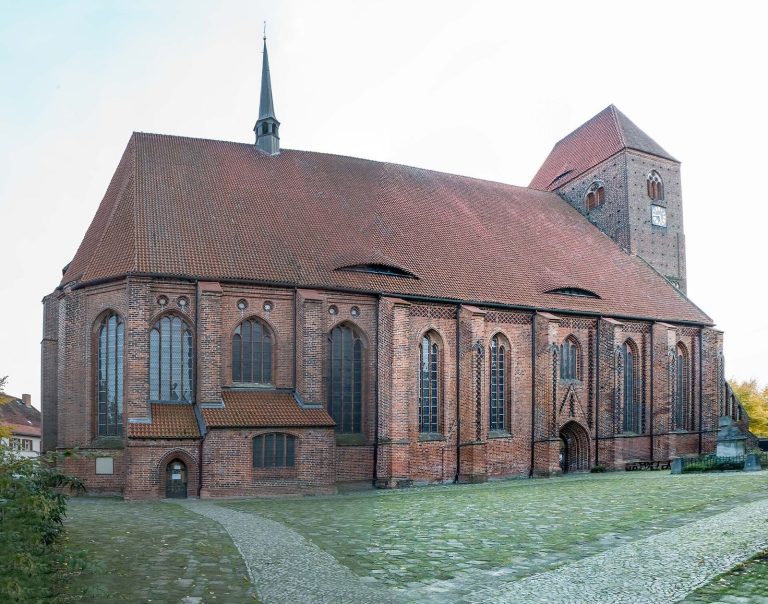
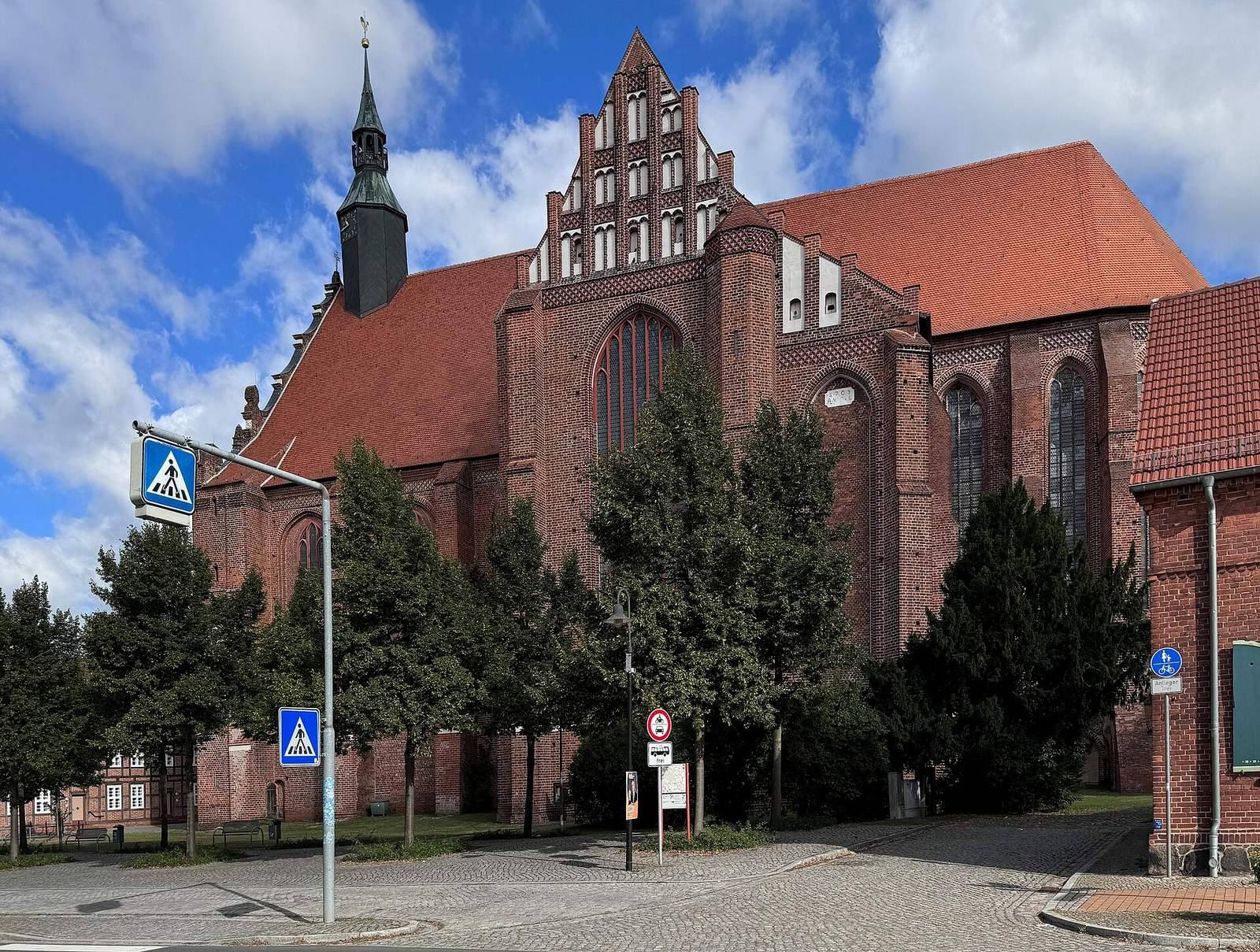
The Church of the Holy Blood at Wilsnack is a three-aisled, cross-shaped hall church in Germany, founded around 1286–1300 in the North German Brick Gothic style, a medieval architectural style built chiefly in brick. Its fame grew after a raid destroyed the church and gave rise to the tradition of the Wilsnack hosts, which drew pilgrims from across Europe.
On 16 August 1383, the Prignitz knight Heinrich von Bülow led a raid on Wilsnack while many townspeople were at Havelberg’s annual cathedral-dedication festival. Von Bülow had long asserted rights over Wilsnack and ten other villages, bringing him into conflict with their lords, Henning, Klaus and Gericke von Möllendorf, and with the Bishop of Havelberg. The church was burned. Rebuilding began in 1384 and was completed around 1400.
According to the miracle tradition, the returning priest Johannes Calbutz searched the ruins and recovered melted bell metal. He also found a charred oak altar board with a compartment holding three consecrated breads, or hosts, used in the Christian Eucharist. Calbutz did not open the compartment. After a dream in which a child’s voice urged him to return and celebrate Mass, he came back with the community on 24 August. The story says they found the board covered by a cloth and the three hosts nearly untouched by fire, with red drops upon them. After Mass, Calbutz took the hosts to nearby Lüben.
The same tradition tells of three candles carried from Lüben to Wilsnack that neither burned down nor went out in the wind. During a Mass, Bishop Dietrich II of Havelberg placed a fourth host beside the three marked ones. Their red marks were said to grow larger, and the bishop certified a miracle after clergy present witnessed the event. The Franciscan Johannes Kannemann also identified the marks as Christ’s blood. Other stories associated with the hosts tell that the knight Dietrich Wenkstern temporarily lost his sight after mocking them, then recovered it after prayer and a promise to make an annual penitential pilgrimage. In 1388, the Westphalian nobleman Geismar Berthold von Hansen was said to have survived hanging after invoking the hosts. His captor, Ritter Conrad Spiegel, released him and asked forgiveness; von Hansen then travelled to Wilsnack.
Pilgrimage and religious controversy
On 20 February 1384, Pope Urban VI issued an indulgence letter to support rebuilding the church as a pilgrimage destination. An indulgence was a grant reducing the temporal penalty associated with sin. Pilgrims came in large numbers for more than 170 years, with hundreds of thousands travelling to Wilsnack. The town prospered from the influx. Visitors came especially from Bohemia, as well as from the Netherlands, Scandinavia, the British Isles, Poland and Hungary. A pilgrimage route connected Berlin’s Marienkirche with Wilsnack. The English mystic Margery Kempe visited in 1433 and recounted the journey in The Book of Margery Kempe.
The church’s income and the growing cult also drew institutional attention. In 1395, Bishop Johann Wöpelitz incorporated the church into his episcopal household, assigning two-thirds of its income to the bishopric. Pilgrim badges were on sale by 1396. Stories of the hosts circulated alongside criticism of their veneration. The Bohemian religious reformer Jan Hus spoke against it in 1403, and the University of Erfurt also opposed the cult.
In 1405, Prague Archbishop Zbyněk Zajíc of Hazmburk commissioned an inquiry that judged the alleged miracles fraudulent and prohibited people within his jurisdiction from making the pilgrimage. In 1412, Magdeburg Archbishop Günther II of Schwarzburg ordered another investigation. A synod, or assembly of church leaders, condemned the pilgrimages but did not end them. The Bishop of Havelberg resisted the senior archbishop’s authority with the backing of Frederick II, Elector of Brandenburg, a prince entitled to vote in the election of the Holy Roman Emperor.
The dispute persisted through the fifteenth century. Cardinal Nicholas of Cusa questioned the hosts and sought to prohibit the pilgrimage while serving as a papal legate. In 1443, theologian Heinrich Tocke examined them and found crumbs and cobwebs, with no visible red marks. Bishop Konrad von Lintorff of Havelberg and Frederick II opposed a proposed ban from Magdeburg; Frederick commissioned the Franciscan theologian Matthias Döring to defend the shrine. Pope Eugene IV supported the cult in two bulls issued in 1447 and required a newly consecrated host to be displayed alongside the relics.
Wilsnack also hosted political business for Brandenburg’s rulers. A princes’ assembly connected with the founding of the Order of the Swan, a chivalric order associated with Brandenburg, met at the church in 1440. King Christian I of Denmark met there with others in 1472, and northern German princes gathered there in 1476 and 1479. Electors Friedrich Eisenzahn and Albrecht Achilles also used the church for state affairs.
The Reformation and the end of pilgrimage
Pilgrimage declined from 1517 as the Reformation spread. Printed versions of the Wilsnack legend appeared in 1520 and 1521. After Protestant worship was introduced in the Margraviate of Brandenburg, the territory ruled by the Brandenburg margraves, in 1539, Protestant services took place alongside Catholic Masses.
On 5 June 1552, Wilsnack’s first Protestant pastor, Joachim Ellefeld, entered the sacristy with two helpers, broke the vessel used to display the consecrated host, and burned the blood-marked hosts. He acted despite a town-council order not to interfere in Catholic affairs. The Havelberg cathedral chapter imprisoned him at Plattenburg, but Elector Joachim II ordered his release and banishment from the territory. The destruction of the hosts ended the basis of the pilgrimage. Visitor numbers declined through the rest of the sixteenth century, contributing to Wilsnack’s economic decline.
Later use and modern history
From about 1560, the Holy Blood Chapel was probably used as the von Saldern Protestant family’s burial vault. From 1952, the graves were moved to the choir vaults and other parts of the church; the chapel was renovated and reopened. French troops used the church as a military hospital in 1806. A smaller altar was installed in 1825 because the large choir altar was too far from the congregation, and Crown Prince Friedrich ordered the stained-glass windows restored in 1881. Near the end of the Second World War, a bomb struck the church but apparently failed to explode.
From October 1989, about a thousand people gathered in the church each Monday for a peace prayer, followed by a candlelit procession. These gatherings formed part of the political actions accompanying the end of the German Democratic Republic. In May 1990, Dietrich Gappa, the first mayor after the political transition, was elected in the church. In 2016, the church entered the Nationally Valuable Cultural Monuments conservation programme. It remains a Protestant church in the Wilsnack-Land united parish, within the Prignitz church district of the Evangelical Church of Berlin-Brandenburg-Silesian Upper Lusatia.
Remains
Church plan and construction
Nave, transept and choir
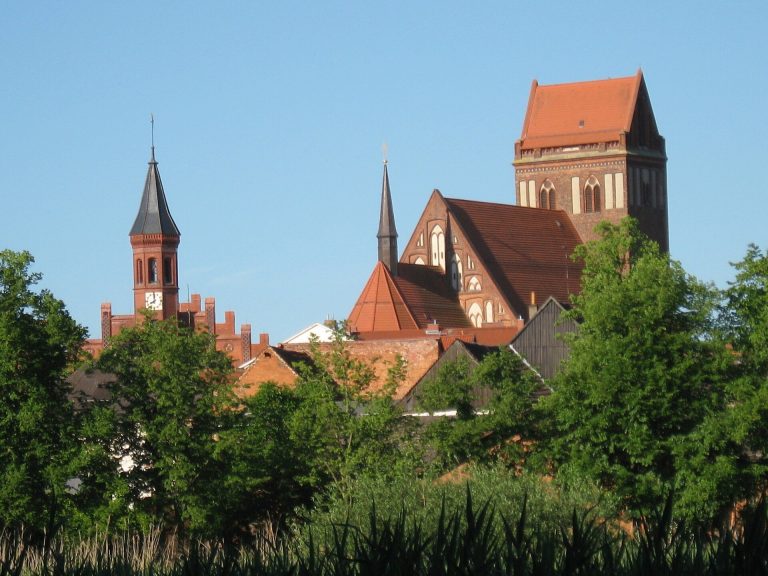
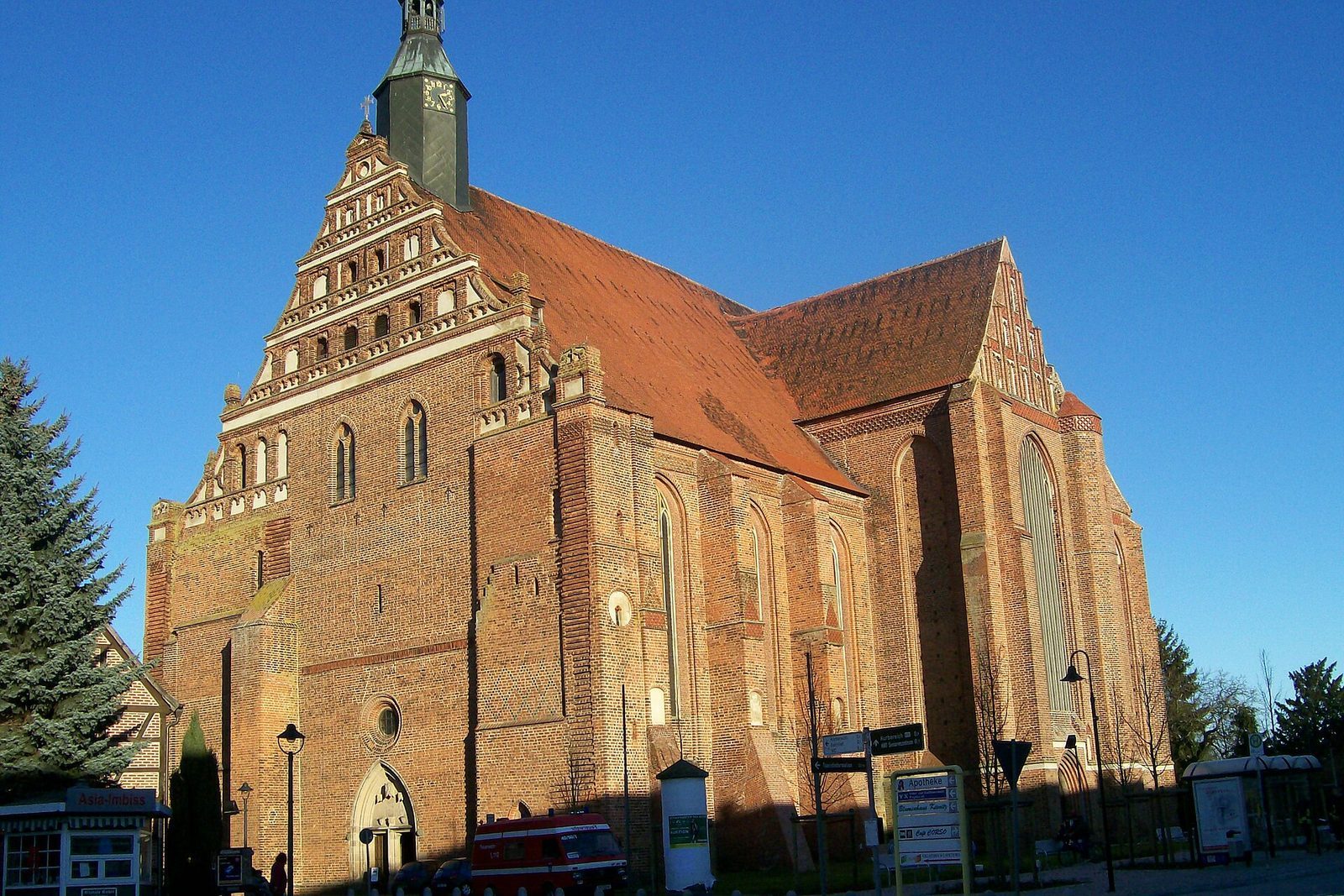
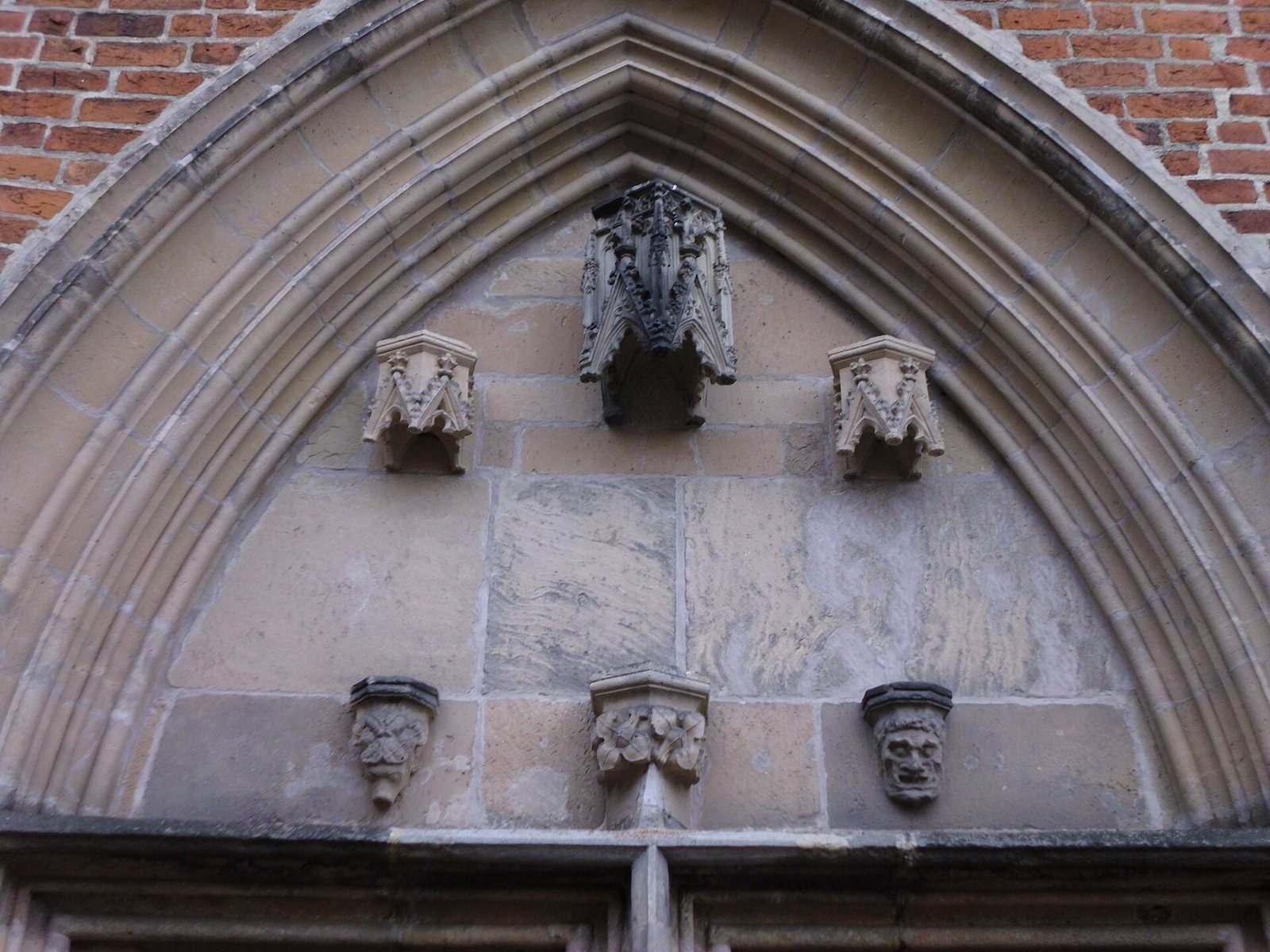
The massive brick church has a short, unfinished nave divided into three structural sections, or bays, and a cross-shaped plan. A rectangular tower from the predecessor church is enclosed within the first bay, though it does not show in the west façade. That façade has a sandstone portal and a brick gable dating to the second half of the fifteenth century; a small roof turret rises above the nave. The crosswise part of the church, called the transept, is about 40 metres wide. Beyond it, the choir ends in five sides of a decagon, with chapels to the east. An earlier passage around the choir, with chapels between its outer supports, has not survived.
Galleries and episcopal connections
Stair towers provide access to galleries in the transept. On the north side, a bridge-like passage with a low, rounded arch connected the galleries to a former episcopal household. Another arched passage linked a gallery in the left side wing with the bishops’ castle. After the Reformation, the von Saldern family used the castle as a residence. It was converted into a palace in 1724, with extensive gardens now known as the Gutspark.
Holy Blood Chapel
Holy Blood shrine
The mid-fifteenth-century shrine stands in a pointed-arch wall niche. Its wooden doors are painted on both sides, and two angels in the gable hold up a vessel for displaying a consecrated host, called a monstrance. On the outer panels, the Mass of Saint Gregory shows Pope Gregory I experiencing a vision while celebrating Mass. A Latin inscription appears above the scene, with floral designs and painted brickwork below. The inner left panel depicts the Trinity as a Mercy Seat, an image of God the Father supporting the crucified Christ with the Holy Spirit also represented; a Latin prayer appears beneath it. The inner right panel presents Christ as Ecce Homo, or Christ shown before his crucifixion, with a crown of thorns, halo, red cloak and loincloth. A band of Latin text runs above the figure. Beneath the main compartment are further compartments behind four undecorated doors. Elaborate iron locks secure the doors.
Saint Christopher fresco
Opposite the chapel entrance, a wall painting shows Saint Christopher carrying the Christ Child across water. Christopher was regarded as the patron saint of pilgrims and travellers, a fitting subject for a chapel associated with the pilgrimage.
Altars and liturgical furnishings
High altar and congregation’s altar
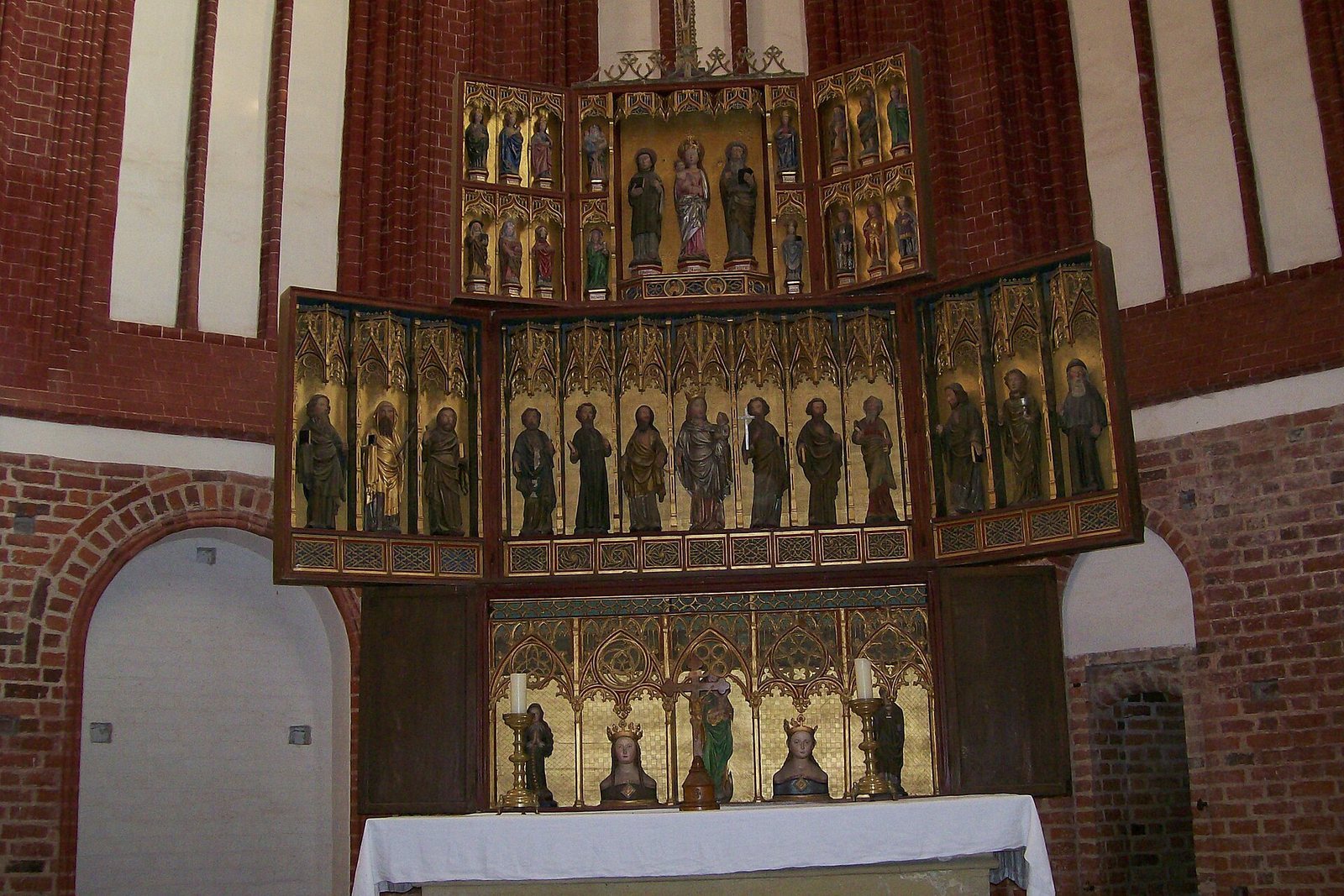
The high altar combines at least three medieval decorated altar structures, known as retables, whose components range from the late fourteenth to the early sixteenth century. Elector Frederick II of Brandenburg donated it. The central section, made in the first third of the fifteenth century, shows Mary surrounded by the twelve apostles. Above it, a three-figure shrine presents Mary with the Fourteen Holy Helpers, a group of saints traditionally invoked for intercession. At the centre of the five-part lower structure is a crescent-moon Madonna. Two female busts flank it on the left, with a monk and a bishop on the right. The separate altar used by the congregation dates to 1960.
Pulpit, font and candlestick
The pulpit dates from the late seventeenth century. Jakob Friedrich von Saldern donated it after the death of his wife, Elisabeth von Bismarck. Its decoration includes the von Saldern rose and the von Bismarck three-leaf clover. The sandstone baptismal font carries eight coats of arms, four of them decorated with the emblems of the Bishopric of Havelberg, Bishop Johann Wöpelitz, the Bishopric of Lebus and the Bishopric of Brandenburg. An Easter candlestick in the choir, to the left of the congregation’s altar, commemorates pilgrims from Hungary.
Carved figures
A painted sandstone statue on a pillar in the northern nave dates to the late fourteenth century. Its style resembles works associated with the Prague Parler workshop, a Central European medieval artistic workshop. It may originally have represented Saint Nicholas, the church’s patron, and was later understood as Bishop Johann Wöpelitz, who led the Havelberg diocese from 1385 to 1401. In the choir, a sandstone statue of Mary with the infant Jesus, just over a metre high and dating to the fifteenth century, stands in a niche on a crossing pier.
Glass, memorials and instruments
Medieval stained glass
The choir and north transept retain medieval stained glass. Twenty-six of the original eighty panels, made by Zweer van Opbueren Wesselsz, survive. A Dutch nobleman donated part of a north-transept window in 1461. Inscriptions on the windows refer to the Royal Glassworks in Berlin. In the north transept, fragile ribs in the window tracery had received repairs using an early concrete mixture in the nineteenth century. Conservation work replaced them when the tall windows were at risk.
Memorials and grave markers
A memorial stone set into the north transept wall shows two kneeling figures holding a shrine for the consecrated Eucharist. They represent Dominus Johannes Bielefelt and Dominus Johannes Cabbues. Cabbues served as a priest at Legde and died in 1412; Bielefelt was a priest at Wilsnack around 1415. Two sixteenth-century grave slabs are also built into the north transept wall. One belonged to Burchard von Saldern, who inherited Wilsnack and Plattenburg with his brother Jakob. The other commemorates rector Johann Tettendorf, a Wilsnack cleric until 1571 who died in 1572.
Two family memorials hang beside the organ. The right-hand monument commemorates Matthias Friedrich von Saldern (1650–1680), with an oval oil portrait on wood, decorative childlike figures and a relief showing him in military equipment. The left-hand one commemorates Friedrich August von Saldern (1694–1720), his wife Elisabeth Charlotta, born in 1688, and other family members. A separate memorial plaque honours Achaz von Saldern.
Organ
Friedrich Christoph von Saldern commissioned the organ in 1782. Adam Heinrich Rietze of Magdeburg built it with twelve stops, or sets of pipes, and one keyboard. Friedrich Hermann Lütkemüller restored it in 1875 and added a stop; in 1884 he enlarged it with another keyboard and three more stops. After the original pipes were taken in 1917 for wartime raw materials, the instrument was rebuilt in 1928 as an eighteen-stop organ with new front pipes. Alexander Schuke Potsdam Orgelbau expanded it to twenty stops in 1993 and completed another restoration in 1999. It now has twenty stops, two keyboards and a foot-operated pedalboard; two complete stops from Rietze’s original instrument survive.
Pilgrimage objects and conservation
Pilgrim badges and copper cauldron
Badges made in Havelberg and sold at Wilsnack by 1396 took the form of three hosts. Pilgrims offered them, and examples have been found in the surrounding area. A dented copper cauldron among the church furnishings is traditionally identified with the burning of the hosts in 1552. It has also been interpreted as marking the end of the pilgrimage centre and the beginning of the Protestant era.
Conservation and structural remains
Conservation work stabilized the roof structure after it had shifted laterally towards the west. Specially designed roof tiles, flat with rounded ends, were used to suit the existing covering. Workers also stabilized the bell frame, restoring the full peal after a year’s interruption, and built a stepped gable on the south transept. In the sacristy, a cellar was uncovered during the work. Inside the church, renovation was limited to the Holy Blood Chapel and the sacristy.