Castle Semple: A Scottish Estate and Gothick Mansion


Site at a Glance
- Rating
- 4.5
- Popularity
- Very Low
- Country
- United Kingdom
- Primary era
- Early Modern
- External website
- Open
- Eras represented
- Medieval, Early Modern
- Civilizations
- British, Kingdom of Scotland
- Site type
- Domestic
- Remains
- Elite Residence
On this page13 sections
History
Castle Semple is a historic estate near Lochwinnoch in the United Kingdom, associated with the Scottish noble Sempill family. Its earlier house was erected, or more probably rebuilt, for John Sempill, 1st Lord Sempill, who gave it the name Castle Semple. The building date remains uncertain, with proposed dates of 1492–93 and around 1550.
The Sempill Residence
The site was formerly called Castletoun. The earlier complex included a large court, parts of which appeared very old, together with orchards and gardens. In 1654, Willem Blaeu’s Atlas Maior depicted Castle Semple using the symbol for the largest castles. George Crawford described it in 1710 as the principal residence of a lordship, with a substantial court and cultivated grounds.
Lord Semple also founded Castle Semple Collegiate Church near the loch. A collegiate church was served by a college of clergy who conducted worship and related religious services, rather than by a monastic community. The earlier Sempill residence was connected with Elliston Castle, whose tower remains lay east of the loch on its southern side. Elliston had been the family residence before around 1550.
The M’Dowall Estate
Hugh Sempill, 12th Lord Sempill, sold the estate in 1727 to Colonel William M’Dowall, a younger son of M’Dowall of Garthland. In 1735, M’Dowall demolished the older house and erected a replacement on the same site. This new mansion was an elaborate Gothick building, using forms inspired by medieval Gothic architecture.
The replacement house became the centre of a 900-acre estate, whose extensive gardens shaped its landscape. M’Dowall sold Castle Semple in 1818 to John Harvey of Jamaica. During part of the estate’s later history, the Glasgow and Ayr Railway crossed the grounds and ran near the loch. A small platform served estate workers but was never opened to the general public. The former trackbed is now part of National Cycle Route 7.
Fire, Demolition, and Protection
The mansion burned down in 1924. The ruins of its central house were demolished in 1960, while four flanking outbuildings remained. Two of these were joined by windowed corridors that survived intact, and the buildings were later adapted as four private homes. Castle Semple’s estate and surviving buildings include Category B listed structures, a Scottish designation for historic buildings of regional or more than local importance. The Temple on Kenmuir Hill also has Category B status.
Remains
Estate Buildings and Landscape
Surviving Outbuildings
The former mansion stood near the eastern end of Castle Semple Loch, within what is now Clyde Muirshiel Regional Park. At the northern end of the loch, the surviving estate buildings include a billiard room, stables, servants’ quarters, kitchens, a coach house, and the head groom’s cottage. Four outbuildings once flanked the central house. Two remain connected by windowed corridors, and the buildings now form four private residences.
Gates, Garden, and Temple
Other estate features include substantial gate arches and a walled garden. A small temple folly stands on a knoll on Kenmuir Hill. A folly is an ornamental structure built mainly as a landscape feature rather than for practical use. The gardens, created as part of the eighteenth-century estate, extended across the grounds and formed its central landscape element.
Archaeological and Religious Remains
Earlier Castle Foundations
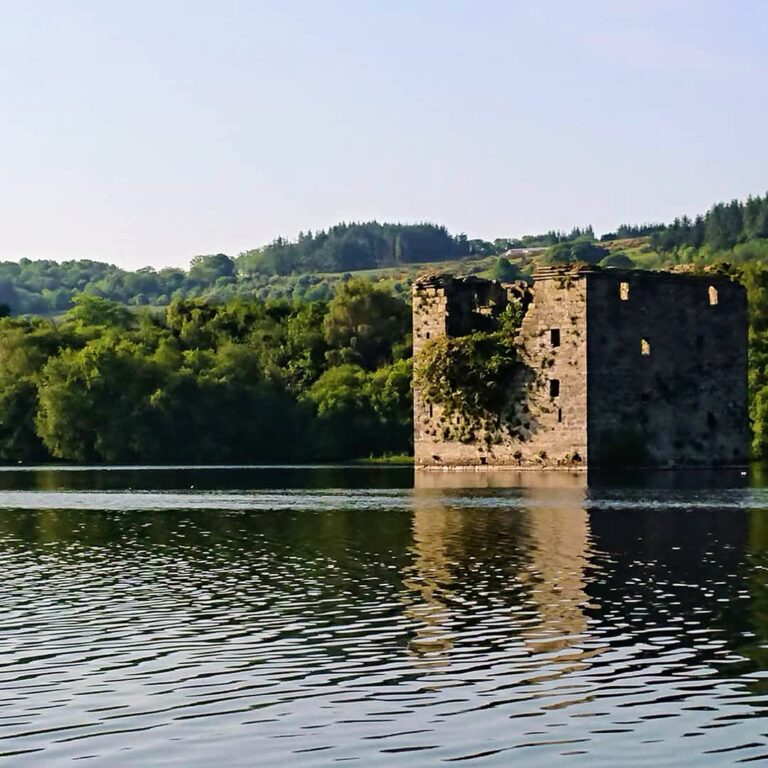
Parts of the foundations of the earlier castle were uncovered below ground in 1830, when workmen repairing drains came upon them. These remains relate to the house that preceded the 1735 mansion. A copper cannon bearing the arms of Scotland and the engraved initials “J.R.S.” was found in the loch near the peel tower and preserved at Castle Semple. A peel tower was a fortified tower house intended for defence and refuge.
Castle Semple Collegiate Church
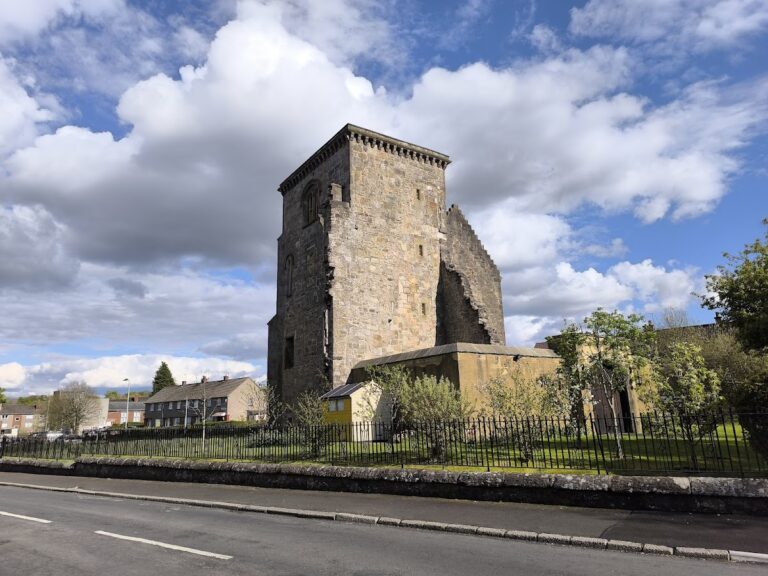
The outer wall of Castle Semple Collegiate Church contains a stone carved with the initials “R.L.S.” and the arms of the Sempill and Montgomery families. The church stands near the loch and forms part of the estate’s surviving historical fabric.
Elliston Castle
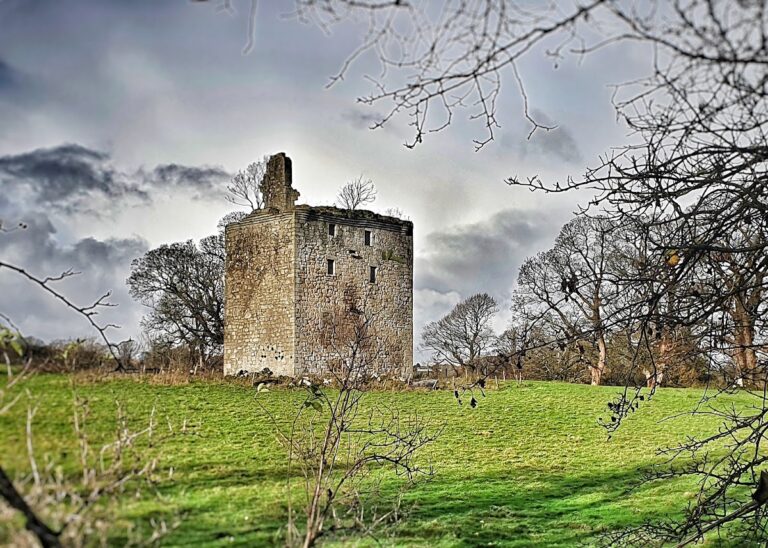
Remains of the old tower of Elliston Castle lie east of Castle Semple Loch on its southern side. The tower represents the earlier residence of the Semple family before the establishment of Castle Semple as the family’s principal seat.
Railway Trackbed
The former railway trackbed passes through the estate and along the loch. It survives as part of National Cycle Route 7, preserving the line of the railway within the historic landscape.
Nearby sites