Holm Church in Dalsland: A Medieval Parish Church in Sweden
Site at a Glance
- Popularity
- Very Low
- Country
- Sweden
- Primary era
- Medieval
- Eras represented
- Medieval, Early Modern, Modern
- Civilizations
- Swedish
- Site type
- Religious
- Remains
- Church
On this page13 sections
History
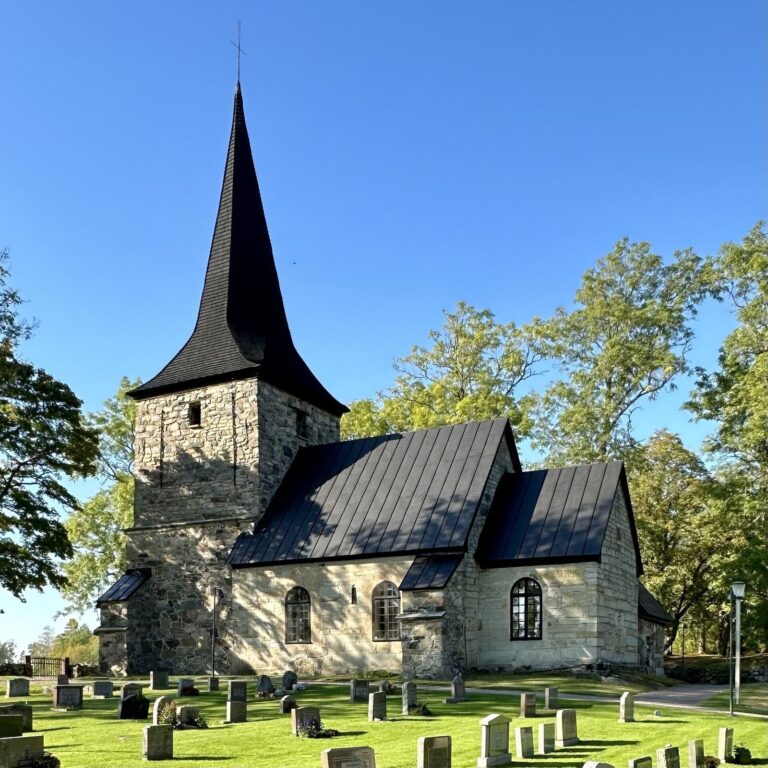
Holm Church is a medieval church just north of Mellerud’s central locality, in Mellerud Municipality, Sweden. Consecrated in the 13th century, it probably dates from that period. It belongs to Holms Parish in the Church of Sweden’s Diocese of Karlstad. The church stood beside the King’s Road, which was traveled by Carl Linnaeus, a Swedish botanist and naturalist, among others.
Medieval church and pilgrimage routes
A medieval pilgrimage route passed the church on its way to Nidaros, the historic name for Trondheim, and the grave of Olaf II of Norway, later venerated as Saint Olaf. The route has since been revived and leads to Edsleskog Church.
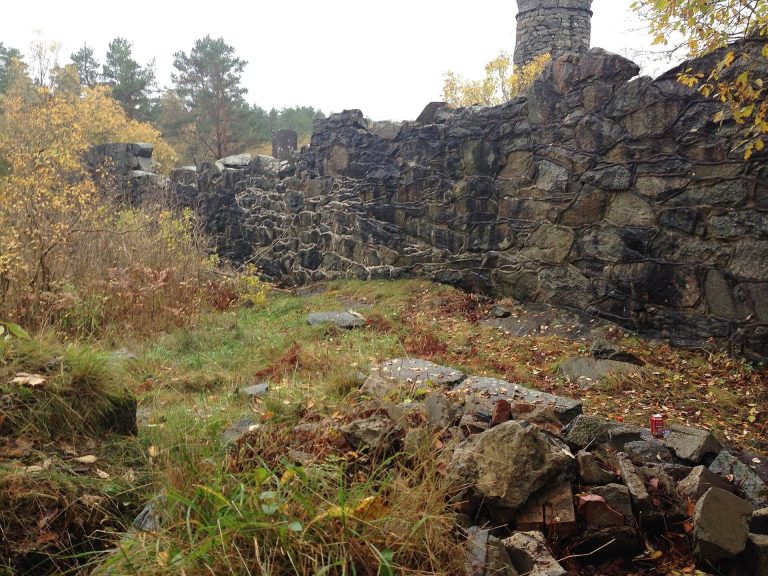
About one kilometre east of Holm stood the medieval church of Östanå, which served a separate parish. Holm and Östanå may originally have been farm churches, and Östanå was probably joined to Holm during the 16th century. The church site at Östanå is marked by its foundation walls and a memorial stone erected in 1927.
Expansion and later changes
In the 17th century, the church was extended eastward to form a three-sided chancel, the area around the altar. A porch was also added on the southwest side. A stone plaque on the porch bears the date 1644, thought to mark the year it was built. In 1727, Gustav Mentzer gave the church an altarpiece made by an unknown artist.
Mellerud began to grow in the late 19th century, about three kilometres south of the church.
Restoration and musical changes
The Swedish architect Axel Forssén led restorations in 1927 and 1944–45. The earlier work removed white paint applied to the altarpiece and pulpit in 1887. During the later restoration, the ceiling’s beadboard covering was taken down and paintings from 1742 were conserved. The original painted decoration of the altarpiece and pulpit was uncovered; pews dating from 1887 were rebuilt, and the interior walls were plastered. A further restoration of the interior and exterior took place in 1992.
An organ made by Johan Nikolaus Söderling of Gothenburg was installed in 1855 with three stops, which select particular sounds or sets of pipes. E. A. Setterquist & Son of Örebro renovated it in 1875 and increased it to four stops. In 1938, it was moved to Mellerud Parish Hall when a new organ was installed in the church. Built by Olof Hammarberg, the newer organ’s pneumatic action, a system using air pressure to transmit key movements, was rebuilt by Lindegren Orgelbyggeri AB in 1959 and 1969. A chancel organ made by Grönlunds orgelbyggeri in 1966 was acquired from Arnäs Church and installed by Lindegren Orgelbyggeri AB in 1992.
Remains
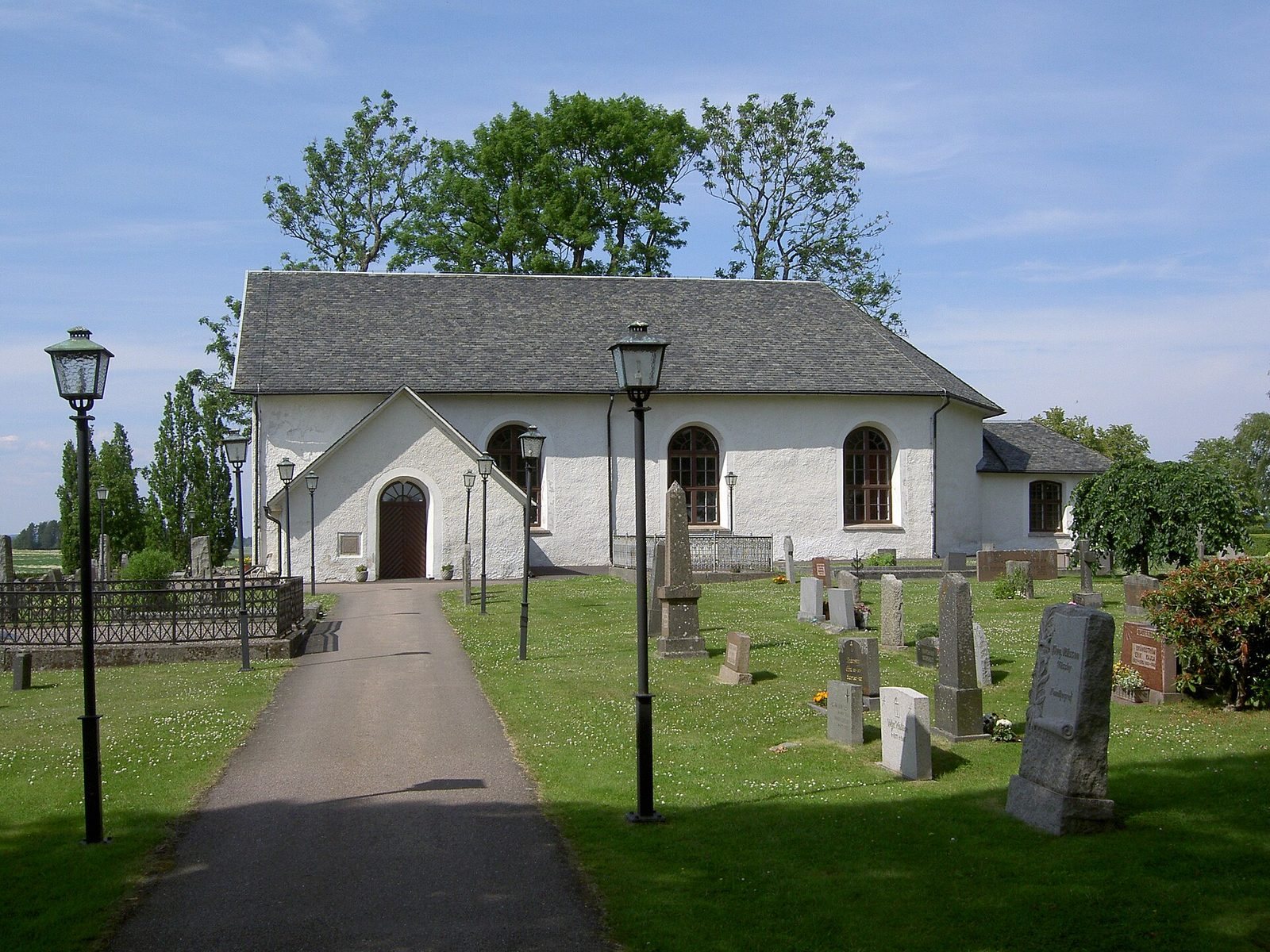
The church is a rendered stone building with its main body, altar area, and sacristy arranged along an east–west axis. A porch projects from the southwest side. The church’s exterior and interior retain evidence of successive building and furnishing phases.
Exterior
Church building
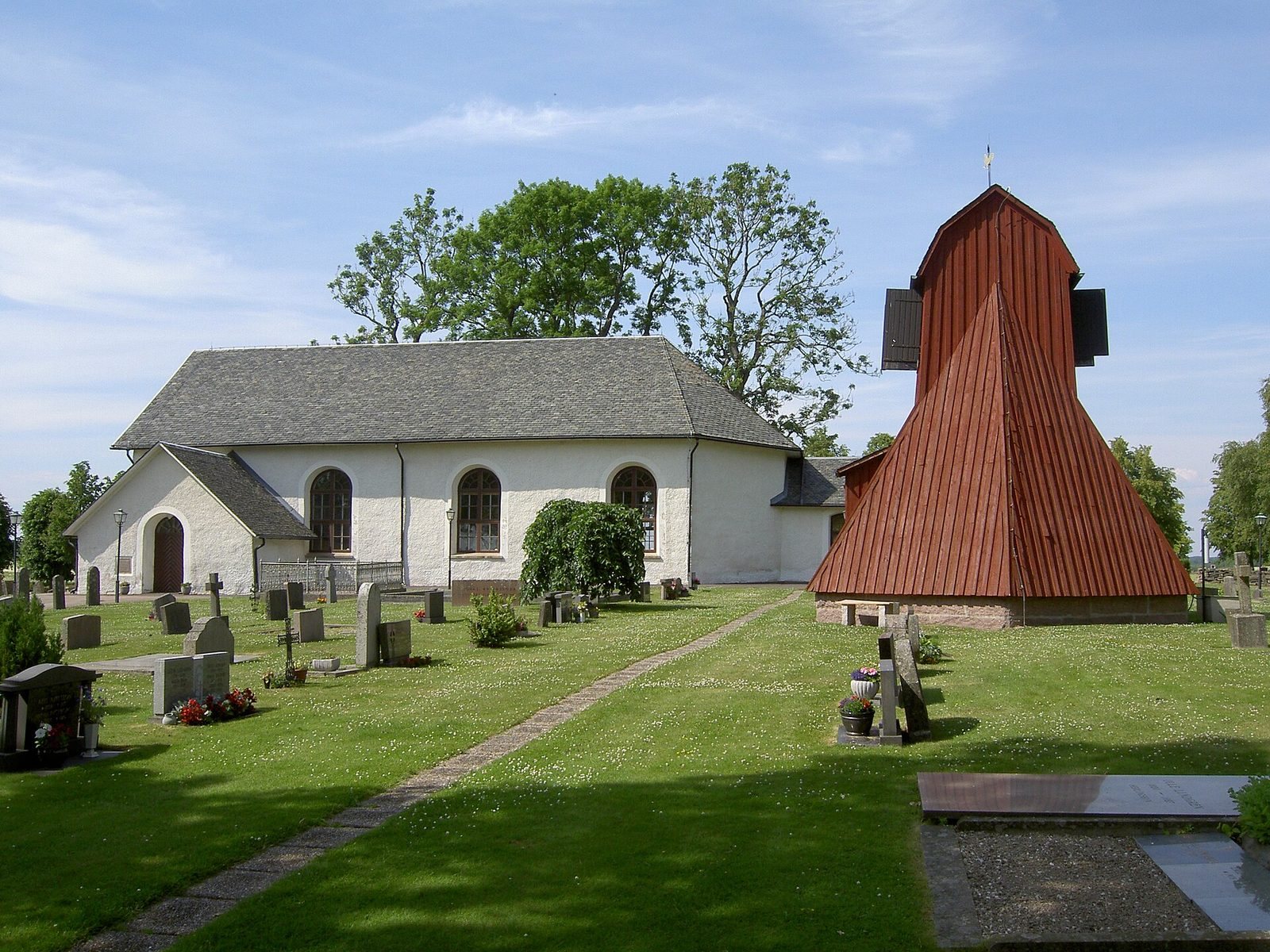
The walls have a rough-textured exterior coating, with smooth plaster around the doors and windows; the coating continues down to ground level. The doors and windows are painted brown. Entrances are located in the west gable and through the south porch, while an eastern entrance leads into the sacristy, a room used by clergy to prepare for services and store liturgical items. The main body and sacristy have slate roofs that slope down on all sides.
Separate belfry
A separate belfry, a structure that houses bells, stands just southeast of the church and is thought to date from the 1770s. Its base is granite, and its walls have red-painted overlapping boards. The slate roof has steep lower slopes and shallower upper slopes; the door and shutters are painted black.
Interior and furnishings
Ceiling and paintings
The 18th-century interior has whitewashed walls, varnished plank flooring, and a flat wooden ceiling decorated in provincial Baroque style, a regional form of the elaborate European style associated with the 17th and 18th centuries. Hans Georg Schüffner painted the ceiling and pulpit. Above the chancel, the ceiling shows a sun with the sign of Yahweh, a name for the God of Israel in the Hebrew Bible, framed by angel heads. The Transfiguration of Christ appears in the middle of the church, and the Last Judgment is depicted above the gallery. Foliage scrolls frame the scenes and run along the ceiling’s edge. The grey-white spaces between them originally carried acanthus-leaf scrollwork, a repeating leafy ornament.
Altar furnishings
The altarpiece is by an unknown maker, and its original painted decoration was uncovered during the 1944–45 restoration. The five-sided altar rail, added in an 1888 renovation, is pierced with quatrefoil ornament, a pattern with four lobes. A church bell placed in front of the chancel is considered to date from the 13th century and was used until 1627.
Baptismal fonts
One baptismal font survives as a 25-centimetre-high foot of reddish sandstone, decorated with simple, coarse corner leaves. The other is a relatively well-preserved 13th-century soapstone font, 71 centimetres high, placed in the north part of the chancel. Its bowl is made of coarser, dark soapstone, with a band of pointed lobes along the upper edge and a plain rounded band below the middle. The foot has a simple pointed-lobed band on its base and a plain rounded band on its shaft. The bowl’s drainage hole is at one side, while the opening in the foot is central, suggesting that the two parts did not originally belong together.
Organs
The organ in the west gallery has 17 stops across two keyboards and a pedalboard played by the feet. It also has two controls for preset combinations of stops and a register-crescendo control, which gradually brings additional stops into use. The chancel organ has a sounding façade, with functional pipes forming its front, and six stops across one keyboard and a pedalboard.