Hoštejn: A Gothic Castle Ruin in Czechia
Site at a Glance
- Rating
- 4.5
- Popularity
- Low
- Country
- Czechia
- Primary era
- Medieval
- Eras represented
- Medieval
- Civilizations
- Holy Roman Empire, Kingdom of Bohemia
- Site type
- Military
- Remains
- Castle
On this page16 sections
History
Hoštejn is a Gothic castle ruin above the village of Hoštejn in Czechia, in the Šumperk District about 7 kilometres west of Zábřeh. It was probably established after 1230 by a member of the Hrabišic family, most likely Boreš of Rýzmburk, and served as a political and military counterweight to the castle at Zábřeh, held by the rival Lords of Zábřeh. The castle’s position reflected the wider struggles of medieval Moravian noble families for territorial influence.
Foundation and royal conflict
A charter of 1267 for the Augustinian monastery of Koruna Mariina at Krasíkov, founded by Boreš, names Mutiš de Honstein among its witnesses. Mutiš may have been Boreš’s burgrave, the castellan responsible for administering and defending the castle. Hoštejn itself appears directly in written records in 1289.
The Hrabišics supported Rudolf of Habsburg, the German king and first Habsburg ruler of the Holy Roman Empire, against Přemysl Otakar II, the king of Bohemia. After Přemysl Otakar II was killed at the Battle on the Marchfeld in 1278, the Hrabišic position grew stronger. Hoštejn was temporarily held by Protiva of Zábřeh, but Frederick of Schonburg, guardian of Boreš of Rýzmburk’s children, recovered it. The Zbraslav Chronicle later called Hoštejn a robber stronghold, although Frederick was probably chiefly a political opponent of King Wenceslas II and a supporter of an anti-royal coalition.
A royal punitive expedition led by Záviš of Falkenstein captured Hoštejn and executed its garrison. Wenceslas II’s stepfather then became the castle’s lord. After Záviš’s death in 1290, Hoštejn and its estate passed to the Lords of Sternberg, whose ownership is certainly recorded from 1335.
Sternberg rule and the Hussite Wars
The Sternbergs joined the Hoštejn estate with the Šilperk and Zábřeh estates, which they also controlled. Following the death of Smil of Hoštejn in 1398, the estate passed to the Lukov branch of the Sternbergs. Jošt, Margrave of Moravia, a high-ranking territorial ruler responsible traditionally for a border province, also asserted a claim to the territory.
Hynčík of Frývaldov was captain of Hoštejn in 1406 and later became a leading supporter of the Hussite movement in the Zábřeh region. The Hussite Wars were fifteenth-century religious and political conflicts in the lands of the Bohemian Crown. Hoštejn consequently became a frequent target of enemy attacks. Forces of Albert of Austria attacked and severely damaged the castle around 1424.
In 1434, Jan of Zvole became the castle’s owner. He was a leading representative of the Catholic side in the Zábřeh region and at that time also styled himself “of Hoštejn.” By 1437, Hoštejn and the village below it were held by Jan Tunkl of Brníčko, who permanently incorporated them into the Zábřeh estate. Prolonged disputes over ownership followed among other noble families.
Destruction and later history
Hoštejn was already in ruins by 1437, indicating that its destruction took place during the Hussite Wars. Its later owners lived elsewhere and had little reason to rebuild the damaged castle, which would have required substantial expenditure. At the beginning of the sixteenth century, the ruins became a refuge for brigands. Although the castle belonged to Ladislav of Boskovice, the brigands occupied it for six years. In 1522, Arkleb Trnavský of Boskovice captured the ruins and reportedly destroyed them completely to their foundations.
Further dismantling took place in 1845 during construction of the Olomouc–Prague railway. Stone from the ruins was reused in the railway track structure. Hoštejn has been protected as a cultural monument of the Czech Republic since 1964.
Remains
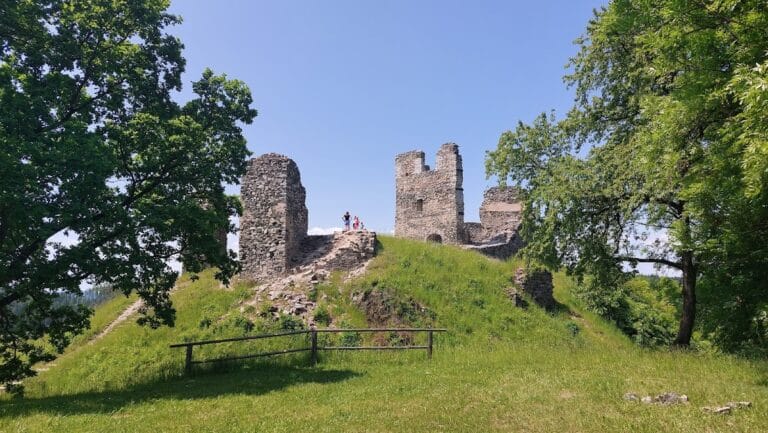
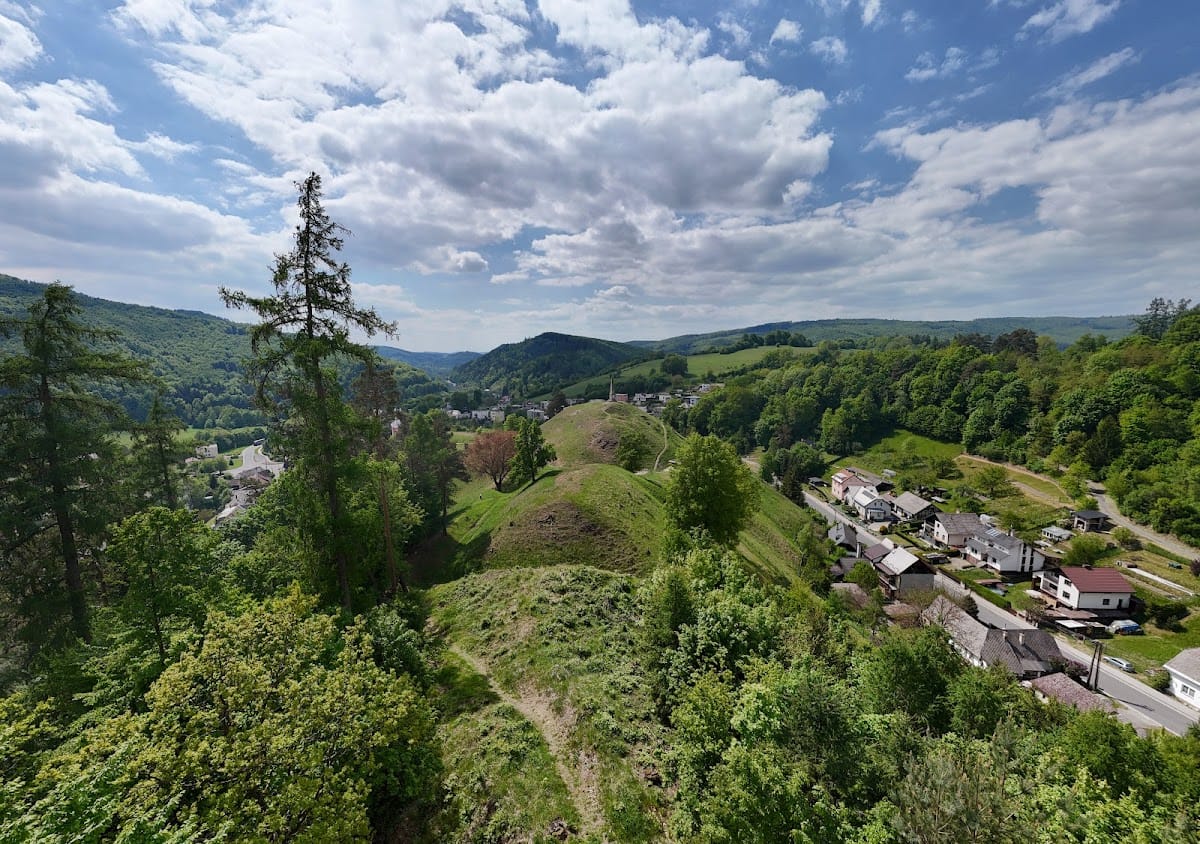
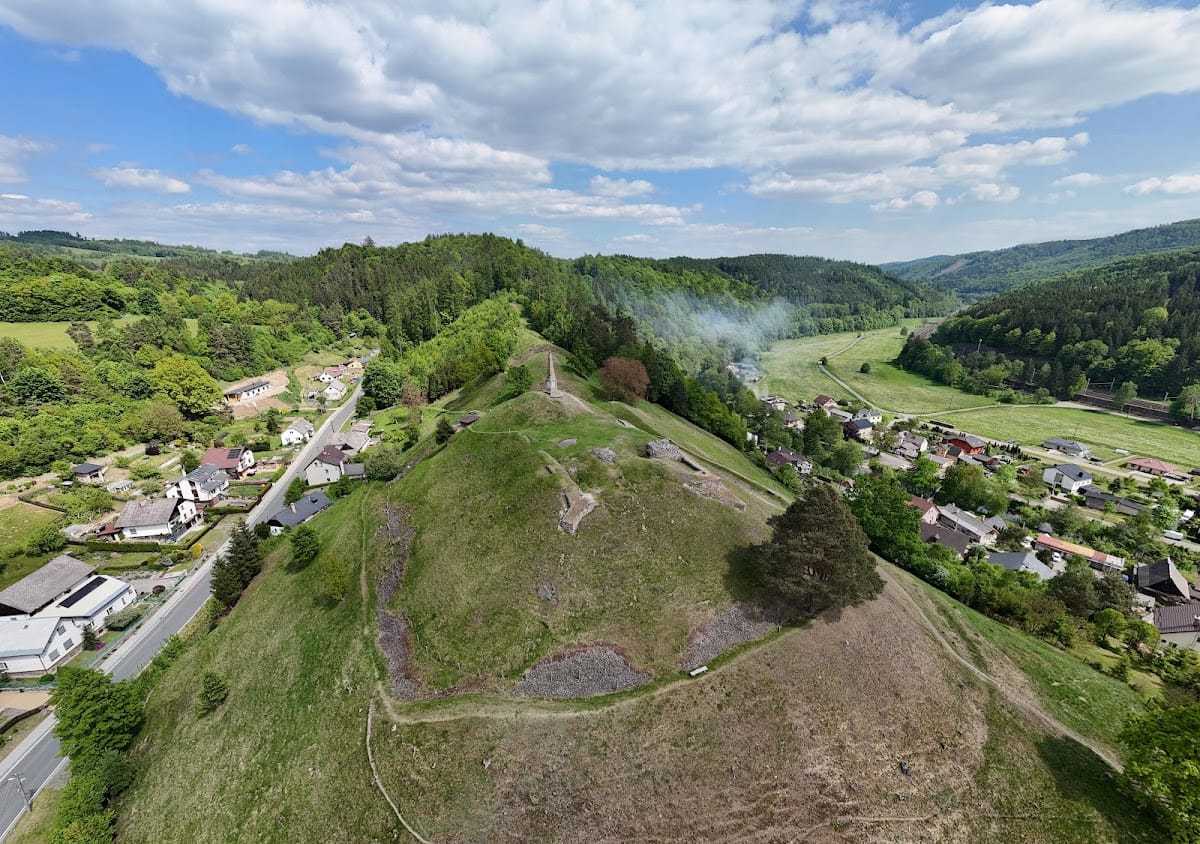
Hoštejn’s fortifications extended for approximately 450 metres around a promontory. The castle was arranged in two principal parts, a nearly rectangular core and a forecourt. Circular ramparts and ditches enclosed the core, while a separate embankment and ditch protected the forecourt. Other fortified platforms and mounds occupied parts of the surrounding terrain.
Castle core and forecourt
Rectangular core
The nearly rectangular core measured about 50 by 20 to 25 metres. Beside the location believed to have held a tower were the remains of a palace measuring approximately 25 by 9.5 metres. The core was encircled by a circular rampart and a ditch between 18 and 38 metres wide. The eastern side of the promontory preserves portions of this system of ditches and ramparts.
Forecourt
The forecourt measured approximately 45 by 14 metres. It was enclosed by an embankment and a ditch that reached up to 25 metres in width on the neck side of the promontory. Its surviving form belongs to the wider defensive arrangement that separated the castle from the approach across the connecting ground.
Defensive features and surviving structures
Western wall and tower mound
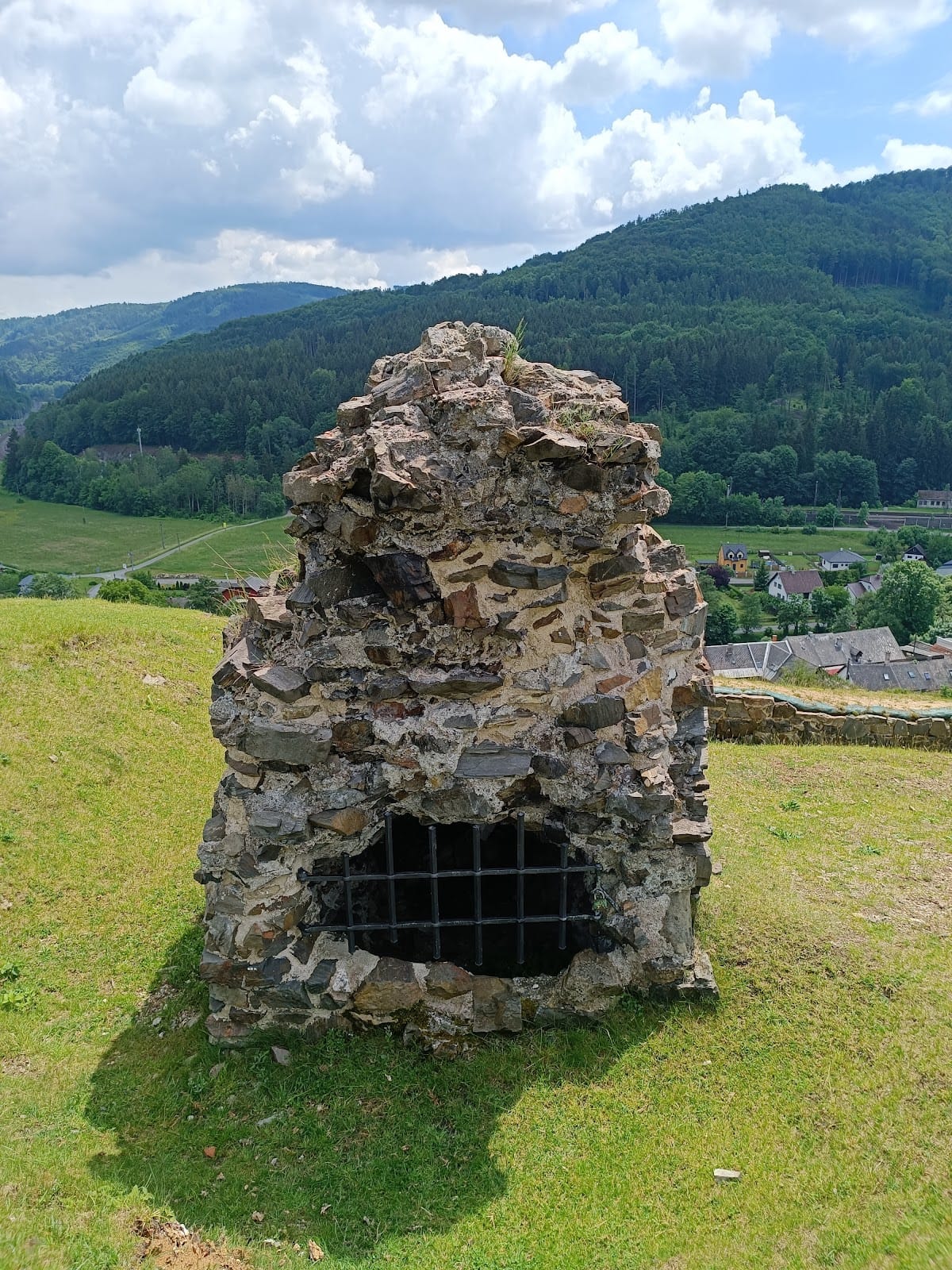
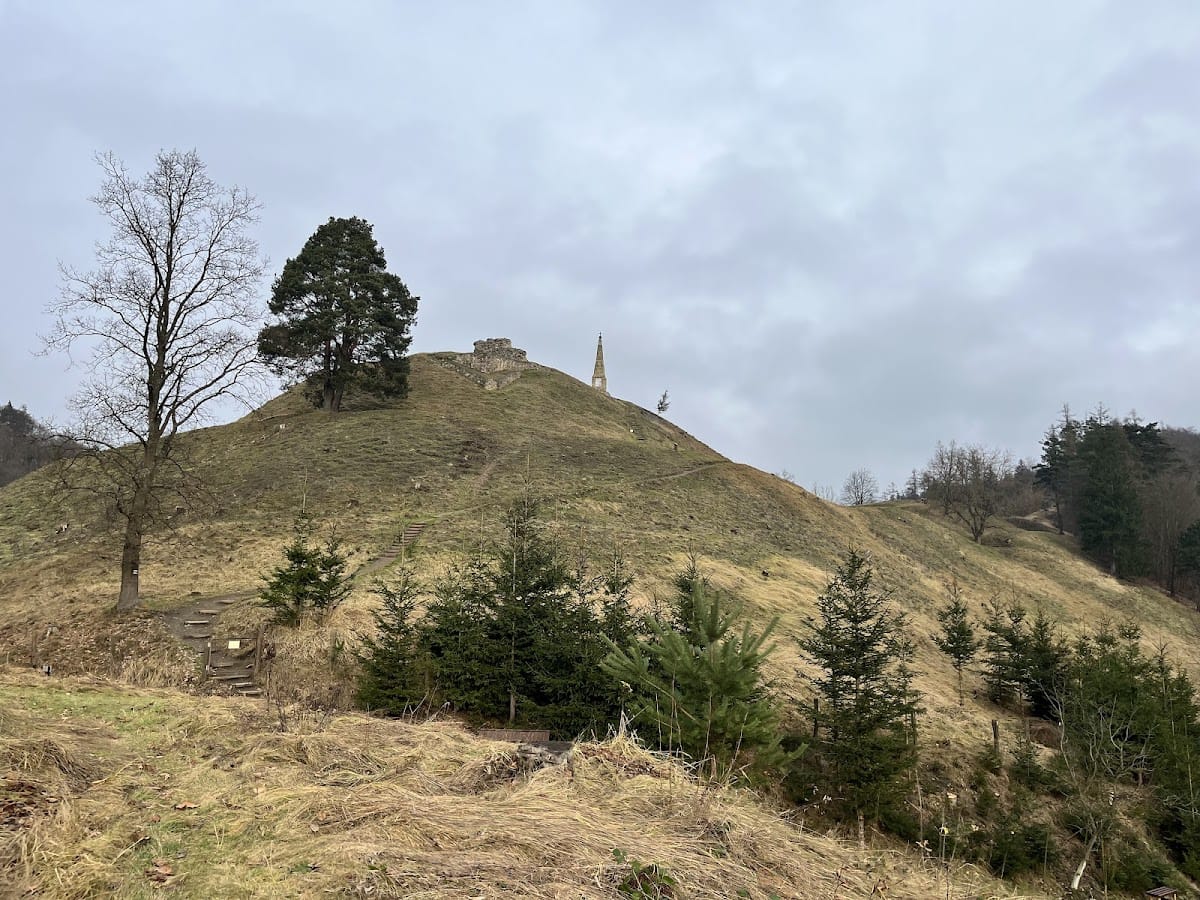
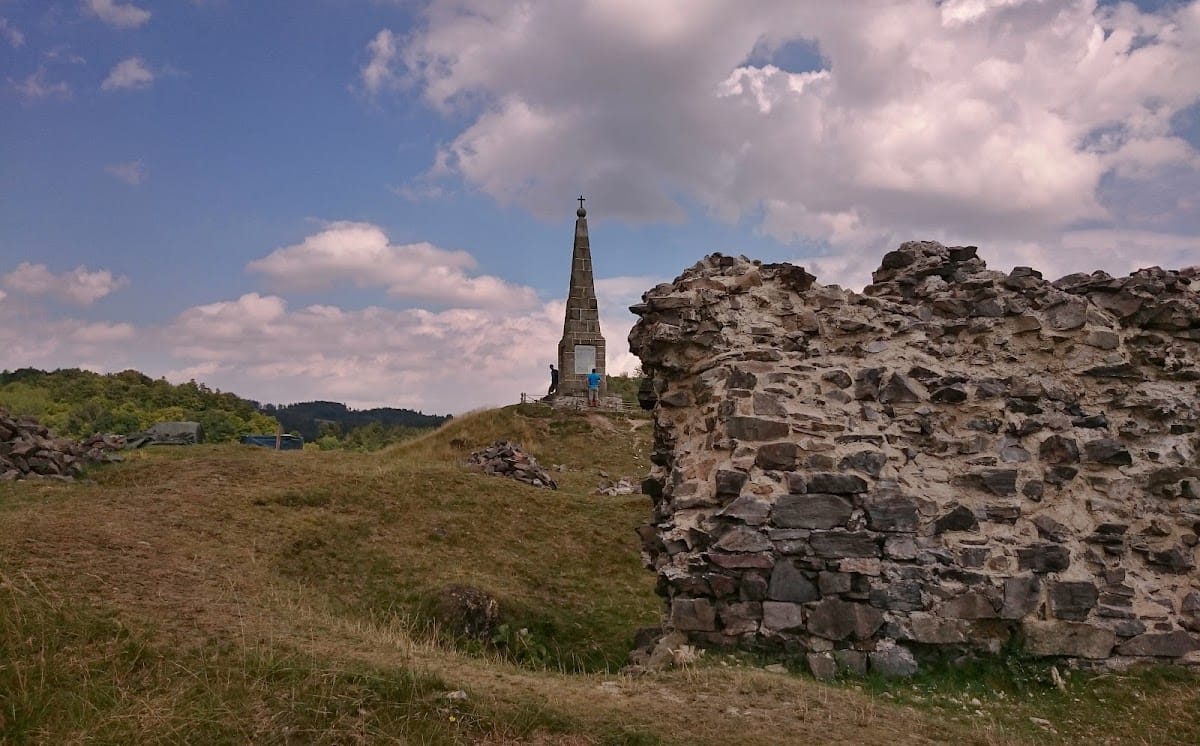
The surviving above-ground wall stands at the westernmost end of the oval fortified area. A cellar and part of a filled-in staircase remain visible below it. A sandstone monument now occupies the site probably associated with the castle tower. Dedicated to the completion of the Olomouc–Prague railway, it stands on a circular mound about 3 metres high and 7.5 metres in diameter.
Terraced platform
Toward the church lies a platform approximately 47 by 19 metres across, with indications of perimeter fortification. Lower terrain terraces border it on three sides. Its purpose remains uncertain. It may have been an earlier settlement later replaced by the larger, better-positioned castle, a camp of a war band, or the location of the original Hoštejn church.
Advanced fortification
On the opposite side of the castle is a five-sided mound measuring about 23 by 15 metres along its axes. A ditch 17 metres wide and 5 metres deep separates it from the neck of the promontory. This advanced fortification protected the neck from the placement of siege engines.
Religious remains and later monuments
Church of Saint Kunigunde
The parish Church of Saint Kunigunde is recorded from 1350 and disappeared at the same time as the castle. A stone sculptural relief of a male head from the former church is now held by the Šumperk Museum. It was once mistakenly interpreted as a surviving part of the tomb of Smil of Hoštejn.
Saint Anne chapel
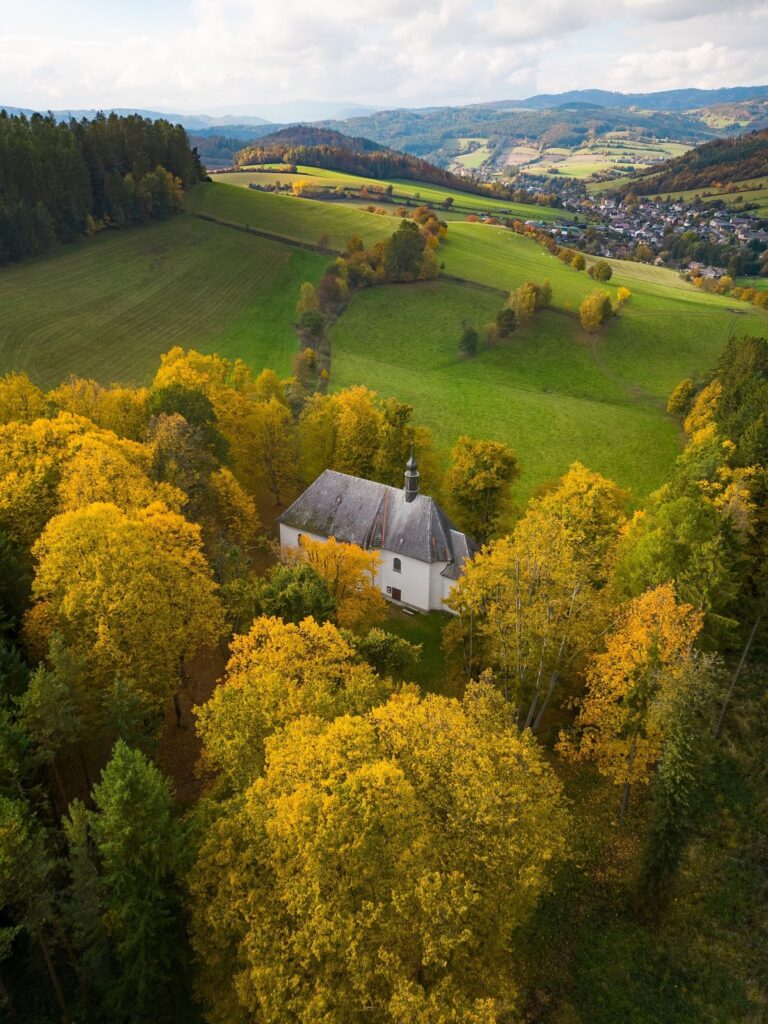
A pilgrimage chapel dedicated to Saint Anne dates from the eighteenth century. It was rebuilt in 1815 as a filial church, meaning a church subordinate to a parish church and generally lacking full independent parish status.
Holy Trinity group
An Empire-style sculptural group of the Holy Trinity dates from 1820. Empire style reflects the Neoclassical art associated with the Napoleonic era and the early nineteenth century.