Hill Court Manor: A Country House in Herefordshire
Site at a Glance
- Popularity
- Medium
- Country
- United Kingdom
- Primary era
- Early Modern
- Eras represented
- Early Modern, Modern
- Civilizations
- British, English
- Site type
- Domestic
- Remains
- Manor House
On this page9 sections
History
Hill Court Manor is a country house at Hom Green, Walford, near Ross-on-Wye, in Herefordshire, United Kingdom. Richard Clarke began building it in 1698. His family was believed to have gained its wealth by importing clover seed to England during the seventeenth century.
The Clarke family
Richard died in 1702 before the house was finished, and his brother Joseph took charge of the work, completing it in 1708. On 21 September 1700, Robert Wayman received £71 12s 9d for brickwork on the house walls and drains. Joseph lived there with his wife and eight children. He became Sheriff of Herefordshire in 1715, a senior local official whose historic duties included judicial and administrative responsibilities.
When Joseph died in 1728, his eldest son Richard inherited the property. Richard probably began enlarging the house around 1736, but died in 1748 before the work was complete. The estate then passed to his brother John, who died in 1759, and their mother, who died in 1765. Their mother’s daughters inherited in turn: Alice died in 1779, Mary in 1789, and Jane in 1806. After Jane’s death, the Clarke estate was divided and Hill Court passed to her second cousin, Kingsmill Evans.
Evans and Trafford ownership
In the early nineteenth century, Evans expanded and improved the gardens. He died without children in 1851, leaving Hill Court to his nephew Captain Kingsmill Manley Power, the son of Sir Manley Power and Anne Evans. After the Captain died in 1888, Major Lionel James Trafford bought the property in 1893.
Trafford’s brother Guy Rawson Trafford succeeded him in 1900 and married Dorothy Moffatt, daughter of Harold Moffat. In 1916, Dorothy inherited Goodrich Court, uniting the two estates into a holding of nearly 2,000 acres across several parishes. Guy became Sheriff of Herefordshire in 1919.
Twentieth-century changes
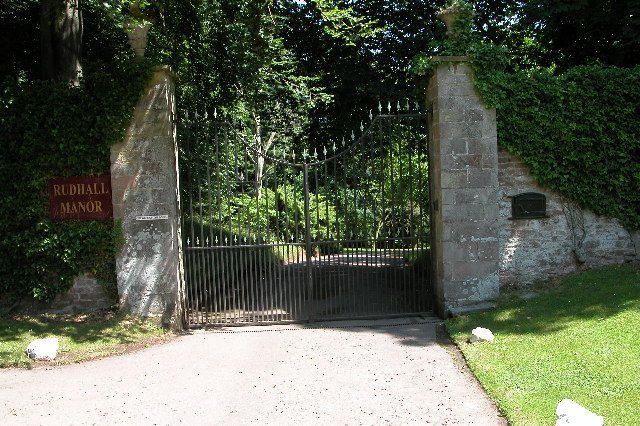
In 1933, the main gate piers were moved to a position in front of the house. A brass plate on one pier explains that the gates were being made as a twenty-first-birthday gift for Guy Harold Trafford, who died in a motor accident on 8 October that year while travelling to Queen’s College, Oxford.
After her mother died in 1938, Dorothy left Hill Court to live at Goodrich Court. During the Second World War, Felsted School moved from Essex to three Herefordshire houses owned by Mrs Trafford to escape German bombing. Its Windsor’s and Ingle’s Houses occupied Hill Court from 1940 until March 1945. Dorothy returned after the school left, as maintaining both large houses had become impractical. Goodrich Court was demolished in 1946.
Dorothy died in 1954, and her son John Lionel Trafford inherited Hill Court. He died unmarried in 1978, after which the estate was divided and tenant farmers had the opportunity to purchase their farms. Hill Court’s estate fell from about 2,000 acres to approximately 40 hectares.
In the early 1980s, interior designer Christopher Rowley and George Hartman acquired Hill Court from the Trafford family. Rowley turned part of the estate into a garden centre. Rehau Ltd, a private German industrial group, bought the property in 1994 and carried out a complete renovation; in 1997, it also acquired the Church of the Paraclete. Hill Court Manor is Grade I listed, the highest statutory listing category in England, reserved for buildings of exceptional interest.
Remains
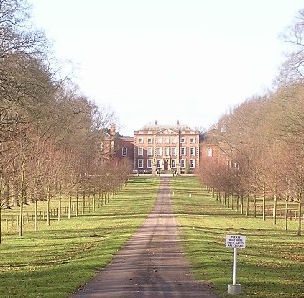
The surviving group includes the enlarged manor house, an avenue and gate piers in front of it, and the Church of the Paraclete to the east.
Buildings and grounds
The manor house
The earliest part of the house has a rectangular plan, two storeys and a large hipped roof, which slopes down on all sides. Its original brickwork is darker than the later work, with the boundary visible just above the first-floor windows of the central block. Later extensions gave the building its present appearance.
The house’s stonework resembles that of the Prospect, a public garden in Ross-on-Wye. The similarity lends support to the local tradition that John Kyrle, a benefactor associated with civic improvements in Ross-on-Wye, designed Hill Court.
Avenue and entrance piers
An avenue lies in front of the house. John Kyrle planted it with elm trees in the eighteenth century. The gate piers now stand before the house, and one bears a brass plate.
Church of the Paraclete
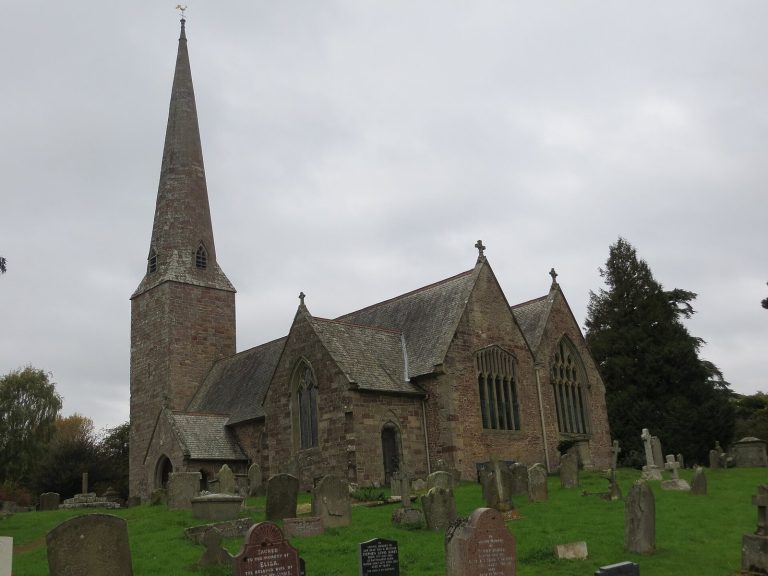
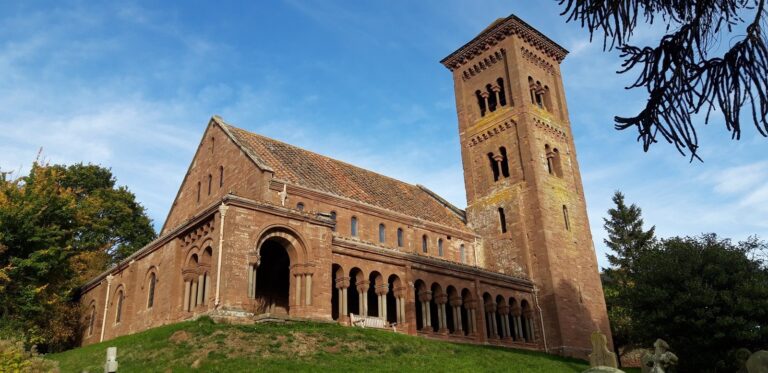
The Church of the Paraclete, whose name uses a Christian title for the Holy Spirit, stands east of the house. Built in 1905–06 in memory of Major Lionel James Trafford, it was designed by George Frederick Bodley, an English architect associated with the Gothic Revival, a nineteenth-century movement that revived medieval Gothic forms. The church is now closed.