Hexham Abbey: An Anglo-Saxon Monastery and Medieval Parish Church
Site at a Glance
- Rating
- 4.7
- Popularity
- High
- Country
- United Kingdom
- Primary era
- Medieval
- Eras represented
- Medieval, Modern
- Civilizations
- Anglo-Saxon, British, English
- Site type
- Religious
- Remains
- Church
On this page22 sections
History
Hexham Abbey is a church in Hexham, United Kingdom, founded as an Anglo-Saxon monastery around 674, with surviving medieval fabric that is predominantly Gothic. Dedicated to St Andrew, it began with a church built under Wilfrid, bishop of York, around 675 to 680.
Foundation and bishopric
In 671 or 672, Æthelthryth, a queen of Northumbria from the Wuffingas royal dynasty of East Anglia, gave land at Hexham to Wilfrid. The monastery established there followed the Benedictine tradition, whose monks lived according to the Rule of St Benedict.
In 678, Theodore of Tarsus, archbishop of Canterbury, reorganized church territories and created a bishopric covering the land between the Rivers Aln and Tees. Hexham and Lindisfarne were both associated with its seat. Eleven bishops followed Eata, six of whom became saints. No successor was appointed after about 821, when conditions in the region were unsettled, and the Hexham bishopric gradually merged with Lindisfarne’s. That see later moved to Chester-le-Street in 883 and Durham in 995.
Attack and rebuilding
In 876, Danish forces led by the Viking leader Halfdan Ragnarsson ravaged Tyneside. Hexham was sacked, and its church was plundered and burned.
Around 1050, Eilaf, treasurer of Durham, was instructed to rebuild the ruined church. His son Eilaf II completed the work, probably in the Norman style.
Augustinian priory
In 1113, Thomas II, archbishop of York, established an Augustinian priory in place of Wilfrid’s monastery. Its canons were clergy who lived together according to the Rule of St Augustine. The priory undertook a major rebuilding of the church, but Scottish incursions interrupted its work.
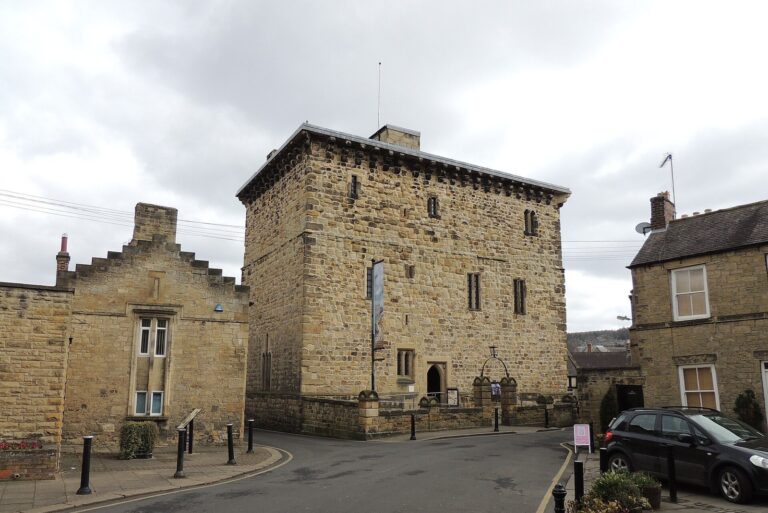
The priory was burned in 1296. Scottish forces returned in 1312 and 1313, and again in 1315 and 1318. In response, the priory built a fortified meeting hall for local assemblies or court proceedings, along with a gaol in the town.
From priory to parish church
Despite armed resistance from its canons, the priory was dissolved in 1536 and 1537, and the church became Hexham’s parish church. In 1538, the Crown granted the remaining priory property and the right to appoint the parish priest to Sir Reginald Carnaby, who had administered the estate for the Crown. The church has remained Hexham’s parish church within the Church of England.
Later history and protection
In 2014, the Abbey reacquired its former monastic buildings, which had been used as Hexham magistrates’ court. The church received Grade I listing in 1951, a category for buildings of exceptional historic or architectural interest. The remains of the medieval priory and Anglo-Saxon monastery beneath and around the church are a scheduled monument, a protected archaeological site.
Remains
Church and precinct
Church fabric
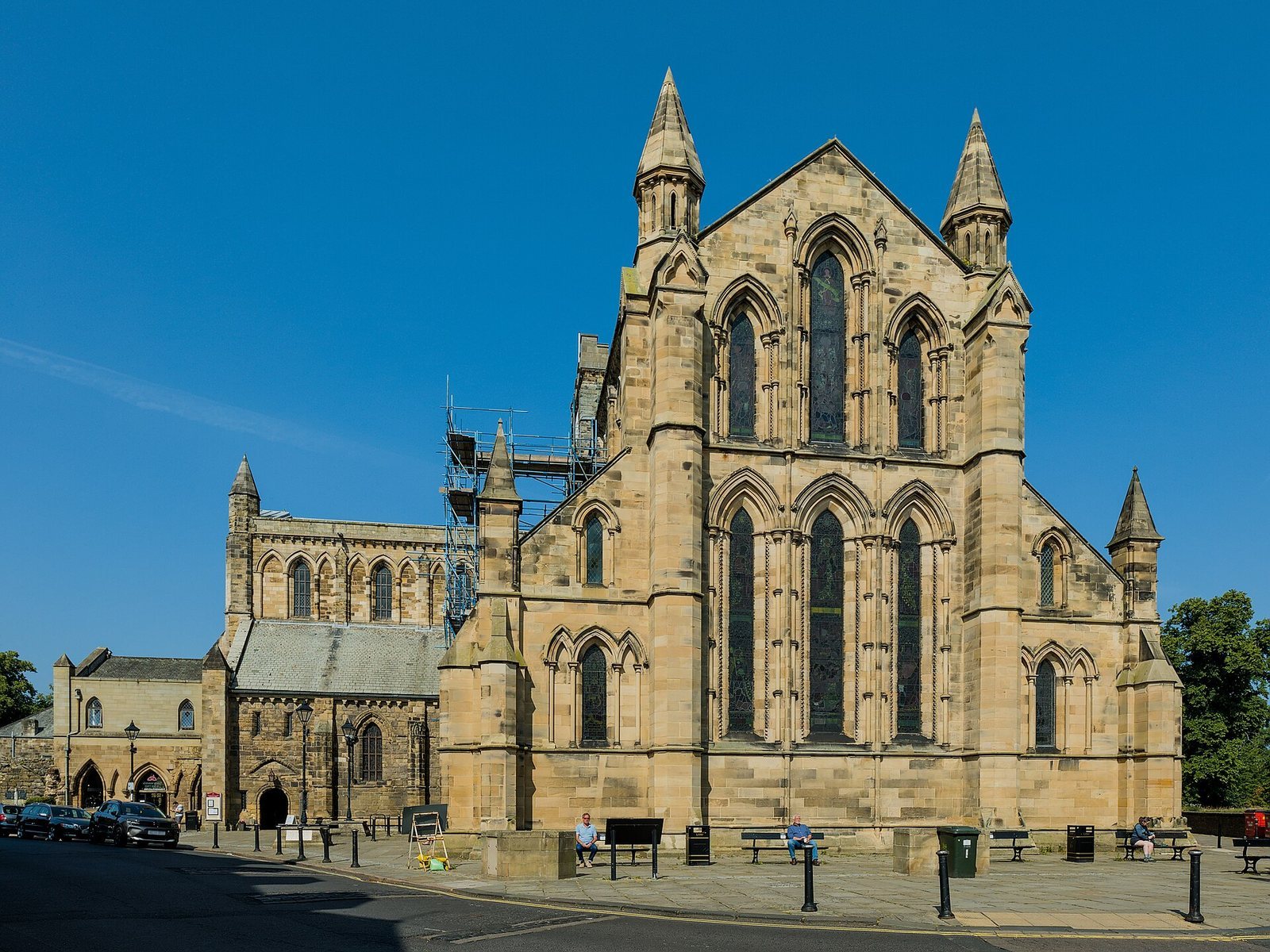
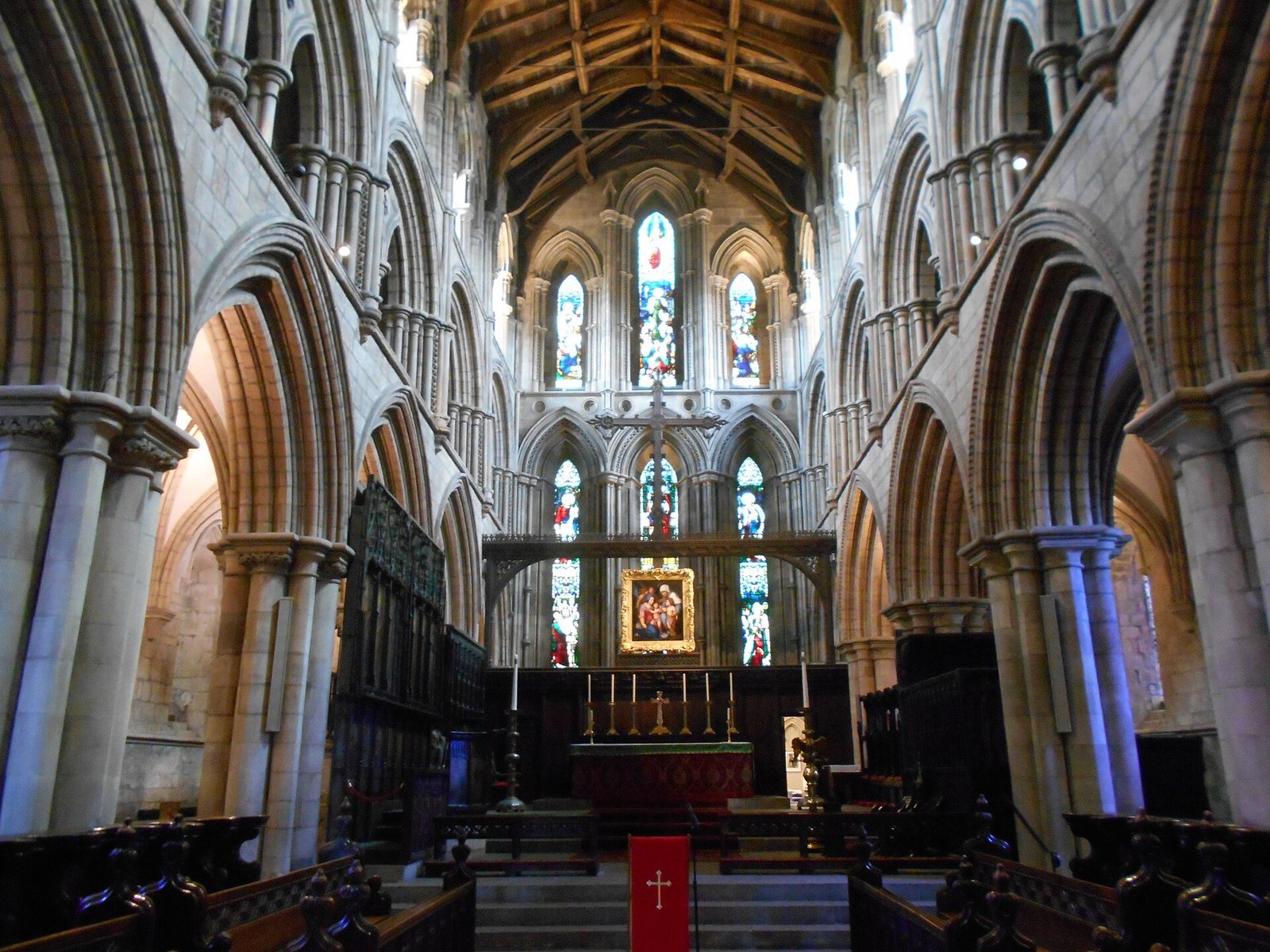
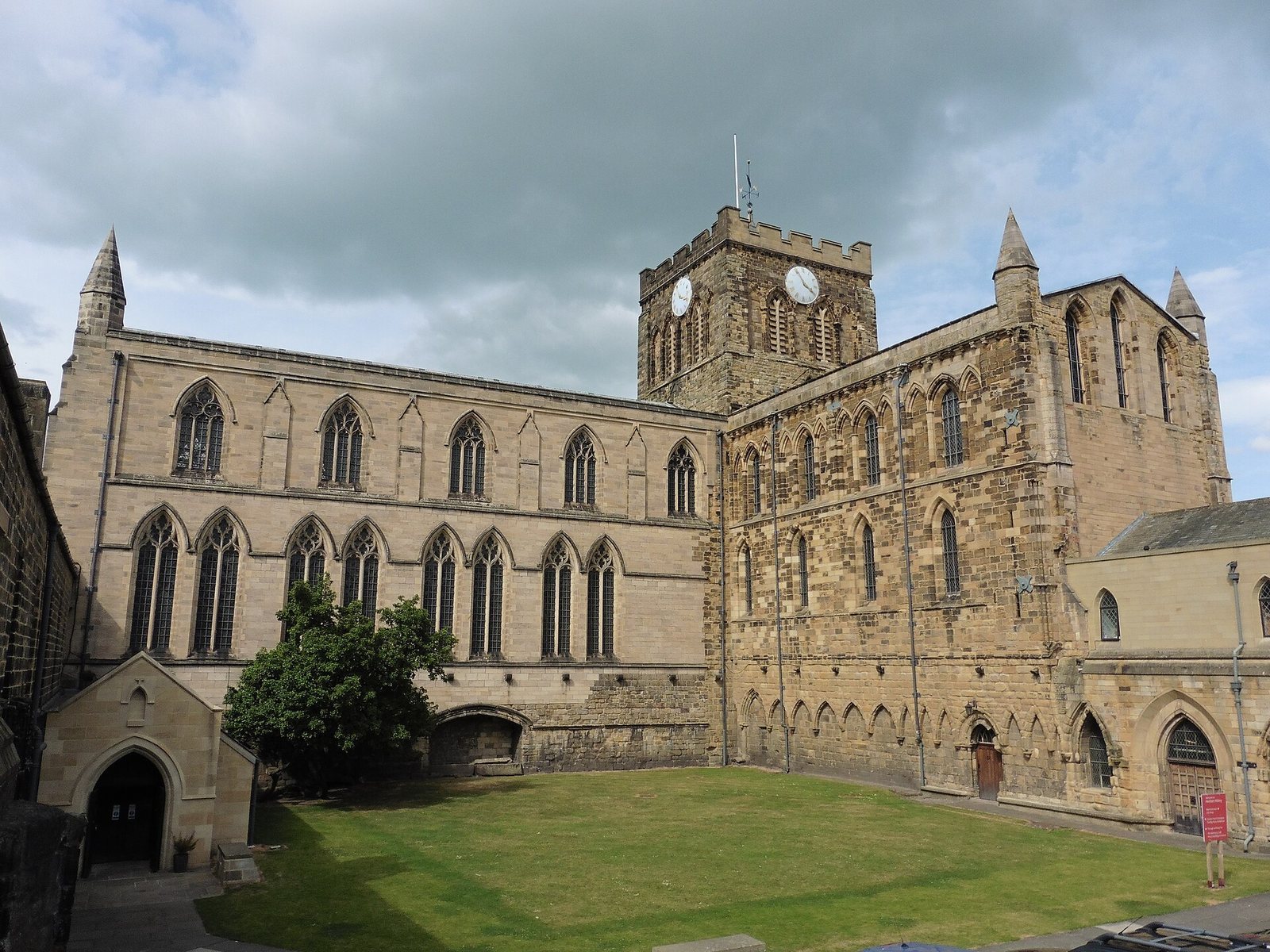
The church is a composite building, with Gothic elements predominating and wooden ceilings throughout. Its oldest parts survive in the two-aisled nave and the transept, the crosswise part of the church. The choir and transepts belong largely to the medieval building campaign of about 1170 to 1250. The east end was rebuilt around 1860 in the Early English Gothic style to harmonize with the rest of the building, replacing the late-medieval east end. Work in the early twentieth century completed the nave in 1907 using parts of the earlier church, and restored the choir. The nave was reconsecrated on 8 August 1908.
Monastic buildings and town structures
The former monastic precinct retains cloisters where the canons studied and meditated, as well as the chapter-house vestibule, a much-rebuilt west range, a washing place and a Norman gatehouse. The priory’s fortified meeting hall and gaol also survive in the town. The gaol is now known as Hexham Old Gaol.
Crypt and carved stone
Anglo-Saxon crypt
The crypt, a chamber beneath the church, has four parts: a chapel, a west ante-chapel, two side passages with enlarged vestibules, and three stairways. Barrel vaults cover the chapel and ante-chapel. Much of the stonework was taken from nearby Roman ruins, and many of the stones bear carvings or inscriptions.
Inscriptions and early stonework
One partly erased Roman inscription names Emperor Septimius Severus and his sons Caracalla and Geta, as well as military units serving under an unnamed commander. Geta’s name remains legible, although it was targeted for erasure after Caracalla murdered him. Two other Roman inscriptions are built into the crypt. The church also preserves numerous ancient and early-medieval stone fragments, including a Romano-Celtic votive stone dedicated to Apollo and the Celtic deities Maponos and Belenos, who were associated with Apollo.
A stone bishop’s throne, dating from the seventh or eighth century, survives in the church. Fragments of the memorial cross of Acca, an eighth-century bishop of Hexham, have been reassembled in the south transept.
Medieval fittings and memorials
Choir fittings and paintings
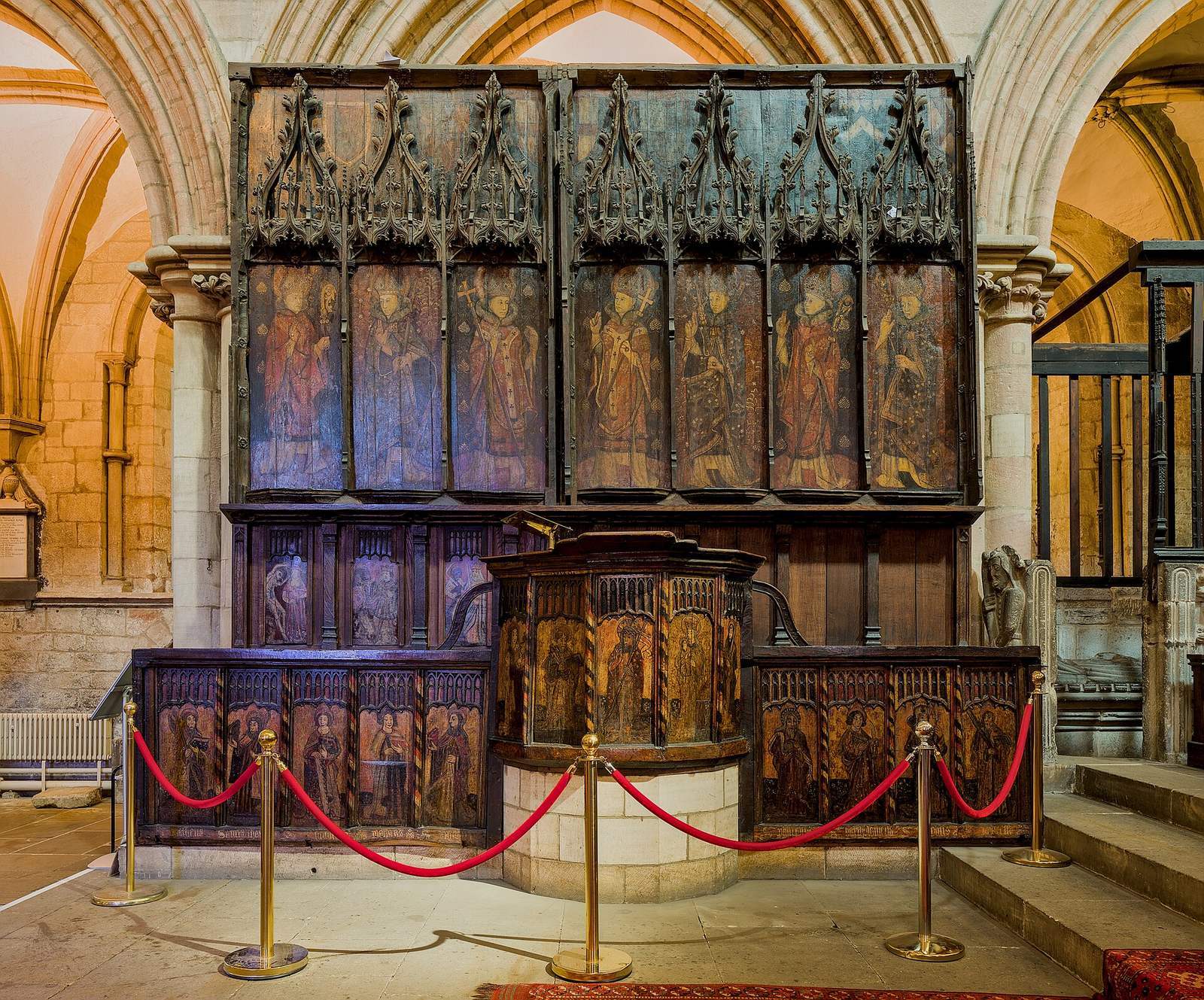
The medieval fittings include a stone stairway known as the Night Stair, which leads from the south transept to the former canons’ dormitory, as well as a choir screen, lectern and misericords, the carved supports attached to folding choir seats. Some retain medieval paint. Paintings of the bishops of Hexham and Lindisfarne appear on the screen’s west face and on the structure behind the altar. The screen passage carries scenes of the Annunciation and Visitation. A nearby screen shows Christ and the Apostles, alongside a Dance of Death.
Chantry chapels
Two chantry chapels, religious foundations associated with prayers for the dead, commemorate Prior Ogle, who died in 1410, and Prior Rowland Leschman, who died in either 1491 or 1499. The late-fifteenth-century Leschman Chantry combines stone carving at its base with finely worked woodwork above. One carving depicts a fox preaching to geese.
Flavinus tombstone
Around three metres high, the tombstone of Flavinus commemorates a Roman cavalry officer who died aged 25 in the first century. It is thought to have come from near Coria, the Roman settlement at present-day Corbridge. Brought to Hexham as building stone in the twelfth century, it was laid face upward in the cloister foundations. Rediscovered in 1881, it now stands at the foot of the Night Stair.
Coins and later church furnishings
Hexham Hoard
The Hexham Hoard consists of about 8,000 Northumbrian stycas, small coins concealed around 850. It was found in 1833 when a grave was being dug at Campey Hill, near the north transept. The coins include issues from the reigns of Eanred, Æthelred II and Redwulf, as well as coins of the archbishops Eanbald and Wigmund.
Windows and altar cross
Four stained-glass windows are the work of Henry Thomas Bosdet, an artist born in Jersey. The east window was installed around 1907, followed by two smaller windows; the large west window was installed in 1918. The Keswick School of Industrial Art made the high-altar cross, which was given to the church in 1902.
Organ
The organ installed in 1865 had been made in 1804 for Carlisle Cathedral and was acquired second-hand. Nicholson of Newcastle installed it, and it opened on 19 October 1865. Norman and Beard rebuilt the instrument in 1905, with Sir Frederick Bridge of Westminster Abbey acting as consultant. In 1974 it was replaced by a mechanically operated organ built by Lawrence Phelps of Pennsylvania, with two keyboards and 34 stops, or sets of pipes.
Font and St Wilfrid’s Chapel
A font, possibly of Roman origin, has later additions, and a canopy is among the church’s furnishings. In 1996, a chapel dedicated to St Wilfrid was created at the east end of the north choir aisle for prayer and quiet reflection.