Herford Abbey: A Medieval Women’s Religious House and Imperial Territory
Site at a Glance
- Popularity
- High
- Country
- Germany
- Primary era
- Medieval
- Eras represented
- Medieval, Early Modern
- Civilizations
- Holy Roman Empire
- Site type
- Religious
- Remains
- Monastery
On this page15 sections
History
Herford Abbey was a women’s religious house in Herford, Germany, founded in 789 by Waltger, a nobleman of the Saxons, a Germanic people of northern Europe. Its first community consisted of secular canonesses, women who lived in a religious community without being enclosed nuns. The house began at Müdehorst, near present-day Bielefeld. Around 800, Waltger moved it to his estate at Herivurth, later called Oldenhervorde, where roads crossed the Aa and Werre rivers at fords. Herford, the oldest women’s religious house in the Duchy of Saxony, formed part of the Christian mission to the Saxons, and the town later developed around it.
Foundation and Carolingian reform
In 819, Herford was transferred to Emperor Louis the Pious, a ruler of the Carolingian dynasty, the Frankish ruling house of the eighth and ninth centuries. He placed its reorganization under Adalard, abbot of Corbie. The community adopted the Rule of Saint Benedict, a framework for communal religious discipline followed by monks and nuns, linking Herford’s development with the foundation of Corvey Abbey. Herford received the status of an imperial abbey in 823 and is recorded as having been dedicated in 832. In 819 it also gained market and mint rights and one-third of the estates originally assigned to Corvey; in 851 it received immunity, a privilege that placed its precinct beyond ordinary secular jurisdiction.
Herford was modeled on the Carolingian imperial abbey of Notre-Dame at Soissons. The Vita Waltgeri, a life of Waltger, and a charter issued by Louis the German in 853 describe this connection. Soissons became Herford’s mother monastery, sending Benedictine nuns to join the community; Abbess Tetta also came from there. In 860, at the urging of Abbess Haduwy, also known as Hedwig, the remains of Pusinna, a Christian holy woman, were brought from her hermitage at Binson near Châlons-en-Champagne. The relics enhanced the abbey’s standing, and its dedication eventually became Saints Mary and Pusinna.
Saxon religious and educational influence
During the tenure of Abbess Matilda I, her granddaughter Matilda received her education at Herford. In 909, through her grandmother’s arrangements, she married Henry, then Duke of Saxony and later King Henry I. Matilda, later venerated as Saint Matilda, and Hathumod, who became an abbess of Gandersheim, were among the women connected with the community’s teaching. Herford also inspired religious foundations at Quedlinburg, Wendhausen, Gandersheim, and Neuenheerse. In 936, Queen Matilda founded a women’s religious house at Quedlinburg in memory of her husband.
Hungarian forces destroyed Herford between 919 and 924. Beginning in 927, Abbess Imma I oversaw its rebuilding, after which the community returned from the Benedictine order to an aristocratic house of canonesses. A tradition called the Herford Vision, a vision of the Virgin Mary regarded as the oldest known Marian apparition north of the Alps, preceded the establishment of a daughter house on Herford’s Stiftberg by Abbess Godesdiu around 1011.
Imperial territory and relations with the town
Herford gained exemption in the mid-twelfth century and, in 1147, imperial immediacy: it became a territory answerable directly to the emperor, rather than to an intervening ruler. This status within the Holy Roman Empire, a decentralized political entity in central Europe, lasted until 1803. The abbey’s lands included 39 principal estates and about 800 smaller farms that paid rent. An elected princess-abbess governed the territory, belonged to the Lower Rhenish-Westphalian Circle, a regional administrative grouping, and represented Herford in the Imperial Diet, the Empire’s assembly of estates. Her abbesses held the rank of imperial princess and participated through the College of Imperial Prelates of the Rhine, which represented regional religious leaders at the assembly.
Secular advocates acted as protectors of the abbey and exercised authority on its behalf. The Billunger family probably first held this role, followed by Henry the Lion, who appointed the Counts of Schwalenberg as deputies. After Henry’s fall in 1180, the counts served the archbishops of Cologne, who were also Dukes of Westphalia. The office appears to have passed to the Counts of Sternberg by 1261 and to the Counts of Jülich-Berg in 1382.
The neighboring town gained municipal rights around 1170–1180, adopted Dortmund’s council constitution, and later secured imperial immediacy for itself. From 1256, the town protected the abbey. From then until around 1530, town and abbey shared government of their territory, an arrangement described as unique within the Empire. By the end of the fifteenth century, Herford was known as “Holy Herford” and contained about 37 churches, chapels, monasteries, hospitals, and other religious houses. Its religious life was compared with Cologne’s.
Reformation and early modern communities
The abbey became Lutheran in 1533. From 1649, its abbesses were Calvinist for more than a century, while the principality itself retained its Lutheran character. In 1652, Brandenburg occupied the imperial city of Herford and incorporated it into Ravensberg. Efforts to impose Reformed worship on the abbey’s territory succeeded only temporarily, and the abbey preserved its independence.
Abbess Elisabeth of the Palatinate gave shelter in Herford to Labadists, members of a seventeenth-century religious movement associated with mystical forms of piety, from 1670, and later to Quakers. The Labadists lived outside the abbey but under its protection. Their practices angered local Lutherans, and an edict from the Imperial Chamber Court, one of the Empire’s highest courts, ordered their expulsion in 1672. Quaker visitors Robert Barclay and William Penn met Elisabeth. She allowed Quaker worship in the abbey and sought their toleration from the King of England. Gottfried Wilhelm Leibniz visited Herford around the turn of 1679–1680 in connection with Elisabeth.
The abbey’s two coadjutresses, women appointed to assist an abbess and sometimes succeed her, were Princess Elizabeth III and Princess Sophie Charlotte of Brandenburg. Elizabeth corresponded with René Descartes and studied his work. Sophie Charlotte received instruction in natural philosophy and physics from Leonhard Euler. Their letters were published as Letters to a German Princess in 1768–1772 and became well known during their lifetimes.
Dissolution and later history
Secularization, the transfer of religious institutions or property to secular authority, brought the abbey to an end in 1802. Its territory was annexed to the Prussian County of Ravensberg on 25 February 1803. The women’s house became a collegiate foundation for men in 1804, but that institution was suppressed in 1810. A spinning mill later occupied the grounds, at times employing 200 people and becoming one of Herford’s largest employers. The mill-owning Schönfeld family lived there until moving to a more prominent residence in 1874.
The last abbey buildings were demolished before the market halls and Herford town hall were built in 1916. The abbey’s shield, bearing a red horizontal bar on silver, also served as the city’s arms until 1899. Herford’s white-and-red colors and flag preserve the abbey’s colors.
Remains
Precinct and excavated remains
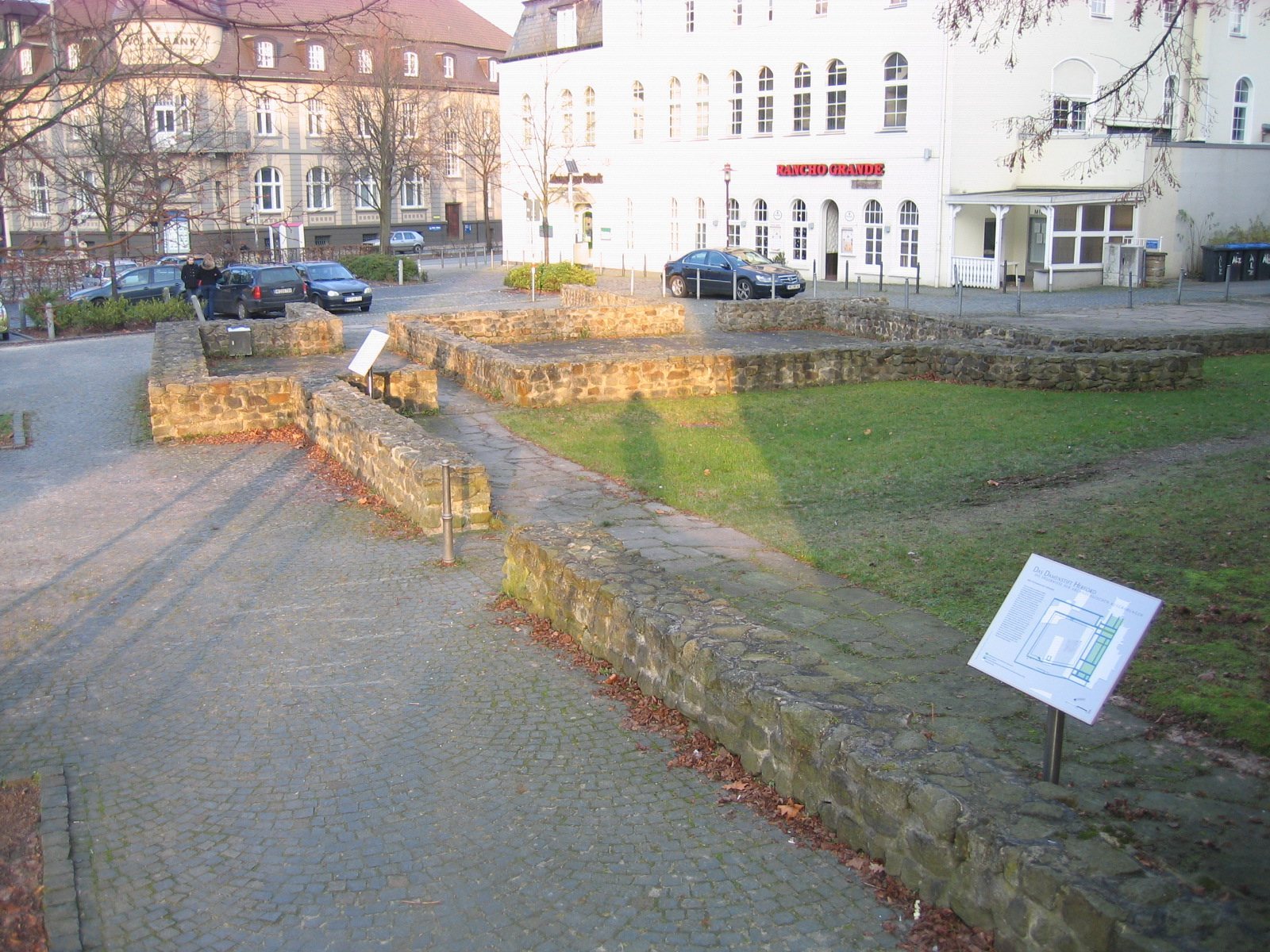
The former precinct occupied central Herford, extending from the Old Market across the area of today’s town hall to Stephanplatz and along Auf der Freiheit. Most of the abbey’s buildings survive as foundations. Excavations at Stephanplatz in 1988–1990 exposed the old abbey well, now in front of the town hall, and made it possible to reconstruct the layout of the cloister, a covered walk around a courtyard, and the foundations of the canonesses’ residences.
Church and chapel
Herford Minster
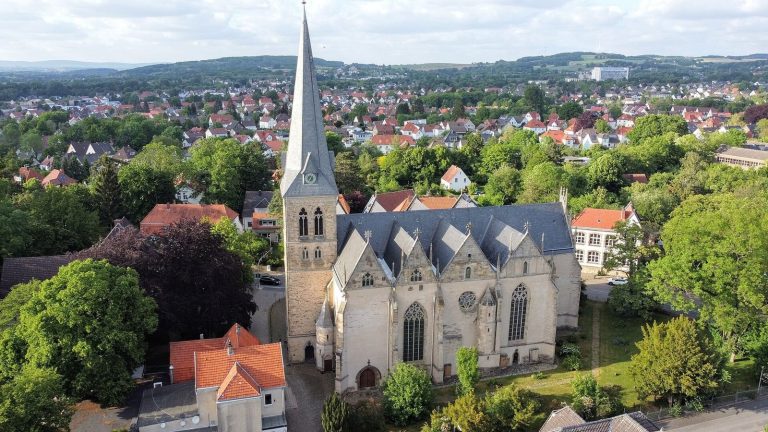
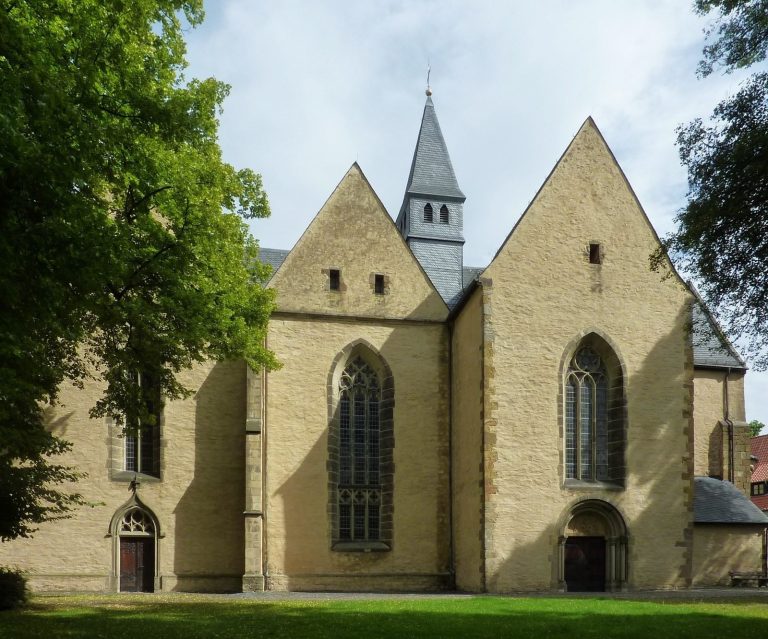
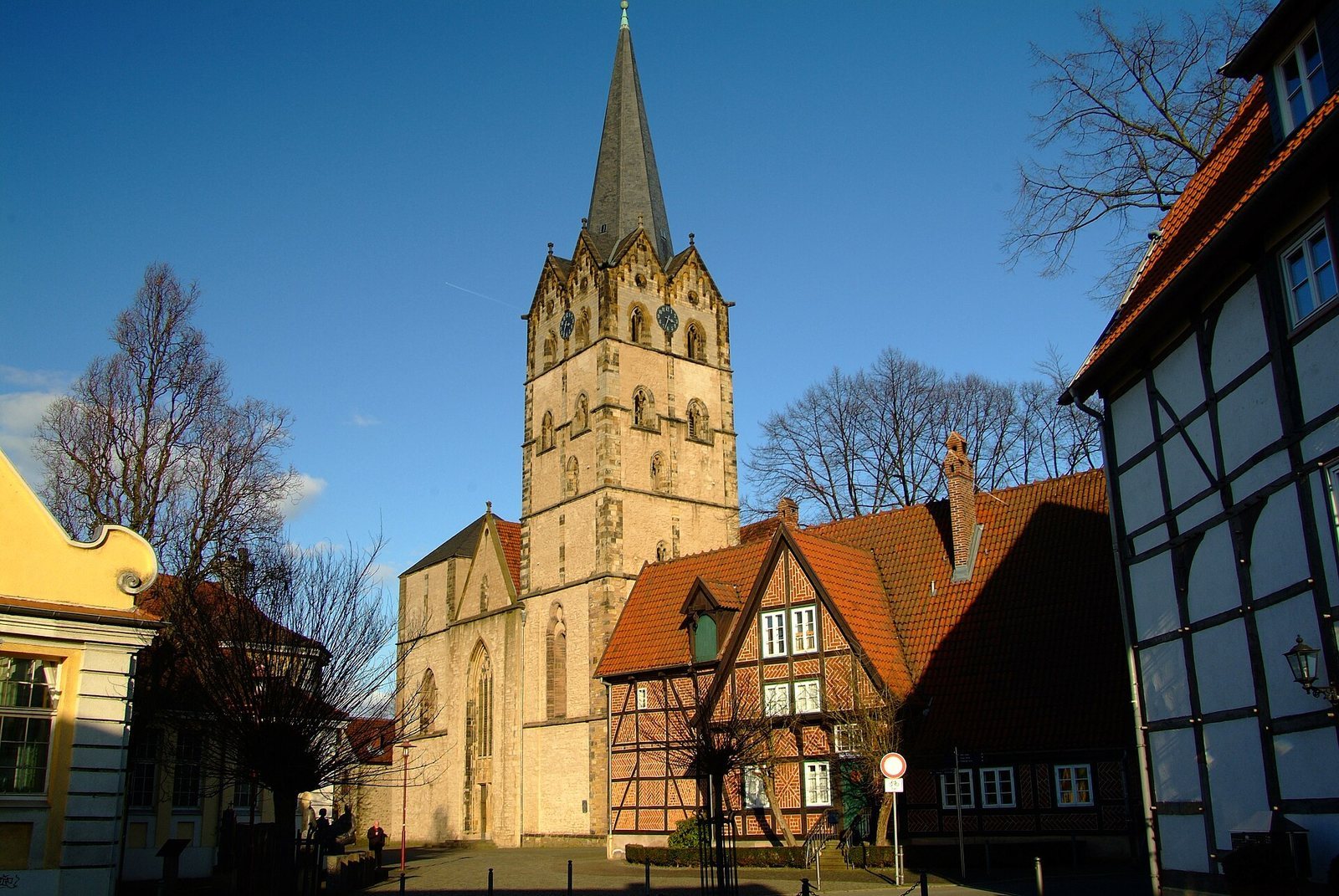
Herford Minster served as the abbey church. Built in the early thirteenth century, it is a hall church, with side spaces rising to roughly the height of the central nave, and is among Westphalia’s largest churches. It now serves as an Evangelical Lutheran parish church.
Wolderus Chapel
Immediately north of the minster, Wolderus Chapel stands on the site of an older chapel. The simple hall building dates to 1735 and was built as the private chapel of a Reformed abbess serving the Lutheran abbey. According to local legend, Saint Waltger is buried there.
Surviving houses and precinct monuments
Cantor’s House
The Cantor’s House, one of Westphalia’s oldest houses, dates to the late fifteenth century. Its timber frame is filled with red brick. A cantor is a church musician who leads or directs singing.
Freie Hof and Labadist House
On the southern side of the former precinct, the Freie Hof is a seventeenth-century timber-framed house with brick infill. The adjoining Labadist House, built in the same period and style as a residence for the Labadists, also survives.
Markers and memorials
Features on the former precinct include a bronze model of medieval Herford and a reconstructed marker of the boundary between the town and abbey grounds. A memorial erected in 1998 addresses the relationship between town and abbey. In front of the market hall, an abbey fountain carries a sculpture of an abbess. Bronze reliefs at the Freie Hof depict medieval Herford and the imperial abbey.