Henryk Sienkiewicz Museum in Oblęgorek: A Writer’s Country Residence


Site at a Glance
- Rating
- 4.8
- Popularity
- Medium
- Country
- Poland
- Primary era
- Modern
- External website
- Open
- Eras represented
- Modern
- Civilizations
- Russian
- Site type
- Domestic
- Remains
- Elite Residence
On this page8 sections
History
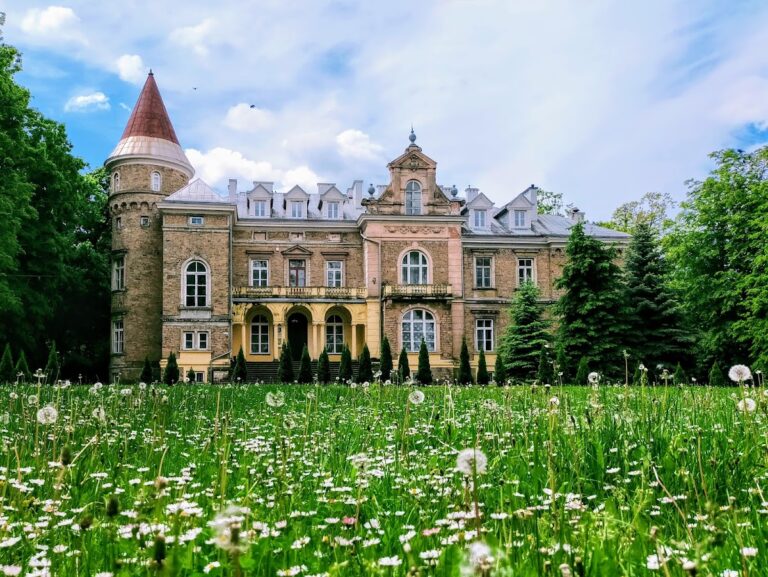
The Henryk Sienkiewicz Museum in Oblęgorek, Poland, occupies the former country residence of Henryk Sienkiewicz, the Polish novelist and Nobel Prize in Literature recipient. The nineteenth-century country house was built in an eclectic style between 1900 and 1902, and the museum opened there on 26 October 1958. Its collections and exhibitions connect Sienkiewicz’s literary career with his life, family, and social and political activity in Poland and abroad.
The Oblęgorek Estate
In 1900, Polish society raised funds to mark the twenty-fifth anniversary of Sienkiewicz’s writing career. The subscription purchased the Oblęgorek estate and presented it to him in recognition of his work. A notarial deed was signed in Kielce on 18 July 1900, recording a purchase price of 51,249 rubles and 59 kopecks. The deed and its four-volume documentation were formally handed to Sienkiewicz during jubilee celebrations on 22 December that year.
The estate covered 515 morgs, a historical land measure whose size varied by region and period. It included 240 morgs of forest, 160 morgs of arable land, 90 morgs of meadow, and areas of park and orchard. Subscription funds also provided 60 head of cattle, six horses, machinery, and farm tools, allowing Sienkiewicz to take possession of a working country estate.
The residence incorporated an earlier hunting lodge of the Tarła family, known as Tarłówka, as well as a hunting pavilion built in 1895 by the notary Mieczysław Halik, the estate’s then-owner. The new country house was designed by the Warsaw architect Hugon Kuder, while the surrounding 49 hectares were planned by the Warsaw gardener Franciszek Szanior.
Sienkiewicz at Oblęgorek
Sienkiewicz first arrived at the residence in May 1902, and his household possessions followed on 9 June. He used Oblęgorek chiefly as a summer retreat and workplace. During his time there, he worked on In Desert and Wilderness, On the Field of Glory, and the short story Two Meadows, published in 1903. His historical novels also included With Fire and Sword, The Deluge, Pan Wołodyjowski, and The Knights of the Cross.
He remained at Oblęgorek until autumn 1914. At the end of September, because of the First World War, he left the estate and travelled to Switzerland by way of Kraków and Vienna. After his death, his wife Maria and their son Henryk Józef lived permanently at Oblęgorek until 1944. During the German occupation, Henryk Józef hid part of the collections among local inhabitants to protect them.
From Family Residence to Museum
After the Second World War, nationalization divided the estate into parcels. The family retained the residence and 49 hectares of land. In 1948, Sienkiewicz’s children, Jadwiga Korniłowicz and Henryk Józef, asked the Ministry of Culture and Art to establish a museum of their father’s memorabilia in the house. The proposal received state support, including financial assistance from the Presidium of the Kielce Voivodeship National Council and the Social Fund for the Reconstruction of the Capital and Country.
The donors transferred the residence and two hectares of parkland to the state treasury by notarial deed in 1956. Renovation began in 1957, with furniture and textiles restored through preparatory work by the Folk and Artistic Industry Central Office in Poznań and Łódź. The first curator was Sienkiewicz’s daughter-in-law, Zuzanna. The museum opened on 26 October 1958 and became a branch of the National Museum in Kielce on 1 January 1976.
Its permanent exhibitions address the twenty-fifth anniversary of Sienkiewicz’s writing career, his life at Oblęgorek, and his social and political activity in Poland and abroad. Biographical and literary holdings include translated editions of his works, letters, correspondence, personal objects, and family memorabilia. In 2007, his granddaughter Maria Korniłowicz bequeathed more than 350 exhibits to the museum, most of which remained at Oblęgorek and enlarged the collection. The residence, historic park, and linden avenue were designated a Monument of History by President Andrzej Duda in January 2019, a high-level Polish heritage status for places of exceptional historical, architectural, or cultural importance.
The museum’s educational and interpretive work remains centered on Sienkiewicz’s life and writing. Its activities have included temporary exhibitions, scholarly sessions, painting workshops, museum lessons, and the recurring program “Evenings at Mr Henryk’s.” In 1935, the discovery of Sienkiewicz’s will at Oblęgorek added another biographical association to the residence.
Remains
Residence and Park
The surviving complex consists of the country residence and its surrounding park. The house, built in an eclectic style during 1900–1902 on the grounds of an older park, combines the earlier Tarłówka hunting lodge with the 1895 pavilion known as Halikówka. Its front elevation is crowned by a distinctive stone hussar, a sculptural figure of a cavalry soldier. Above the entrance and the balcony doors, a stone cartouche, an ornamental framed panel, displays the Oszyk coat of arms of the Sienkiewicz family.
The approach passes through the Red Gate and continues along a linden avenue. Around the residence lies a large English-style park dominated by old oaks and lindens. The grounds also contain a garden tended by Sienkiewicz’s third wife, Maria from the Babski family, and their daughter Dzinia.
Reconstructed Ground-Floor Rooms
The ground floor has been reconstructed to represent the appearance and furnishings of the rooms during Sienkiewicz’s residence. His study is organized around the writer’s desk and also contains a revolving shelf and a glazed bookcase filled with books. Family portraits decorate the room.
The guest salon contains a round table and chairs brought from Sienkiewicz’s Warsaw apartment, together with the small table at which he played cards with guests. Paintings by various artists hang on the walls. Other reconstructed rooms include the dining room, smoking room, and bedroom. The bedroom opened to visitors in 1974, and its reconstruction drew on observations provided by Sienkiewicz’s housekeeper Maria Lutówna and his daughter-in-law Zuzanna.
Upper-Floor Exhibitions and Collections
The upper floor, once occupied by the children, now houses biographical and literary exhibitions. Displays include multilingual editions of Sienkiewicz’s works, letters, and personal mementos, while the museum as a whole preserves literary works, correspondence, family memorabilia, and objects associated with the writer.
The associated collection includes a white-marble bust of Sienkiewicz made by the sculptor Pius Weloński for the 1900 jubilee. It also contains portraits of Jadwiga Sienkiewicz and Henryk Józef Sienkiewicz, paintings by W. Czachórski, J. Malczewski, and K. Mordasewicz, and works by P. Stachiewicz depicting Zagłoba, Skrzetuski, Helena, a figure identified as Kurcewiczowa, and Pan Wołodyjowski. The more than 350 objects bequeathed by Maria Korniłowicz in 2007 form an important part of the family material preserved at Oblęgorek.