Hayton Castle: A Musgrave Manor House in Cumbria
Site at a Glance
- Popularity
- Medium
- Country
- United Kingdom
- Primary era
- Early Modern
- Eras represented
- Medieval, Early Modern
- Civilizations
- British, English
- Site type
- Domestic
- Remains
- Castle
On this page10 sections
History
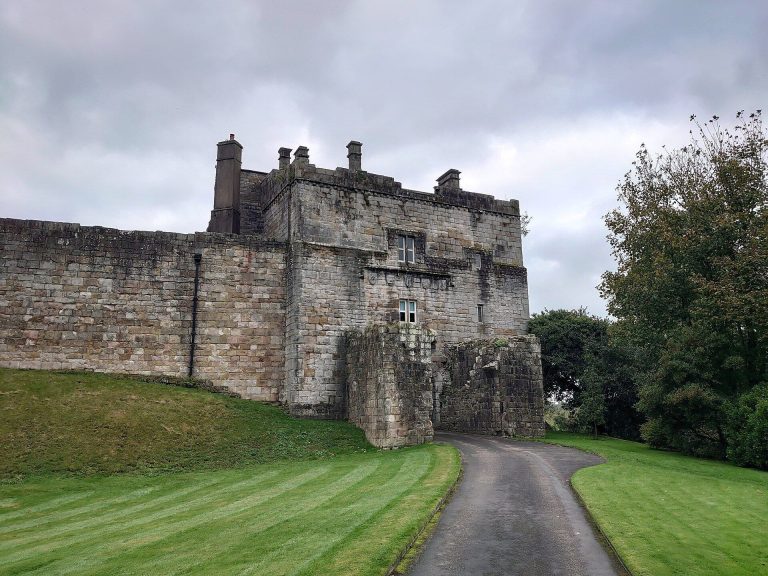
Hayton Castle is a former fortified manor house northeast of Hayton village in Cumbria, United Kingdom. It became the center of a small manor in Allerdale, a landed estate that also served as a local unit of ownership and authority. During the sixteenth and seventeenth centuries, the Musgraves enlarged the building and adapted it from a tower house, a fortified residence organized around a multi-storey tower, into a domestic residence. Much of the structure’s later character is attributed to their work.
Medieval ownership
Alan, second Lord of Allerdale, granted the manor to his huntsman Seliff. Seliff’s descendants adopted the name De Hayton. Through female heirs, the estate passed to Robert de Mulcaster, whose marriage connected him to an heiress of the Lucy family. The Mulcasters held it for five generations. Robert’s son William served twice as High Sheriff of Cumberland between 1298 and 1306. A High Sheriff was a county officer with administrative and judicial duties, and members of the family also appear to have represented Cumberland in Parliament as Knights of the Shire during the fourteenth century.
After the Mulcaster male line ended, the manor passed through marriage to Piers Jeffrey Tilliol. His daughter Isabella inherited Hayton and married John Colville of Torpenhow. Colville died in 1438, and his family line ended in 1479 with two daughters, who married younger sons of Sir Thomas Musgrave of Hartley Castle (1417–1469). The later Musgrave line at Hayton began with the marriage of Margaret Colville to Nicholas Musgrave (1450–1506), Sir Thomas’s fourth son. Their descendants held the manor for fourteen generations, over roughly three centuries.
The Musgraves and the house
Nicholas was succeeded by Thomas Musgrave, Marshal of Berwick, who was born in 1483 and died during the sixteenth century. Thomas’s son William (1518–1597), a Member of Parliament for Hayton, inherited the estate. The succession continued through William’s son Sir Edward Musgrave (1561–1641), his son William (1596–1634), and William’s son Edward (1621–1676). In 1638, Edward became the first Baronet of Hayton Castle. A baronetcy is a hereditary title below the rank of baron; the Baronetage of Nova Scotia was one of the hereditary baronetage orders.
In the sixteenth and seventeenth centuries, the building was enlarged and changed from a tower house into a residence. A branch of the Musgrave family lived there during the seventeenth century, and the family is credited with much of the building work that shaped its later form. A tradition also places Mary, Queen of Scots, at Hayton overnight on 17 May 1568. She is said to have given her host a plain gold ring containing a miniature portrait of herself, which reportedly passed through later generations. Cockermouth is also associated with Mary’s stay that night, so the location remains uncertain.
The Civil War and the baronets
Sir Edward Musgrave, first Baronet, was a committed Royalist during the English Civil War, the seventeenth-century conflict between supporters of the monarchy and Parliament. He maintained a cavalry regiment at his own expense and served as a colonel at the Battle of Preston in 1648. At the Battle of Worcester, after Charles II’s horse was shot from beneath him, Musgrave is said to have given the king his own horse. Following the Royalist defeat, Musgrave took refuge in Scotland with George Gordon, Duke of Gordon. When Parliamentary forces found his refuge, Oliver Cromwell threatened to send cavalry to storm the duke’s castle unless Musgrave was surrendered. Musgrave escaped to the Isle of Man, where he later died.
Parliamentary forces badly damaged Hayton Castle during the war, especially its south end. After the conflict, Sir Edward’s son Richard rebuilt that part of the building. The second Baronet was Sir Richard Musgrave (1650–1710). His son, the third Baronet (1675–1711), represented Cumberland in Parliament in 1701 and from 1702 to 1708. The fourth Baronet, also named Sir Richard, lived from 1700 to 1739.
The fifth Baronet, Sir Richard Musgrave (1724–1755), adopted the name Hylton under the will of his uncle John Hylton of Hilton Castle and died without children. The title passed to his brother Sir William, the sixth Baronet (1735–1800), a commissioner of customs, and then to their younger brother Sir Thomas, the seventh Baronet (1737–1812), a British Army general. It subsequently went to their distant cousin Sir James Musgrave, eighth Baronet, of Barnsley Park in Gloucestershire. After his death in 1814, his son Sir James (1785–1858) became the ninth Baronet. The manor itself did not pass with the title.
Later ownership and use
The manor later belonged to Mrs Jolliffe, a younger daughter and eventually the sole heiress of a Sir Richard Musgrave. She was related to William Jolliffe, a Member of Parliament for Petersfield who died in 1802. The Jolliffe family did not live at the castle but leased it as a tenant farm. Tenants included the Reverend Isaac Robinson in 1816; John Blackburn and his son in 1828; John Blackstock and, by 1882, his widow Nancy; and the sportsman Thomas Biglands, who remained until 1903.
A domestic chapel associated with the castle was reportedly used until 1820, when it was dismantled and fell into decay. It is uncertain whether it had stood inside the castle or in a separate building attached to it. David Mitchell bought the property in 1903. Originally from Scotland, he had recently returned from South Africa, where he had served for three years in the British Army during the Anglo-Boer War. His family retained the property. Hayton Castle was designated a Grade I listed building on 11 April 1967.
Remains
The castle has a simple rectangular plan, measuring about 29 metres from north to south and 16 metres from east to west. Its walls are very thick, and a basement is roofed by a barrel vault, a continuous arch shaped like the lengthwise half of a cylinder. A central wall about two metres thick is thought to preserve part of the earlier castle. The north end is best preserved, while the south end has undergone the most substantial alteration. The windows belong to three periods: the fifteenth century, the Elizabethan period, and the Georgian period.
Staircases and inscribed heraldry
Main stone staircase
A wall-mounted stone slab at the first turn of the main staircase displays the Musgrave and Penruddock family shields. The Musgrave arms show six ring-shaped devices arranged in rows of three, two, and one, with a small stylized bird beneath the group of three. These rings and the bird marked the family’s fifth and fourth sons, respectively. The Penruddock arms show a jagged diagonal band on a red field. The Musgrave crest depicts two armored arms with gloved hands holding a ring, which may refer to Hylton.
The slab bears the words LAVS. TIBI. DNE REX.GL. ORIE., translated as “Praise to you, O Lord, King of Glory,” followed by the date 1609. A second inscription, PRECOR. VT.SIMVS. MEMORES. BENEFICI ORUM. ERGA. NOS., is a petition asking the King of Kings to remember and favor the petitioner and his family. The display is thought to have been installed by Sir Edward Musgrave, whose wife Catherine was the daughter of Sir Thomas Penruddock of Arkelby and Exeter.
Spiral staircase and chapel record
A second stone spiral staircase appears to survive from a longer stairway that once extended from floor to roof. A stone slab in an old window in the east wall records that Anne Musgrave, third daughter of Sir Richard Musgrave and Dame Dorothy, paid for chapel repairs in 1719.
Other heraldic features
Another example of the Musgrave arms appears above a seventeenth-century fireplace and is thought to have been installed by Anne Musgrave, daughter of Sir Richard and Dorothy. On the castle’s north exterior wall, a shield attributed to either the Martindale or Mulcaster family has silver and red coloring with a black diagonal band. A stone sundial in the garden bears the initials of Sir Richard, son of Sir Edward, and his wife Anne, together with the date 1725.