Hala Sultan Tekke: An Ottoman Mosque and Religious Complex in Cyprus


Site at a Glance
- Rating
- 4.2
- Popularity
- Medium
- Country
- Cyprus
- Primary era
- Modern
- External website
- Open
- Eras represented
- Early Modern, Modern
- Civilizations
- Ottoman
- Site type
- Religious
- Remains
- Sufi Lodge
On this page10 sections
History
Hala Sultan Tekke is an Ottoman mosque and religious lodge complex in Cyprus, beside Larnaca Salt Lake near Larnaca. Built in stages around the tomb associated with Umm Haram, it combines an Islamic sacred site with an archaeological landscape that preserves evidence of Late Bronze Age and later ancient occupation.
Bronze Age and ancient occupation
During the second half of the second millennium BC, the area served as a cemetery for the inhabitants of Dromolaxia Vizatzia, a large Late Bronze Age city several hundred metres to the west. Its tombs date approximately from 1650 to 1100 BC. Looting in the 1890s preceded excavations by the British Museum in 1897 and 1898, first under Henry Beauchamp Walters and later under John Winter Crowfoot. The finds were divided between the British Museum and the Cyprus Museum.
Arne Furumark identified the settlement in 1947, after which the Cyprus Department of Antiquities carried out preliminary work. From the 1970s, a Swedish archaeological mission led by Professor Paul Åström excavated part of the city and established it as a major urban centre of Late Bronze Age Cyprus. Excavations by the New Swedish Cyprus Expedition began at Hala Sultan Tekke in 2010 under Professor Peter M. Fischer of the University of Gothenburg. In 2018, Fischer uncovered tombs dated to approximately 1500 and 1350 BC, whose Bronze Age artefacts point to extensive trade.
Radar surveys carried out between 2010 and 2012 indicated that the Late Bronze Age city may have covered about 50 hectares, making it among the largest cities of its period. Investigations beneath the former women’s quarter also revealed buildings from the Late Archaic, Classical, and Hellenistic periods, approximately from the sixth to the first centuries BC. Some finds may indicate that the area served as a sanctuary, although the limited investigations do not establish that interpretation with certainty.
Umm Haram and the early Islamic tradition
Religious tradition connects the site with Umm Haram, also known as Hala Sultan in Turkish tradition. She was a woman of the early Muslim community, the wife of Ubada bin al-Samit and the foster sister of Muhammad’s mother, Amina. According to the tradition associated with Hala Sultan Tekke, Umm Haram died after falling from her mule during the first Arab raids on Cyprus under Caliph Muawiyah, between 647 and 649, and was buried where she died. Shia belief instead places her grave in the Jannatul Baqi cemetery at Medina.
Ottoman construction and development
Under Ottoman administration, a mosque and tekke complex was built in stages around the tomb. A tekke was a lodge for gatherings of a Sufi brotherhood. In the eighteenth century, the dervish Sheikh Hasan reportedly discovered the tomb, erected the first structure there, and persuaded the administrative and religious authorities that the place was sacred. He then created and decorated a shrine around it in 1760.
Giovanni Mariti, who visited Cyprus between 1760 and 1767, attributed the shrine’s construction to a governor whom he called Ali Agha and stated that stones from a standing church in a nearby ruined village had been used before 1760. The wooden enclosure around the tomb is attributed to the nineteenth-century Ottoman governor Seyyid Elhac Mehmed Agha. His successor, Acem Ali Agha, replaced it with bronze fencing and two doors.
The mosque’s construction is also attributed to the governor Seyyid Mehmed Emin Efendi. It was completed in November 1817 in the classical Ottoman style. An Ottoman inscription at the entrance to the garden is dated 4 March 1813, and Sultan Mahmud II’s monogram appears on both sides. The inscription identifies the complex with the Ottoman governor of Cyprus.
Religious and modern history
Hala Sultan Tekke is a holy place for Turkish Cypriot Muslims and is also revered by Muslims more generally. It has been described as the third-holiest Muslim site in the world, while other descriptions place it fourth in the Islamic world after Mecca, Medina, and Jerusalem. Because the complex lies in the Greek, non-Muslim sector of the divided island, pilgrimage visits are infrequent. During the Ottoman period, Ottoman-flagged ships off Larnaca lowered their flags to half-mast and saluted Hala Sultan with cannon fire.
The ancillary buildings were repaired in 2004 while the mosque and minaret underwent restoration. The work was supported by the Bi-communal Development Programme, funded by USAID and the United Nations Development Programme and implemented through the United Nations Office for Project Services. Hala Sultan Tekke is listed as an Ancient Monument.
Remains
Principal religious buildings
The complex consists of a mosque, mausoleum, minaret, cemetery, and residential or guest accommodation for men and women. The mosque is square in plan, domed, and provided with a balcony. Its walls are built from yellow stone blocks, and the minaret was repaired in 1959. Behind the mosque’s qibla wall, the direction-facing wall toward the Kaaba in Mecca, lies the tomb associated with Umm Haram. An inscription beside it dates to 1760.
Tombs and cemetery
Four additional tombs stand beside Umm Haram’s tomb, including two belonging to former sheikhs. Another is a two-level marble sarcophagus dated 12 July 1929. It belongs to Adile Hüseyin Ali, the Turkish wife of Hussein bin Ali, Sharif of Mecca of the Hashemite House. Hussein bin Ali was a grandson of the Ottoman grand vizier Koca Mustafa Reşid Pasha and a descendant of Muhammad.
A cemetery occupies the eastern corner of the mosque and tekke. It contains the graves of several former Turkish administrators and was closed to further burials around 1899.
Garden, accommodation, and waterworks
The garden was designed by a pasha and became known as the Pasha Garden. The adjoining buildings were called Gülşen-Feyz, meaning the garden of plenitude or enlightenment. A men’s guesthouse formerly stood north, or to the left, of the entrance. Another guesthouse stood to the right, with one block serving as the men’s selamlik, the men’s section of an institutional complex, and the other as the women’s haremlik.
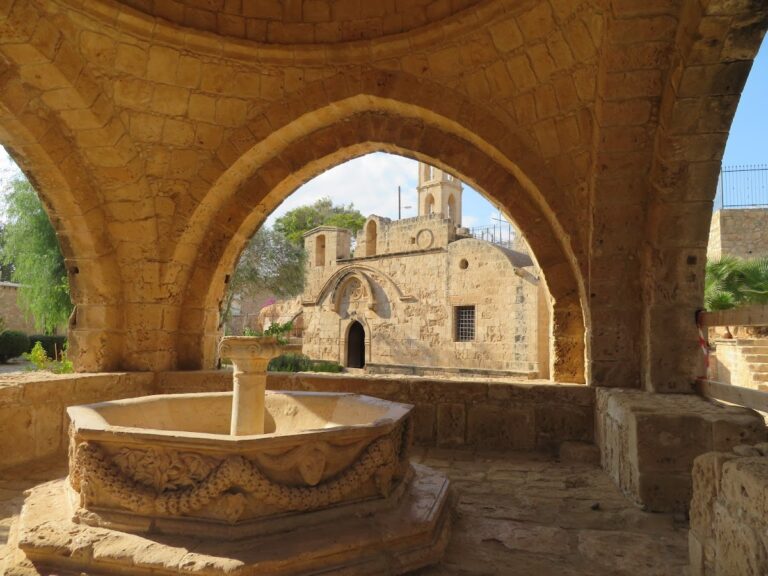
An octagonal fountain stands opposite the mosque. The governor of Cyprus, Silahtar Kaptanbaşı Mustafa Agha, built it around 1796 and 1797, and a marble inscription records its construction. A second inscription, dated 1895 and found in the garden, records the construction of infrastructure for bringing water to the complex on the instructions of Sultan Abdülhamid II.
Archaeological cemetery and earlier buildings
The cemetery associated with Dromolaxia Vizatzia contains numerous Late Bronze Age tombs. The tombs excavated in 2018 yielded Bronze Age artefacts connected with extensive contemporary trade. Beneath the former women’s quarter, building remains from the Late Archaic, Classical, and Hellenistic periods preserve evidence of later ancient activity. Some associated finds may point to sanctuary use, although that interpretation remains uncertain.
Nearby sites